

If homework, class messages, games and short videos all arrive through the same device, telling a student to “use the phone less” is not a workable rule. You need a boundary that separates necessary use from attention-hungry use, protects sleep and still leaves room for schoolwork.
The most effective limit is not a punishment or a single number copied from another family. It is a shared system: screens have a stated purpose, a defined place and a clear stopping point. Here is how to build that system at home and ask for the same coherence at school.
Choose the limit by purpose, not by one headline number
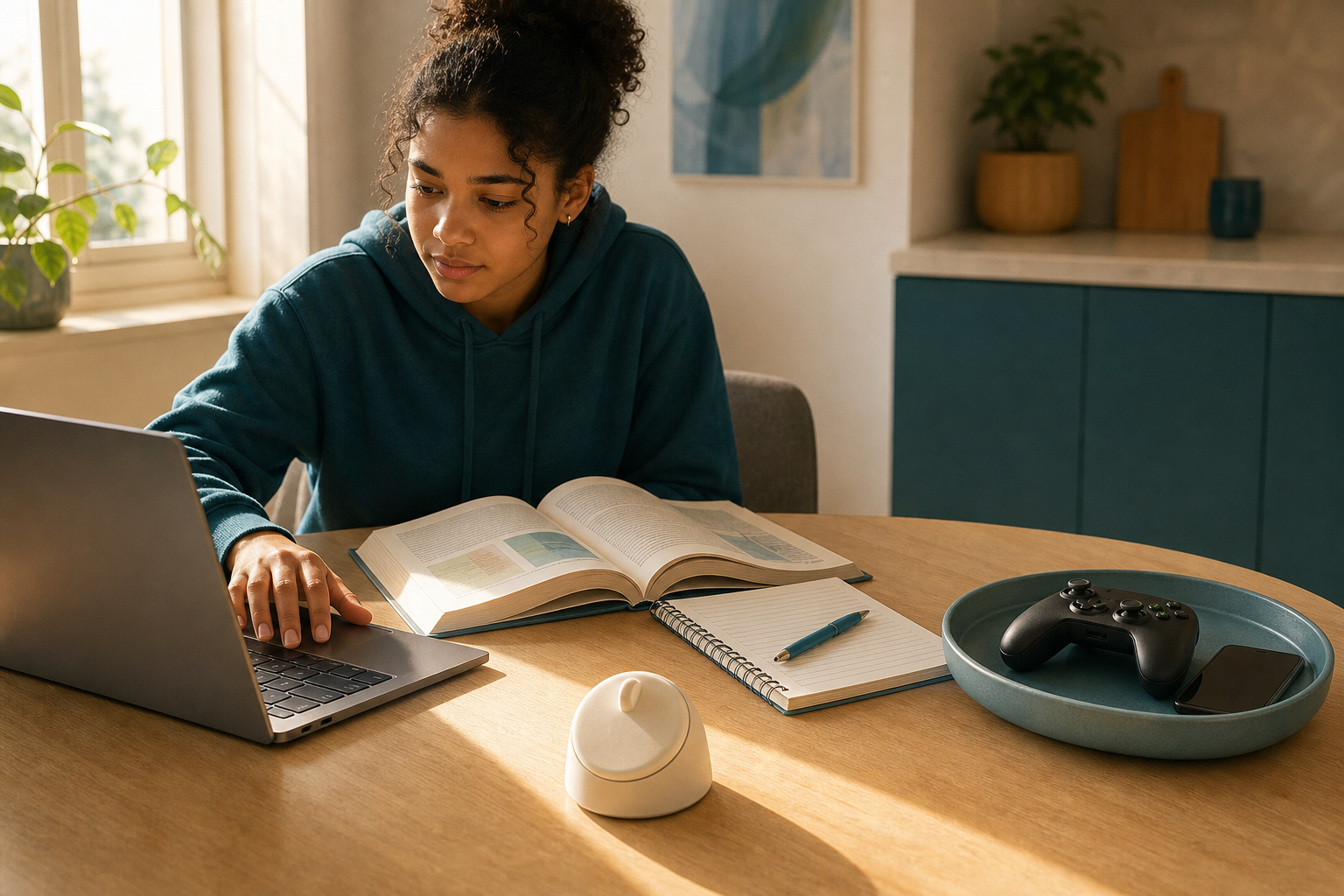
A video lesson, a drawing project and an hour of infinite scrolling may all appear identical in a device’s screen-time report. They do not make identical demands on attention. Purpose, content and context determine much of the effect, while timing decides whether device use displaces sleep, movement or focused study.
Start by sorting a student’s use into functional categories:
- Required use: assigned lessons, research, school communication and accessibility needs.
- Deliberate optional use: creating art, coding, practising a language, speaking with relatives or pursuing a chosen interest.
- Recreational consumption: gaming, social feeds, short-form video and browsing without a defined objective.
- Unplanned drift: opening one notification and being pulled into unrelated content long after the original task is finished.
Required use is not automatically healthy merely because a school assigned it. It can still crowd out sleep, strain the eyes or encourage multitasking. Conversely, recreation is not automatically harmful. The first target should be unplanned drift, followed by recreational use that displaces a protected need.
This distinction also prevents a common family argument. If all device use counts against one allowance, a child may feel punished for completing online homework. Keep required and recreational time separate, then give each a stop rule. A lesson ends when the assigned task is submitted. A game or social session ends at the agreed boundary, not after “one more” round or video.
Interfaces built around variable rewards, autoplay, infinite feeds and social feedback make that stopping point difficult to feel from within the activity. Adolescents are especially susceptible because the systems used for impulse control and long-range planning are still developing. Treating this as an environment-and-habit problem produces better rules than treating every lapse as a character failure.
Do not use a total screen-time figure by itself to label a student “addicted.” Problematic use means compulsive engagement that continues despite recognised harm and interferes with daily functioning. Formal diagnoses vary by behaviour. A high total caused by school assignments is different from an inability to disengage from gaming or social media despite lost sleep, falling grades and damaged relationships.
Build a home plan that can survive homework and resistance

A family media plan works when the student can predict what happens before the device is opened. Write the rules down and apply them to adults where the same principle fits. A parent who checks notifications throughout dinner cannot convincingly describe the table as a protected place for attention.
- Name the purpose before unlocking the device. “Finish the mathematics exercise” is a purpose. “Do homework” is too vague and leaves every distracting tab available.
- Choose the place. Keep recreational use in a shared area where stopping is visible. Charge phones outside bedrooms so the night rule does not depend on willpower.
- Set the stopping event. Use completion of the task, a timer or a scheduled household transition. Do not rely on the student to stop when an endless feed feels complete; it is designed not to feel complete.
- Remove avoidable cues. Silence non-essential notifications, turn off autoplay where possible and keep only the needed learning resource open during study.
- Protect the next offline activity. Decide in advance whether the screen session is followed by a meal, outdoor movement, reading, music practice, seva or sleep preparation.
Bedtime deserves its own boundary because late device use can combine bright light, social pressure and emotionally arousing content. A practical household rule is to stop screens 60 to 90 minutes before bedtime, silence notifications and keep the bedroom device-free. If required homework routinely makes that impossible, the problem is no longer only the student’s self-control. Raise the workload and submission schedule with the school.
Protect the body during necessary screen sessions as well. The 20-20-20 practice is simple: after every 20 minutes of close screen work, look at something about 20 feet away for 20 seconds. It helps interrupt sustained near-focus, but it does not replace outdoor activity, good posture, daylight or movement. Schedule those activities so they cannot be quietly consumed by extra online time.
When conflict is high, change the environment before increasing the lecture. Put the charging station in a common space. Let the student see the timer. Agree on exceptions for emergencies and required school communication. Review whether the rule protected sleep and study rather than arguing only about whether an exact minute was exceeded.
A weekly digital upavasa, or deliberate pause from recreational screens, can make the larger purpose visible. It should not be presented as moral humiliation or forced isolation. Fill the released time with something real: sport, a temple or gurdwara visit, a walk, family cooking, reading, simran, meditation, creative work or seva. Otherwise the pause feels like an empty penalty and the device remains the only available source of stimulation.
Dharmic traditions give families several useful ways to describe this discipline. Aparigraha asks whether we are endlessly accumulating stimulation. Brahmacharya asks where our energy is being directed. Right Mindfulness and Right Effort ask us to notice the impulse before obeying it. Simran and seva redirect attention from the restless self toward remembrance and service. These ideas should help a young person practise agency; they should never be used to shame a struggling student.
Ask schools for coherent rules, not a phone ban in isolation
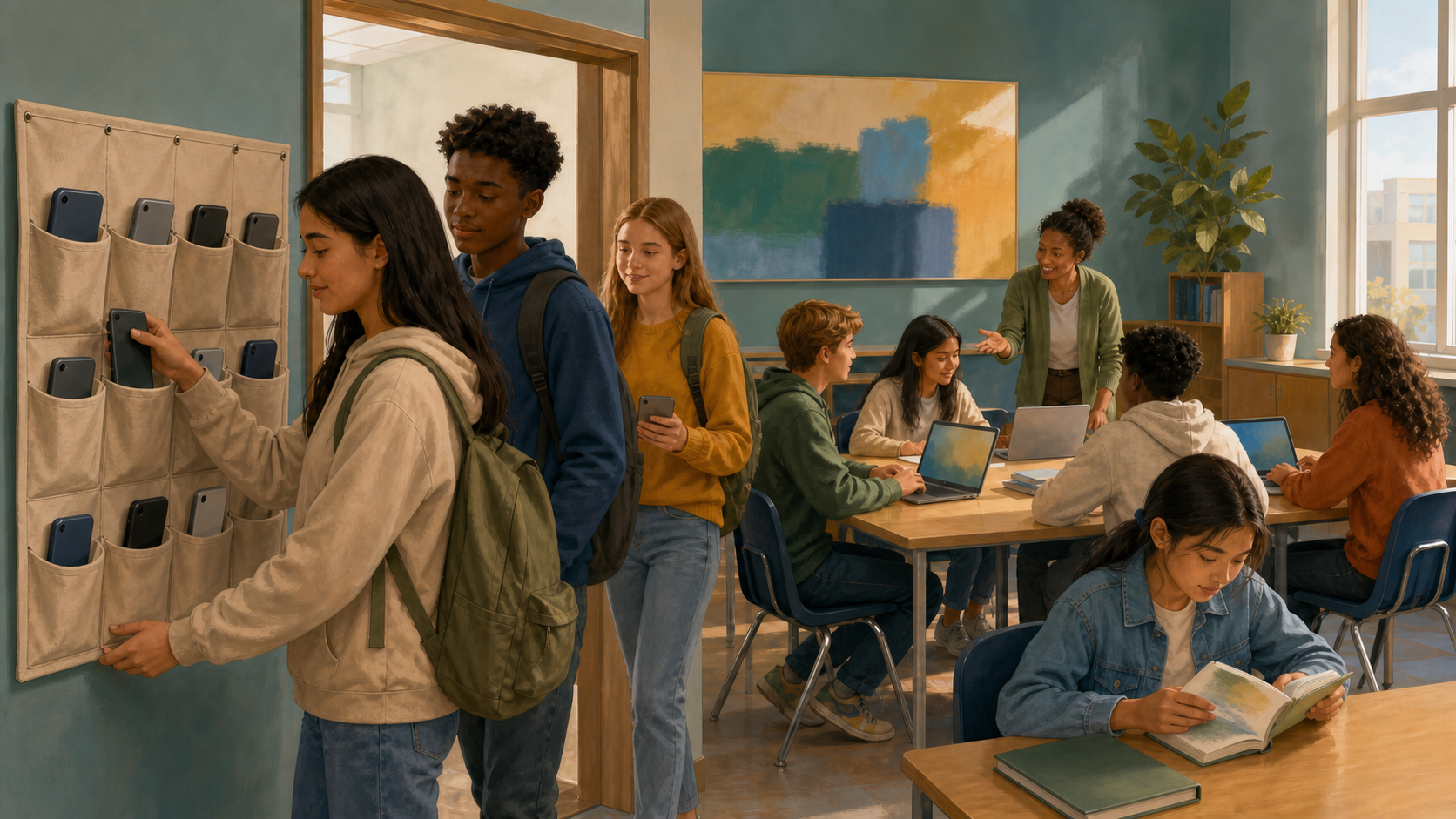
A school cannot demand device-free attention in class, assign screen-heavy work at night and leave parents to reconcile the contradiction. The call for stronger student screen-time safeguards in Goa is therefore most useful when translated into classroom design, campus practice and home expectations that reinforce one another.
In the primary years, the default should be device-free teaching unless a screen serves a specific learning or accessibility need. Older students may use digital tools for a defined objective under supervision, but the teacher should be able to answer three questions: What does the device improve? How will the session end? What offline activity follows?
School leaders can turn those principles into visible practice:
- Use phone lockers or another secure storage system during lessons and breaks, with clear emergency and accessibility exceptions.
- Design offline-first homework around reading, writing, calculation, observation, discussion and fieldwork.
- Use educational technology for a bounded task such as a simulation, retrieval quiz or targeted practice rather than as the default setting for an entire lesson.
- Prefer creation over passive consumption when a screen is necessary: students should produce, solve, compare or explain something.
- Provide printed, offline or locally cached alternatives so a family is not penalised for limited connectivity or lack of a personal device.
- Teach how notifications, recommendation systems, social rewards and misleading online claims compete for attention.
Technical controls can support these rules without turning school into a surveillance system. School-owned devices may use mobile-device management, curricular whitelists, category filtering and classroom timers. The school should collect only the data it needs, avoid unnecessary third-party tracking and assess patterns in aggregate rather than building behavioural profiles of individual children.
Acceptable-use and privacy policies should also be reviewed for alignment with India’s Digital Personal Data Protection Act, 2023, including age-appropriate handling of student data and parental consent where applicable. This requires proper legal and administrative review; a filtering product or signed classroom rule is not, by itself, proof of compliance.
If you sit on a parent committee or speak with a principal, ask for a one-page policy that states where phones are stored, when they may be used, who approves exceptions, what offline alternative exists and what student data the technology collects. Then ask how success will be measured. Useful indicators include sleep and alertness, classroom disruption, academic engagement, discretionary screen use and participation in physical or creative activities. Anonymous surveys and aggregate reporting can reveal whether the policy is helping without exposing individual students.
Know when a difficult habit has become meaningful harm

Complaining when a game ends is not enough to establish addiction. Look for a pattern of impaired functioning: persistent daytime sleepiness, repeated loss of sleep, intense irritability whenever access ends, declining school performance, withdrawal from offline relationships or activities, and continued compulsive use despite the student recognising the harm.
When the warning signs are mild, begin with practical skill-building. Timebox recreational sessions. Remove cues such as non-essential alerts. Move the device out of the bedroom. Ask the student to identify what the activity provides: peer belonging, relief from pressure, achievement, novelty or escape from an uncomfortable task. A replacement has to meet the underlying need; confiscation alone does not teach that skill.
Values clarification and mindfulness can help the student notice the gap between an intention and an automatic action. A useful question is: “What did you plan to do when you opened the phone, and what happened next?” That invites observation instead of a courtroom argument about blame.
Seek help from a school counsellor, paediatrician or qualified mental-health professional when the pattern persists and is materially affecting sleep, education, mood, relationships or daily functioning. Get prompt professional support if device-related conflict creates a safety risk. A family media plan can support treatment, but it is not a substitute for an individual assessment.
Key takeaways
- Separate required school use, deliberate creative use, recreation and unplanned digital drift before setting limits.
- Protect sleep, movement, meals and focused study first; fit screen use around those priorities.
- Give every session a purpose, a place and a stopping event.
- For the evening, use a device-free bedroom and stop screens 60 to 90 minutes before bedtime.
- Ask schools to pair phone restrictions with offline-first homework, supervised learning use, privacy protection and equitable alternatives.
- Treat persistent functional impairment as a health and support issue, not simply as disobedience.
Start with the boundary that will change tomorrow morning: park devices outside the bedroom tonight, write down the purpose of each required session and ask the school how much online work it actually expects. Once the boundary is visible and consistent, a student can begin learning the deeper skill that no filter can supply: choosing where attention goes.