
If your April calendar places Vishu on one date but shows Trayodashi changing into Chaturdashi on another evening, nothing has gone wrong. You are looking at two celestial clocks: a solar calendar that follows the Sun’s movement and a lunar calendar that follows the changing relationship between the Moon and Sun.
Once you separate those clocks, the month becomes much easier to navigate. You can identify why an observance falls when it does, which local time actually matters, and which details you should verify before arranging a vrata, puja, temple visit, or family celebration.
Begin with the event in the sky, not the printed date
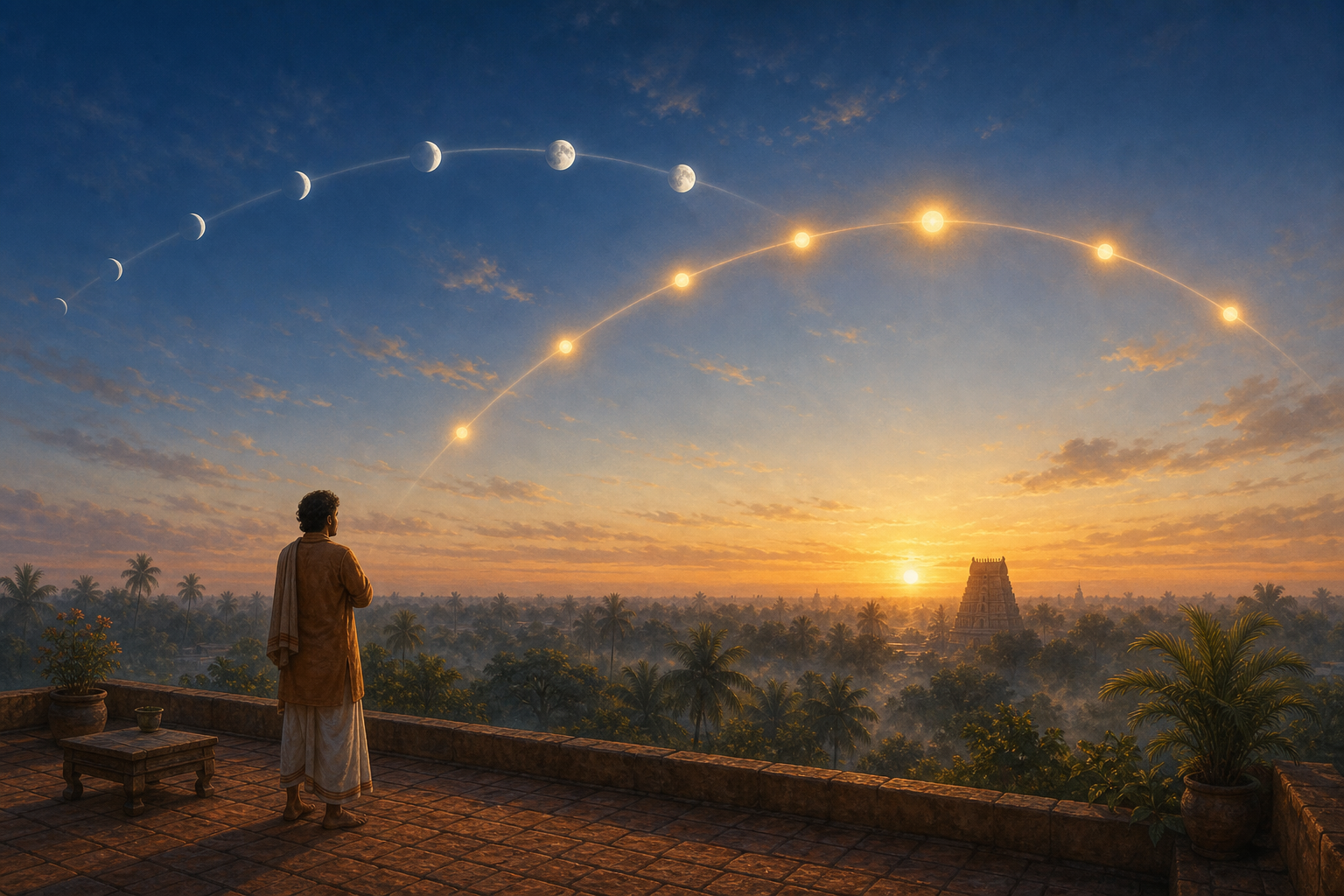
A civil date begins at midnight. Sacred observance does not always follow that boundary. A ritual may depend on the tithi at sunrise, the tithi during evening twilight, the lunar condition near midnight, or the instant of a solar ingress. The first question is therefore not simply, “What festival is on this date?” It is, “What astronomical condition establishes this observance, and during which ritual window must it prevail?”
A tithi measures the angular separation between the Moon and Sun. Each tithi covers 12 degrees of that changing separation. Because the Moon’s apparent motion is not uniform, a tithi is not a fixed 24-hour day. It can begin in the afternoon, end after sunset, or cross midnight. One civil date can consequently contain parts of two tithis.
A solar observance uses a different anchor. Vishu is associated with Mesha Sankramana, the Sun’s entry into sidereal Aries, and the beginning of Medam in the Malayalam calendar. Its annual placement comes from that solar ingress rather than from the Moon’s phase. This is why Vishu can inaugurate a solar year while a separate lunar vrata unfolds according to Trayodashi, Chaturdashi, or another tithi in the same part of April.
This distinction prevents a common planning mistake: treating every calendar label as an all-day condition. A date is only the container. For a precise observance, you still need the relevant celestial event, the ritual window, and your location.
April 15, 2026 shows why the ritual window matters
April 15 provides a useful worked example. Across much of India, Krishna Paksha Trayodashi continues until approximately 8:12 PM, after which Krishna Paksha Chaturdashi begins. That transition does not make the earlier or later part of the date more authentic. It gives each part a different ritual character.
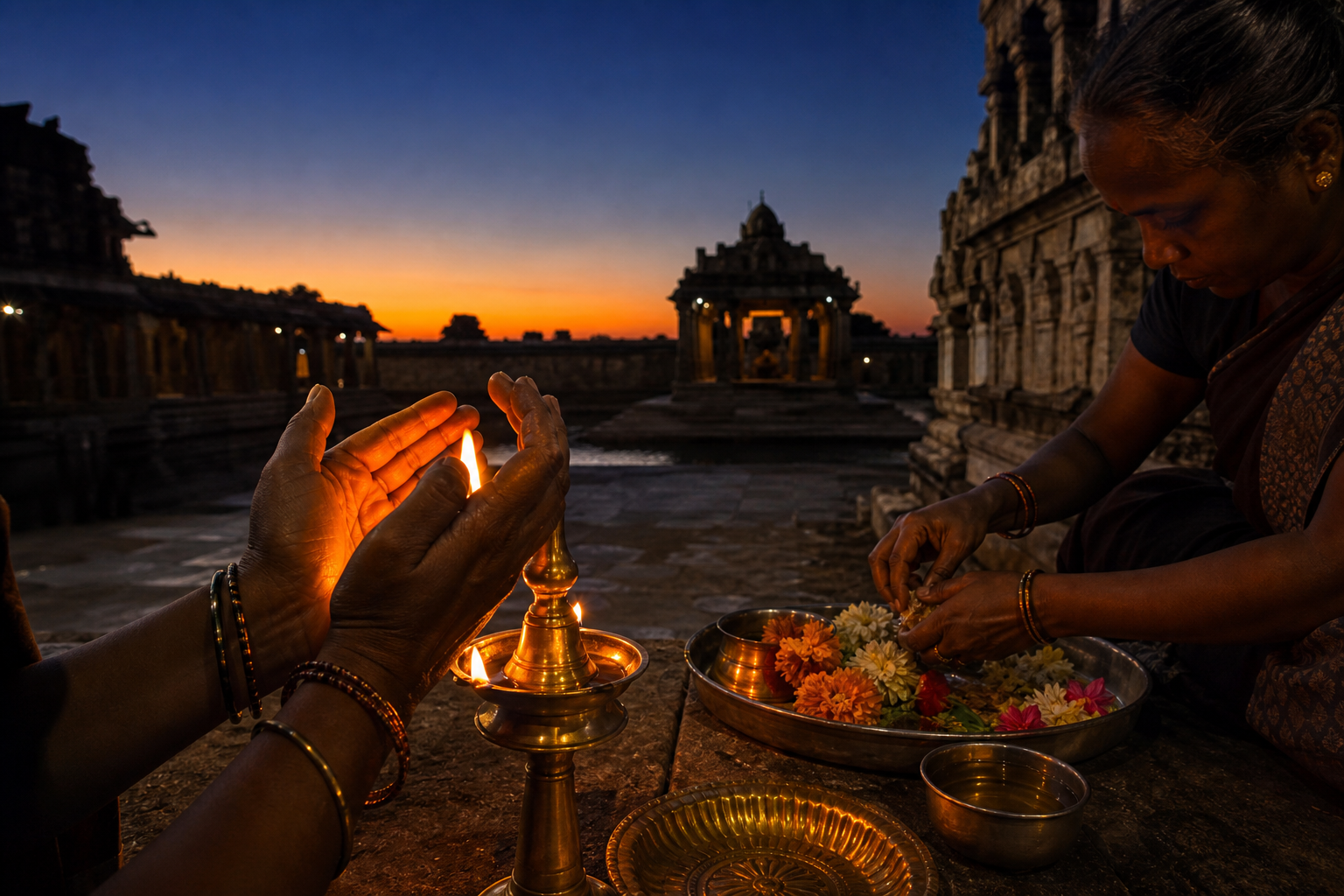
Pradosh Vrat depends on Trayodashi prevailing during pradosha kala, the evening twilight around local sunset. This window is commonly treated as roughly an hour and a half bracketing sunset. Because April 15 is a Wednesday and Trayodashi lasts into the evening in much of India, many locations can observe Budha Pradosh that evening. You should still confirm your own sunset and the locally calculated end of Trayodashi before fixing the puja time.
- Select the city where you will actually perform the observance. Do not use the sunrise or sunset of a distant city merely because its calendar appears first in a search.
- Note local sunset and the Panchang’s stated pradosha window.
- Confirm that Trayodashi overlaps that window. If it does, the essential calendrical condition for Pradosh is present.
- Arrange the worship around that condition: prepare the deepa and offerings beforehand so household logistics do not consume the operative twilight.
- If your family or temple follows a particular sampradaya, use its sankalpa and locally accepted Panchang rather than assembling rules from several incompatible almanacs.
After the transition at about 8:12 PM, Chaturdashi gives the night a more inward Shaiva orientation. Masik Shivaratri, however, is not established merely because Chaturdashi appears somewhere on the date. The relevant test is whether Krishna Chaturdashi overlaps nishita kala, the period near local midnight. Depending on local calculations, the operative night can require more care than the date printed beside the festival name suggests.
In practical terms, do not force Pradosh and Masik Shivaratri into a contest over which “owns” April 15. Their conditions are different. Trayodashi during evening twilight establishes one observance; Chaturdashi during nishita establishes the other. Check each window independently.
For Vishu, prepare for sacred sight rather than chasing a tithi
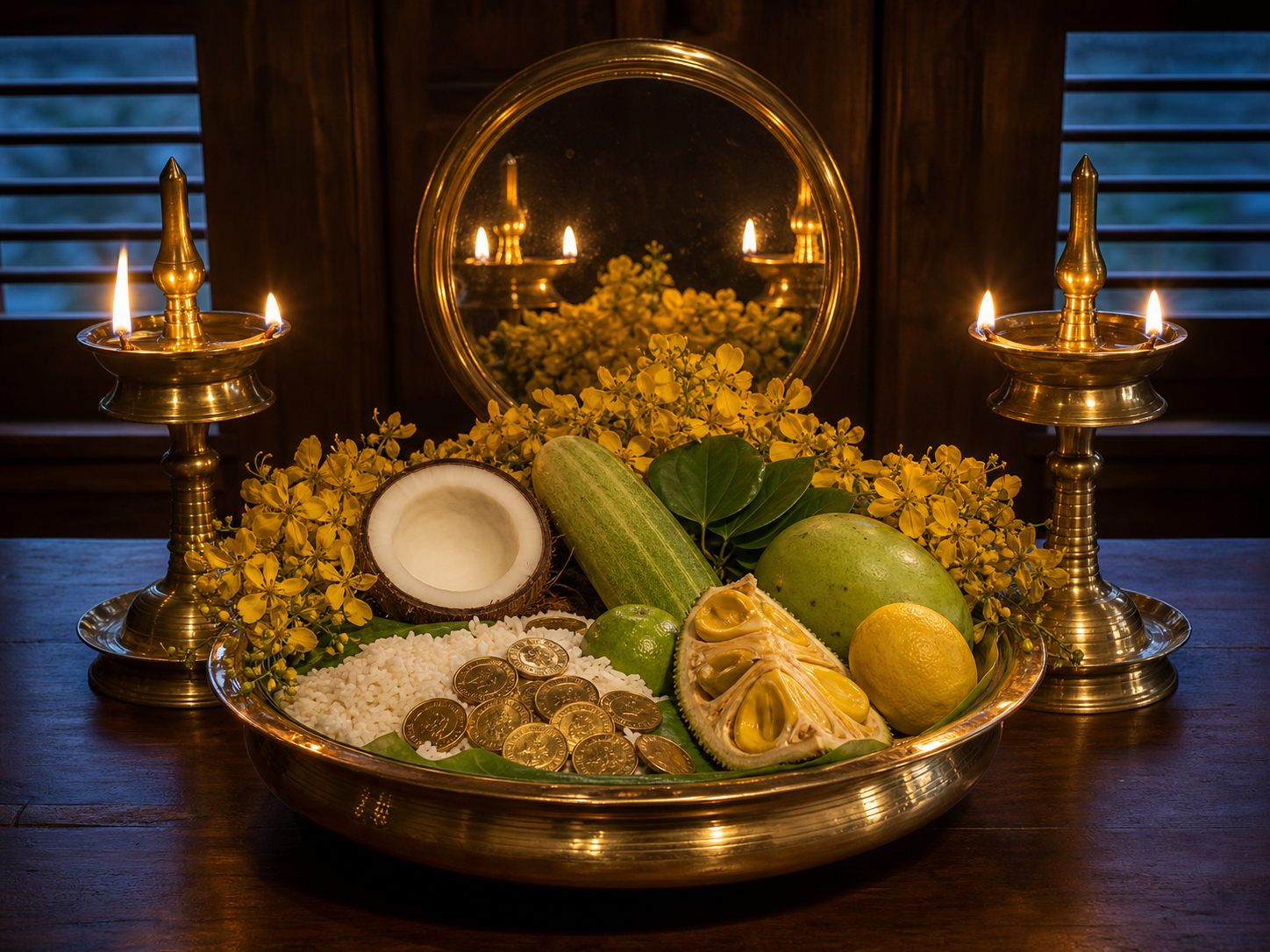
Vishu asks you to organize the household around a solar threshold. Panchanga calculations determine Mesha Sankramana and the suitable relation between that ingress and the dawn observance. The practical result is Vishukkani: the first intentional sight of the new year, prepared before the household wakes.
Set up the kani on the previous night. Traditional elements include a nilavilakku, a valkannadi or mirror, rice, coins or gold, coconut and seasonal produce, the golden kani konna blossoms, and an image or murti of Sri Krishna or Vishnu. The arrangement joins light, reflection, nourishment, abundance, season, and deity in one field of vision. Its purpose is not to produce a decorative inventory. It is to discipline what the family sees first and therefore how it enters the year.
You can preserve that intention without turning the ritual into a shopping exercise. Use the metal lamp and vessel your household already owns. Choose sound, local, seasonal produce where possible. Keep the arrangement orderly enough that every element can be seen. If kani konna is unavailable in the diaspora, follow your family or community’s established practice rather than presenting an unrelated flower as a historical substitute.
At dawn, the sequence matters. Elders traditionally guide children toward the kani before ordinary distractions take over. Darshan comes first; prayers, new clothing, temple visits, the festive meal, and Vishukkaineetam follow. When elders give money to children, dependents, temple workers, neighbors, or people in need, the auspicious sight becomes an ethic of dana rather than a private wish for prosperity.
Recognize the shared season without flattening its traditions
Vishu belongs to a wider mid-April field of solar and seasonal observances that includes Puthandu, Vaisakhi, Pohela Boishakh, and Bohag Bihu. Theravada Buddhist New Year celebrations in Sri Lanka and mainland Southeast Asia also reflect this broad seasonal turn. These parallels reveal civilizational relationships, but they do not make every rite interchangeable.
The same discipline applies to lunar traditions. Buddhist Uposatha observances, Jain tithi-based fasting and Pratikraman, and historically lunar elements in Sikh commemoration all show how celestial rhythms can organize religious life in distinct ways. You can teach this as Dharmic kinship without claiming that every community uses the same calendar rule, theology, or ritual form.
Use a hierarchy of checks instead of stacking every auspicious factor
A Panchang offers more information than most household decisions require. Its five classical limbs are vara, tithi, nakshatra, yoga, and karana. Additional tools can include Chandra Rashi, Tarabalam, Abhijit Muhurat, Rahu Kalam, Yamaganda, Gulika Kaal, and Choghadiya. The presence of all these factors does not mean every factor has equal weight for every action.
| Your question | Primary check | What to do |
|---|---|---|
| Does a vrata or festival apply? | Tithi, solar ingress, and the prescribed ritual window | Establish the observance first. A convenient muhurta cannot replace a missing Trayodashi, Chaturdashi, or Sankramana condition. |
| What clock time should I use? | Local sunrise, sunset, pradosha, nishita, or solar noon | Use your actual city. Recalculate when travelling rather than carrying the home city’s times with you. |
| Is this a suitable time to begin an ordinary undertaking? | Abhijit Muhurat and the weekday’s Rahu Kalam, Yamaganda, and Gulika Kaal | Apply these after the religious condition is settled. They are planning filters for beginnings, not substitutes for the observance rule. |
| Do I need a personal refinement? | Nakshatra, Chandra Rashi, and Tarabalam from the Janma Nakshatra | Add this layer for a consequential personal undertaking when your tradition normally uses it. It is usually unnecessary for every routine act. |
| Why does another calendar differ? | Drik versus vakya calculation, amanta versus purnimanta month reckoning, and regional convention | Follow the almanac accepted by your temple, family, or sampradaya so the observance remains coherent. |
Abhijit Muhurat illustrates why location matters even when a rule sounds universal. It is a broadly auspicious period of approximately 48 minutes centered on local solar noon. It should not automatically be copied as 12:00 PM to 12:48 PM. Its clock placement shifts with the local sunrise, sunset, city, and season.
Rahu Kalam, Yamaganda, and Gulika Kaal are likewise derived from the local daylight span. Divide the time from sunrise to sunset into eight equal segments, then apply the established weekday sequence. On Wednesday, Rahu Kalam occupies the fifth daylight segment. If your Panchang already supplies city-specific times, use those values rather than estimating unless you need a quick cross-check.
Karana and Choghadiya are later refinements. Vishti, also called Bhadra, is traditionally avoided for certain important beginnings, while favorable Choghadiya periods such as Amrit, Shubh, and Labh can help with everyday scheduling. Stop adding filters once you have answered the decision actually in front of you. More parameters do not automatically produce more certainty, especially when they come from almanacs using different computational or regional conventions.
Key takeaways for your April calendar
- Separate solar observances from lunar ones. Vishu follows Mesha Sankramana; Pradosh and Masik Shivaratri depend on tithi during specified ritual windows.
- Never assume a tithi lasts from midnight to midnight. Confirm its beginning and end, then test whether it overlaps sunrise, pradosha, or nishita as required.
- For April 15, 2026, much of India has Trayodashi until about 8:12 PM and Chaturdashi afterward, but your city-aware Panchang remains the final timing reference.
- Use local sunrise and sunset for pradosha, Abhijit Muhurat, Rahu Kalam, Yamaganda, Gulika Kaal, and Choghadiya.
- Follow one coherent regional and sampradaya framework. Small differences between drik and vakya calculations or amanta and purnimanta reckoning can shift an observance.
- Preserve the inner work of the festival: intentional sight and dana at Vishu, steady worship during Pradosh, and quiet inward practice as the waning Moon approaches Amavasya.
Before the April observances arrive, choose one reliable Panchang configured for your city and accepted by your household or temple. Write down only four things for each occasion: the governing celestial event, its transition time, the required ritual window, and what must be prepared beforehand. That small discipline turns a crowded festival calendar into sacred time you can actually inhabit.
References
- DharmaRenaissance Blog — April 15, 2026 Panchang Guide: Krishna Trayodashi–Chaturdashi, Sacred Pradosh and Auspicious Timings
- DharmaRenaissance Blog — Vishu’s Timeless Mahatmya: Rituals, Astronomy, and the Soul of Kerala’s New Year