

You may be loyal to a family, religious institution, political movement, employer, or nation and still reach a point where cooperation feels morally wrong. The difficult question is not whether loyalty matters. It is when loyalty ceases to serve dharma and begins to protect adharma.
A troubled feeling alone cannot answer that question. You need a disciplined way to separate conscience from anger, courage from self-display, and principled dissent from convenient betrayal. Yuyutsu at Kurukshetra and Guru Tegh Bahadur in Delhi faced radically different circumstances, yet their choices reveal a practical dharmic grammar for doing so.
Dharma asks for discernment, not reflexive obedience
Loyalty is ordinarily a virtue. It sustains families, communities, institutions, and political order. But dharmic loyalty is not a blank cheque. It cannot turn kinship into permission for injustice or transform obedience into an excuse for harming the vulnerable.
This is where viveka, discerning intelligence, becomes indispensable. Conscience in a dharmic setting is not merely a strong private preference. It is the faculty by which you test a demand against truth, justice, non-harm, rightful responsibility, and the probable effects of your participation. An agitated mind can call resentment conscience. A frightened mind can call surrender prudence. Viveka asks you to slow down and examine both.
The dharmic traditions do not define every duty in identical terms, and their differences should not be erased. They nevertheless offer a recognizable family of moral disciplines: Hindu reflection on dharma and viveka, Jain insistence on satya and ahimsa, Buddhist cultivation of karuna, and the Sikh union of fearlessness, responsibility, and concern for the well-being of all. Across these paths, inward integrity is tested by outward conduct.
That immediately corrects two common mistakes. The first is treating every inherited rule as dharma merely because it is old or socially enforced. The second is treating every act of rebellion as righteous merely because it challenges authority. Dharma can require obedience, reform, refusal, departure, resistance, or sacrifice. The right response depends on what is being demanded, who will be harmed, which duties conflict, and whether a less destructive remedy remains possible.
When you face such a conflict, begin by writing the disputed demand in one plain sentence: “I am being asked to do, approve, conceal, or tolerate this.” Then name the duty that the demand violates. If you cannot describe either one without slogans, your moral judgment is not ready for action.
Yuyutsu and Guru Tegh Bahadur crossed different moral thresholds

Yuyutsu refused complicity in an unjust cause
On the verge of the Kurukshetra War, Yudhishthira publicly allowed warriors who doubted the Kaurava cause to change sides before combat began. Yuyutsu, a son of Dhritarashtra, accepted the invitation. He left the army of his own kin and joined the Pandavas because his obligation to dharma outweighed his obligation to faction.
The timing matters. Yuyutsu did not wait to see which side would win and then revise his allegiance. He crossed while the outcome remained dangerous and uncertain. Nor was his decision a sudden attempt to acquire moral prestige. His established dislike of deceit had already separated him from Duryodhana’s inner circle. The battlefield made visible a judgment that had been forming before the crisis.
His conduct identifies one threshold for dissent: when remaining inside a group would make you an active instrument of its wrongful purpose, criticism without withdrawal may no longer be enough. Counsel is appropriate while correction remains possible. Refusal becomes necessary when you are ordered to participate. Departure may become necessary when membership itself supplies manpower, legitimacy, information, or silence to the wrong.
Yuyutsu also exposes the cost concealed by the word “defection.” He did not merely revise an opinion. He crossed a physical line between armed relatives in public view. The act placed reputation, security, and family identity at risk. A principled dissenter should therefore ask not only, “Do I disagree?” but also, “What wrongful act will my continued allegiance help perform?”
His later life adds an equally important qualification. Dharmic dissent need not become permanent hostility toward everyone associated with the rejected side. After the war, Yuyutsu is remembered for serving Hastinapura and caring respectfully for Dhritarashtra and Gandhari. He rejected an unjust war policy without renouncing humane obligations to defeated elders. The boundary was firm, but it was not vindictive.
Guru Tegh Bahadur defended conscience beyond his own community
Guru Tegh Bahadur confronted another kind of demand: imperial coercion directed at religious conviction. In Sikh memory, Kashmiri Pandits facing pressure to convert appealed to him at Anandpur Sahib. The ninth Sikh Guru placed himself at risk not to secure a privilege for Sikhs, but to defend the right of another community to remain faithful to its chosen tradition.
That distinction is central. Tolerating only beliefs you share is not freedom of conscience. The real test comes when you protect another person’s spiritual agency even though that person may never join your path, strengthen your institution, or repay your sacrifice. Guru Tegh Bahadur’s stand universalized the principle by refusing to make dignity dependent on communal power.
Sikh, Persian, and later accounts differ in some historical details, but the enduring moral arc is clear: the Guru would not surrender conviction under state pressure. Bhai Mati Das, Bhai Sati Das, and Bhai Dayal Das likewise remained steadfast. On 24 November 1675, Guru Tegh Bahadur was executed publicly in Delhi. Coercion could take his life, but it could not obtain the inward assent it demanded.
His example marks a second threshold for dissent. Yuyutsu refused to become an instrument of an unjust faction. Guru Tegh Bahadur refused to let authority govern the sanctuary of conviction, and he bore witness for people outside his own Panth. One act changed sides; the other would not permit power to decide what the soul must profess.
The Sikh pairing of nirbhau and nirvair gives this courage its proper discipline: without fear, but also without enmity. Fearlessness without restraint can become aggression. Absence of hatred without courage can become passive accommodation. Principled dissent requires both: enough courage to say no and enough moral control not to turn the opponent’s wrongdoing into permission for your own.
Use a six-part test before you call your dissent principled

Historical courage can inspire you, but it should not tempt you into theatrical imitation. Most present-day conflicts are not Kurukshetra, and most disputes do not resemble the imperial coercion faced by Guru Tegh Bahadur. Apply the moral structure of these examples, not their dramatic scale.
- Name the act, not just the atmosphere. Identify exactly what you are being asked to do, endorse, hide, finance, repeat, or ignore. “This group is bad” is too vague. “I am being asked to conceal a deliberate wrong” identifies a possible point of complicity.
- Name the higher duty. State the principle that would be violated: truth, non-harm, freedom of conscience, protection of the vulnerable, fidelity to a legitimate promise, or another concrete obligation. Do not use “dharma” as a label that ends the inquiry; explain what dharma requires here and why.
- Test your motive against self-interest. Ask what you gain from dissent and what you are prepared to lose. Personal benefit does not automatically invalidate a position, but a dissenter who demands sacrifice only from others has not yet demonstrated moral seriousness.
- Choose the least destructive action that actually ends complicity. Private counsel may be sufficient when leaders remain open to correction. A direct refusal is necessary when you are personally ordered to do wrong. Withdrawal becomes relevant when your presence materially supports the wrong. Public witness is justified when secrecy protects continuing harm or silences those unable to speak.
- Identify the beneficiary. Whose dignity, safety, or freedom does your action protect? Yuyutsu’s choice opposed an unjust cause despite family pressure. Guru Tegh Bahadur’s stand defended people of another tradition. If your action protects only your status, anger, or faction, examine it again.
- Decide what duties survive the break. Rejecting an unjust command does not erase every obligation to colleagues, relatives, dependants, elders, or the wider community. Define what you must stop doing and what humane responsibilities you must continue to honour.
Watch for three warning signs. You may be rationalizing if you describe every opponent as wholly corrupt, if you cannot acknowledge any cost imposed on innocent people by your action, or if you keep changing the stated principle whenever a different argument becomes advantageous. Conscience becomes credible through consistency.
If dissent could expose you or others to dismissal, arrest, violence, loss of housing, or legal liability, do not act from historical romance. Separate the moral decision from the operational plan. Seek qualified legal or professional advice where appropriate, protect vulnerable dependants, and use the safest lawful channel capable of ending your complicity. Prudence is not cowardice when it preserves your ability to uphold the principle effectively.
The way you dissent determines what your stand becomes
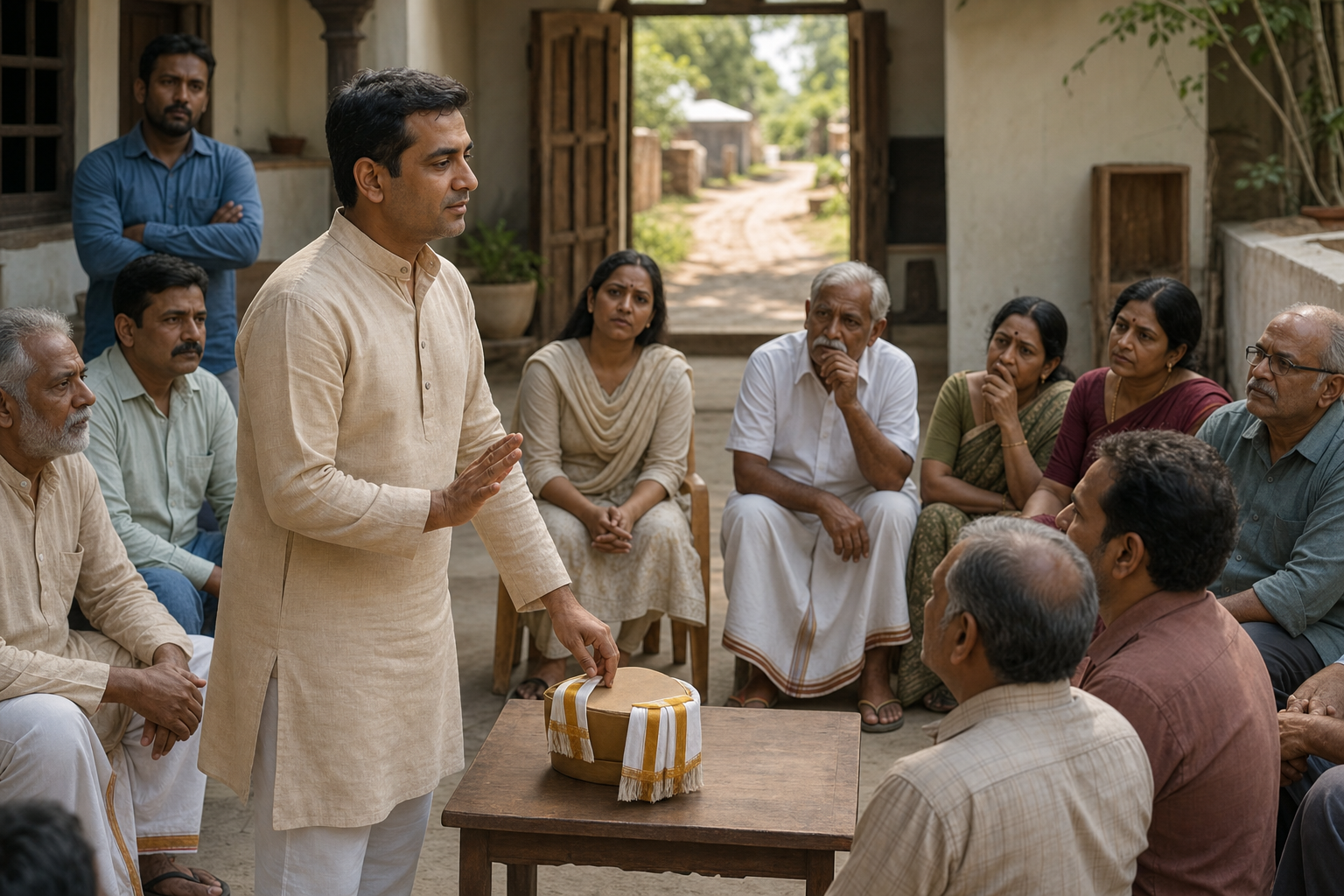
A correct objection can still be expressed through adharmic conduct. Humiliation, falsehood, indiscriminate retaliation, and hatred do not become righteous because they serve a cause you consider righteous. Means shape the moral character of the end.
Begin with precision. Criticize the policy, command, deception, or coercive act rather than inventing claims about every person’s inner motives. This is not timid language. It makes the accusation harder to evade and reduces the chance that anger will outrun truth.
Next, make your boundary legible. State what you cannot do, the principle involved, and the change that would resolve the conflict. A boundary such as “I will not assist this coercion” is clearer than a stream of moral denunciation. It tells others where cooperation ends and leaves open the possibility of correction.
Accept personal cost without manufacturing unnecessary suffering. Yuyutsu did not ask the Pandavas to bear the reputational cost of his decision for him. Guru Tegh Bahadur did not demand that the threatened community first adopt his faith. In both cases, the dissenter assumed a burden connected to the principle being defended. That is different from seeking punishment as proof of purity.
Finally, plan for the day after the refusal. A departure may protect your integrity while leaving an institution damaged, dependants uncertain, or ordinary people caught between factions. Yuyutsu’s post-war service shows why stewardship matters after rupture. The purpose of dharmic dissent is not to enjoy the moral clarity of saying no. It is to reduce adharma and restore the conditions in which rightful duties can be performed.
Institutions also have duties toward conscientious dissenters. Yudhishthira’s invitation before battle created a defined moment in which a warrior could change allegiance without automatic disgrace. That principle can be translated into ordinary governance: provide a channel for objection, evaluate the claim rather than punishing disloyalty reflexively, protect good-faith refusal from retaliation where possible, and distinguish a conscientious dissenter from someone acting through sabotage or deceit. A community confident in its dharma should not need coerced unanimity.
Key takeaways
- Loyalty remains dharmic only while it serves a rightful purpose; kinship, office, and group identity do not excuse complicity in adharma.
- Conscience must be tested through viveka. Name the disputed act, the violated duty, the likely harm, your motive, and the cost you will personally bear.
- Use proportionate dissent: counsel when correction is possible, refuse a wrongful command, withdraw when membership materially enables wrongdoing, and speak publicly when silence protects continuing harm.
- Freedom of conscience is proven by defending the spiritual agency of people outside your own community, not merely by demanding liberty for your side.
- Nirbhau must remain joined to nirvair. Be fearless about the boundary and disciplined enough to reject hatred, falsehood, and indiscriminate retaliation.
- Plan for repair after rupture. Principled dissent should leave you ready to protect innocent people, honour surviving duties, and help rebuild legitimate order.
If a demand is troubling you now, do not begin by asking whether dissent will make you look courageous or disloyal. Write down the act you are being asked to support, the person who may be harmed, and the duty you would violate by complying. Then choose the smallest truthful action that genuinely ends your complicity.
That first action may be counsel, a clear refusal, or preparation to leave. Whatever form it takes, keep the dharmic standard intact: courage without hatred, conviction without vanity, and fidelity to truth above the comfort of belonging.
References
- DharmaRenaissance Blog – Yuyutsu’s Dilemma at Kurukshetra: A Courageous Defection That Redefined Dharma-Yuddha
- SikhNet – Shaheedi of Guru Tegh Bahadur: 350 Years of Courage that Secured Freedom of Conscience