
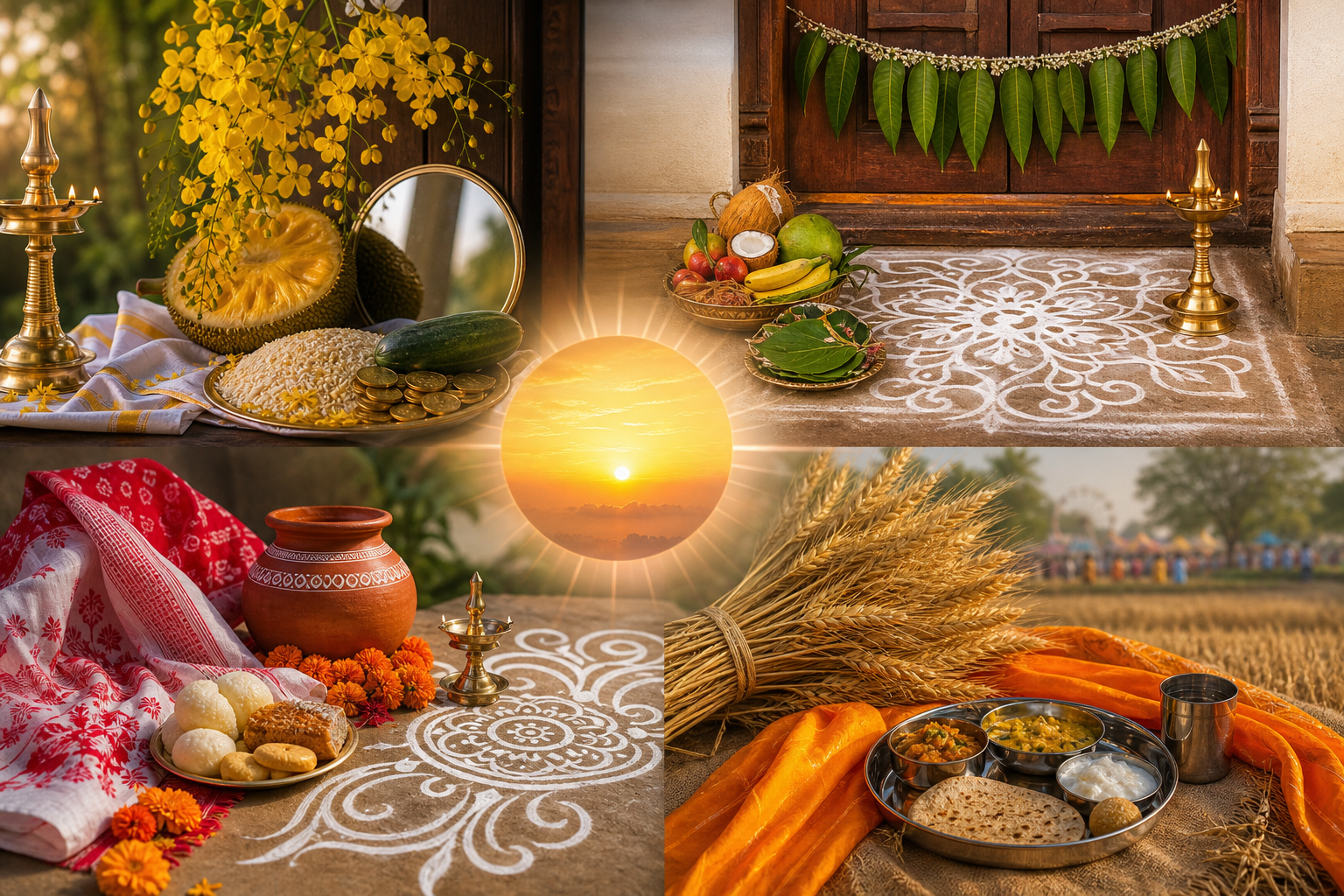
You have Vishu, Puthandu, Poila or Pohela Boishakh, and Vaisakhi marked within the same mid-April window, yet relatives or community calendars may not even agree on the date. If you are planning a family observance, temple visit, or public event, the useful answer is not that these are all the same festival.
They are distinct regional new-year traditions gathered around a shared solar threshold: Surya’s sidereal ingress into Mesha. Once you separate the astronomical instant from the local civil day – and the common value of renewal from each region’s ritual language – you can honor more than one tradition without reducing any of them to decoration.
The shared solar turning does not produce one universal date

Mesha Sankranti is the instant at which the Sun enters sidereal Aries. Calendars built around this nirayana, or sidereal, framework therefore place the transition in mid-April. This is different from the tropical zodiac used to identify the equinox as the beginning of Aries; the two systems are not measuring the same zero point.
The astronomical ingress happens at a precise moment, but a festival is observed on a civil day. A regional rule may assign the new year to the sunrise following the ingress, while a reformed civil calendar may fix it to a standard date. Local time zones and sunrise can therefore place closely related celebrations on different dates without either community having made a mistake. This is why Vishu may fall on 14 or 15 April and why the first day of Boishakh can differ across Bengal.
The 2026 calendar provides a clean example. West Bengal’s astronomical reckoning places Poila Boishakh on 15 April, while Bangladesh’s reformed civil Bangla calendar fixes Pohela Boishakh on 14 April. That one-day difference reflects two calendrical rules, not two opinions about the movement of the Sun.
Before you announce a date, record three things:
- The city and time zone in which the observance will occur.
- The regional calendar being followed, such as a Kerala panchang, Tamil panchang, West Bengal’s astronomical convention, or Bangladesh’s civil Bangla calendar.
- The local temple or community schedule, especially when the observance depends on sunrise, Nirmalya darshan, Usha puja, or a formal panchanga reading.
Do not copy a date from a relative in another city and assume the temple near you will use the same window. For a dawn observance, the local panchang and the temple’s published schedule are more useful than a generic festival graphic.
Each region gives the new year its own ritual grammar
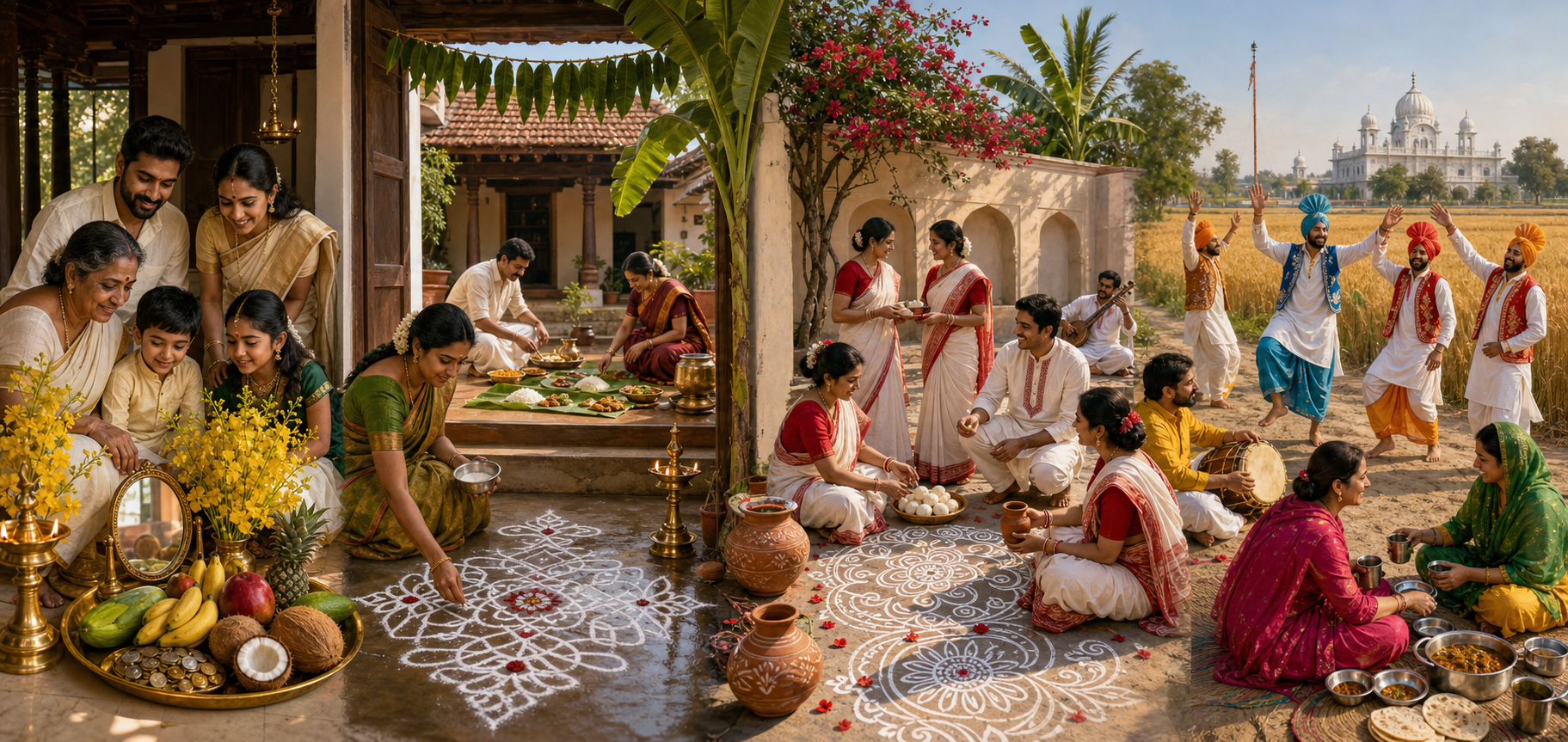
The common solar hinge explains the family resemblance among these festivals. It does not make their practices interchangeable. The clearest way to preserve both unity and difference is to ask what each tradition places at the center of the day.
| Tradition | Regional setting | Distinctive focus | Your planning cue |
|---|---|---|---|
| Vishu | Kerala and Malayali communities | Vishukkani as the first sight at dawn, followed by Kaineettam and, where customary, early temple worship | Prepare the kani before the household wakes and verify the local sunrise or temple window |
| Puthandu | Tamil Nadu and Tamil communities | The opening of Chithirai, with temple alankaram, abhishekam, archana, and panchanga pathanam among prominent observances | Check when the chosen temple conducts its special worship and annual calendar reading |
| Poila Boishakh | West Bengal | The first day of Boishakh, expressed through household purification, alpona, mangal ghat, cultural gatherings, and Hal Khata for businesses | Use the West Bengal date and keep the commercial ledger ritual connected to an actual household or business tradition |
| Pohela Boishakh | Bangladesh | The civil Bangla New Year on 14 April, with household, cultural, and public expressions of renewal | Use the nationally fixed civil date rather than importing West Bengal’s sunrise-based date |
| Vaisakhi | Punjab and Punjabi communities | A Punjab-linked new-year celebration in the same Mesha Sankranti season, with its own Sikh and regional identity | Do not relabel Vishukkani, Tamil temple customs, or Hal Khata as Vaisakhi practices |
Vishukkani is not a universal Mesha Sankranti centerpiece. Hal Khata is not a generic pan-Indian prosperity exercise. Puthandu’s panchanga pathanam is not another name for Vishu’s first sight. Vaisakhi should not become a convenient label for customs borrowed from Kerala, Tamil Nadu, or Bengal. If you are hosting a shared event, name each element and let someone connected to that tradition explain or lead it.
The unity lies at another level: auspicious beginning, gratitude, seasonal renewal, generosity, disciplined attention, and community welfare. Those values allow different practices to stand beside one another without requiring them to become identical.
Do not bundle every Vaishakha observance into New Year’s Day
Similar names can create another confusion. Boishakh is a solar month beginning around Mesha Sankranti, while several important observances are calculated through the lunar Vaishakha month. Akshaya Tritiya and Buddha Purnima may fall within or near the solar month of Boishakh, depending on the panchang, but they are not simply additional names for its first day.
This distinction matters when you are preparing an inter-Dharmic calendar. Give the Mesha Sankranti new years their proper mid-April place, then list Jain, Buddhist, Vaishnava, or other lunar observances on their own tithis. Shared seasonality is worth noticing; collapsed chronology is not.
Build a household observance around one inherited grammar
If your immediate question is what your family should actually do, begin with the tradition already present in the household. A focused observance carries more meaning than a display assembled from every region. You can share food, greetings, music, or a temple visit across communities after the central rite has been honored on its own terms.
A workable Vishukkani sequence
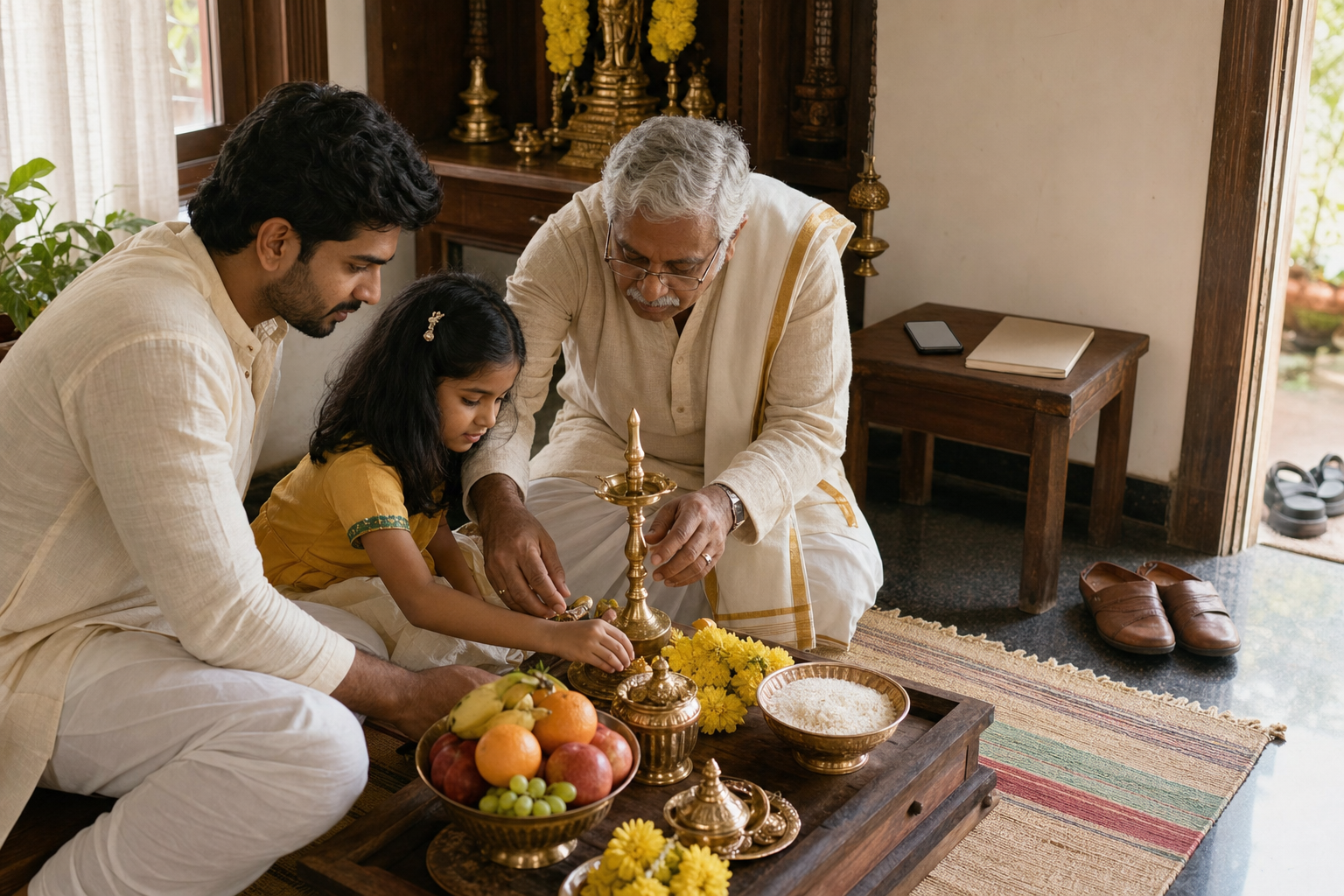
Vishukkani is an intentional first sight, not merely a festive still life. Its arrangement presents nourishment, light, sacred learning, material sufficiency, and self-reflection together. If Vishu is your household tradition, use this sequence:
- Confirm the local date and dawn timing before the previous evening. If you intend to visit a temple, check its Vishukkani and Usha puja schedule rather than assuming that the doors open at sunrise.
- Clean the shrine area and prepare an uruli or brass plate. Arrange rice, pulses, seasonal fruits and vegetables, betel leaves and areca nut, coins or gold, a mirror, a sacred text, and fresh flowers. Cucumber and jackfruit often appear when seasonally available.
- Use kani konna when it is available. If it is not available where you live, fresh yellow flowers can preserve the visual emphasis without turning the search for one flower into the point of the observance.
- Position the lamp on a stable, fire-safe surface and light it under supervision before the household gathers. Keep unrelated visual clutter and phone screens away from the first-sight path.
- Wake children gently and guide them to the kani. The first moments should be unhurried enough for them to notice what has been arranged, not merely pose beside it.
- Give Vishu Kaineettam with a blessing or a short word about how the gift should be used. The custom carries generosity and responsibility together; the amount is less important than the relationship it expresses.
A home arrangement does not need to imitate a temple installation. The essential Vishukkani elements can be assembled with a clean vessel, food staples, a mirror, sacred text, flowers, valuables, and a steady lamp. Order, intention, and the first sight matter more than ornamental scale.
If you are going to a Kerala-style temple, arrive early enough to settle before the dawn rush. Nirmalya darshan, Usha puja, Vishukkani, and Kaineettam may have distinct windows. Families accompanying elders can ask whether a calmer later-morning darshan is available, accepting that it may not reproduce the exact dawn sequence.
For a Puthandu or Boishakh household
A Tamil household need not create a Vishukkani merely because the two festivals occupy the same solar window. If your family centers Puthandu on temple worship, plan around the relevant alankaram, abhishekam, archana, or panchanga pathanam. The annual calendar reading is especially useful when you want the day to orient the household toward the coming year’s religious rhythm rather than function only as a greeting exchange.
For Poila or Pohela Boishakh, begin with the Bengali language of the day: clean the home and shrine, make alpona where that is your custom, establish the mangal ghat, and join the cultural or devotional gathering meaningful to your family. Hal Khata belongs naturally in a shop, professional practice, or family business that is genuinely opening new ledgers. It should not be staged as an unexplained prosperity prop.
Let the meal follow the household rather than an imagined all-region menu. Vishu families may prepare a sadya, while Bengali celebrations may include panta bhaat or other seasonal food. You do not need to reproduce every named dish for the day to be valid. Fresh, sattvic food offered and shared with attention is a stronger center than an overextended menu that exhausts the people observing the festival.
Plan a mixed-region celebration without erasing differences
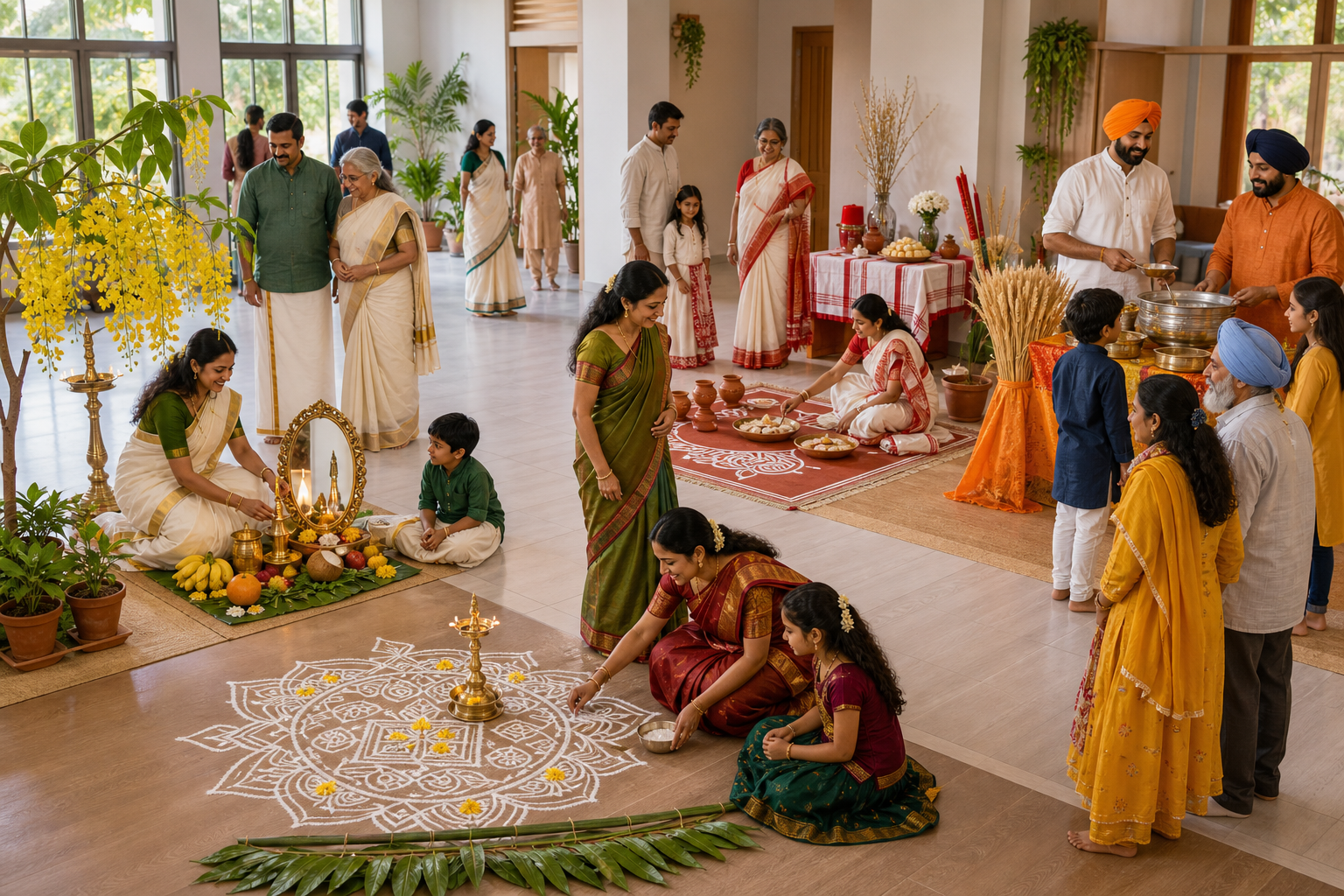
Mixed Malayali, Tamil, Bengali, Punjabi, Buddhist, Jain, Sikh, and other Dharmic families do not have to choose between a generic celebration and four separate households. The practical answer is a layered day: protect lineage-specific rites first, then create a shared space for greeting, food, generosity, music, or prayer.
- Name the event accurately. Mesha Sankranti new-year gathering is more honest than claiming that every participant observes one Indian New Year in the same way.
- Publish the date basis. State the city, calendar tradition, and whether the schedule follows a local panchang, a temple program, or a civil calendar.
- Give every regional element a label and a host. A Vishukkani display, Tamil panchanga reading, Bengali alpona, and Vaisakhi segment should not appear as anonymous festival decor.
- Protect timing-dependent rites. Vishukkani belongs to the first sight at dawn; recreating it casually at midday changes the function of the custom. A family can complete its dawn observance at home and join the larger gathering afterward.
- Choose one common ethical action. Kaineettam, annadanam, a shared meal, support for a younger family member, or an honest opening of business accounts can translate auspiciousness into responsibility.
A household joining Vishu and Puthandu can follow a simple sequence: Vishukkani at dawn, then a Tamil or Kerala-style temple according to family practice, followed by the shared meal. Families in Chennai commonly move between Kerala-style Vishu observances and Tamil Puthandu temples, showing that participation in both does not require pretending that both are the same ritual.
For a community program, ask each regional host two questions before designing the schedule: what must remain distinct, and what can everyone join? The answers will usually tell you where a formal ritual needs its own time and where music, food, greetings, or service can create genuine fellowship.
Be equally precise with language. Use Poila Boishakh when referring to West Bengal and Pohela Boishakh when referring to Bangladesh if that is how the participating community identifies the day. Say Vishu for the Malayali first-sight tradition, Puthandu for the Tamil New Year, and Vaisakhi when the Punjabi or Sikh observance is actually being represented. Correct names are a small act of hospitality.
Key takeaways for your mid-April observance
- Mesha Sankranti is a precise sidereal solar ingress; the observed new-year date depends on the regional rule used to convert that instant into a civil day.
- A 14 or 15 April date does not by itself indicate an error. Location, sunrise, time zone, panchang convention, and civil-calendar reform can all affect the published date.
- In 2026, Poila Boishakh falls on 15 April under West Bengal’s reckoning, while Bangladesh observes Pohela Boishakh on its fixed civil date of 14 April.
- Vishukkani, Puthandu temple observances, Bengali Hal Khata, and Vaisakhi are distinct practices or traditions, not interchangeable labels for a single ritual package.
- Akshaya Tritiya and Buddha Purnima are lunar observances that may occur within or near the solar month of Boishakh; they should not be folded automatically into New Year’s Day.
- For a shared celebration, identify the calendar, protect dawn-dependent rites, label every regional custom, and unite the gathering through a concrete act of generosity or community welfare.
Before you send the invitation or buy the flowers, write down the place, the calendar tradition, and the authority you will use for the date. Then choose the one practice your household can perform with full attention. Once those two decisions are settled, you can welcome other regional traditions as honored guests rather than blending them into a festival no community actually observes.
References
- HinduPad – Vishu in Chennai: A Definitive Temple Guide to Vishukkani, Kaineettam, and Sunrise Darshan
- HinduPad – Boishakh Mash 2026, Bengali Calendar 1433: Dates, Poila Boishakh 2026, Rituals, and Dharmic Unity