
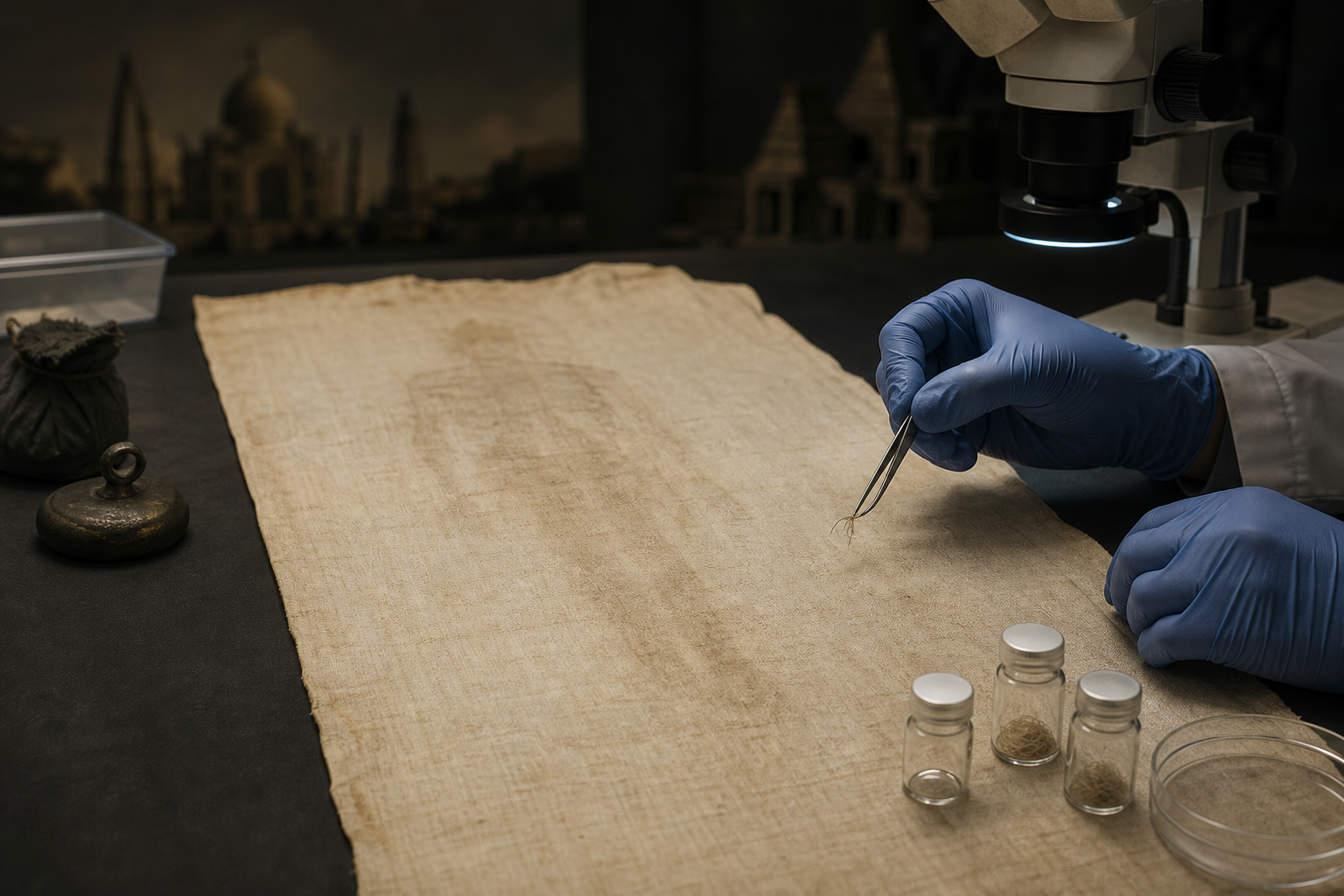
You may have received a video, screenshot, or message making a dramatic deduction: Indian DNA was found on the Shroud of Turin, therefore Jesus was Indian or spent part of his life in India. Before you forward it or challenge it, separate three different questions: whose biological material was sampled, when the cloth was made, and whether the cloth can be connected to the historical Jesus.
Once those questions are separated, the answer becomes clear. The Shroud’s mixed DNA does not establish the ancestry of the person depicted, and it does not prove an Indian biography for Jesus. You can reject that leap without denying the very real history of contact between Bharat and the Mediterranean world.
The short answer: the Indian DNA claim does not hold
The accurate statement is much narrower than the viral claim. Mitochondrial DNA associated with several regions, including the Indian subcontinent, was recovered from dust and other material on the Shroud’s surface. That finding concerns biological traces accumulated on an object. It is not a genetic identification of the person represented by the image.
Key takeaways
- The DNA came from dust and surface particulates, not from a complete genome securely belonging to the depicted person.
- The sample contained a mixture of mitochondrial haplogroups associated with Europe, the Near East, North Africa, and the Indian subcontinent.
- A regional haplogroup association does not establish modern nationality, the identity of the person who left the material, or the ancestry of the Shroud’s image.
- Three laboratories dated the linen in 1988 to 1260-1390 CE. Objections remain under discussion, but the mainstream scholarly position continues to treat the cloth as medieval.
- Ancient links between India and the Mediterranean make cultural contact historically credible. They do not supply a travel record for Jesus.
What the DNA can identify, and where the inference breaks

In 2015, a peer-reviewed Scientific Reports analysis examined mitochondrial DNA extracted from dust and particulates collected from the linen. The resulting profile was highly varied. It included haplogroups associated with several broad geographical populations rather than one clean biological lineage.
That mixture is important. A cloth that has been handled, stored, displayed, moved, and venerated over centuries can collect material from many people and environments. The DNA can therefore illuminate the object’s contact history. Without a secure way to assign a particular particle to the person depicted, it cannot establish that person’s ancestry.
The phrase Indian DNA also conceals two different leaps. First, mitochondrial haplogroups are population-lineage categories, not passports. A haplogroup associated with the Indian subcontinent does not encode the modern identity Indian. Second, even if a particle came from a person of South Asian ancestry, its presence would show contact with the cloth, not that the person was Jesus.
Follow the chain one link at a time. A mitochondrial signature was present in the sampled surface material. Someone or something carrying that signature may have contacted the linen directly or indirectly. Neither statement identifies when that contact occurred. Neither assigns the material to the figure in the image. The conclusion that Jesus was Indian requires all of those missing links to be filled, and this analysis fills none of them.
When you encounter a genetic claim about any relic, ask four questions: Was the sample taken from the object or from securely identified human remains? Was it surface material or material embedded in a controlled archaeological context? Did it contain one coherent profile or a mixture? What evidence connects that profile to the named historical person? If the last answer is only an assumption, the ancestry claim has already outrun the evidence.
Why the 1260-1390 CE radiocarbon date still matters
The DNA question does not stand alone. In 1988, three laboratories used radiocarbon testing and placed the Shroud’s linen between 1260 and 1390 CE. That range falls in the medieval period, far removed from the first-century life of Jesus.
Critics have proposed contamination, nonrepresentative sampling, and the possibility that the tested section belonged to a medieval repair. Textile, chemical, and statistical arguments continue to be debated. Those objections explain why discussion of the Shroud has not disappeared, but the existence of a dispute is not the same as a successful first-century authentication. The mainstream position still regards the linen as a medieval artifact.
This distinction gives you a reliable way to evaluate apologetic arguments. Showing that a measurement might have a weakness can reduce confidence in that measurement. It does not automatically establish the preferred alternative. A critique of the medieval date would need to succeed on its own terms, and positive evidence would still be required to date the cloth to the first century and connect it specifically to Jesus.
The same rule applies to claims about India. Even if future work overturned the medieval date, that result would reopen the age question; it would not transform mixed surface DNA into proof of Indian ancestry. Age, authenticity, identity, and ancestry are separate propositions. Each needs its own evidence.
Where Indian Jesus stories cross from possibility into legend

The idea of Jesus in India did not begin with the Shroud. It appears in the Notovitch story commonly associated with the Life of Saint Issa and in later traditions linking Jesus with Kashmir. These accounts have enduring cultural and spiritual appeal, but academic assessments generally treat them as legendary or unsubstantiated rather than established biography.
That judgement does not require pretending India and the Mediterranean were isolated worlds. Indo-Roman maritime trade connected South Asian ports such as Muziris with the Red Sea and Mediterranean markets. Mauryan inscriptions refer to Hellenistic polities. Classical writers described Indian gymnosophists, while Gandhara art preserves a striking Greco-Buddhist synthesis. Merchants, teachers, monks, and mendicants carried objects and ideas across long distances.
Those connections establish routes and opportunities for exchange. They do not identify a particular traveller. A trade route is not an itinerary, a shared ethical theme is not a travel document, and cultural similarity is not proof of direct borrowing. The history of exchange makes movement possible in a general sense; a claim about Jesus requires evidence specific to Jesus.
Use three labels when weighing such claims: possible, plausible, and demonstrated. An available route may make a journey possible. A claim becomes plausible only when its chronology, setting, and independent evidence fit together. It becomes demonstrated when evidence can be tied reliably to the named person and event. The Indian Jesus traditions have not crossed that final evidentiary threshold, and mixed DNA from the Shroud does not move them closer to it.
This disciplined distinction actually strengthens the history of Bharat. India’s documented civilizational reach is substantial enough to stand on inscriptions, trade networks, artistic synthesis, and the known movement of religious communities. It does not need an unsupported claim about Jesus to make that history meaningful.
A Dharmic response can be truthful without becoming hostile

For a Dharmic audience, the choice is not between celebrating an Indian Jesus and defending a culturally European image of him. European artists often represented Near Eastern sacred figures with European features. South Asian communities have likewise expressed sacred personalities through local artistic forms. Such images can make devotion intimate, but they are not forensic portraits and should not be treated as ancestry evidence.
Correcting Eurocentric representation by assigning Jesus an unsupported Indian identity merely reverses the same mistake. It turns appearance into historical proof and can pull a worthwhile discussion about colorism, migration, or cultural power into an argument that the evidence cannot sustain.
Ahimsa, daya, karuna, and seva offer a better ground for discussion among Hindus, Buddhists, Jains, Sikhs, and Christians. In practice, that means correcting the claim rather than humiliating the person who shared it, distinguishing devotional meaning from historical demonstration, and refusing to use a sacred figure as a weapon against migrants or another religious community.
If you need a concise response, use this: The Shroud analysis found mixed mitochondrial DNA in dust on the cloth, including haplogroups associated with the Indian subcontinent. It did not recover Jesus’s genome or identify the ancestry of the image. Radiocarbon testing dated the linen to 1260-1390 CE, although methodological objections continue to be debated. Ancient India and the Mediterranean were connected, but those connections do not prove that Jesus travelled to India.
If the conversation is devotional rather than historical, name that boundary gently. A person may find a meaningful resonance between the teachings attributed to Jesus and Dharmic ideals without turning that resonance into genealogy. Interfaith respect does not require a shared biological origin, and historical honesty does not require spiritual hostility.
Before sharing the next dramatic relic claim, label each piece of evidence: surface contact, object date, cultural connection, or personal biography. Stop whenever the conclusion jumps from one category to another without a bridge. That small habit protects both the historical record and the Dharmic commitment to truth expressed with compassion.