
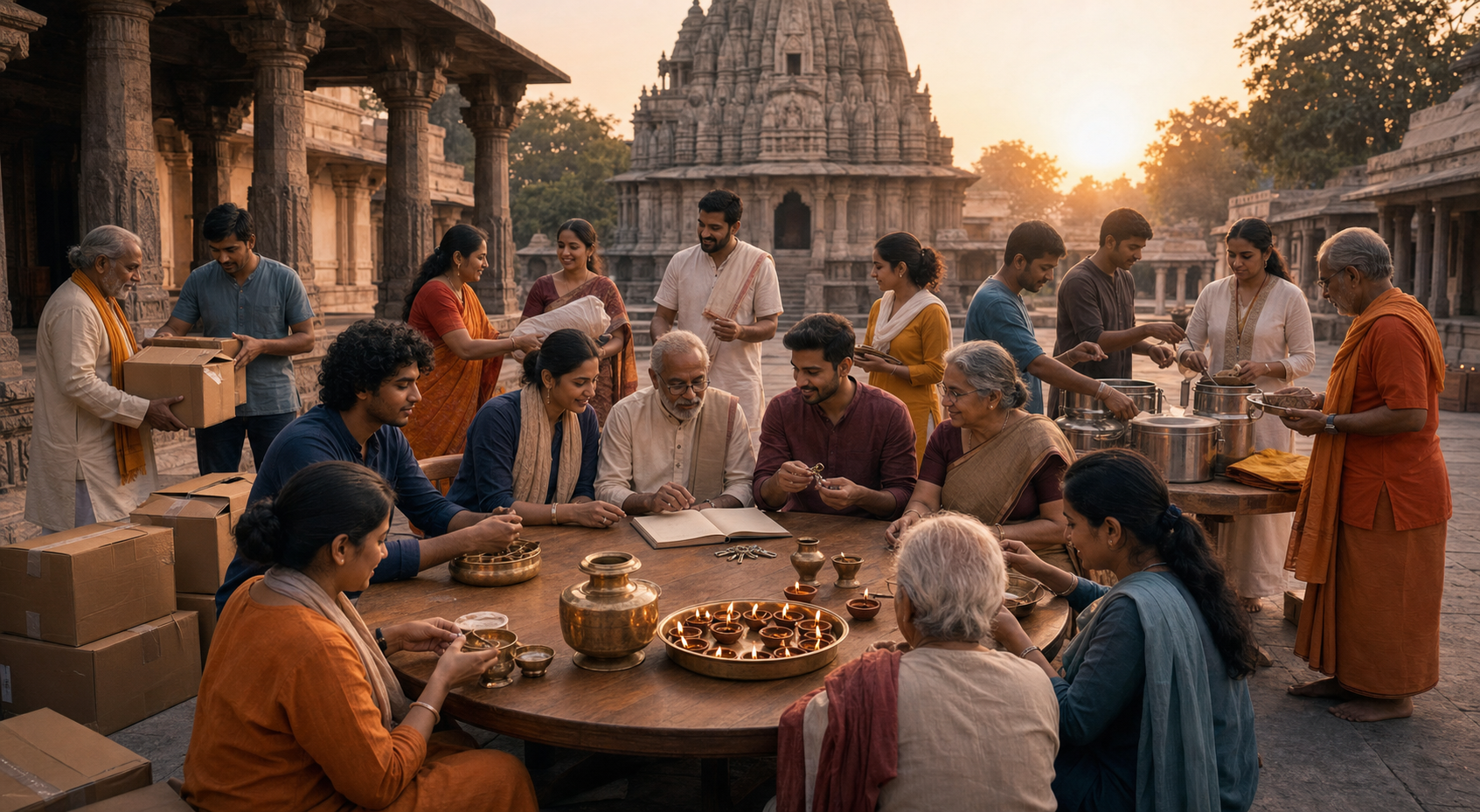
You may be trying to unite a temple committee, a priest network, a youth group, or several Dharmic institutions after a dispute or before a demanding festival. The temptation is to begin with a declaration of unity. Begin instead with one duty people can perform together, one rule applied equally, and one record the next leadership team can inherit.
Dharmic unity becomes consequential when it survives caste divisions, doctrinal differences, leadership changes, financial strain, and emergencies. For the person responsible for an institution, that means converting goodwill into governance, recurring seva, institutional memory, and mutual aid.
Define unity through shared responsibilities, not religious sameness
Hinduism, Buddhism, Jainism, and Sikhism are not interchangeable systems. They contain distinct doctrines, lineages, disciplines, forms of authority, and sacred practices. Cooperation becomes trustworthy only when that distinction is stated at the beginning. No federation, committee, or public campaign should acquire the power to rewrite another institution’s theology or ritual maryada.
The common ground lies in duties that do not require theological merger. A durable ethic can be expressed through ahimsa and karuna, dana and seva, anekantavada, and sarbat da bhala: restraint from harm, compassion, generosity, service, humility before multiple perspectives, and concern for the welfare of all. These principles give different communities a practical vocabulary for working together while retaining their own identities.
You can test any proposed unity initiative with a simple question: does it help people discharge a shared responsibility, or does it ask them to surrender a legitimate distinction? Joint fire planning, volunteer training, heritage documentation, food-safety procedures, and disaster relief belong in the first category. Pressure to standardize worship, doctrine, initiation, or internal religious authority belongs in the second.
A useful minimum agreement should cover five commitments:
- Every participant receives equal dignity, irrespective of caste, family background, language, occupation, wealth, or institutional rank.
- Each institution retains control over its doctrine, ritual practice, sacred spaces, and lawful internal affairs.
- Common resources are governed transparently, with named responsibilities and records that can be inspected.
- Disagreements are handled through a documented process that favors reconciliation without concealing fraud, violence, abuse, or legal violations.
- Public activity remains centered on service, heritage, education, safety, and coexistence rather than partisan capture.
This distinction protects both sides of Dharmic unity. Shared responsibility prevents pluralism from becoming indifference. Protected autonomy prevents solidarity from becoming control.
Build a federation for standards and mutual aid, not central control

An isolated sacred institution can become dependent on the memory and energy of a few individuals. When a trustee retires, a priest falls ill, a festival crowd exceeds expectations, or a property dispute appears, the institution may have no one to call. A local federation changes that without absorbing its members.
The federation should own common standards, training, referral networks, and emergency coordination. Member temples, mathas, viharas, derasars, and gurdwaras should retain their property, governance, ritual authority, and community relationships. This network model allows sacred institutions to pool legal assistance, conservation knowledge, security practices, training, and crisis support while remaining locally anchored.
Start with a short charter that an ordinary volunteer can understand. It should state the network’s scope, what it cannot decide, how members join or leave, how money is authorized, how conflicts of interest are disclosed, and how a complaint can be appealed. If the document says only that everyone will cooperate, it is not yet a governance instrument.
Then separate four kinds of responsibility:
- Ritual responsibility: Decisions about worship, lineage, sacred objects, and religious observance remain with the institution’s recognized religious authorities.
- Administrative responsibility: Budgets, maintenance, contracts, volunteer rosters, communications, and regulatory work receive named administrative owners.
- Assurance responsibility: Auditors, safety reviewers, conservation specialists, or other qualified reviewers examine work that cannot credibly be self-certified.
- Community accountability: Devotees, volunteers, donors, and affected community members receive a clear channel for questions, grievances, and appeals.
Succession deserves the same attention as appointment. Every critical role should have a written description, an accessible handover file, a deputy or alternate contact, and a defined transition process. A respected leader may carry an institution for years, but resilience begins when essential knowledge no longer resides in that person’s private messages, memory, or cupboard.
Do not copy another institution’s bylaws without checking the law that applies locally. Temple governance can sit under different public-trust or endowment regimes, including the Maharashtra Public Trusts Act, 1950, the Tamil Nadu HR&CE Act, 1959, the Karnataka HRICE Act, 1997, and the Andhra Pradesh endowments framework of 1987. Property disputes, foreign contributions, employment questions, and changes to trust documents can create legal or financial exposure. Use qualified local legal and accounting professionals for those decisions rather than treating a network template as legal advice.
Make recurring seva the place where social trust is built
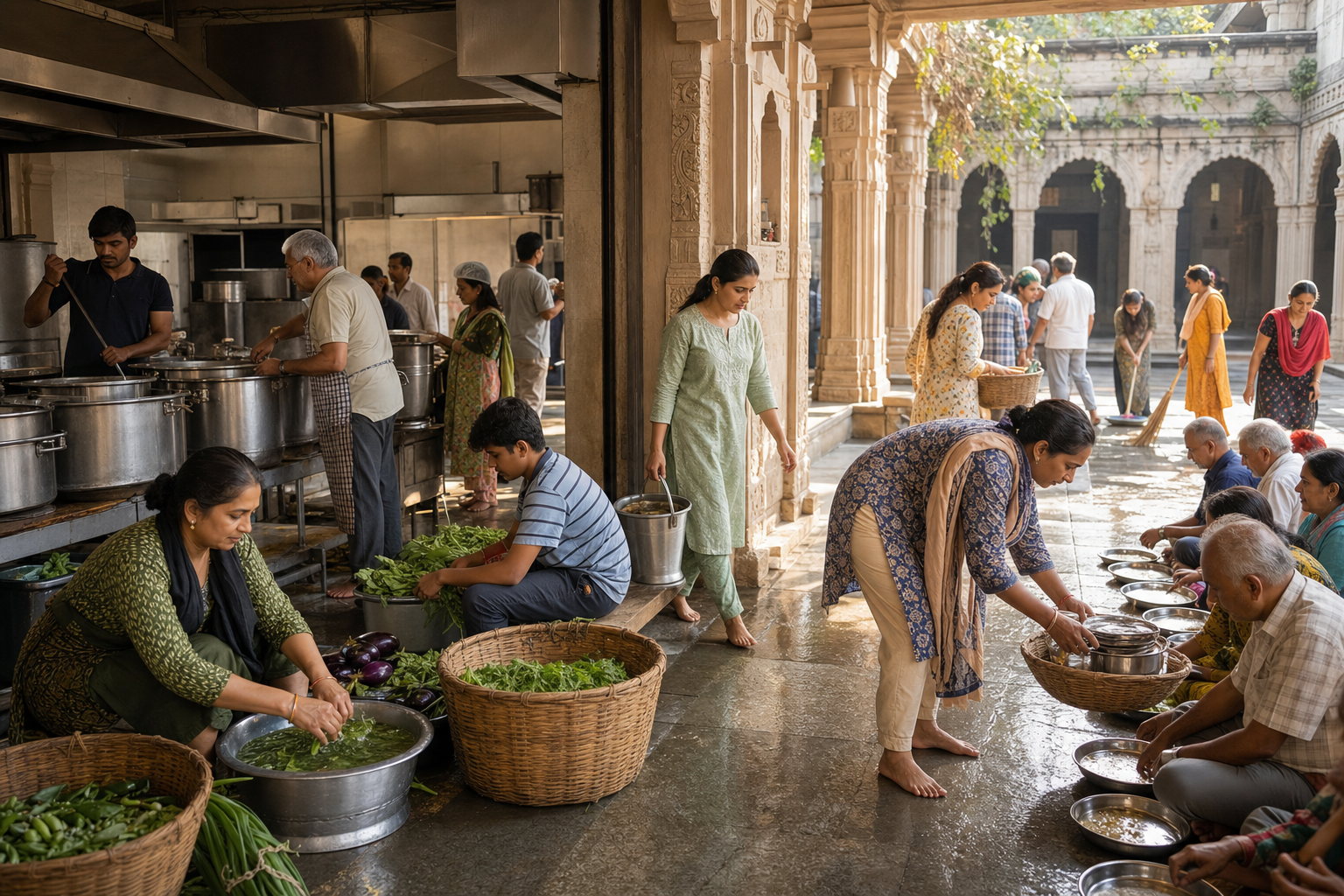
People do not overcome inherited social distance merely by agreeing with a speech. They need repeated occasions to work beside one another, solve a real problem, and see that duties and respect are shared. That is why seva should be part of the institutional calendar rather than reserved for exceptional occasions.
Choose one recurring activity that the community genuinely needs: a community kitchen, cleanliness drive, skills workshop, education initiative, health camp, heritage-recording effort, or festival-support team. Mixed teams and repeated positive contact can reduce social distance, but only when the work itself does not reproduce the hierarchy it is meant to overcome.
Design each seva activity with the following safeguards:
- Recruit across caste, language, age, gender, occupation, and participating institution instead of relying on one established social circle.
- Rotate visible and less visible tasks. Cooking, cleaning, registration, public speaking, carrying supplies, and serving food should not become permanent assignments for particular groups.
- Publish role descriptions before the activity so authority is not improvised by the loudest participant.
- Use multilingual instructions where first-generation learners or different language communities are involved.
- Pair younger participants with mentors beyond their usual social group, and make the relationship about skills and responsibility rather than patronage.
- End with a short operational review: what failed, who was excluded, which complaints remain open, and what must change next time.
Count more than beneficiaries and meals. Record who planned the work, who held decision-making roles, which groups participated, whether volunteers returned, and whether participants felt they were treated fairly. A large event can distribute substantial aid while leaving the institution’s internal barriers untouched.
A grievance process is essential because appeals to unity can otherwise be used to silence the person who reports exclusion. Provide a confidential route for complaints, record the response, disclose conflicts of interest, and allow review by someone outside the immediate dispute. Reconciliation is appropriate for many interpersonal conflicts. Allegations involving violence, abuse, theft, fraud, or unlawful discrimination require competent authorities and professional advice, not an informal compromise designed to protect reputation.
Keep service visibly non-partisan. A shared kitchen or heritage project loses its unifying function when access, recognition, or leadership is conditioned on political loyalty. The institution can maintain a confident Dharmic identity while applying its rules fairly and respecting lawful freedom of belief and association.
Strengthen the five systems that keep an institution alive
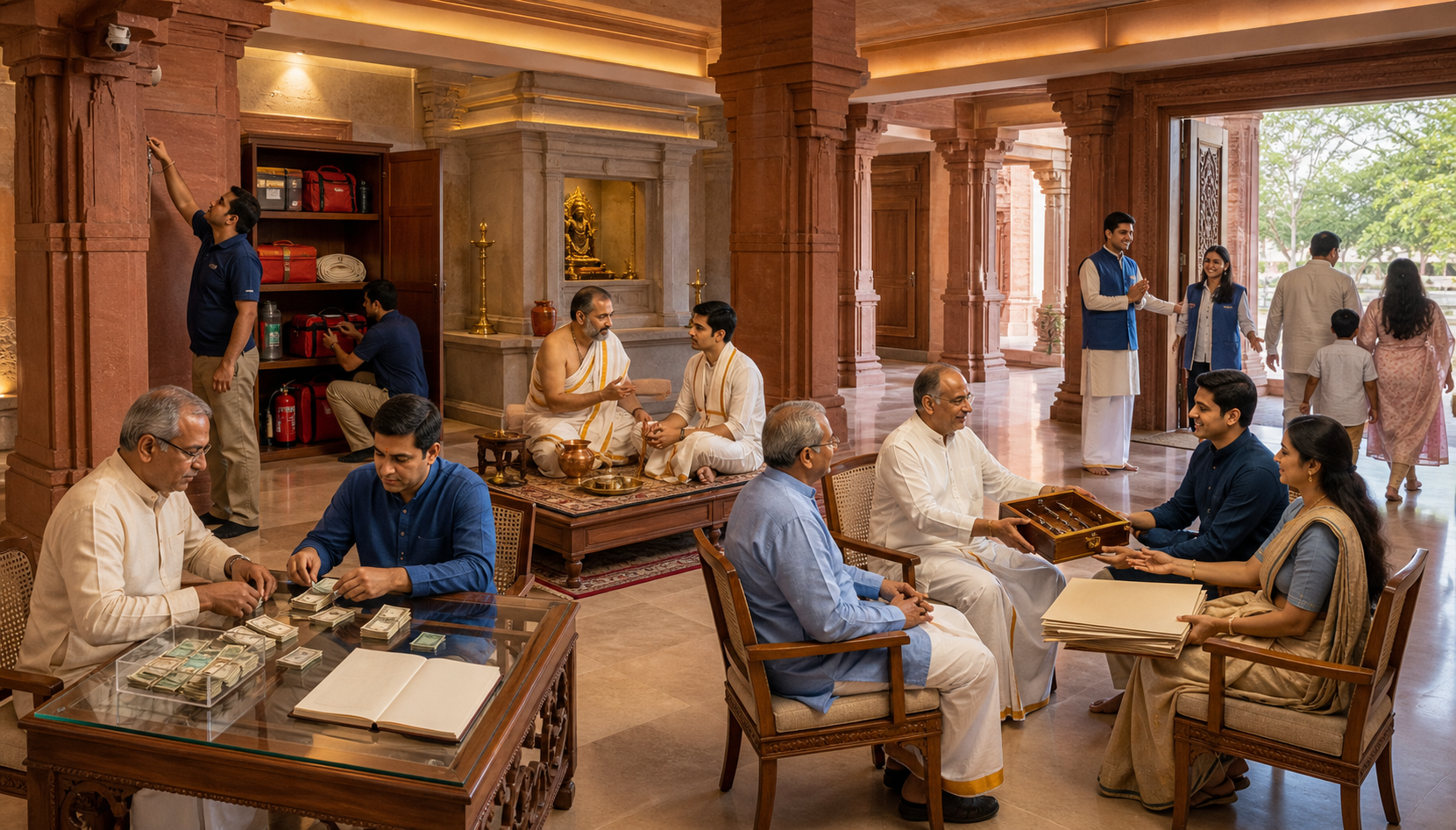
Institutional resilience is the ability to continue worship, service, stewardship, and lawful governance when ordinary conditions break down. It depends less on a grand headquarters than on five systems working together.
1. Institutional memory
Create a register for immovable property, buildings, sacred objects, ornaments, vessels, manuscripts, equipment, insurance policies, major contracts, and official accounts. For each item, record its identity, location, condition, responsible custodian, supporting document, and any ritual or access restriction. Sensitive details should be visible only to authorized people, but they should not exist solely in one person’s possession.
Land records need particular care. Title documents, cadastral identifiers, mutation entries, historical grants, and relevant revenue or municipal records should be reconciled and securely preserved. Digitized and, where feasible, geo-referenced records can make encroachment or ownership problems easier to identify. They do not replace legally valid originals or professional title review.
Record knowledge as well as property. Festival sequences, local ritual variations, supplier contacts, conservation history, emergency contacts, and lessons from previous events should be part of the handover archive. Documentation should preserve the local sampradaya, not flatten legitimate variation into a universal manual.
2. Financial integrity
Use double-entry accounting, written donation policies, real-time receipts for digital payments, controlled access to financial systems, and annual statutory audits. Distinguish routine operating money from restricted donations and funds reserved for major works. Publish enough information for devotees to understand how resources are governed without exposing donor data or security-sensitive details.
Insurance should follow a documented risk review rather than a generic purchase. Structure, liability, valuable objects in custody, and major events present different exposures. Investment of a corpus, acceptance of foreign contributions, and treatment of restricted funds require policies aligned with applicable law and qualified financial advice.
3. Safety and continuity
Map the hazards relevant to the site: fire, flood, earthquake, structural weakness, crowd surge, electrical failure, food contamination, and loss of communications. Mark evacuation routes, establish first-aid arrangements, assign emergency roles, and maintain current contacts for police, fire, health services, and local administration.
Festival plans should specify routes, access zones, barriers, public announcements, surge staffing, and the person authorized to make time-sensitive decisions. Women, children, older devotees, and people with disabilities need to be considered during route and queue planning, not added as an afterthought. Conduct drills with the outside agencies expected to respond; an untested plan is still only a document.
4. Heritage care
Begin with condition mapping. Record cracks, water ingress, biological growth, corrosion, surface loss, and previous repairs before authorizing treatment. Historic stone, murals, metals, manuscripts, and traditional masonry require compatible methods; harsh cleaning chemicals or inappropriate modern materials can cause irreversible damage.
Use qualified conservation expertise for consequential interventions. Where ritual permissions allow, high-resolution photography and three-dimensional documentation can establish provenance and provide a recovery baseline if an object is stolen, damaged, or displaced. Documentation complements physical security; it does not substitute for controlled access, inventories, alarms, and responsible custody.
5. Secure digital operations
A role-based management system can connect donations, inventory, volunteers, events, queues, and audit logs. Give each person only the access required for the role. Use multi-factor authentication, timely security updates, encrypted backups, and a tested recovery procedure. Keep an offline copy of information needed during a network outage or cyber incident.
Official websites and messaging channels should publish schedules, closures, accessibility information, donation methods, and emergency updates. Work toward WCAG 2.1 accessibility for web content. CCTV and crowd-monitoring data require written retention periods, restricted access, and audit trails so that safety measures do not become uncontrolled surveillance of devotees.
Use a one-year path from goodwill to resilience

You do not need to repair every weakness at once. Sequence the work so that the institution first knows who is responsible, then controls its largest risks, and finally builds repeatable cooperation.
During the first 90 days
- Form a local working group that includes religious functionaries, administrators, volunteers, and community representatives.
- Approve the minimum unity charter, a role map, conflict-of-interest rules, and a grievance route.
- Open or update the asset, property, contract, and emergency-contact registers.
- Complete a basic safety and governance audit, then rank the unresolved risks by potential harm and urgency.
- Create a mutual-aid contact tree showing which nearby institution can provide people, equipment, space, or expertise during a disruption.
By 180 days
- Train the people assigned to finance, crowd management, first aid, heritage records, communications, and complaint handling.
- Test standard operating procedures during an actual program or a controlled drill.
- Improve donor receipts, financial reporting, access controls, and audit follow-up.
- Pilot one digital function, such as inventory, volunteer scheduling, donations, or event communication, instead of attempting a complete system change at once.
- Establish a recurring mixed-team seva activity and review participation across social groups.
Within one year
- Complete the initial heritage documentation baseline and reconcile priority land records.
- Review insurance coverage against the risk register.
- Conduct an inter-agency emergency drill and close the most serious weaknesses it reveals.
- Formalize voluntary cooperation protocols with neighboring Dharmic institutions while preserving doctrinal and ritual autonomy.
- Publish a stewardship report covering governance, finances, participation, safety, heritage work, and unresolved risks.
This 90-day, 180-day, and one-year sequence makes progress visible without confusing activity with resilience. Assign an owner and a review date to every commitment. Otherwise, the roadmap becomes another declaration.
Keep the dashboard small enough to govern. Useful indicators include audit findings closed on time, high-risk asset problems addressed, volunteer training completed, festival incidents and near misses reported, heritage items documented, representation across community groups, participant satisfaction, and water or energy use. Do not reward silence by measuring only incident-free days; track whether people report problems and whether the institution closes them.
Key takeaways
- Define Dharmic unity as cooperation on shared duties, never as the erasure of distinct doctrines or rituals.
- Give a federation responsibility for standards, training, and mutual aid while member institutions retain local authority.
- Use recurring, mixed-team seva with rotating roles to turn social contact into durable trust.
- Protect institutional memory through registers, succession files, secure records, and documented operating procedures.
- Measure inclusion, safety, stewardship, and problem closure, then publish enough information to make accountability real.
At your next meeting, place three items on the table: a one-page charter, an initial risk register, and one recurring seva project with mixed participation. Give each an owner. That is a modest beginning, but it changes unity from something people are asked to proclaim into something their institutions are equipped to practice.
References
- Hindu Jagruti Samiti – Beyond Caste: A Powerful Call for Dharmic Unity at Navi Sangvi’s Virat Hindu Sammelan
- Hindu Jagruti Samiti – Unite to Safeguard Temples: Mandir Mahasangh’s Blueprint for Priests and Dharmic Unity