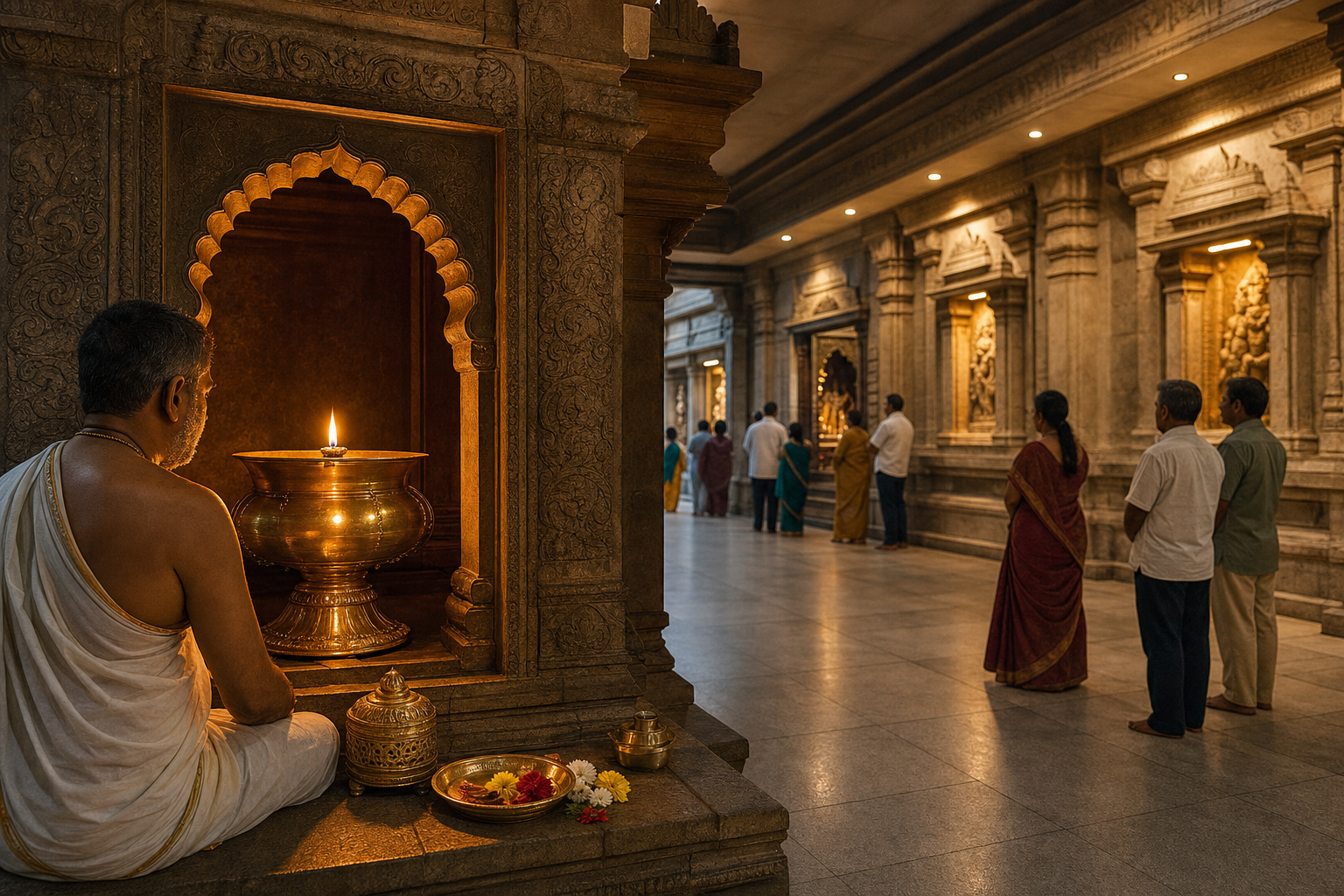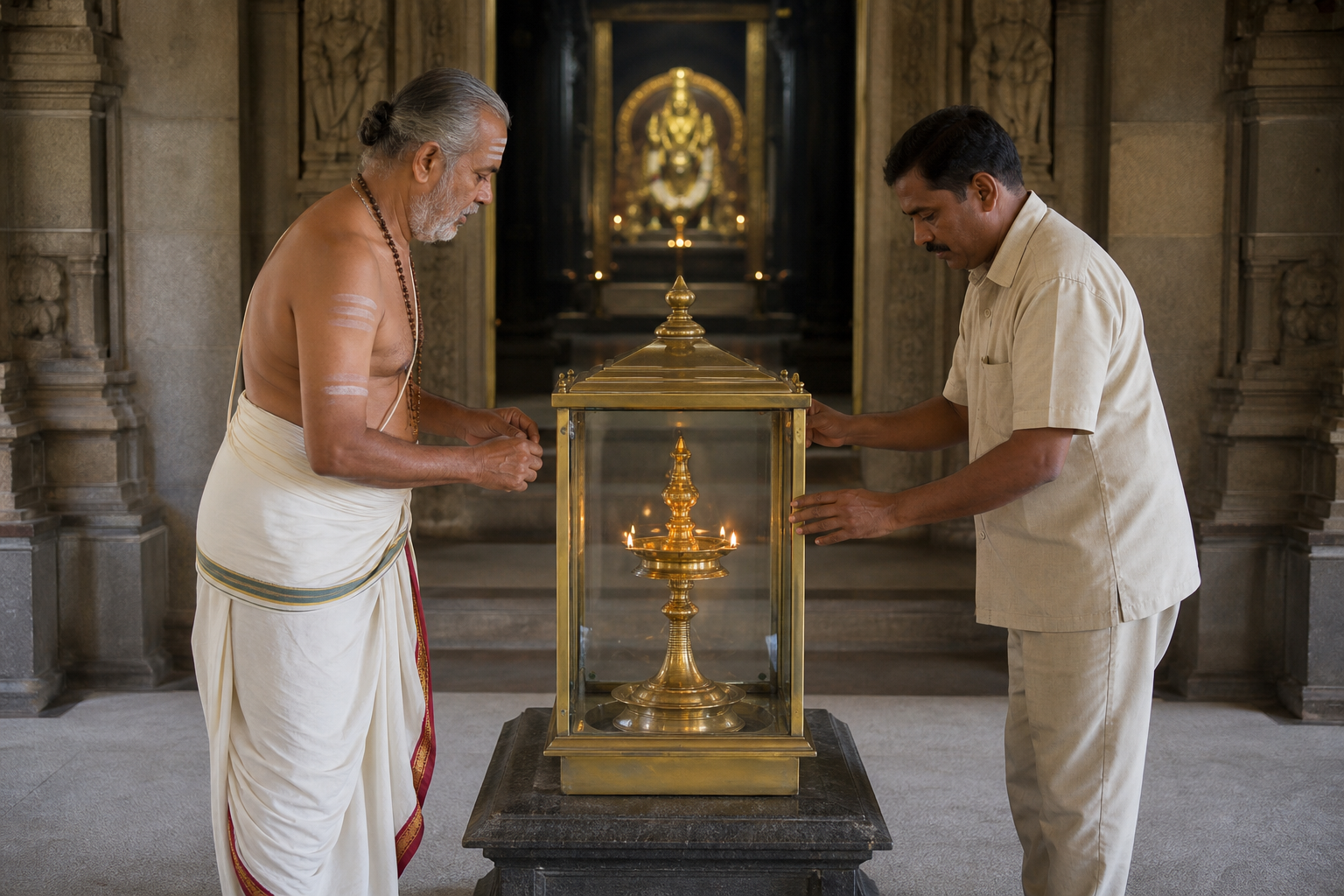
If you help manage a temple, you may be facing a difficult question: how do you keep an Akhand Jyoti genuinely akhand without exposing devotees, sevaks, the murti, or the sanctum to preventable harm?
The answer is not to pretend that a living flame carries no risk. Nor is it to replace Agni with an electric imitation and retain the sacred name. A better approach protects three things together: the ritual identity of the jyoti, the continuity of its seva, and the physical safety of the temple. The protocol below gives trustees, archakas, sevaks, facilities teams, and conservation professionals a practical way to do that.
First decide what must never be substituted
The first safeguard is conceptual clarity. In the Vedic and Agamic understanding, Agni is not simply a source of light. Agni serves as Devata, witness, messenger, and purifier. Where a temple’s paddhati establishes an Akhand Jyoti, its identity rests on a continuously served living flame. An LED diya may provide visibility, guide a crowd, or create a devotional atmosphere, but it does not acquire the ritual function of a ghee-fed sacred flame merely because it is shaped like one.
This distinction should be settled before engineers, vendors, or communications teams enter the discussion. The chief archaka or other competent ritual authority must first define the temple’s requirements according to its sampradaya, Agama, and established paddhati. A facilities team can then design around those requirements. It should not quietly redefine them.
| Question | Ritual Akhand Jyoti | Auxiliary lamp |
|---|---|---|
| Primary purpose | Ritual presence, offering, and continuity | Visibility, decoration, crowd guidance, or emergency support |
| Form of light | A living flame maintained under the temple’s paddhati | Usually electric, battery-powered, or otherwise non-ritual |
| Governing authority | Temple ritual authority | Facilities, electrical, design, or visitor-management team |
| Continuity | A defined ritual obligation | An operational requirement only |
| Public description | Identify explicitly as the temple’s Akhand Jyoti | Label as decorative, functional, or emergency lighting |
Turn that distinction into a short ritual charter. It should answer five questions:
- Which flame is the temple’s ritually established Akhand Jyoti, and in what sacred zone does it reside?
- Which fuel, wick, vessel, method of replenishment, and forms of handling are authorized by the temple’s paddhati?
- Who may tend, move, relight, or otherwise intervene in the jyoti?
- What ritual procedure applies if continuity is interrupted by accident or emergency?
- Which nearby lamps are merely decorative or functional, and how will the temple prevent them from being mistaken for the sacred jyoti?
Do not copy these answers from another mandir. A sound safety system can be standardized in many respects, but ritual particulars belong to the temple’s own tradition and competent authorities. Once those particulars are written down, every later decision has a stable boundary.
Build a safety envelope around the living flame
An Akhand Jyoti should be treated as both a sacred presence and a continuously operating combustion system. The National Building Code of India 2016, Part 4: Fire and Life Safety, together with applicable state fire rules, provides the modern safety baseline for high-occupancy premises. Ritual importance does not remove the need for risk assessment, flame control, monitoring, and an emergency response plan. It makes disciplined protection more important.
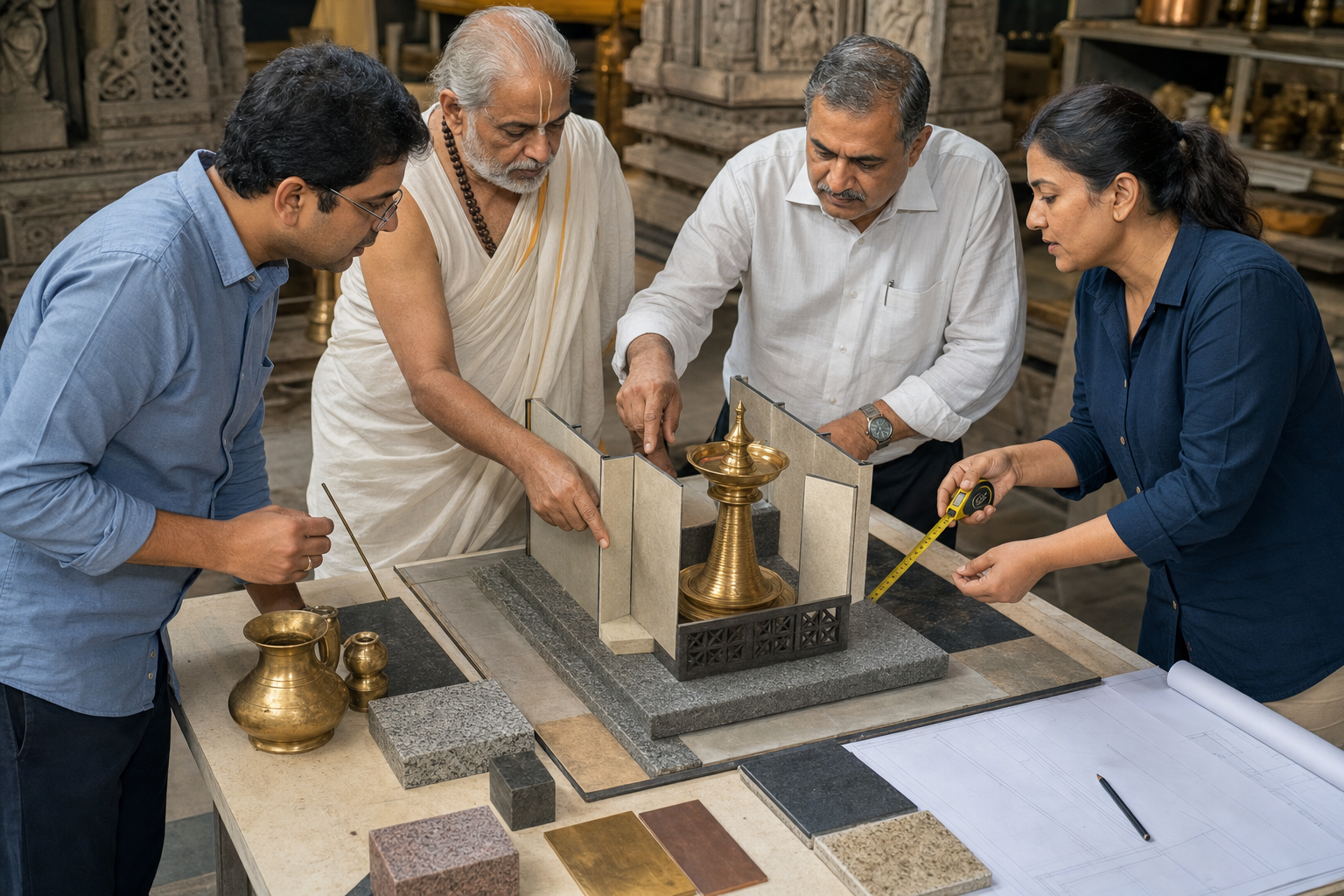
The following points are a design brief, not a do-it-yourself engineering specification. The final assembly and response plan should be reviewed at the actual site by the temple’s ritual authority and a qualified fire-safety professional familiar with the applicable local rules.
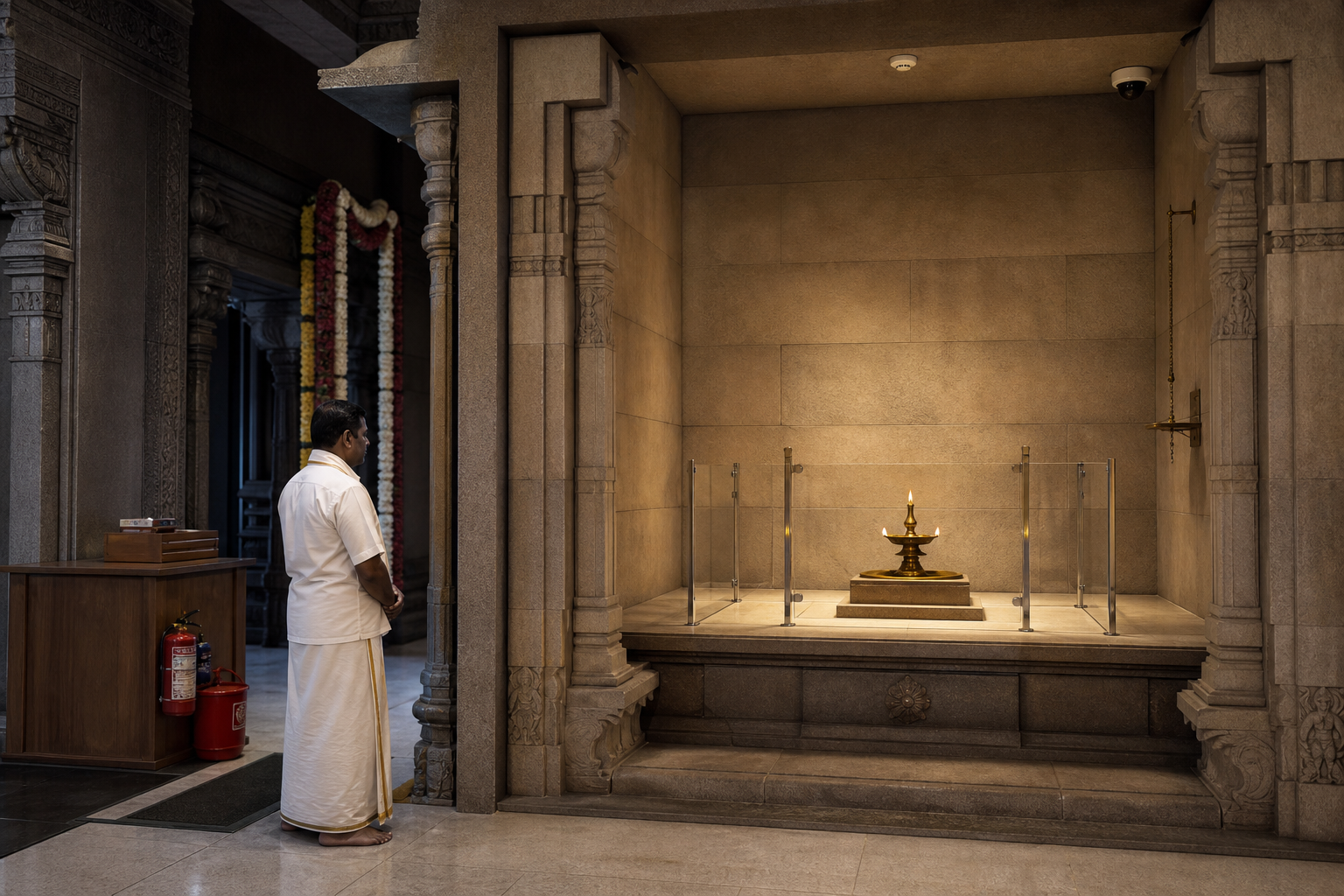
- Start with a stable vessel. A heavy-gauge brass or panchaloha deepa with a broad, stable base is less vulnerable to casual movement than a light decorative lamp. Its size, metal, and form must also satisfy the temple’s ritual requirements.
- Add secondary containment. Place the deepa within a shallow, metal-lined containment plinth capable of catching normal overflow or a displaced wick. The containment element should be visually subordinate to the sacred lamp, accessible for cleaning, and unable to become a trip or snag hazard.
- Buffer drafts without sealing the flame. A clear, high-temperature glass shield can reduce exposure to sudden air movement and accidental contact while leaving the flame visible. It must not create an airtight enclosure. A living flame needs adequate oxygen, and poor airflow can worsen incomplete combustion and soot.
- Map everything that can move toward the flame. Garlands, vastra, curtains, temporary festival decorations, loose cotton, offering trays, electrical cables, and the clothing of priests or devotees all deserve attention. Assess the lamp under actual ritual and crowd conditions, not only when the sanctum is empty.
- Protect movement and escape routes. No lamp assembly, fuel container, barrier, or queue arrangement should obstruct egress. Crowd pressure can turn a manageable flame into a larger hazard if people cannot move away from it.
- Detect trouble early. Discreet aspirating smoke detection may be appropriate where conventional devices would be visually intrusive. A qualified designer must account for the smoke and vapour produced during normal worship so that the system remains useful rather than generating routine false alarms.
- Select suppression for the real environment. A suitable non-water clean-agent extinguisher may reduce damage to sacred objects and heritage surfaces, but the agent, capacity, placement, and training cannot be chosen by guesswork. A fire-safety professional should specify equipment compatible with the hazard, local rules, occupancy, and conservation needs.
- Write the response before an incident. The plan should identify who raises the alarm, who directs evacuation, which trained person may attempt an initial response, and when everyone must withdraw. No sevak should have to invent a choice between ritual respect and life safety while a fire is spreading.
Pay particular attention to modifications made for festivals. A flame that is adequately separated from the ordinary shringar may become unsafe when additional fabric, flowers, wood, temporary wiring, or crowd-control structures are introduced. Include the jyoti in the approval of every temporary decoration near the sanctum.
Make continuity a documented seva, not an assumption
The word akhand describes the required continuity of the flame. It does not create a staffing system. Continuity depends on named people, reliable handovers, sufficient fuel, observation, and a response to abnormalities. If any one of those is left informal, the temple is relying on memory at precisely the place where memory is most likely to fail: shift changes, quiet hours, festivals, and unexpected absences.
Create a seva rota with an incoming and outgoing custodian for every handover. Set inspection and replenishment intervals only after observing the tested lamp assembly’s fuel consumption under supervised operating conditions. Do not copy a time interval from another vessel: fuel volume, wick geometry, airflow, and local conditions can change the burn rate.
Each handover record should capture:
- Date and time of the observation.
- Name of the outgoing and incoming sevak.
- Flame condition and approximate fuel status.
- Any ghee replenishment or wick trimming performed.
- Condition of the vessel, base, containment plinth, and glass shield.
- Any spill, unusual flame behaviour, accelerated soot, odour, smoke, or draft.
- Availability of the approved fuel and service tools.
- Any deviation escalated to the ritual, safety, or conservation lead.
The log is not a substitute for attentive seva. It makes that seva auditable and allows patterns to emerge. Repeated soot after one shift, faster consumption following a wick change, or recurring drafts after a door is opened are operational clues. Without a record, each incident appears isolated.
Store reserve ghee and service materials in the manner approved by the fire plan, away from accidental contact with the flame. Keep the immediate work area uncluttered. Train authorized sevaks in both the ritual method and the physical controls; a person who understands only one side of the responsibility can inadvertently compromise the other.
The temple also needs an interruption protocol approved in advance by its ritual authority. If the flame is extinguished, staff should record what happened, remove any continuing hazard, and follow the prescribed ritual process. Concealing an interruption protects neither ritual integrity nor institutional trust. An honest, established recovery procedure is stronger than an improvised claim of continuity.
Control soot without erasing the experience of darshan
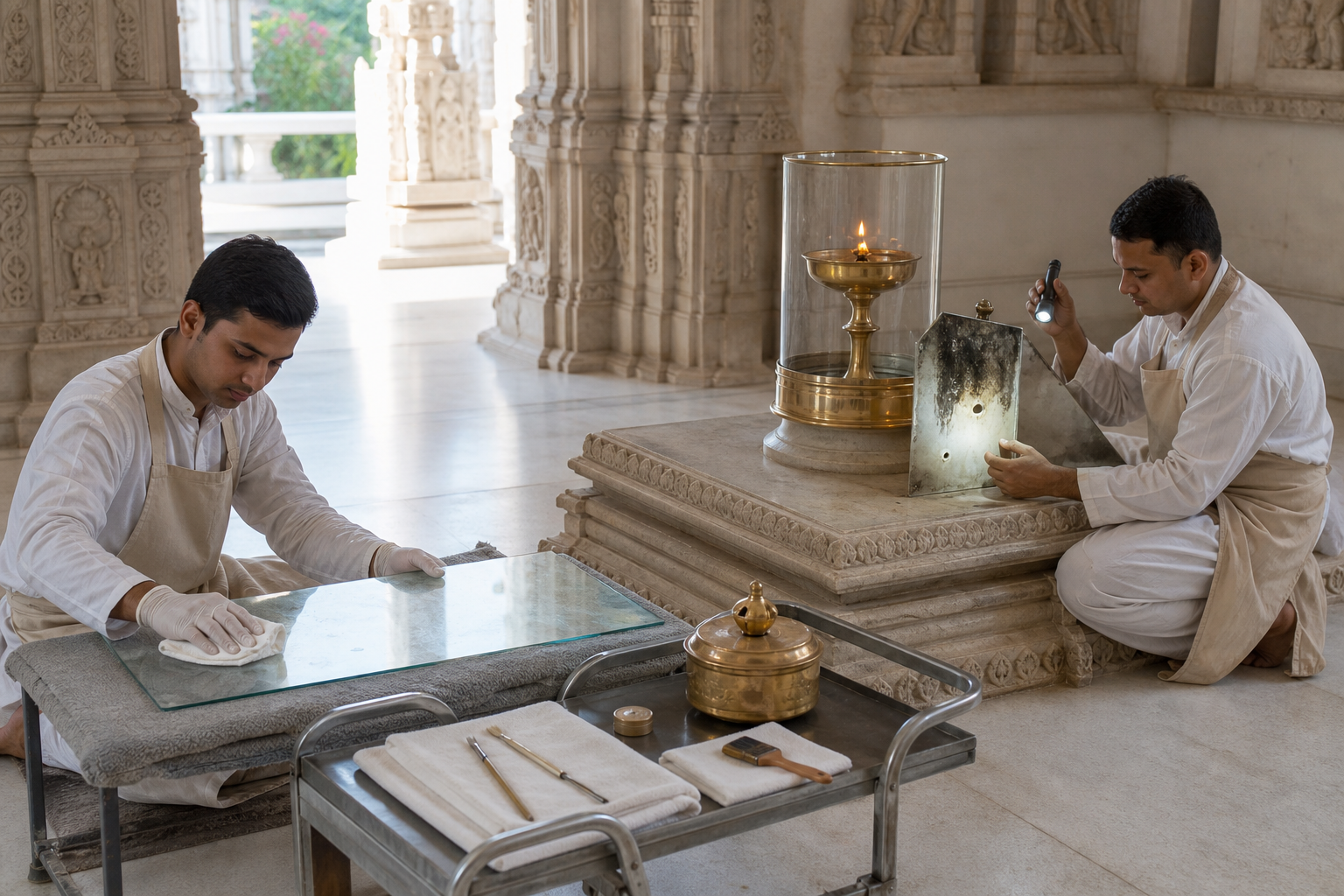
Soot is not merely a housekeeping issue. In a confined garbha gruha, carbon deposits can accumulate on stone, metal, painted surfaces, shringar, and nearby sacred objects. Darkening around the lamp can also reveal poor combustion, an unsuitable wick, disturbed airflow, or a change in fuel quality.
The objective is not to sterilize the sanctum until the warmth, fragrance, and visible life of the jyoti disappear. Those sensory qualities are part of how many devotees remember and experience darshan. The objective is to keep the real flame while preventing avoidable damage.
- Establish a visual baseline. Before commissioning or changing the lamp system, document the clean condition of the vessel, shield, plinth, and nearby surfaces. Future observations can then be compared with something more reliable than memory.
- Use consistent, suitable ghee. Unexplained changes in fuel can alter flame behaviour and deposition. Procurement and storage should therefore be controlled rather than left to last-minute substitution.
- Tune the wick deliberately. Wick geometry affects the flame and soot load. Only trained, authorized sevaks should trim or reposition it, and any change should be entered in the log.
- Manage air at the scale of the lamp. Thoughtful micro-ventilation can carry combustion products away from vulnerable surfaces. Excessive airflow, however, can make the flame unstable. Ventilation should be designed around both combustion and the sanctum’s fabric.
- Watch the path of heat and smoke. The lamp should not discharge directly toward a murti, painted ceiling, textile canopy, garland, or frequently handled sacred surface.
- Use conservation-grade cleaning. Do not ask general staff to scrub stone, polish historic metal, or wipe painted and ornamented surfaces with an improvised chemical. Minimally invasive treatment should be selected by a conservation professional who understands the material being cleaned.
- Review every material change. A different vessel, shield, wick, ghee, door position, ventilation setting, or festival arrangement can alter combustion. Treat it as a change to the system, not a cosmetic adjustment.
If deposits begin increasing, do not jump directly to an artificial lamp. First inspect fuel consistency, wick shape, oxygen supply, drafts, shield geometry, and smoke movement. Often the practical choice is not between ritual authenticity and preservation, but between an unmanaged flame and a well-managed one.
Make the temple’s policy visible to devotees
A temple can maintain the correct ritual internally and still lose public trust if devotees cannot distinguish the sacred flame from nearby electric fixtures. Social-media images flatten location, purpose, scale, and context. A flame-shaped plastic light photographed without explanation can easily be interpreted as a replacement for Agni.
The debate surrounding lighting at the Shri Ram Janmabhoomi Mandir demonstrates this communication risk. Shri Ram Janmabhoomi Teerth Kshetra stated that a sacred jyoti had been installed after prescribed pujan at the place where the movable vigrah had previously stood. Yet uncertainty about what viewers were seeing allowed ritual questions, decorative lighting, and procurement concerns to merge into a single controversy.
Explain the arrangement before an ambiguous image circulates. A short public note can state:
- What the temple recognizes as its Akhand Jyoti.
- That it is a living flame, if that is the temple’s established practice.
- The broad sacred area in which it is maintained, without publishing sensitive operational details.
- That electric or battery lamps elsewhere are decorative, functional, or used for visitor safety.
- Which temple office is responsible for ritual maintenance and which team oversees fire and conservation controls.
- How devotees can verify future announcements or raise a genuine concern.
Use the same vocabulary on signs, websites, media statements, vendor briefs, and staff instructions. If every flame-shaped fixture is casually called an Akhand Jyoti, confusion is being created by the institution itself.
Procurement needs the same clarity. Country of manufacture, ritual function, and physical safety are separate questions. A locally made LED remains auxiliary lighting; it does not become Agni through a swadeshi label. At the same time, choosing high-quality Bharatiya craftsmanship for both ritual vessels and auxiliary fixtures supports local skill, improves repairability, and better reflects the cultural setting. Metalworking traditions such as those associated with Moradabad, along with established sthapati traditions in southern Bharat, can be approached with a demanding technical brief rather than a purely ornamental request.
A procurement brief should specify the intended ritual or non-ritual role, acceptable materials, heat tolerance, structural stability, absence of unsuitable plastics near heat, cleanability, repairability, availability of parts, and the sign-offs required before installation. Inspect the delivered item against that brief. A decorative prototype should never drift into ritual use simply because it has already been purchased.
Key takeaways
- An Akhand Jyoti and an electric diya belong to different categories. Define and label them separately.
- Let the temple’s ritual authority establish the non-negotiables before the safety system is designed.
- Use a stable metal deepa, secondary containment, controlled airflow, monitoring, and professionally selected fire protection.
- Support continuity with named custodians, tested service intervals, recorded handovers, and an approved interruption procedure.
- Treat soot as operational evidence. Control fuel, wick geometry, airflow, smoke movement, and conservation cleaning.
- Publish a simple policy so devotees do not have to infer ritual practice from a photograph of an unfamiliar fixture.
Before the next major festival or change to the sanctum, bring the chief archaka, seva coordinator, qualified fire-safety professional, and conservation adviser to the actual lamp location. Leave that review with three approved documents: the ritual charter, the safety and emergency plan, and the seva and maintenance record. That is how you keep the jyoti living, the temple trustworthy, and the sacred space ready to carry Dharma forward.