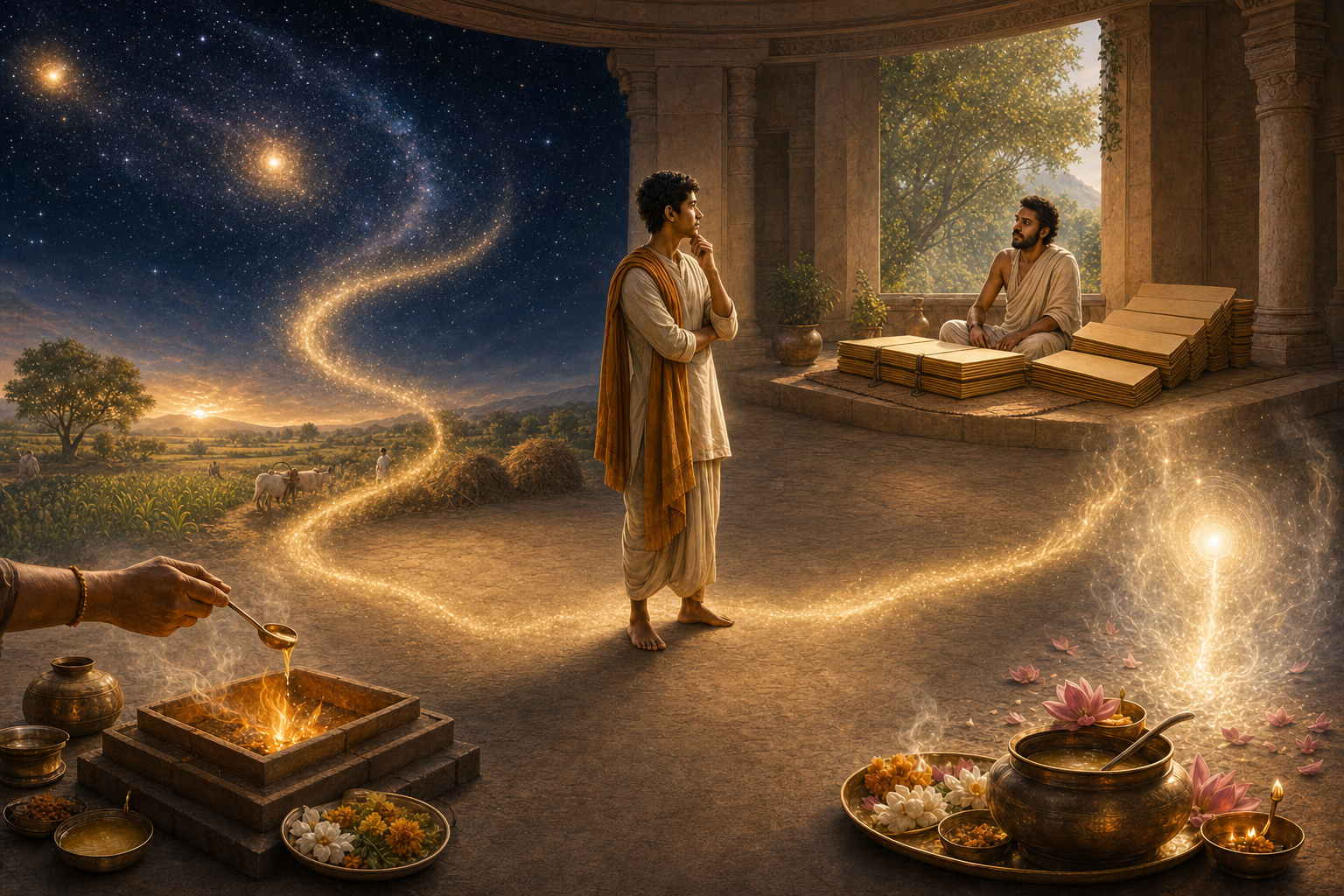
If you have been told that Mimamsa is simply "atheistic," you may be wondering how a Hindu darshana can take Vedic ritual, mantras, and devatas seriously while declining to make God the creator of the world, author of the Veda, or judge of karma.
The confusion clears once you stop treating belief in Ishwara as a single yes-or-no question. Mimamsa separates several jobs that people commonly assign to God. It then asks which of those jobs are actually necessary to establish dharma, interpret the Veda, and explain the fruit of ritual action. That distinction gives you a more accurate way to understand both Mimamsa and your own place within a devotional Hindu tradition.
Ask what explanatory job Ishwara is being asked to do
The broad question "Does Mimamsa believe in God?" compresses several different questions into one. Is Ishwara the creator of the cosmos? Is Ishwara the author of the Veda? Is Ishwara required to make Vedic words authoritative? Does Ishwara personally distribute karmic fruits? Is Ishwara or a devata addressed in worship? Mimamsa does not give the same answer to every one of these questions.
Jaimini begins with athato dharma-jijnasa, an inquiry into dharma, and defines dharma through codana, or scriptural injunction. This establishes the practical center of the system: Mimamsa first asks what the Veda directs you to do, how that direction is known, and what result is connected with the prescribed act. A theology is relevant when it helps answer those questions, but it is not allowed to replace the close interpretation of the Vedic sentence.
Two commitments allow Mimamsa to defend Vedic authority without appealing to a divine author. The Veda is apaurusheya, meaning that it is not the composition of a person. Verbal testimony, or shabda, is also a genuine means of knowledge, with Vedic testimony possessing its own distinctive authority. The Veda therefore does not need Ishwara to write it, certify it, or rescue it from the limitations of an author.
This is more than a technical claim about authorship. If a text were authoritative because a person composed it, you would have to establish that person’s knowledge, truthfulness, and freedom from error. By treating the Veda as unauthored, Mimamsa avoids transferring the entire problem of scriptural authority to a claim about the perfection of an author. The work of interpretation remains with grammar, context, sentence function, and the relation between a command and the act it enjoins.
- Ask whether the dispute concerns creation. Classical Mimamsa does not require a creator-God to explain a beginningless, ordered cosmos.
- Ask whether it concerns the Veda. The Veda’s authority does not depend on divine authorship.
- Ask whether it concerns karmic fruits. Mimamsa can explain the connection between action and delayed result through an unseen causal link rather than a divine administrator.
- Ask whether it concerns worship. Mantras address devatas, and deities retain meaningful roles within ritual language and performance.
- Ask which Mimamsa thinker is under discussion. Some later thinkers allow Ishwara as karmaphaladata, the giver of karmic fruits, while still refusing to make Ishwara the author of the Veda.
This checklist prevents the most common mistake: turning a refusal to use Ishwara for one explanatory purpose into a denial of every form of divine reality or worship. Mimamsa is methodologically non-theistic where an appeal to God is unnecessary. That is not the same thing as modern materialism, hostility to worship, or a declaration that sacred language is empty.
How karma reaches a delayed fruit without a divine judge
The hardest part of the Mimamsa position is not its account of scripture. It is the gap between an action performed now and a fruit that may arise later. A sacrifice ends. Its visible materials are consumed or dispersed. Yet the Veda connects that completed act with a result such as svarga. What carries the causal force across the interval?
Mimamsa answers with apurva, an unseen potency generated by the properly performed act. The related language of adrishta, the unseen, helps identify a causal connection that is not available to ordinary perception. The ritual does not need to remain physically in progress until its fruit appears. Nor must a divine being watch the ceremony, record its merit, and decide when to issue the reward. The act produces an unseen efficacy that mediates between performance and fruition.
- A Vedic injunction connects a specified act with a specified result.
- The act is performed as enjoined.
- The completed act generates apurva, an unseen causal potency.
- That potency accounts for the otherwise unexplained connection between the finished act and its later fruit.
You should not picture apurva as a physical substance waiting to be detected. It is a philosophical explanation of how an enjoined action remains causally significant after its visible performance has ended. Its role is precise: it bridges action and delayed result while preserving the reliability of the Vedic prescription.
This account also changes how you should hear the word karma. Karma is not merely fate, and it is not necessarily a record maintained by a cosmic personality. In the Mimamsa framework, action has consequences because dharma and ritual causality possess an ordered, law-like structure. The regularity does not become meaningless merely because it is not administered as a personal judgment.
That point marks a real disagreement with Nyaya-Vaisheshika. Nyaya argues that cosmic order, scriptural authority, and the distribution of karmic fruits support the existence of an intelligent Ishwara. Mimamsa replies that these tasks are already covered: the Veda is apaurusheya, verbal testimony supplies knowledge, and apurva or adrishta connects action with result. The disagreement is therefore not simply between belief and unbelief. It concerns which explanations are necessary and which introduce an additional entity without solving an unresolved problem.
When you encounter the claim that karma must imply a divine rewarder, ask one exact question: what part of the causal sequence cannot operate without that rewarder? A Naiyayika and a Mimamsaka will answer differently. Naming that disagreement is more honest than pretending all Hindu schools share one theory of karmic governance.
Read ritual as a structured act, not a magical transaction
Mimamsa does not treat ritual as an improvised exchange in which a worshipper flatters a deity and requests a favor. It reads ritual through the architecture of Vedic language. Different sentences do different kinds of work, and a passage can be misunderstood when praise, invocation, prohibition, naming, and command are treated as interchangeable.
| Vedic category | Primary interpretive role | Question to ask while reading |
|---|---|---|
| Vidhi | Injunction directing an act | What is the performer being told to do? |
| Nishedha | Prohibition | What action is being excluded? |
| Arthavada | Praise, blame, or explanation supporting an injunction | How does this language encourage or discourage the relevant act? |
| Mantra | Sacred formula used within ritual performance | Which devata, action, or ritual element does the formula bring into focus? |
| Namadheya | Nomenclature or naming | What ritual item, act, or category is being identified? |
This classification matters especially when a passage praises a devata. Mimamsa often reads such praise as arthavada: language that supports and motivates the enjoined act. That does not make the praise false or the devata irrelevant. It means the passage’s interpretive function must be established before it is turned into an independent claim about the structure of the entire cosmos.
Two opposite errors follow from ignoring this distinction. One error reduces the ritual to lifeless mechanics, as though mantras and devatas were disposable decorations around an action. The other takes every expression of praise as a self-contained metaphysical definition. Mimamsa avoids both by asking how every sentence functions inside the ritual whole.
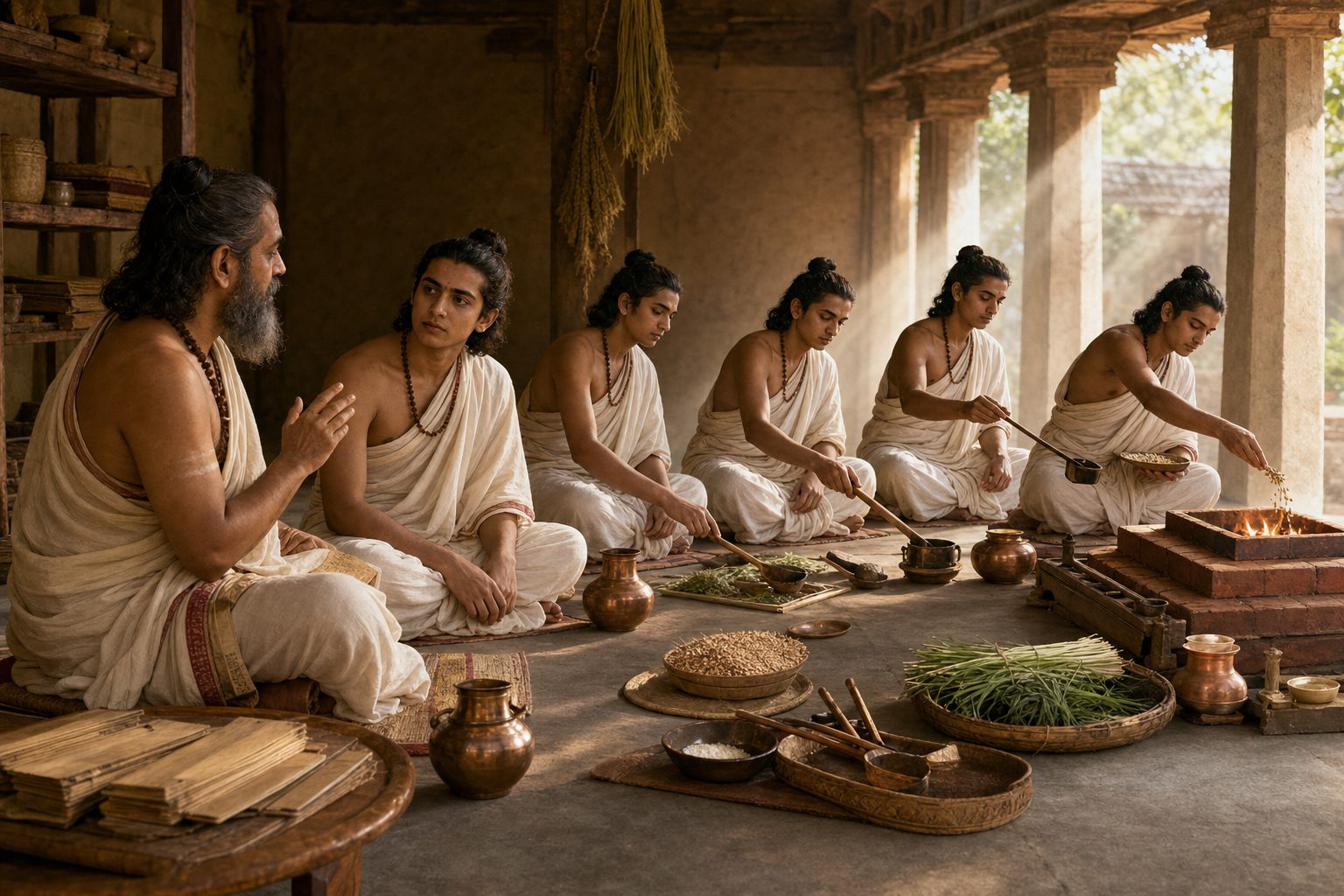
You can apply that discipline in three passes. First, locate the injunction or prohibition and state the required action as precisely as the language permits. Second, identify the surrounding praise, blame, naming, and explanation, and relate each element to that action. Third, examine the mantra and devata within the performance rather than extracting them as isolated slogans. This will not turn a general reader into a ritual specialist, but it will stop the most basic category errors.
The same discipline should shape actual learning. A mantra detached from its injunction and ritual setting does not disclose the full act. If you are learning a Vedic rite, do not assemble it from isolated lines that happen to be available. Learn the sequence and its textual relations within a competent ritual tradition. Mimamsa’s central practical lesson is that precision belongs to dharma: the wording, function, and connection of the parts matter.
Devotion can remain without rewriting Mimamsa as theism
If you worship Ishwara, the Mimamsa position does not force you to abandon bhakti. It asks you to distinguish devotional commitment from a philosophical claim about what must explain Vedic authority. You may revere Ishwara while accepting that Mimamsa does not need divine authorship to validate the Veda. You may honor devatas while recognizing that ritual efficacy is explained through injunction, action, and apurva.
Deities are not absent from this world of practice. Mantras address them, rites are oriented toward them, and praise gives sacred and motivational force to performance. What Mimamsa resists is theological inflation: moving from the ritual relevance of a devata to the conclusion that a single supreme creator must author scripture, originate the cosmos, and personally distribute every karmic result.
Internal diversity requires care here. The Bhatta and Prabhakara streams disagree about aspects of knowledge, duty, and the means by which something absent or unseen is established. The Bhatta line accepts anupalabdhi, non-cognition, as an independent means of knowledge, while Prabhakaras generally account for absence through other means. Both make use of arthapatti, or presumption, in explaining what must be posited though it is not directly perceived. These differences show why "Mimamsa says" should not be used to conceal genuine school-level distinctions.
The same caution applies to Ishwara. Influential Mimamsakas maintain that a divine karmic administrator is unnecessary. Some later thinkers allow Ishwara to serve as karmaphaladata without conceding that God authored the Veda. If you read a theistic Mimamsaka, therefore, do not assume that every classical argument has been discarded. Ask exactly which role has been granted to Ishwara and which claims about Vedic independence remain intact.
Vedanta offers a natural point of synthesis, but not by erasing the distinction between the systems. Vedanta places Brahman and Ishwara at the center of its accounts of ultimate reality and liberation. At the same time, Vedantins rely heavily on Mimamsa’s tools for classifying scriptural sentences, reading context, and resolving apparent conflict. A Vedantin can therefore reject Mimamsa’s restraint about theology while still depending on its interpretive discipline.
For your own reading, keep the layers visible. Let Mimamsa ask what a sentence enjoins and how its parts work together. Let your Vedantic or other sampradaya explain Ishwara, the self, and liberation according to its own commitments. Do not make devotional theology a hidden premise in a Mimamsa argument that was designed to stand without it. But do not misuse Mimamsa’s method as a weapon for dismissing devotion either.
Keep pan-Dharmic comparisons precise
Mimamsa’s law-like account of action and consequence can help you notice family resemblances across Dharmic traditions. Jain thought also gives moral causality an ordered structure. Buddhist paths emphasize method, conduct, and the consequences of cultivated action. Sikh tradition gives sacred utterance and Hukam a central place through Shabad. These are useful parallels, not interchangeable doctrines.
The responsible comparison names the shared concern and preserves the different explanation. You can say that several Dharmic paths refuse to separate spiritual truth from disciplined action. You should not conclude that apurva, Jain karmic theory, Buddhist accounts of karma, and Hukam are different labels for one mechanism. Unity becomes stronger when it does not depend on flattening differences.
Key takeaways for your next reading of Mimamsa
- Replace "Does Mimamsa believe in God?" with separate questions about creation, Vedic authorship, karmic distribution, and ritual worship.
- Read the injunction before building theology from the praise surrounding it.
- Understand apurva as the unseen causal bridge between a completed ritual action and its delayed fruit, not as a personal divine verdict.
- Do not confuse the rejection of a necessary creator or scriptural author with the rejection of devatas, mantras, or sacred practice.
- When positions differ, identify the school or thinker and ask which specific function has been assigned to Ishwara.
- Use Mimamsa to discipline interpretation, even when your own sampradaya gives Ishwara a much more central metaphysical role.
The next time you meet a Vedic passage, mark five things before deciding what it means: the commanded or prohibited act, the supporting praise or blame, the mantra, the devata, and the promised fruit. Then ask what connects the act to that fruit. That small exercise will show you where Mimamsa’s argument begins, where theology may enter, and why the two need not be enemies.