If you know Purandara Dasa as the great teacher whose methods still shape Carnatic music, you may wonder what changed Srinivasa Nayaka, the hard merchant of devotional memory, into a dasa who placed his wealth, voice, and talent at the service of the divine.
The answer begins not with a composition or a guru’s discourse, but with Saraswati Bai making a costly decision inside her own home. Her role matters because the awakening did not arise from Srinivasa’s success. It began when her compassion exposed what his success could not measure.
The nose ring revealed two different measures of wealth
Srinivasa Nayaka belonged to a prosperous Karnataka household within the devotional and commercial world of the Vijayanagara Empire. Though raised amid family piety and temple worship, he is remembered as an exacting moneylender: skilled at protecting capital, strict in his dealings, and reluctant to let another person’s distress alter his calculations.
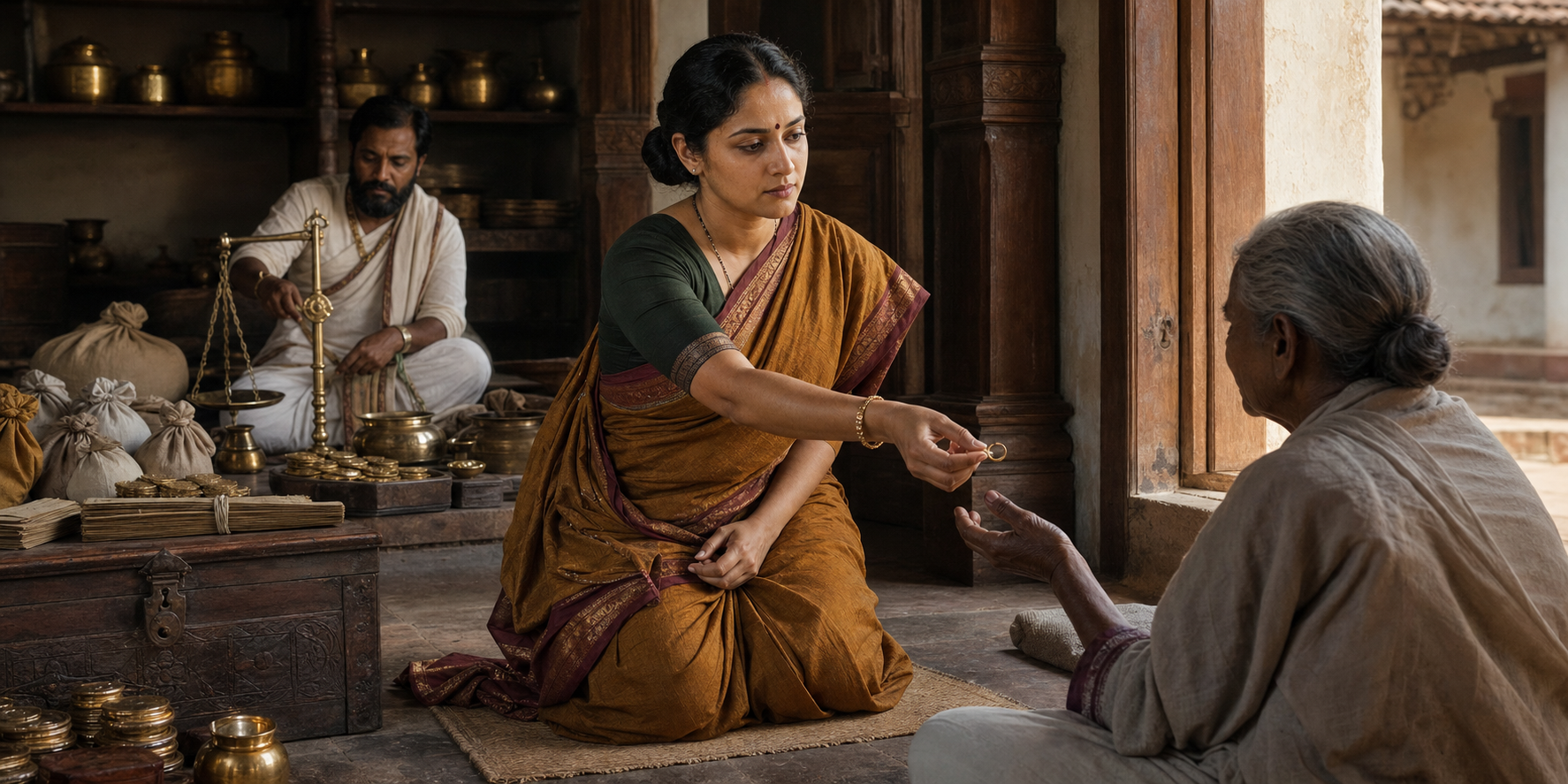
A poor Brahmin approached him for help with his son’s upanayana, the rite through which the child would enter a disciplined life of sacred learning. Srinivasa refused. The man then appealed to Saraswati Bai, who recognized both the religious purpose of the request and the family’s immediate need. She gave him her nose ring so that he could raise the required money.
The Brahmin unknowingly took the ornament to Srinivasa’s own establishment. Srinivasa recognized it, suspected that something had happened within his household, and ordered Saraswati Bai to produce the ring. She now faced an impossible demand: the ornament she had given away was being held by the very man asking her to show it.
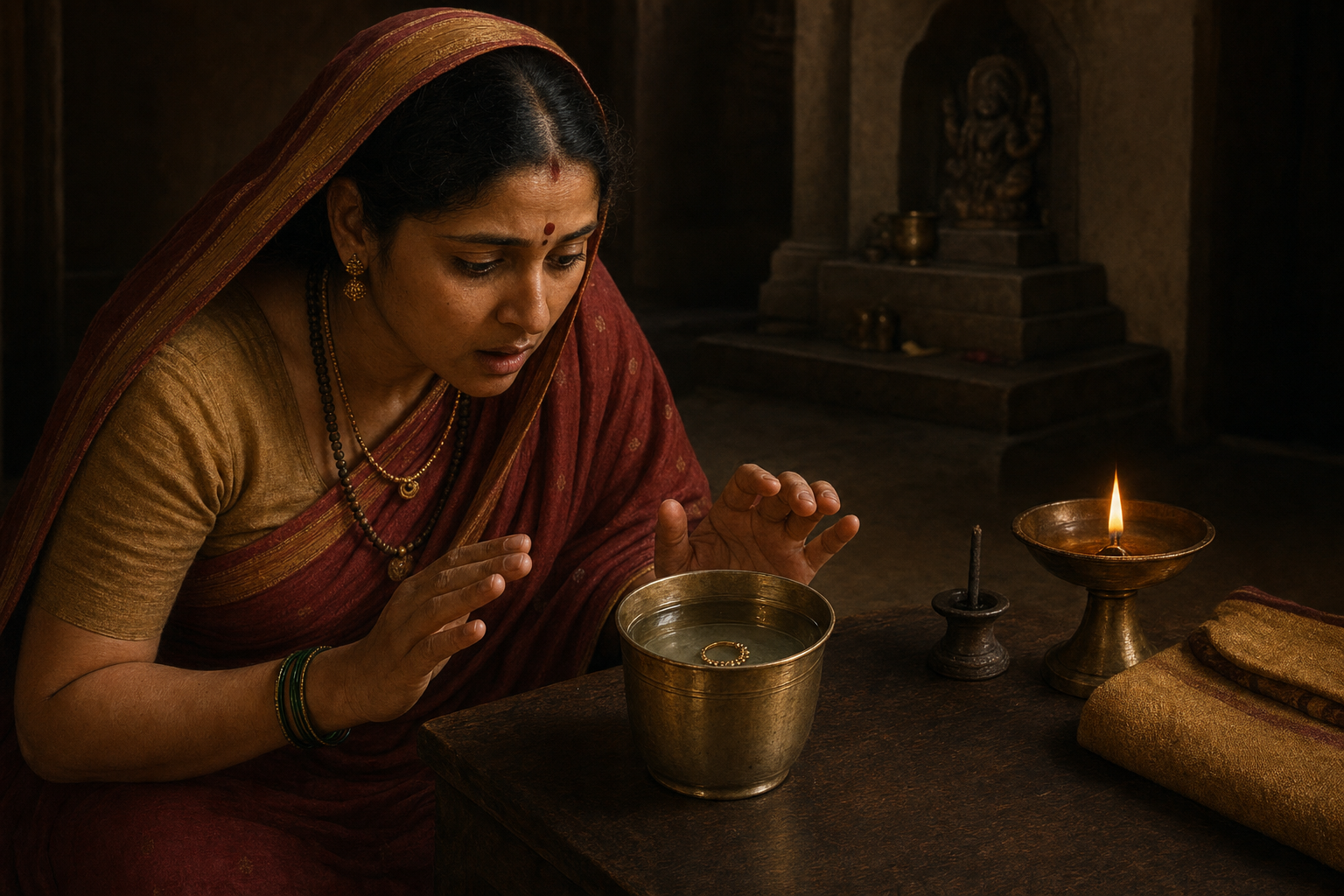
In the devotional telling, Saraswati Bai prayed in complete dependence on divine grace. A nose ring then appeared, allowing her to place it before her husband. When Srinivasa returned to inspect the ornament pledged at his shop, it had disappeared. The ring received from the Brahmin and the ring produced by Saraswati Bai were revealed as one.
That reversal breaks more than the logic of a transaction. Srinivasa had treated possession as the final proof of value: the ring was in his inventory, so it was under his control. Saraswati Bai had acted from another measure: property has a dharmic purpose, and human need can carry a claim that a ledger cannot express. His accounts could identify the owner of the gold. They could not tell him what the gold was for.
Saraswati Bai was the moral agent, not a supporting figure
It is easy to tell this story as though Saraswati Bai merely supplied the object through which a famous man received grace. That reading misses the decisive human action. The Brahmin’s need had already been presented to Srinivasa. He saw it and refused. Saraswati saw the same need and responded.
The nose ring intensified the meaning of her choice. It was not an impersonal coin taken from excess stock. Within the story, it was a form of stridhana and an intimate emblem of marital auspiciousness, dignity, and household prosperity. By giving it, Saraswati Bai placed compassion above the instinct to preserve a valued symbol at every cost.
Her act should not be reduced to impulsive generosity. She exercised discernment. The request concerned an upanayana, not an appetite for display; the person before her lacked the means to discharge an important religious responsibility; and she possessed something capable of meeting the need. Day-to-day dharma often appears in precisely this form: not as a grand declaration, but as the ability to recognize which claim upon us is morally serious.
Nor should the story be forced into a simple contest between husband and wife. Saraswati Bai did not seek victory over Srinivasa. Her compassion became the means by which he could see the poverty of his own moral arithmetic. She did not take his place or acquire his later musical achievements; she made his transformation possible by acting rightly before he was ready to do so.
This is one reason the household deserves a more serious place in our understanding of civilizational history. Temples, courts, teachers, and artistic lineages are visible institutions. Yet the disposition that sustains them is often formed in private decisions: whether a need is noticed, whether wealth is released, whether conscience survives convenience, and whether one family member’s clarity can awaken another. Saraswati Bai’s choice became consequential far beyond the room in which she made it.
How to read the miracle without losing its meaning
The nose-ring episode comes to us as hagiography: sacred memory organized around the making of a saint. That genre carries theological and ethical meaning through a life-changing event. It should neither be dismissed because it contains a miracle nor presented as though every narrative detail had been established by modern historical documentation.
The variations within the tradition are worth noticing. Some tellings direct Saraswati Bai’s prayer to Lord Venkateswara, others to Sri Krishna or Panduranga Vittala. The ring may appear in a vessel or arrive through another providential means. These differences counsel precision. You can affirm that the miracle is cherished within the devotional tradition without claiming that one surviving version settles every detail.
The stable structure matters more than the variable scenery. A person in need is refused. Saraswati Bai gives what is precious. Her decision creates a crisis that ordinary calculation cannot resolve. Divine grace vindicates compassion. Srinivasa recognizes the limit of the life he has built and changes its direction. Every element pushes toward the same dharmic judgment: artha is legitimate, but it must remain answerable to dharma.
If you receive the event as sacred history, the miracle reveals grace entering the material world and answering a devotee’s surrender. If you approach it through historical-critical reading, its narrative form preserves a community’s understanding of the moral rupture that made Srinivasa’s transformation intelligible. These readings ask different questions. Neither requires you to erase Saraswati Bai’s courage or the ethical demand carried by the story.
The least useful response is to become so preoccupied with the ring’s mechanics that the transformation becomes secondary. A miracle in Bhakti memory is not spiritual entertainment. Its credibility within the story is measured by its fruit. Srinivasa does not merely feel astonished; he relinquishes hoarded wealth, gives in charity, accepts spiritual discipline, and redirects his abilities toward devotion and service.
Purandara Dasa’s awakening became a method others could follow
After the awakening, Srinivasa did more than exchange commerce for private piety. In the remembered lineage, he became a disciple of the Madhva scholar-saint Vyasaraja, also known as Vyasa Tirtha. He received the devotional signature Purandara Vittala and used it in compositions offered to the Lord. The new name marked a new center of identity: ownership yielded to service.
His devaranamas carried devotion into accessible Kannada. Their concerns included surrender, remembrance of the divine name, humility, ethical conduct, and criticism of greed. This was a crucial form of teaching. Philosophical insight no longer remained only within scholastic discussion; it could be sung in a home, temple, or public gathering and retained by people who had never entered a learned debate.
Purandara Dasa’s most practical legacy lies in the disciplined path he is credited with establishing for beginning students of Carnatic music. The sequence moves through sarale varase, janti varase, alankaras, and simple geethams: first basic note movement, then paired-note work, then patterned permutations, and finally short compositions coordinating raga and tala. Instead of asking a novice to imitate mastery, the method builds the capacities that mastery requires.
Tradition also credits him with choosing Mayamalavagowla for beginners because its symmetrical arrangement gives the student a clear field in which to learn pitch relationships. Whether you are studying music or teaching another discipline, the underlying pedagogical decision is sharp: reduce avoidable confusion at the beginning, order the exercises, repeat fundamentals, and introduce an integrated work only after the parts have become manageable.
This is how the awakening acquired civilizational scale. An emotional conversion might have ended with renunciation. Purandara Dasa instead turned devotion into songs, a teaching sequence, and a path that other people could enter. Although tradition attributes a vast body of compositions to him and only a fraction survives, his influence continues wherever beginners learn through the graded foundations associated with his name.
The connection to Saraswati Bai remains visible. She responded to exclusion by placing a resource in another person’s hands. Purandara Dasa later did something structurally similar with knowledge: he made musical and spiritual formation more accessible. Her dana opened his closed heart; his pedagogy opened a difficult art to generations of learners. Compassion became institution.
Key takeaways: apply the story without imitating it carelessly
- Examine the refusal before admiring the miracle. When a genuine need reaches you, separate inability from unwillingness. Verify the purpose, identify what you can responsibly offer, and notice when convenience is disguising itself as prudence.
- Do not treat secret disposal of shared property as the lesson. Giving away jointly controlled assets can injure dependants and destroy trust. The safer application is to agree in advance on what the household can give, which assets require joint consent, and who can respond when an urgent need appears.
- Make artha report to dharma. Earning, saving, and commercial discipline are not condemned. The failure begins when accumulation becomes self-justifying. Protect necessities, meet legitimate obligations, and assign a portion of surplus or skill to service before every claim on it becomes personal consumption.
- Judge awakening by changed conduct. A moving temple visit, story, or song may begin a change, but it does not complete one. Name one observable practice that will differ: a refusal reconsidered, a recurring act of dana, an exploitative habit ended, or time committed to teaching.
- Turn expertise into an entrance for someone else. Use Purandara Dasa’s progression as a design test. Give a learner one basic exercise, a repeated variation, a pattern that builds control, and then a simple complete task. Knowledge becomes seva when another person can actually use it.
You do not need to wait for an unaccountable event before examining your own ledger. Choose one resource you control – money, time, knowledge, access, or attention – and ask which real need it is capable of serving. Then make the smallest responsible commitment that changes its direction. Saraswati Bai’s enduring instruction is not that every precious object must be surrendered. It is that prosperity becomes dharmic only when compassion is allowed to make a claim upon it.