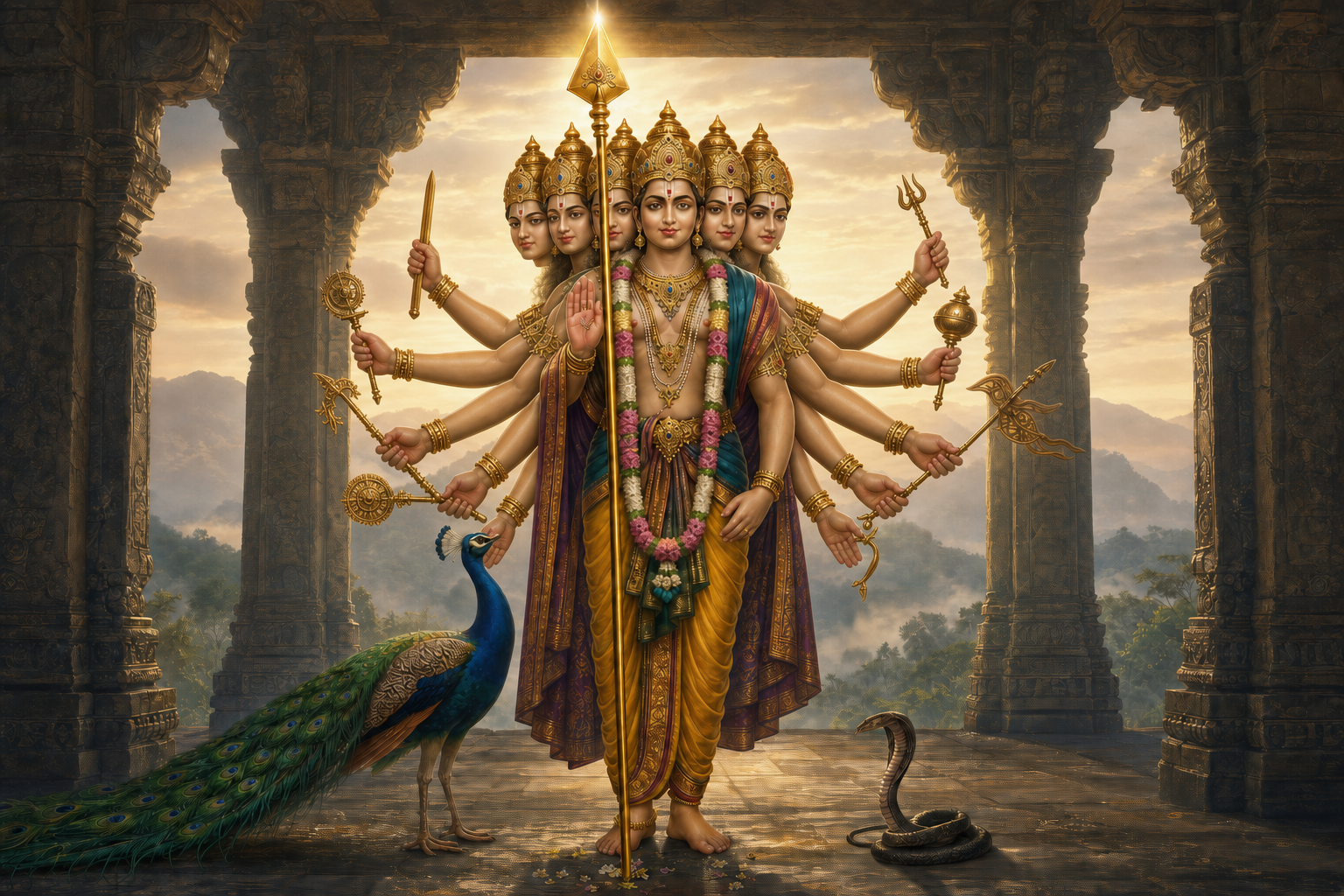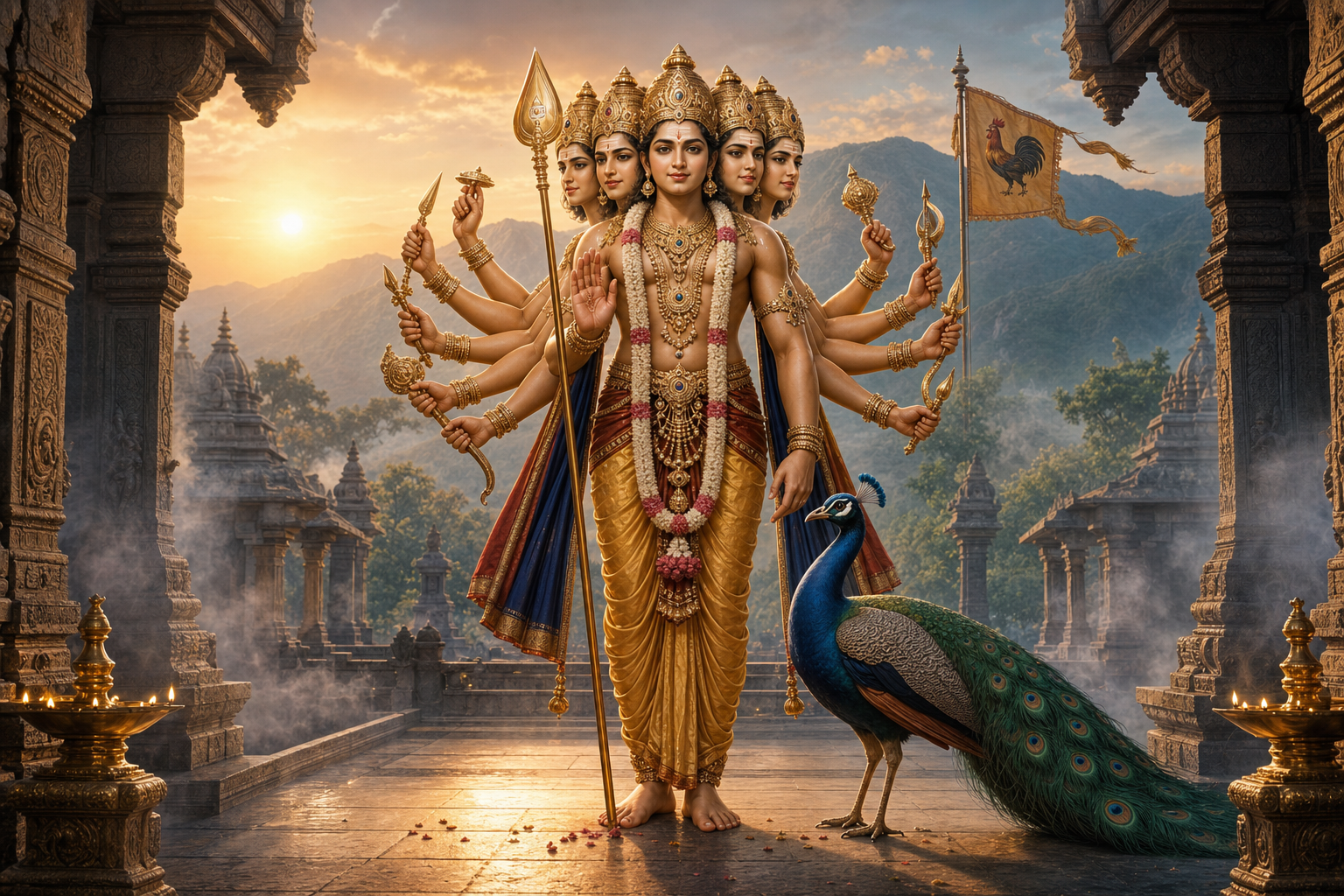
You see Murugan with six faces, and the question seems simple: what is each face called? The honest answer is more useful than a memorized list. Hindu traditions do not preserve one universally fixed set of proper names assigned face by face. They preserve several complementary ways of contemplating the same sixfold form.
That distinction changes how you approach Shanmukha. You are not trying to identify six separate deities or solve a piece of iconographic trivia. You are learning to see one divine intelligence as courageous, instructive, nurturing, youthful, inward and regenerative at once. Once you understand the available maps, you can choose one that serves your worship instead of confusing several lineages.
Do not force the six faces into one official list
Shanmukha means six-faced. Murugan is also worshipped as Subrahmanya, Skanda, Kartikeya, Kumara, Guha, Saravana and Arumugam. These are names of the one deity, not an agreed register of six independent personalities.
The sixfold form is rooted in Murugan’s sacred birth. The divine child emerges at Saravana Poigai and is nurtured by the six Krittikas. His six faces allow him to receive the care of all six mothers simultaneously. Devotion extends that image beyond the birth narrative: the Lord who attends fully to six mothers can attend to beings in every direction and condition without dividing his awareness.
This is why one temple may explain the faces through six epithets, while another emphasizes the six syllables of a mantra, the six directions or six spiritual obstacles. The order and directional assignment can vary by lineage. Plurality here is not carelessness. Each mapping answers a different devotional question.
If your family, guru or temple follows a particular order, use that order. Do not replace a living practice merely because a chart online looks more systematic. If you have no inherited mapping, the six-name framework below is a sound and accessible place to begin.
Key takeaways
- The six faces express the completeness of one Murugan, not six separate gods.
- No single face-by-face list of proper names is universally binding across all traditions.
- The faces may be contemplated through divine epithets, mantra syllables, directions, faculties, virtues or obstacles.
- A local temple or lineage-specific interpretation should take precedence within that tradition’s worship.
- The best map is the one that sharpens attention and leads you toward a concrete act of dharma.
A practical six-name map for contemplation
A widely used devotional framework associates the six faces with Skanda, Subrahmanya, Kartikeya, Kumara, Guha and Saravana. Treat these names as six entrances into one presence. Each name gives you a quality to contemplate and a question to carry into daily life.
| Name | Devotional emphasis | Question for contemplation | Response in daily life |
|---|---|---|---|
| Skanda | Righteous action, strategic wisdom and protection | What does dharma require me to face directly? | Take the necessary step without turning courage into aggression. |
| Subrahmanya | The compassionate guru and illuminator of Brahman-knowledge | What must I learn before I act? | Listen, study or seek sound instruction before defending a conclusion. |
| Kartikeya | Gratitude to the Krittikas, nurturing and communal duty | Whose care helped make my life possible? | Honor a responsibility to family or community without abandoning spiritual purpose. |
| Kumara | Youthfulness, purity, vitality and fearless aspiration | Where have fatigue or cynicism displaced sincerity? | Begin the neglected discipline again with a clean intention. |
| Guha | The hidden indweller and wisdom within the cave of the heart | What becomes visible when mental noise settles? | Leave room for silence before reacting or speaking. |
| Saravana | Sacred emergence, renewal and auspicious beginnings | What worthy beginning needs protection? | Give a new commitment a clear first action and guard it from distraction. |
Skanda is associated with Murugan’s role as Mahasena, commander of the celestial hosts. This is disciplined courage rather than uncontrolled force. When you contemplate Skanda before a difficult decision, the useful question is not whether you feel powerful. It is whether your action protects order, serves dharma and has been guided by clear judgment.
Subrahmanya reveals a different strength: the ability to teach. At Swamimalai, Murugan’s guru-dimension is remembered through his instruction to Shiva concerning the pranava. The child becomes the teacher without ceasing to be the son. For you, this face corrects the assumption that authority always follows age, status or outward rank. Wisdom must still be heard wherever it becomes luminous.
Kartikeya turns attention toward received care. The name recalls the Krittikas who nurtured him. Gratitude, in this frame, is not a private feeling. It matures into duty. The practical test is whether appreciation changes how faithfully you support the people and communities that sustain dharma.
Kumara keeps spiritual effort from hardening into bitterness. Youthfulness here does not mean immaturity. It means the capacity to begin without cynicism and to preserve purity of aim through study, tapas and service.
Guha directs the gaze inward. The cave is the subtle interior in which noise no longer dictates perception. This face does not ask you to withdraw permanently from duty. It asks you to discover whether your outward action arises from discernment or merely from agitation.
Saravana returns you to the sacred place of emergence. A sincere return to dharma can be treated as a new birth rather than as an occasion for shame about delay. The face becomes practical when renewal receives protection: a definite commitment, a first action and fewer openings for distraction.
Match the sixfold map to the work before you
The six-name framework is not the only valid approach. Before beginning a period of contemplation, ask what you are actually trying to understand. Then choose one map and stay with it long enough for its logic to become clear.
- Use the six-syllable mantra for concentrated remembrance. Sa-Ra-Va-Na-Bha-Va is often aligned syllable by syllable with the six faces. One devotional interpretation moves from auspicious beginning through radiance, stability, return to essence, effulgent wisdom and compassionate action. The repeated Va is not necessarily redundant; it can mark both stabilization and the final movement into action.
- Use the six directions when you need a sense of complete guardianship. East, south, west, north, zenith and nadir express awareness with no neglected side. This is especially useful when your concern is protection, responsibility or the fear that something important lies outside your field of attention.
- Use the five senses and the mind when distraction is the problem. The six faces can symbolize integrated command of seeing, hearing, smell, taste, touch and thought. The aim is not hostility toward the senses. It is freedom from being pulled in six competing directions.
- Use the six inner enemies when ethical reactivity is the problem. Kama, krodha, lobha, moha, mada and matsarya name desire, anger, greed, delusion, pride and envy. In this framework, Shanmukha represents sovereignty over the tendencies that distort judgment.
- Use the five acts of Shiva plus knowledge for theological contemplation. Some Shaiva Siddhanta interpretations relate the faces to creation, preservation, dissolution, concealment and grace, with jnana as the integrating sixth principle. This map is especially suited to reflecting on change, loss, hiddenness, grace and the knowledge that holds them together.
Do not pile all five frameworks into the same sitting. If anger is your immediate difficulty, the arishadvarga map will show you more than an elaborate debate about directional assignments. If you are chanting Sa-Ra-Va-Na-Bha-Va, let the mantra organize your attention. If you are receiving darshan at a temple with its own explanation, remain within that temple’s liturgical grammar.
This discipline prevents a common mistake: treating symbolic correspondences as competing historical claims. Directions, senses and inner enemies do not cancel one another because they do not perform the same job. Each turns the sixfold countenance toward a different dimension of practice.
Let the iconography correct your reading
A Shanmukha image often presents six faces and twelve arms. The form should first register as expanded awareness joined to expanded capacity for action. Murugan sees completely and responds adequately. The many arms are therefore not visual excess; they show that insight is equipped to protect, restrain, direct and overcome.
The Vel is the central key. It is jnana-shakti, the power of knowledge that pierces ignorance. This makes the spear a demanding symbol. It asks you to identify the confusion that must be penetrated before you aim force at an outward opponent. Valor without discernment can reproduce the disorder it claims to fight.
Other implements may include a bow and arrow, axe, thunderbolt, noose, goad and shield. Their presence and arrangement vary by region and temple. Read them as a family of functions rather than insisting that every image contain an identical inventory: focus, separation from obstruction, decisive energy, restraint, redirection and protection.
The peacock completes the teaching. Its radiant plumage evokes the multiplicity and beauty of manifestation. Its relation to the serpent represents the sublimation of lower impulses. The point is not lifeless suppression. Energy remains present, but wisdom places it in service of a higher direction. The image asks whether your talent, appetite and intensity have been yoked to discernment or are still choosing their own destination.
At your next darshan, slow down and read the murti in a deliberate order:
- Look at the six faces and notice the claim of complete attention.
- Find the Vel and name the confusion you need knowledge to pierce.
- Observe the other hands and ask whether your situation calls for protection, restraint, focus or decisive movement.
- Look at the peacock and identify one strong energy that needs direction rather than denial.
- Return to the faces and hold all these functions within the unity of Murugan.
Abhishekam can be approached with the same attentiveness. Milk, honey, panchamrita, sandal paste and sacred water do more than create sensory beauty. Their cooling and purifying movement can turn your attention toward the fever of avidya and the clarity sought through worship. Choose one quality before the rite begins; otherwise the richness of the ritual can pass before the senses without educating them.
Turn Shanmukha from an idea into a practice
You do not need to master every correspondence before beginning. A simple home contemplation can use the six-name map without pretending to replace your family’s puja paddhati, a temple’s Agamic worship or instruction received from a guru.
- Name the real issue. Bring one decision, duty, habit or inner disturbance to the practice. Vagueness produces vague reflection.
- Select one sixfold map. Use the six names if you need a balanced practice, the mantra if you need collected attention, or the inner-enemy framework if a specific reaction is clouding judgment.
- Move through the faces without rushing. With the six-name map, remember Skanda, Subrahmanya, Kartikeya, Kumara, Guha and Saravana in sequence. Let each name expose a different part of the issue.
- Chant Sa-Ra-Va-Na-Bha-Va slowly. Give every syllable its own moment. Do not turn speed or repetition count into a substitute for attention.
- Choose one visible response. Courage may require a difficult conversation. Guru-wisdom may require more study. Gratitude may require service. Renewal may require restarting a neglected discipline. Silence may require delaying a reactive message.
- Carry the action out. The contemplation is incomplete if all six faces remain beautiful ideas while your conduct remains untouched.
You can also let the ritual calendar deepen a particular dimension of the form. Skanda Sashti places insight-guided courage at the center through the Soorasamharam, vrata, recitation of the Kanda Sashti Kavasam and surrender. The practical emphasis is not fascination with battle. It is the disciplined overcoming of adharma, including the disorder within your own motives.
Thaipusam brings the Vel, vows and kavadi into public devotional life. Its reciprocal structure is important: grace calls forth disciplined resolve, and resolve becomes capable of receiving grace. If you undertake a vow, make its ethical purpose as clear as its outward form. A demanding observance should leave your conduct more truthful and your service more dependable.
Karttigai Deepam uses light as spiritual pedagogy. A lamp does not merely decorate darkness; it changes what can be seen. Let the observance expose one area in which habit, pride or confusion has been allowed to remain obscure.
Pilgrimage offers a larger curriculum. The six sacred abodes known as the Arupadai Veedu are Thiruparankundram, Tiruchendur, Palani, Swamimalai, Thiruthani and Pazhamudircholai. They should not be reduced to six entries on a travel checklist. Palani foregrounds renunciation and ripe knowledge through pazham nee, while Swamimalai foregrounds Murugan’s guruhood. Across the six abodes, geography becomes a path of spiritual formation.
The next time you stand before Shanmukha, do not begin by asking which internet list has won. Ask which map your tradition is using and what it is training you to notice. Begin with one name, one obscuration and one act of dharma. That is enough to let the six faces become a living practice rather than a fact you merely remember.