
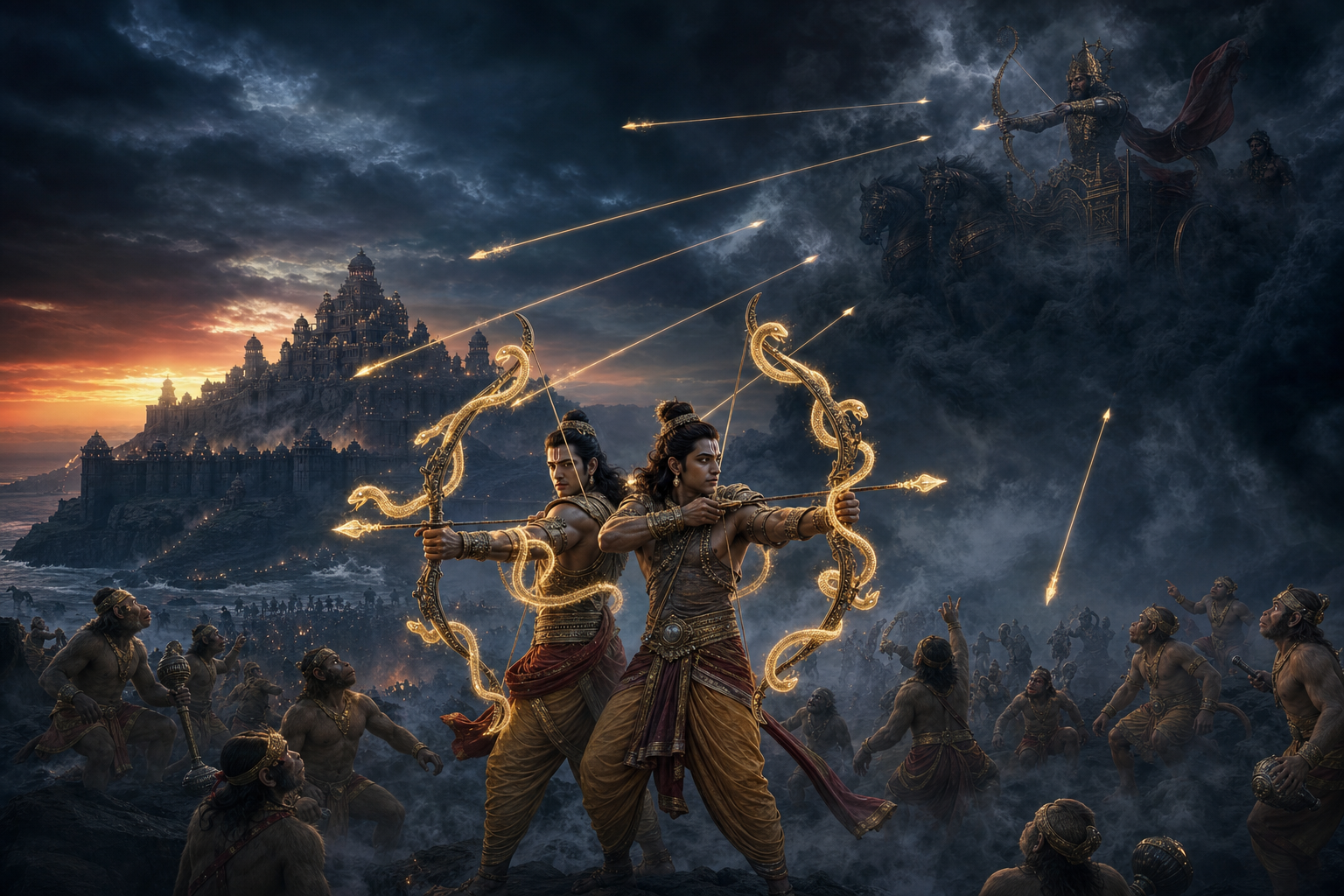
If you are trying to decide whether Indrajit’s invisible attacks made him an adharmic warrior, do not begin with invisibility. The harder question is whether his power remained answerable to dharma. A tactic can be disorienting, an astra can be overwhelming, and its wielder can be extraordinarily disciplined without any of those facts settling the moral verdict.
This distinction matters because two common readings miss the point. One reduces astras to fantastic superweapons; the other treats dharma-yuddha as if it were a sporting code requiring both sides to fight in plain sight. The Lanka battle presents a more demanding framework. You have to examine the cause being served, the nature of the weapon, the effect sought, the restraint exercised, and the response to an incapacitated enemy.
Key takeaways
- An astra is not simply a stronger shastra. Its invocation, cosmic correspondence, and demands on the wielder are part of what it is.
- Indrajit’s maya-yuddha attacks perception before it attacks bodies. Confusion and panic are intended battlefield effects.
- Invisibility does not by itself prove adharma. The more useful tests are purpose, truthfulness, proportionality, and restraint.
- The Naga-pasha episode shows that disabling command can matter more than causing indiscriminate destruction.
- Garuda’s intervention teaches a distinctive strategic principle: the right counter restores balance instead of merely escalating force.
An astra is not simply a more powerful shastra
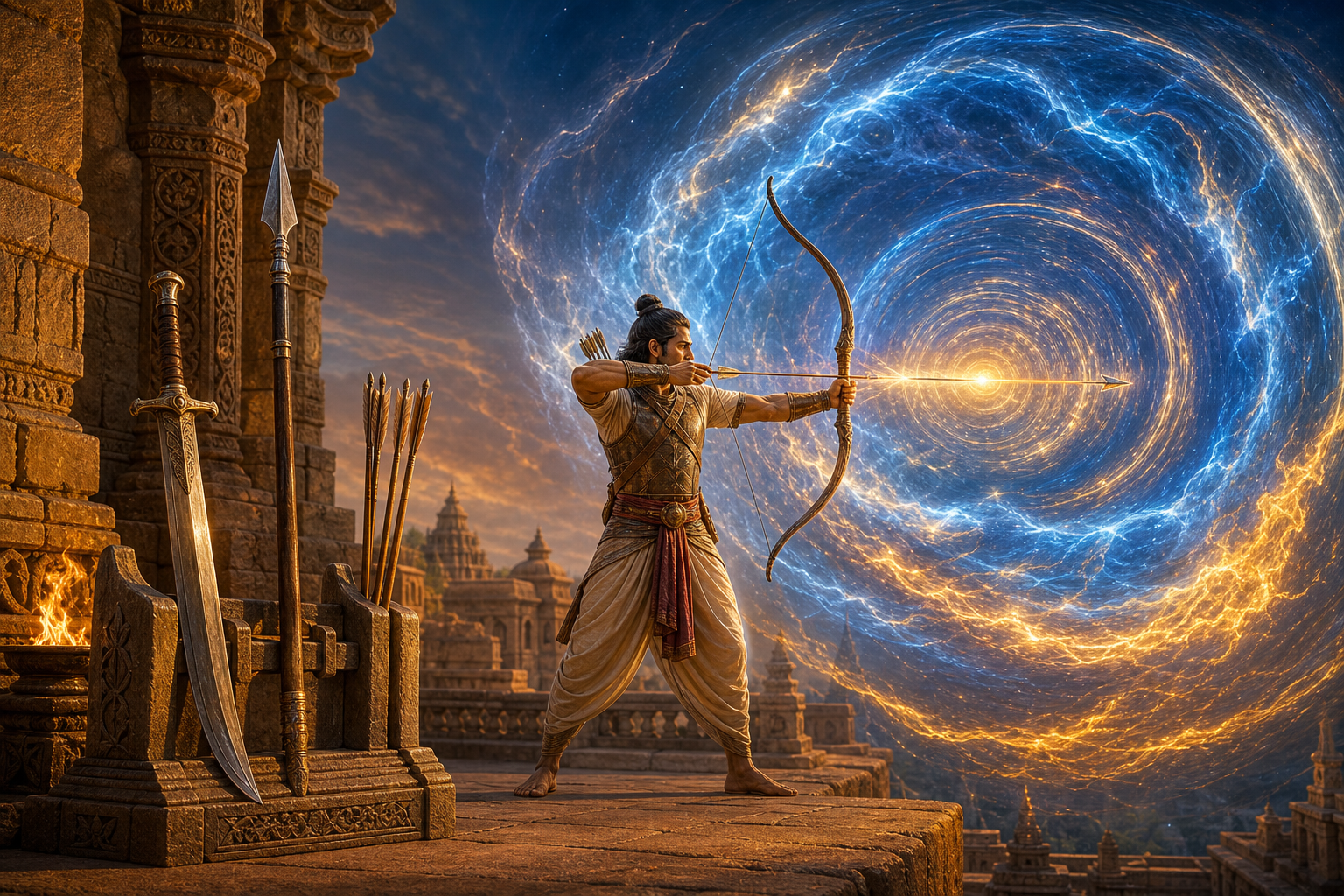
The first distinction you need is between shastra and astra. A shastra is a conventional weapon such as a bow, sword, or spear, operated through bodily skill, training, and technique. An astra is invoked through mantra and aligned with a deity or cosmic principle. Agneyastra corresponds to fire, Varunastra to water, Vayavyastra to wind, Nagastra to serpent power, and Brahmastra occupies the highest order of this weapon tradition.
That difference changes how you should read every astra encounter. The mantra is not ornamental language added to an ordinary missile. Concentration, correct invocation, ritual alignment, and restraint belong to the weapon’s operation. Mastery therefore includes more than accuracy. It includes knowing when the force is appropriate, how its effects relate to other cosmic powers, and what can properly neutralize it.
Maya-yuddha adds another layer. Maya in this battlefield setting does not mean that nothing happened. It means that the opponent’s access to reliable perception has been disrupted. Indrajit uses concealment, speed, smoke, mantra, and unseen volleys to make the Vanaras respond to effects whose origin they cannot locate. The arrows are real; the uncertainty surrounding them is itself a weapon.
Indrajit, also called Meghanaada, is formidable precisely because he integrates these domains. His epithet, the conqueror of Indra, signals exceptional martial attainment. He is not merely carrying a rare weapon obtained by chance. His effectiveness rests on disciplined mantra-vidya, astravidya, timing, concealment, and command judgement.
This gives you a practical test for evaluating any retelling of the scene. If an astra behaves like unlimited ammunition, requires no disciplined invocation, has no fitting counter, and creates no ethical burden for its user, the retelling has preserved the spectacle while losing the weapon’s cosmological grammar.
Indrajit’s first target is the enemy’s ability to know
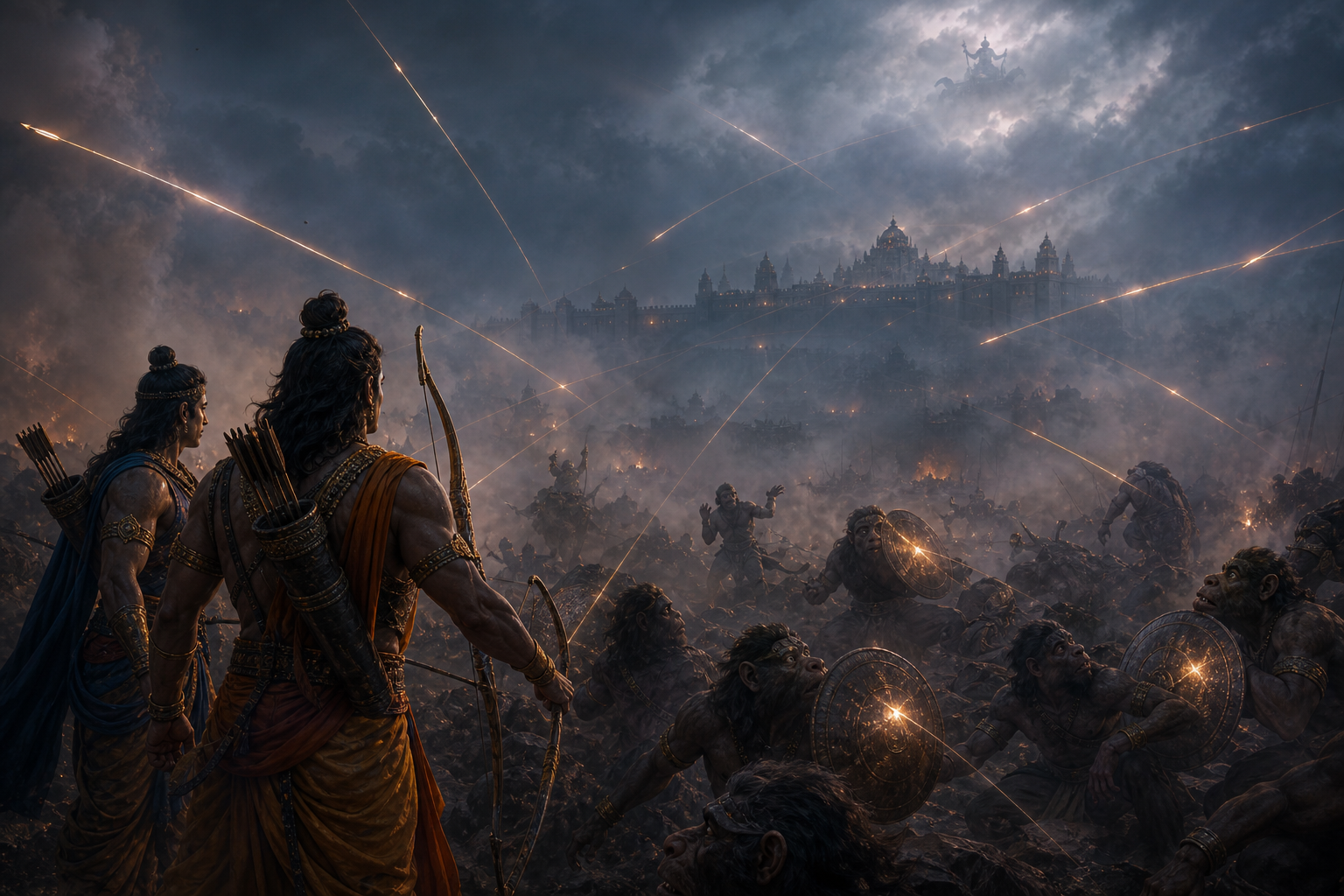
The invisible onslaught is best understood as a sequence rather than a collection of dazzling feats. Indrajit does not begin by trying to overpower every Vanara individually. He first destroys confidence in the battlefield picture.
- Unseen volleys make the Vanaras search for an attacker they cannot reliably locate.
- The loss of visual certainty divides attention between survival, detection, and command.
- Panic weakens formation and turns every unexplained sound or impact into a possible new threat.
- The Naga-pasha then binds Rama and Lakshmana, striking the coalition’s command and moral centre.
- The immobilized princes become a second tactical problem because the army must protect them while remaining under pressure.
The Naga-pasha is therefore more than an exotic restraint. Its serpent bonds immobilize Rama and Lakshmana, halt their freedom of action, and threaten the confidence of the army gathered around them. Indrajit obtains a strategic effect without needing to defeat the entire coalition one combatant at a time.
The allied response deserves as much attention as the attack. Rama and Lakshmana recognize that the bonds are not ordinary ropes that can be broken by greater exertion. They remain composed rather than wasting force against a correctly invoked astra. Jambavan and Sugriva stabilize the army, protect its vulnerable centre, and prevent uncertainty from becoming a general collapse.
When you analyse this battle, ask what each tactic does to decision-making, not only what it does to bodies. Indrajit’s concealment consumes attention. His arrows create sensory uncertainty. The Naga-pasha removes key leaders from action. The Vanara commanders answer by reducing unnecessary movement, guarding the centre, and refusing to let panic choose their response.
The same principle explains why intelligence later becomes so important. The useful question is no longer limited to Indrajit’s location. It becomes: what conditions generate his advantage? Vibhishana’s later counsel concerning Indrajit’s rites at Nikumbhila directs attention toward the preparation that amplifies his battlefield power. Effective counter-strategy looks for the system behind the weapon, not merely the last arrow that system produced.
Invisibility is not the final ethical test
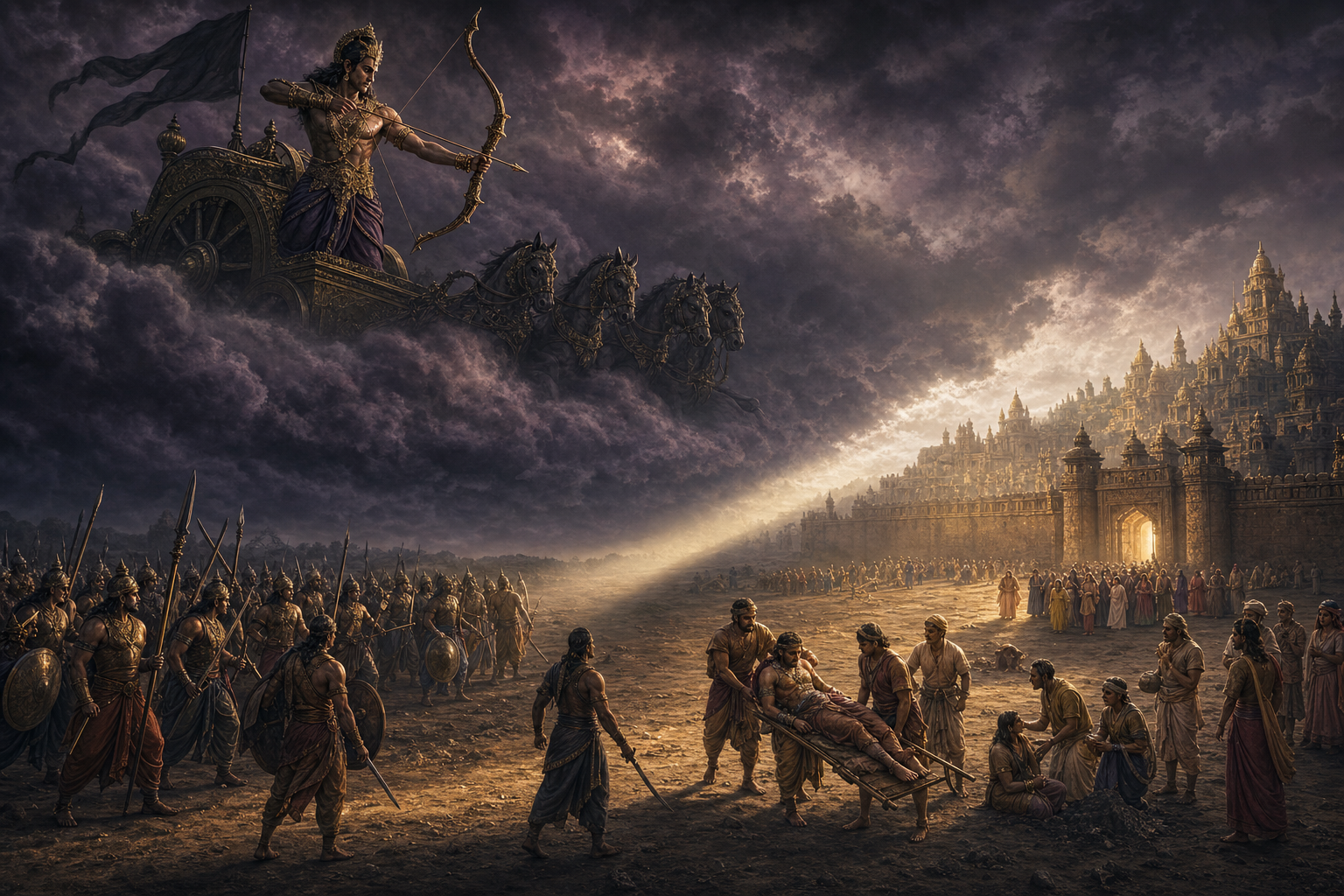
Calling Indrajit a cheat because he cannot be seen is too easy. It mistakes tactical openness for moral righteousness. Concealment, surprise, mobility, and the disruption of enemy perception can all belong to warfare without automatically abolishing its ethical limits.
The opposite mistake is more serious: admiring Indrajit’s mastery so completely that competence becomes a substitute for dharma. Skill can tell you whether an act was executed well. It cannot, by itself, tell you whether the act served a righteous purpose. Indrajit’s discipline makes him a great warrior and a dangerous commander; it does not cleanse Ravana’s cause merely by being impressive.
A useful dharmic assessment separates five questions that are often collapsed into one:
- What cause is the force serving? Martial excellence remains morally subordinate to the order it protects or violates.
- What does the method do? Distinguish a tactic that creates temporary uncertainty from conduct that makes every promise, restraint, and moral boundary meaningless.
- Is the force proportionate to the objective? Possessing cosmic power is not permission to use the maximum available power in every encounter.
- What happens when the opponent is disabled? Restraint is clearest when cruelty would be easy, not when both sides remain equally dangerous.
- Does the wielder remain accountable? Mantra, siddhi, lineage, or victory cannot place an act beyond ethical judgement.
Applied to the Naga-pasha, this framework prevents a premature verdict. The weapon binds command figures and opens a tactical opportunity; it is not presented as indiscriminate devastation. Indrajit’s invocation demonstrates control. Yet neither precision nor control proves the righteousness of the larger war he serves. The act’s technical character and its moral location have to be judged separately before they can be judged together.
Victory and defeat are equally poor shortcuts. Rama and Lakshmana being bound does not make the weapon righteous. Garuda freeing them does not retroactively make every act against them adharmic. Battlefield success measures effectiveness. Dharma asks what effectiveness was for, which limits survived pressure, and whether power remained governed by conscience.
This is also where comparison across Dharmic traditions can help, provided differences are not erased. Buddhist reflection on maya draws attention to veiled perception. Jain ahimsa makes restraint, intention, and the consequences of violence impossible to treat casually. Sikh dharam-yudh insists that force claiming righteousness must remain morally bounded. These are not interchangeable doctrines, but they train the reader to ask a shared question: who governs power when power becomes available?
Garuda shows what a proportionate counter looks like
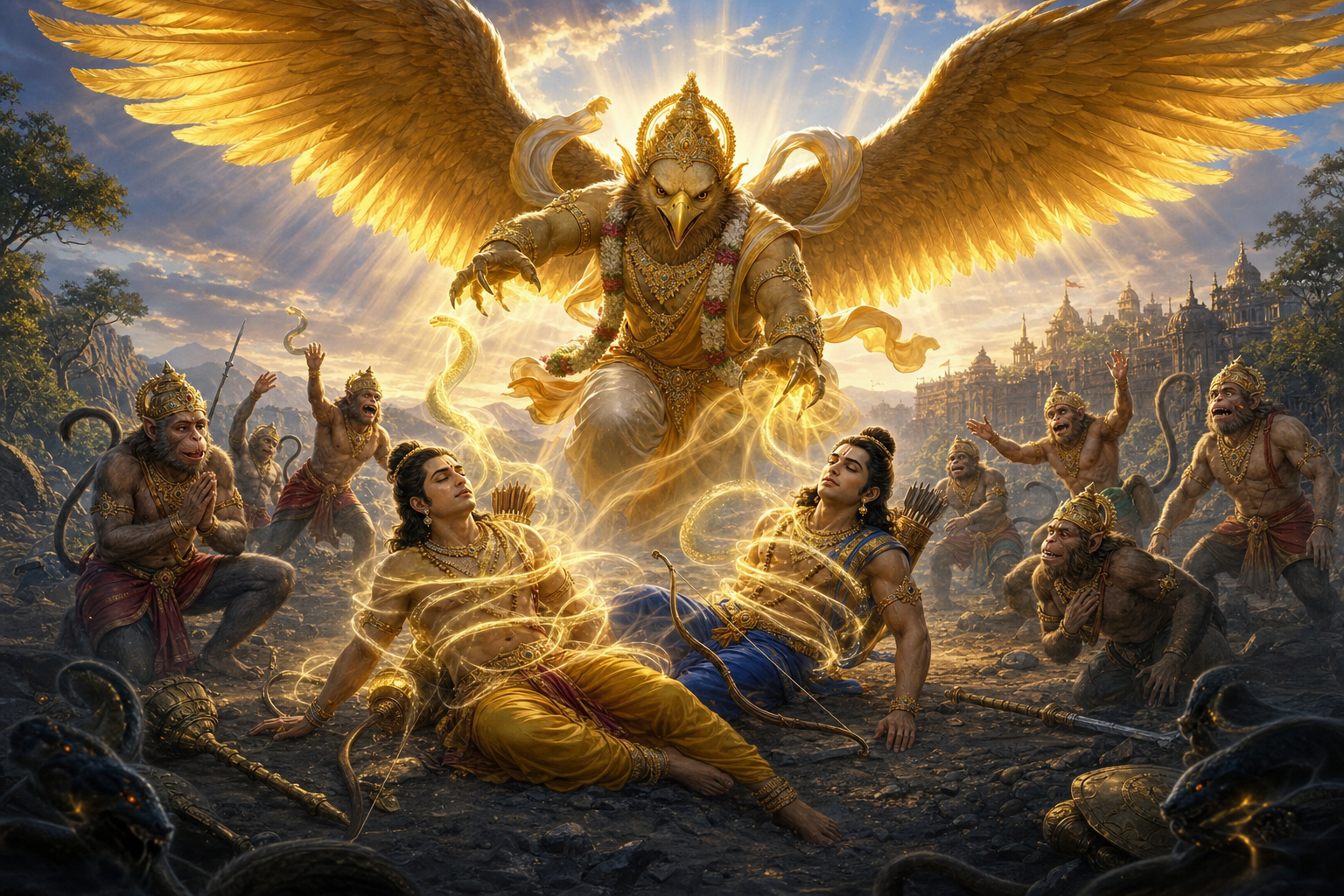
The release from the Naga-pasha is not achieved by producing a larger explosion. Garuda’s presence causes the serpent bonds to loosen and withdraw. The counter works through a fitting relationship: the power associated with serpents yields before their cosmic adversary.
That encounter reveals three different kinds of countermeasure within the astra tradition:
- Elemental neutralization: an opposing principle answers the weapon’s element, as water answers fire.
- Deity-aligned correspondence: the invoked power is met by the presence properly related to it, as Garuda answers the serpent bond.
- Behavioural discipline: the threatened side stops feeding the weapon’s advantage through panic or futile exertion and preserves itself until the correct remedy becomes available.
The third counter is easy to miss because it is not spectacular. Rama and Lakshmana’s composure does not dissolve the Naga-pasha, but it prevents a binding weapon from also mastering their judgement. The Vanara commanders cannot invoke Garuda by shouting more loudly, yet they can keep the army from disintegrating before relief arrives. Ethical discipline and tactical discipline meet at exactly this point.
Modern comparisons can clarify the relationships if you keep them modest. Indrajit’s concealment resembles stealth in function; maya resembles the degradation of an adversary’s sensors; an astra can resemble a precision capability; and the attack on cohesion resembles psychological or electronic warfare. These are analogies, not claims that the Ramayana is describing modern hardware under ancient names. Translate the strategic problem, not the machinery.
You can use the episode as a five-question discipline whenever a conflict is being described through spectacular capabilities:
- What has become difficult to see, verify, or understand?
- Is the visible strike the main attack, or is fear and confusion the intended result?
- Which person, relationship, or institution functions as the true centre of gravity?
- What is the narrowest counter that can restore order without reproducing the same excess?
- Which ethical limit must remain binding even if abandoning it would bring a faster victory?
This reading is useful beyond war. Public panic, deceptive rhetoric, institutional confusion, and personal fear can all make people strike at whatever is most visible while ignoring the condition that gives the threat its power. The lesson is not to imagine every difficulty as an astra. It is to preserve perception, protect the moral centre, and choose a remedy fitted to the actual bond.
The next time you encounter Indrajit’s astras, read the scene in three passes: identify the weapon’s effect, identify the discipline and conditions that make it effective, and then test its use against dharma. That method lets you respect formidable martial knowledge without mistaking formidable power for righteousness.