
You are trying to plan one sacred month, but the dates seem to disagree. A Sikh calendar places Vaisakhi around 13 or 14 April. A Gujarati, Kannada, or Telugu Panchang begins lunar Vaishakha on 18 April. A North Indian almanac may apply the name Vaishakha to a different span again.
These are usually not competing claims. They are different calendar systems measuring different cycles. Once you separate solar Vaisakh, amanta Vaishakha, and purnimanta Vaishakha, you can build a reliable 2026 observance calendar without forcing every regional tradition into one date range.
Key takeaways
- In the Gujarati, Kannada, and Telugu amanta calendars, lunar Vaishakha runs from 18 April through 16 May 2026 in India, subject to location-specific tithi timings.
- Vaishakha is the second lunar month in the Kannada and Telugu calendars but the seventh in the Gujarati year. The ordinal changes because the regional year begins at a different point; the underlying lunation does not.
- Many North Indian calendars use purnimanta reckoning, so their named month begins after a full moon rather than after a new moon. The festival tithi can agree even when the month label does not.
- Solar Vaisakh, including the seasonal setting of Sikh Vaisakhi, begins around the Sun’s ingress into Mesha near 13 or 14 April. It is not the same interval as the lunar month beginning on 18 April.
- Use the published date range only as a planning frame. Confirm each vrata, evening observance, and fast-breaking window in a city-specific Panchang.
Start by separating three different Vaisakh clocks

The word Vaishakha, Vaisakha, Vaishakh, Vaisakh, or Baisakh can point to a lunar month, a solar month, or a regional civil-calendar label. Similar spelling does not guarantee identical boundaries.
| Calendar in front of you | 2026 baseline | How the month is reckoned | What you should do |
|---|---|---|---|
| Gujarati Panchang | 18 April-16 May; Vaishakh of Vikram Samvat 2082 | Amanta, from the day after Amavasya to the next Amavasya; Vaishakh Sud is the waxing fortnight and Vaishakh Vad the waning fortnight | Use Gujarati Sud-Vad terminology and local sunrise timings; do not substitute a North Indian month boundary |
| Kannada Panchanga | 18 April-16 May; Vaisakha masa | Amanta; the second lunar month | Confirm Karnataka temple timings, Ekadashi parana, and evening tithi requirements locally |
| Telugu Panchangam | 18 April-16 May; Vaishakha Masam or Madhava Masam | Amanta; the second lunar month | Include Telugu regional observances only when they belong to your family or temple tradition |
| Maharashtra and other amanta traditions | Broadly aligned with the same new-moon-to-new-moon sequence | Amanta | Treat 18 April-16 May as the common Indian planning window, then verify the city-specific Panchang |
| Many North Indian Panchangs | The named month follows a different boundary and should be read from the regional almanac | Purnimanta, from the day after Purnima to the next Purnima | Match observances by tithi and paksha before comparing their month names |
| Solar Bikrami or Sikh Vaisakh | Begins around 13 or 14 April near Mesha Sankranti | Solar ingress rather than a new-moon or full-moon boundary | Keep Vaisakhi as a solar observance; do not move it to the 18 April lunar-month opening |
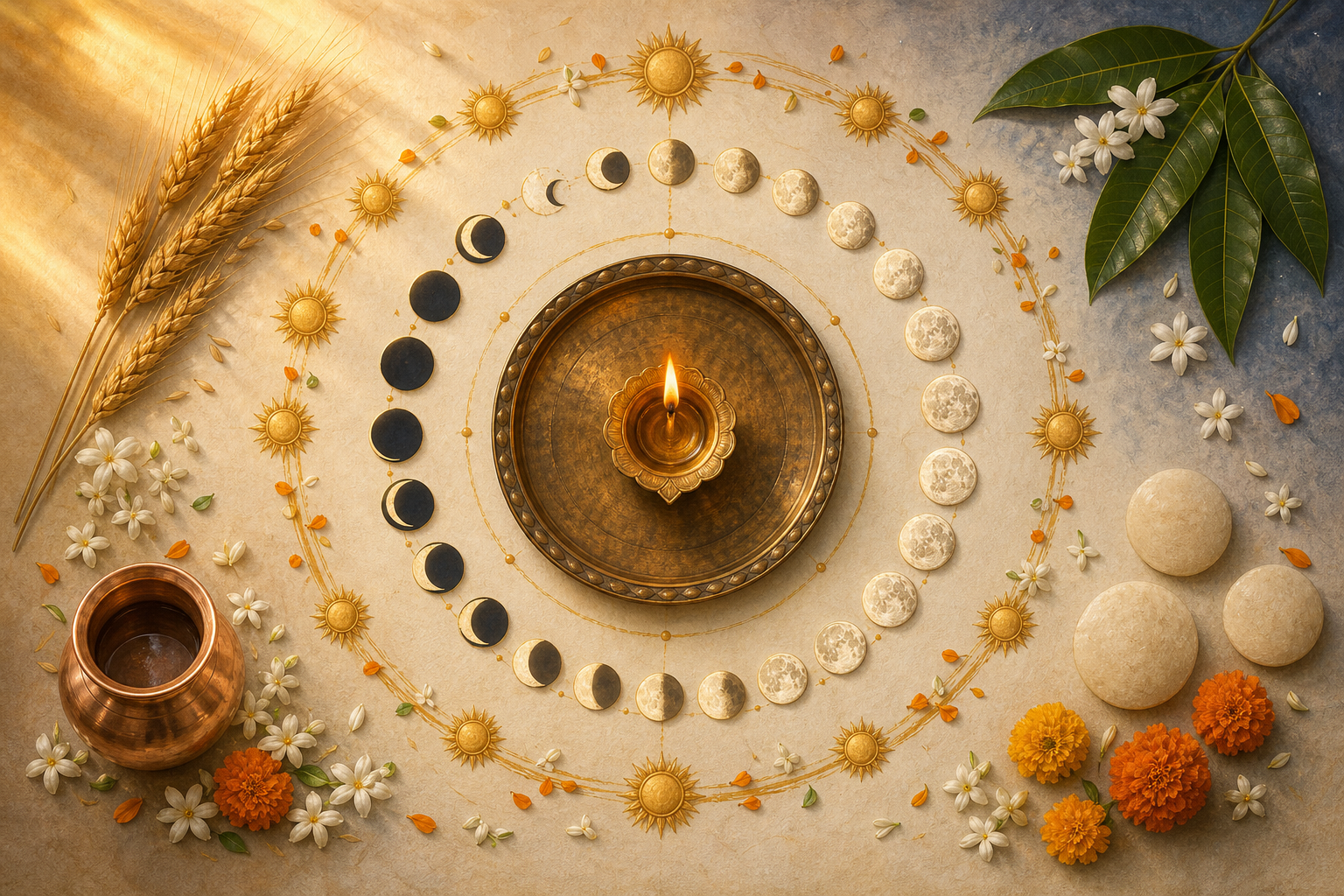
The amanta month has an intuitive sequence: new moon, waxing fortnight, full moon, waning fortnight, and new moon. Vaishakha therefore opens with Shukla Pratipada on 18 April and closes at Vaishakha Amavasya on 16 May in the common 2026 Indian reckoning.
Purnimanta reckoning rearranges the label rather than the Moon. Its month runs from the day after one full moon to the next full moon, placing the waning fortnight before the waxing fortnight. The waxing Vaishakha fortnight is normally recognizable across both systems, but the month name attached to a waning fortnight can differ by one month. If a northern list calls a Krishna-paksha observance Vaishakha while a southern list calls the same lunar interval Chaitra, first check the reckoning system. Do not assume one has made an astronomical error.
The Gujarati ordinal creates a separate, harmless confusion. Vaishakh is the seventh month because the Gujarati year is counted from Kartik after Deepavali. Karnataka and the Telugu regions call it the second month. This is like numbering the same station from different starting points: the sequence number changes, but the station itself remains where it is.
Solar Vaisakh belongs to another layer. Mesha Sankranti, when the Sun enters Aries, provides the seasonal threshold around 13 or 14 April. Sikh Vaisakhi marks the establishment of the Khalsa and a North Indian harvest turning point within this solar rhythm. Bengali Pohela Boishakh and Kerala’s Vishu also stand near the same solar threshold. These observances share a season, but they should not be treated as alternate names for the amanta lunar month beginning on 18 April.
Why one tithi can produce two civil dates

A tithi is not a weekday-sized box running from midnight to midnight. It advances whenever the angular separation between the Moon and Sun increases by 12 degrees. Its beginning and ending can therefore occur at any civil time, and its duration is not fixed at 24 hours. This is why simply counting three dates forward from Shukla Pratipada is not a dependable way to find Akshaya Tritiya.
For many observances, the working rule is udaya tithi: use the tithi prevailing at local sunrise. It is a baseline, not a universal shortcut. Ekadashi depends on its sunrise status and is completed by parana during the prescribed Dvadashi window. Narasimha Jayanti requires attention to Chaturdashi around the relevant evening period. A sankranti rite follows the exact moment of solar ingress. Some sampradayas also apply special rules when the same tithi touches two sunrises.
Location matters because sunrise and the local civil date change with longitude, latitude, and time zone. A tithi that controls an observance in Ahmedabad or Bengaluru can fall on the adjacent civil date in Toronto, London, Singapore, or another diaspora location. Copying an India date into an overseas family calendar can therefore move a fast, puja, or parana to the wrong local day.
Panchangs may also differ because they use different astronomical calculation traditions, including Drik and Vakyam methods, or because they apply a ritual rule differently. A one-day discrepancy should prompt you to compare location, sunrise, tithi end time, and sampradaya before declaring either calendar wrong.
Use this sequence when you prepare your 2026 calendar:
- Write down the regional calendar and sampradaya you actually follow. Gujarati, Kannada, Telugu, North Indian purnimanta, and a temple’s Vaishnava calendar are not interchangeable labels.
- Set the Panchang to the city where the observance will occur, not the birthplace of the family and not automatically India Standard Time.
- Record the festival’s tithi and paksha before recording its Gregorian date. This preserves the religious anchor if the civil date changes.
- Check which portion of the day matters: sunrise, an evening interval, Purnima, Amavasya, or an exact solar ingress.
- For Ekadashi, enter the fast and the Dvadashi parana window as separate calendar items. A correct fasting day without a correct parana plan is incomplete scheduling.
- Confirm major temple observances with the temple itself. Its archana, abhishekam, procession, or communal parana may be scheduled within a narrower ritual window than a general-purpose almanac displays.
A useful household entry contains more than a festival name. Record the tithi, local civil date, controlling time rule, fasting level, parana window when applicable, and temple programme. That format also makes disagreements easy to diagnose: you can see whether the difference comes from astronomy, location, or ritual convention.
Use tithi anchors, not guessed Gregorian dates
The 18 April-16 May range tells you where amanta Vaishakha sits in 2026. It does not by itself settle the civil date of every observance. Build your working calendar from these tithi anchors, then let the local Panchang supply the date and time.
- Vaishakha Shukla Tritiya: Akshaya Tritiya or Akha Teej. Parashurama Jayanti coincides with it in many traditions. It is used for durable sankalpas, learning, charity, and auspicious beginnings. If the beginning involves property, investment, or a binding contract, religious auspiciousness does not replace legal checks, financial judgment, or an appropriate full muhurta.
- Vaishakha Shukla Saptami: Ganga Saptami or Jahnu Saptami in traditions that observe it. Add it when Ganga worship belongs to your household or temple practice.
- Vaishakha Shukla Navami: Sita Navami. Its place in the schedule is especially relevant for families and temples maintaining Ramayana-centered worship.
- Vaishakha Shukla Ekadashi: Mohini Ekadashi. Enter the fast only after checking local sunrise status, and enter the following Dvadashi parana separately.
- Vaishakha Shukla Chaturdashi: Narasimha Jayanti. Because the evening presence of Chaturdashi matters, a sunrise-only festival list is not sufficient for the puja decision.
- Vaishakha Purnima: Buddha Purnima or Vesak in Buddhist communities; Kurma Jayanti in many Vaishnava traditions; and a common occasion for Satyanarayana Puja in Hindu households. Each observance retains its own theology and ritual form even though the full moon is shared.
- Vaishakha Krishna Ekadashi: Apara Ekadashi in the amanta month. As with Mohini Ekadashi, check both the fasting day and Dvadashi parana.
- Vaishakha Krishna or Bahula Dashami: many Telugu-speaking communities observe Hanuman Jayanti here. Do not transfer this regional placement into every Hindu calendar without checking the tradition.
- Vaishakha Amavasya: the close of the amanta month on 16 May in the common Indian reckoning. Families may perform tarpana, remembrance of ancestors, deepa-dana, and quiet charity. Some calendars associate Shani Jayanti with this new moon, while other traditions place it in Jyeshtha, so the label should be verified rather than universalized.
Akshaya Tritiya and Vaishakha Purnima reveal how several Dharmic traditions inhabit the same season without becoming one observance. Jain tradition remembers Akshaya Tritiya in connection with Bhagavan Rishabhanatha accepting sugarcane juice and with Varshitap parana. Buddhist communities mark the Vaishakha full moon as Vesak, associated across different lineages with the Buddha’s birth, awakening, and parinirvana. Hindu traditions may worship Kurma, perform Satyanarayana Vrata, or honor Vishnu as Madhava on that full moon.
Sikh Vaisakhi belongs beside this picture but not inside the lunar tithi list. It is a solar and historical observance near Mesha Sankranti, preceding the 18 April opening of amanta Vaishakha in 2026. A multi-tradition family can place Vaisakhi, Akshaya Tritiya, Jain Varshitap parana, and Vesak on one shared calendar while retaining the correct basis and meaning of each.
This distinction protects genuine Dharmic unity. Unity does not require us to pretend that Hindu, Buddhist, Jain, and Sikh rites are identical. It asks us to notice the common civilizational grammar of disciplined practice, generosity, gratitude, courage, wisdom, and service while respecting each path’s calendar and sacred memory.
Turn the calendar into a workable Vaishakha practice

Vaishakha is traditionally called Madhava Masam in Vaishnava settings. The Padma Purana and Skanda Purana preserve Vaishakha-mahatmya traditions centered on snana, dana, and japa. The month falls in the heat of the Indian summer, so its religious disciplines repeatedly join inward restraint to practical relief for living beings.
You do not need to turn every day into a large ceremony. Choose practices that can remain steady through the full month:
- Give the morning a stable anchor: an early bath, arghya to Surya, tulasi worship, nama-japa, Vishnu Sahasranama, or a manageable passage from the Bhagavad-Gita or Srimad-Bhagavatam.
- Make summer seva concrete. Offer potable water, buttermilk, panakam, fruit, food, shade, an earthen water pot, sandals, an umbrella, or another genuinely useful form of heat relief. If you maintain a public water point, keep its vessels clean and the water safe to drink.
- Use Akshaya Tritiya for a sankalpa that can endure after the festival: regular study, recurring anna-dana, support for a water facility, care for trees, or another sustained act of service.
- Keep Ekadashi with the form of upavasa accepted in your health situation and sampradaya, then observe parana deliberately rather than treating the fast as finished at midnight.
- Approach Narasimha Jayanti through both courage and restraint. Worship of Narasimha is not merely admiration of force; Prahlada’s story directs strength toward the protection of dharma and the devoted.
- Let Purnima retain its layered character. A Hindu household can perform Satyanarayana Puja or Kurma worship while respectfully recognizing the Buddhist sanctity of Vesak.
- Close the amanta month on Amavasya with remembrance, tarpana where customary, simple charity, and a review of which sankalpas will continue into Jyeshtha.
Cooling the deity with sandalwood and cooling the world through water charity express the same seasonal intelligence. Chandan Yatra begins at Jagannath Puri on Akshaya Tritiya, while temples in several regions use sandal paste, cooling offerings, processions, and abhishekam during the summer. A household can carry that temple symbolism into ordinary life by relieving heat for people, animals, and the surrounding environment.
If you are arranging a griha pravesh, naming ceremony, business opening, or another samskara, do not treat the whole month as one uninterrupted muhurta. Vaishakha may be broadly auspicious, and Akshaya Tritiya is widely regarded as intrinsically auspicious, but a specific ceremony can still require attention to weekday, nakshatra, tithi, family custom, and other planetary conditions. Use the month to shortlist the period; use a competent local Panchang and your ritual authority to choose the actual time.
Before entering a single festival date, write your city, calendar system, and sampradaya at the top of your 2026 plan. Then fill in the local civil date, controlling tithi interval, and parana from one trusted Panchang. That small discipline will let you honor regional diversity without losing calendrical precision.
References
- DharmaRenaissance Blog – Vaishakh Maas 2026 in the Gujarati Panchang: Sacred Timelines, Festivals, and Ritual Guide
- DharmaRenaissance Blog – Vaisakha Masa 2026 (Kannada Calendar): Dates, Sacred Significance, and Festival Guide
- DharmaRenaissance Blog – Vaishakha Masam Mahatmya: Sacred Significance, Vishnu’s Grace, and Dharmic Unity
- DharmaRenaissance Blog – Vaishakha Masam 2026: Dates, Key Vratas, and Dharmic Significance in the Telugu Calendar