

You may be looking at a familiar imbalance: women teach the children, feed the sangat, organize observances, preserve family knowledge, welcome newcomers, and rescue programs when volunteers disappear – yet someone else controls the agenda, budget, property, and appointments. If you want to make a Dharmic organization genuinely women-led, adding a woman to the committee will not solve that imbalance.
The stronger question is whether women can shape the system through which service continues. Across Hindu, Buddhist, Jain, and Sikh experience, women have turned learning, devotion, discipline, hospitality, patronage, and moral courage into institutions that carry dharma beyond one lifetime. You can use that inheritance as a practical design standard, whether you are strengthening a mandir, vihara, basadi, gurdwara, pathashala, heritage project, or diaspora seva group.
The first test: can she change the system?

An event happens once. An institution makes a repeatable promise. A community kitchen promises that people will be fed with dignity. A pathashala promises that knowledge will reach another generation. An archive promises that memory will remain available after its present custodians are gone. A spiritual community promises practice, guidance, and belonging through both ordinary time and crisis.
Each promise needs five things: defined responsibility, resources, a method, a record, and succession. Remove any one of them and the work becomes dependent on personal sacrifice. That is why visible participation is a poor measure of leadership. A woman can perform most of an organization’s labor while possessing almost none of its institutional authority.
Use a more demanding test. In the part of the organization described as women-led, can a woman or a women-led council:
- set priorities rather than merely receive assignments;
- approve expenditure and examine the relevant accounts;
- appoint, train, and remove people within a defined mandate;
- shape the curriculum, standards, ritual calendar, or service method;
- record decisions and control responsible access to those records;
- represent the work in the main governing body; and
- prepare a successor who will inherit both knowledge and authority?
If the answer is no, you may have women-supported work, but you do not yet have women-led institutional work. This distinction matters because praise can conceal dependency. Calling women Shakti while denying them the authority to change a harmful process turns a profound Dharmic idea into ceremonial language.
Begin your audit with one recurring activity. Follow a decision from its beginning to its end: Who identifies the need? Who approves the plan? Who controls the money? Who performs the work? Who receives credit? Who handles complaints? Who decides what will happen next time? Write the names and roles down. The gap between labor and authority will become visible quickly.
Four traditions reveal four dimensions of authority

Hinduism, Buddhism, Jainism, and Sikhism should not be flattened into interchangeable versions of one system. They name liberation differently, organize religious authority differently, and preserve distinct disciplines. Their women’s histories nevertheless expose several forms of institution-building that contemporary communities routinely overlook.
Hindu traditions: authority over knowledge, devotion, and public works
Gargi Vachaknavi and Maitreyi belong in any discussion of leadership because their authority is intellectual, not decorative. Their presence in Upanishadic inquiry places women inside the search for atman and brahman. They are not presented merely as supporters of someone else’s learning. They question, reason, and direct attention toward first principles.
Akka Mahadevi and Mirabai demonstrate another kind of authority. Devotional composition carried spiritual teaching beyond restricted scholarly settings through song, recitation, and assembly. Their significance for an organization is practical: pedagogy does not begin and end in a classroom. The person who determines what a community sings, remembers, discusses, and passes to children helps determine its spiritual vocabulary.
Ahilyabai Holkar extends the lesson into civic and material stewardship. Her support for temples, ghats, pilgrimage routes, and endowments linked sacred continuity with the physical conditions that allow pilgrims, worshippers, artisans, and local economies to function. Patronage was not an honorary attachment to religious life. It was a way of building the roads, spaces, and financial continuity through which religious life endured.
If your mandir asks women to teach but excludes them from curriculum decisions, or asks them to raise money while denying them an endowment or facilities mandate, it has separated work that these precedents hold together. Correct that separation. Give women defined authority over knowledge, resources, and the conditions in which service occurs.
Buddhist traditions: authority needs discipline and transmission
Mahapajapati Gotami’s request stands at the beginning of the bhikkhuni community, while the Therigatha preserves the voices of early Buddhist nuns. Sanghamitta’s mission to Sri Lanka, associated with the arrival of a Bodhi tree sapling, adds a transregional dimension: women carried not only personal attainment but disciplined community, sacred continuity, and a living teaching network.
The institutional lesson is that inspiration alone does not transmit a path. A community needs formation, recognized responsibilities, teaching competence, discipline, memory, and a way to authorize the next generation. This is particularly important when contemporary communities are recovering or strengthening women’s lineages. A celebration can create attention, but only a training and succession structure can create continuity.
A vihara or Buddhist association can apply this lesson by identifying who trains teachers, who maintains practice records, who interprets organizational rules, who supports novices, and who can recognize another person’s readiness for responsibility. If women can participate in programs but cannot shape these transmission points, the leadership pipeline remains incomplete.
Jain traditions: many-sided inquiry belongs inside governance
Jain aryikas and laywomen have sustained religious life through learning, dana, manuscript preservation, and basadi networks. Svetambara narratives also recognize Mallinatha as female; that identification should be stated as a Svetambara position rather than presented as an uncontested claim across all Jain traditions. The distinction itself illustrates why careful listening matters.
Anekantavada offers more than a general appeal to tolerance. As an institutional discipline, many-sidedness asks a council to examine how its own standpoint may be partial. That does not mean every claim is equally sound or that decisions must be postponed indefinitely. It means responsible judgment should survive contact with the strongest relevant perspective that the decision-makers do not already hold.
Put that discipline into meeting procedure. Before approving a major program, assign someone to present the strongest case against the preferred plan. Record the affected groups that were consulted, the objections that remain unresolved, and the condition under which the decision will be revisited. Women must be able to initiate this review, not merely supply a perspective after the practical options have already been closed.
Sikh tradition: hospitality is governance, not backstage work
Mata Khivi’s stewardship of langar shows how nourishment, equality, organization, and dignity can be joined in one institution. Mai Bhago represents the authority to call a community back to courage and responsibility. Mata Sahib Kaur, revered as the Mother of the Khalsa, stands within the formation of collective identity. These are different forms of leadership: operational, moral, and civilizational.
Langar makes the institutional point especially clear. Procurement, food preparation, cleanliness, volunteer coordination, accessibility, and the treatment of every guest are not secondary to the spiritual work. They are where the spiritual claim is tested in public. If women carry those responsibilities, they should also possess the budget visibility, safety mandate, volunteer authority, feedback channel, and representation in the gurdwara’s governing structure needed to fulfill them.
The common pattern across these traditions is not that every woman led in the same way. It is that teaching, discipline, hospitality, patronage, archives, and moral correction are all sites of real authority. Your organization should treat them accordingly.
Redesign the mandate, money, memory, and succession

Representation matters, but it cannot carry an institution by itself. A seat at the table is useful only when the table controls something and the person seated there can exercise a known mandate. The following comparison can help your committee distinguish symbolic inclusion from structural leadership.
| Dimension | Symbolic inclusion | Institutional leadership |
|---|---|---|
| Mandate | Women are invited to advise | A written charter identifies decisions they can make |
| Money | Women raise or spend funds without full visibility | They approve a defined budget and review its accounts |
| Knowledge | Women teach material chosen elsewhere | They help govern curriculum, archives, and access |
| Governance | Attendance is visible but influence is informal | Voting, agenda, appeal, and conflict procedures are explicit |
| Service | Responsibility expands whenever a need appears | Scope, staffing, standards, and escalation routes are defined |
| Succession | The program depends on one indispensable volunteer | A deputy, records, training path, and handover process exist |
You do not need to begin by creating another organization. Start with one recurring public promise: a monthly community meal, a weekly children’s class, a manuscript catalog, a women’s study circle, elder support, a festival accessibility team, or a river-cleanup seva. Then build an institution around that promise.
- Write the mandate. Name what the women-led team can decide, what remains with the wider governing body, and how disagreements will be appealed. Avoid phrases such as “support the committee” or “assist as needed.” They create unlimited responsibility and almost no authority.
- Attach resources to responsibility. Specify the budget, space, keys, records, equipment, communication channels, and volunteer hours available. A mandate without access is permission in name only.
- Separate service from self-erasure. Publish role descriptions and rota limits. If the same reliable women are expected to absorb every shortage, the program will preserve itself by exhausting its builders.
- Distribute oversight. Use recorded decisions, disclosed accounts, more than one authorized person for sensitive functions, and a clear conflict-of-interest process. Distributed governance protects both the institution and its leaders from personality-centered control.
- Preserve institutional memory. Keep meeting decisions, teaching plans, vendor information, ritual or service procedures, permissions, and lessons from failed attempts in an accessible archive. Memory should belong to the institution, not remain trapped in private messages.
- Design succession immediately. Name a deputy, rotate facilitation, let emerging leaders observe financial and planning work, and require a handover note after each cycle. Do this while the founding leader is active, not after she has stepped away.
Cross-tradition learning can strengthen this work when it is precise and respectful. Langar logistics can prompt better thinking about a mandir kitchen. Vihara libraries can inspire methods for organizing basadi records. Jain pathashala practices can sharpen curriculum discussions elsewhere. Sikh chardi kala can illuminate volunteer resilience. Borrow an operational insight, but let practitioners within each tradition determine how it fits their discipline and sacred context.
Measure service without reducing it to a number
Dharmic service has gross and subtle effects. You can count meals, classes, volunteer hours, cataloged manuscripts, or completed visits. You cannot infer from those counts alone that people were treated with dignity, learned accurately, developed trust, or became capable of serving others. Output is what the program produced; outcome is what changed because the program existed.
A simple measurement chain keeps the distinction visible:
- Inputs: volunteer time, dana, knowledge, sacred space, equipment, and partnerships.
- Activities: meals, classes, study groups, mentoring, archival work, relief operations, and heritage conservation.
- Outputs: services delivered, sessions completed, materials preserved, and people reached.
- Outcomes: continued participation, demonstrated learning, greater access, stronger volunteer capability, and increased trust.
- Long-term purpose: lokasangraha – the sustained well-being and cohesion of the wider community.
Build a small dashboard around the promise you selected. Record service volume, volunteer return, who could and could not access the program, one indicator of learning or capability, and one account of the participant experience. Review both the count and the testimony at the same meeting. Numbers can reveal drift; human accounts can reveal what the numbers missed.
Let the ethical method govern the measurement. Ahimsa asks who may be harmed or excluded. Seva asks whether the work serves a real need rather than the institution’s image. Aparigraha asks whether accumulation is displacing purpose. Anekantavada asks which perspective is absent. Nishkama karma asks leaders to act diligently without making personal recognition the condition of service. Measurement then becomes a discipline of accountability, not a hunt for impressive totals.
Run a 90-day pilot before announcing a movement
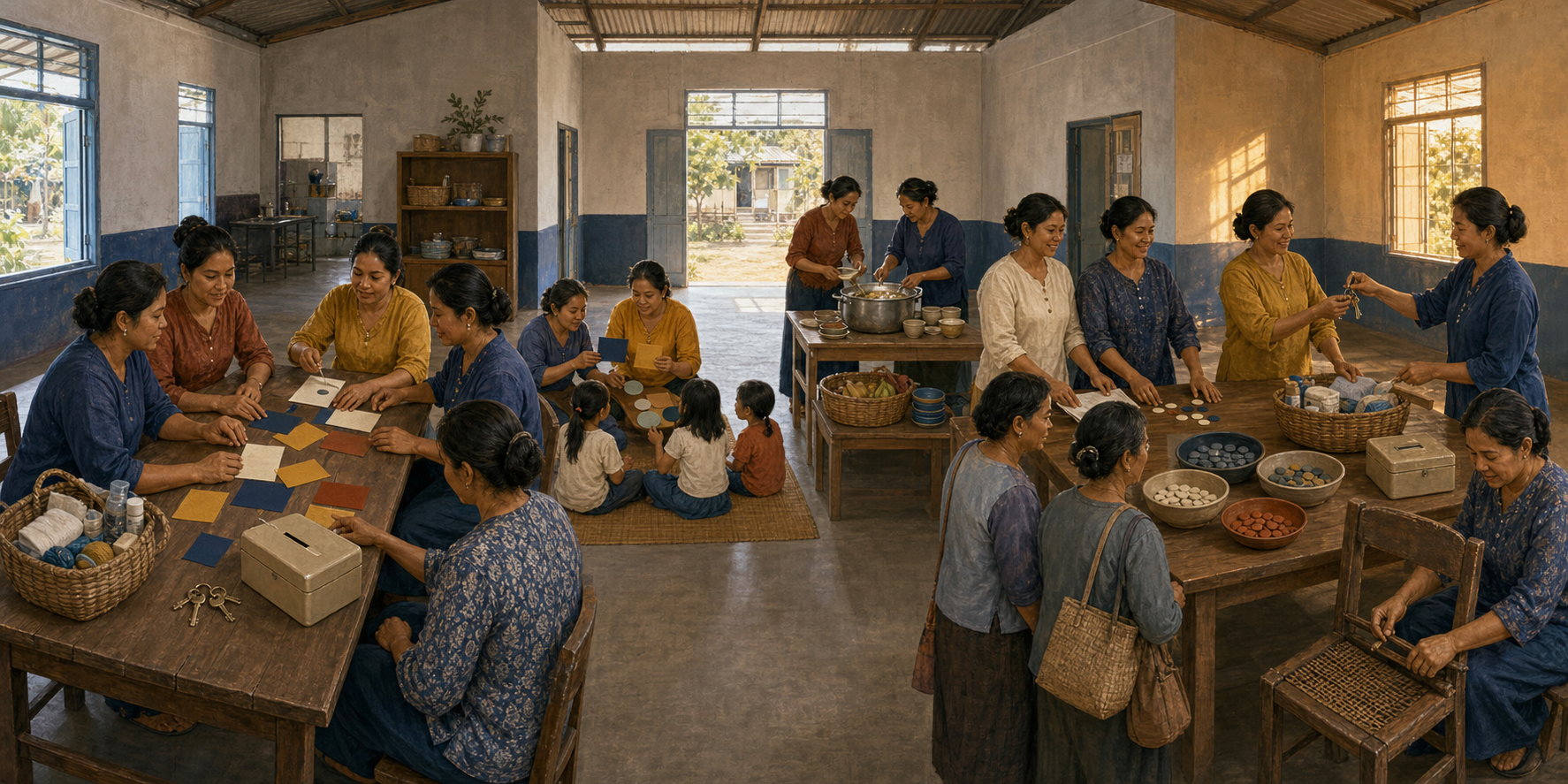
A large launch can produce attention before you know whether the institution works. A 90-day pilot gives the women leading it enough authority to test a complete cycle, while giving the wider community a defined point at which to review the design.
- Days 1-14: map the current decision chain. Select one recurring service. Speak separately with a participant, a frontline volunteer, a teacher or practitioner, the person handling money, and a member of the governing body. Ask each person who currently has authority, where delays occur, and what happens when something goes wrong.
- Days 15-30: issue the charter. Name the women-led council, its purpose, decision rights, budget, reporting duty, safeguards, and escalation route. Publish this information to the people affected by the program.
- Days 31-60: deliver one complete cycle. Keep a decision log, accounts, volunteer rota, participant feedback, and a record of exceptions. Pay attention to work that appears only after the formal plan is approved; hidden coordination is where overload often returns.
- Days 61-75: conduct a many-sided review. Hear participants and frontline volunteers separately from donors and senior officeholders. Record the strongest objection to continuing unchanged. Ask whether women had enough authority to solve the problems for which they were held responsible.
- Days 76-90: decide and hand over. Continue, redesign, or stop the pilot. Publish a short account of resources used, services delivered, unresolved concerns, and changes approved. Confirm a deputy and store the records where the next leader can retrieve them.
Watch for three predictable failures. The first is mythic praise without present authority: an organization celebrates Gargi, Sanghamitta, Mata Khivi, or Ahilyabai while keeping today’s women outside financial and governance decisions. The second is overloading: a new title is added to a woman’s existing seva without removing anything or providing resources. The third is personalization: every process depends on one respected founder, making succession feel like disloyalty. Correct these failures in the charter, not through private assurances.
Key takeaways
- A women-led institution gives women written decision rights, resources, records, and succession authority; visibility alone is not leadership.
- Teaching, kitchens, archives, devotional assemblies, discipline, patronage, and moral correction are core institutional functions, not secondary support work.
- The method must resemble the goal: an institution seeking dignity cannot be built through invisible labor, exhausted volunteers, or unaccountable control.
- Count outputs and examine outcomes. Pair service totals with evidence about access, learning, trust, and volunteer capability.
- Start with one recurring promise, test it through a 90-day cycle, document what happened, and make continuation a deliberate decision.
Your next move is not to form a vague women’s empowerment committee. Choose one service your community cannot afford to lose, map who works and who decides, and give a women-led council the mandate, resources, safeguards, and succession path to carry that promise forward. That is where recognition becomes authority, and where Shakti becomes an institution.