
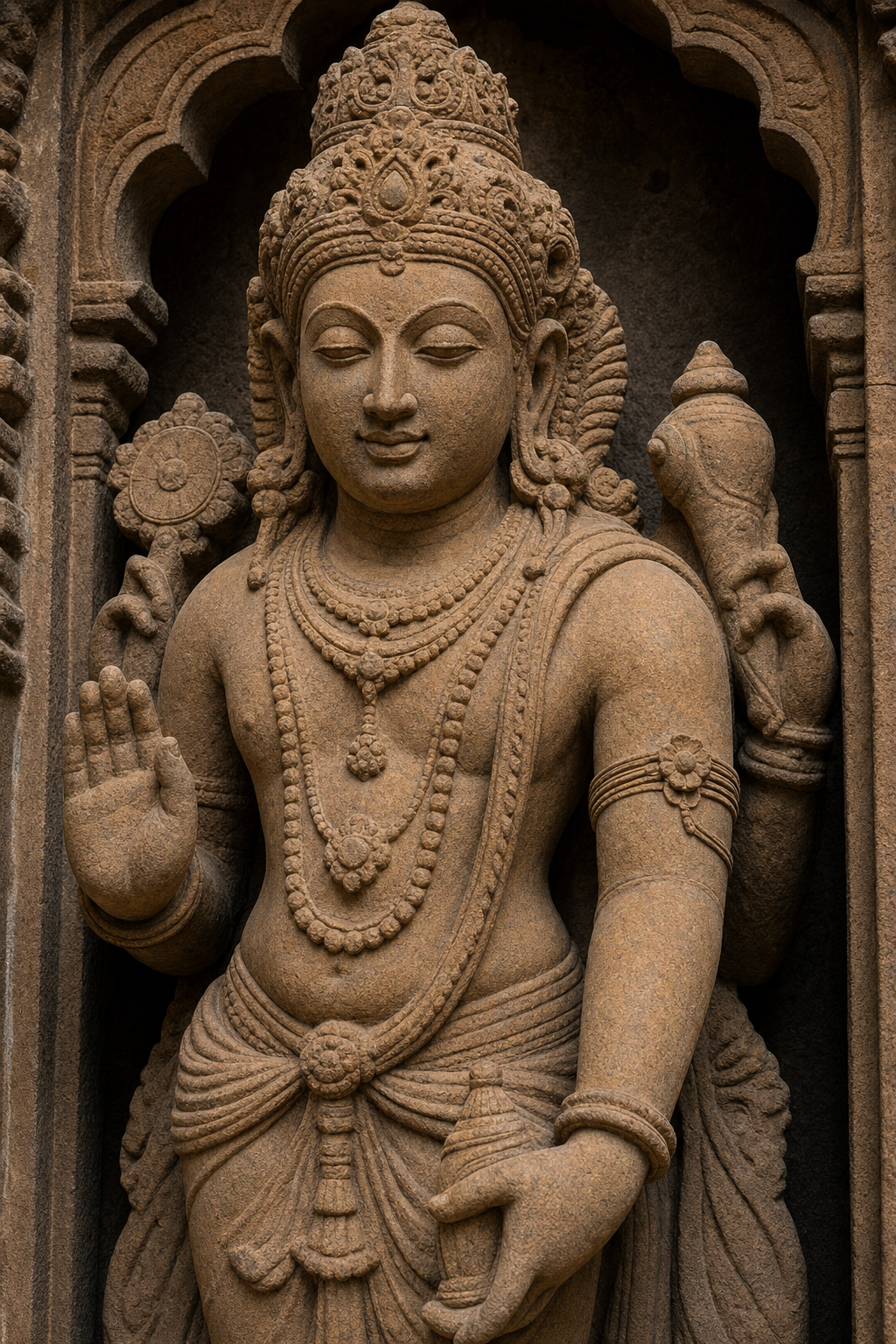
You recognize the crown, weapons, necklaces, and mudras. Then you notice a smaller detail: several cords appear to tighten around the deity’s upper arm, perhaps meeting at a flower-shaped plaque. Is that simply decorative jewelry, or does it tell you something about the image?
It may be a bahubandha, the flexible tied armlet also related to the terms bhujabandha and bajuband. To identify it confidently, you need to look beyond its position. Its strands, fastening, contact with the body, and relationship to the rest of the icon all matter.
First decide whether the ornament is actually tied
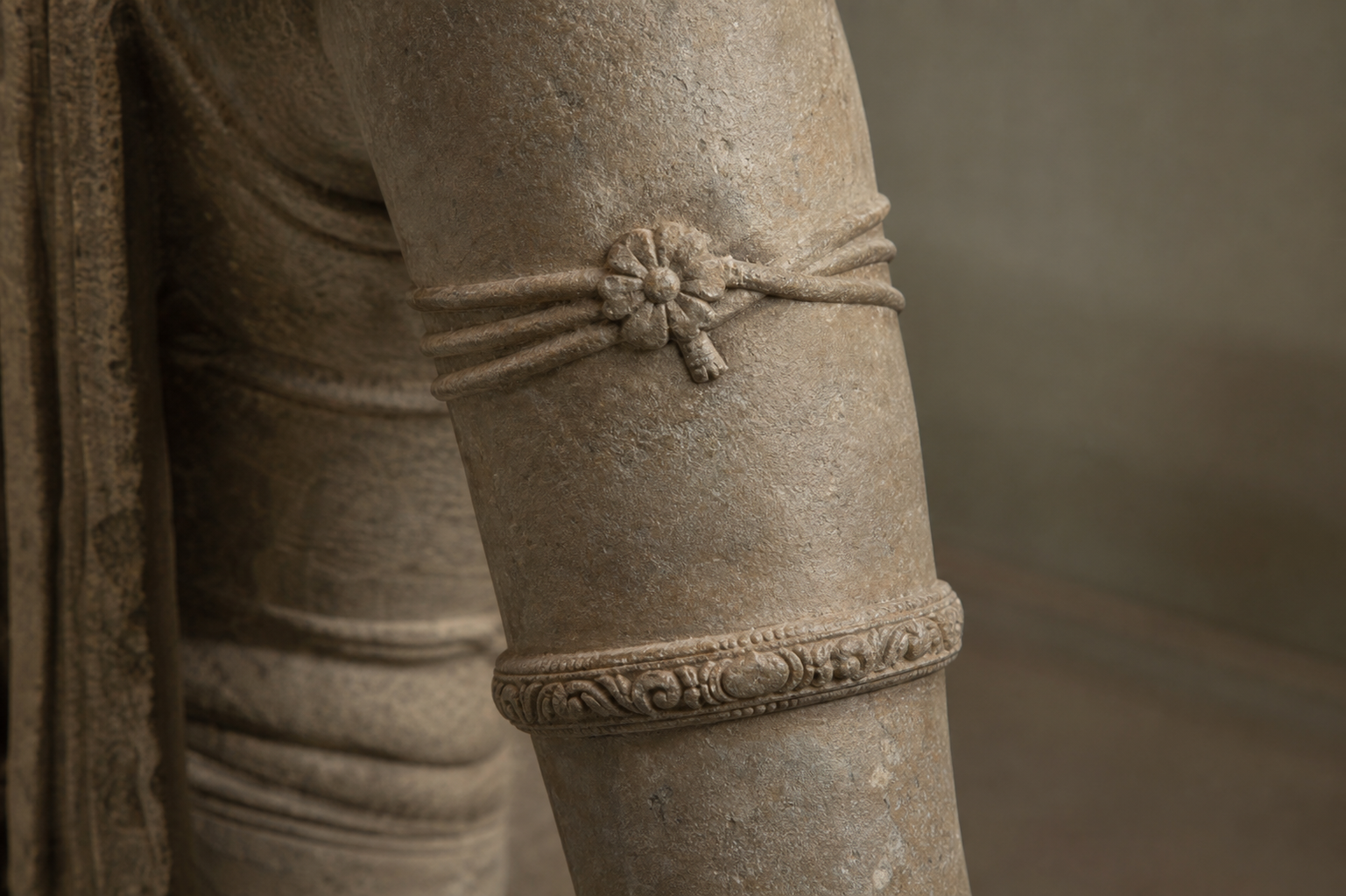
A bahubandha normally encircles the upper arm above the elbow. That location gives you a starting point, but it does not settle the identification. Keyura and bahuvalaya can occupy the same part of the arm. The decisive question is whether the sculptor has represented a flexible binding or a rigid circlet.
Look for cords, braided strands, knots, tassels, bead-like strings, or a plaque held in place by visible ties. The strands may pass around a lotus-shaped rosette or another central ornament on the biceps. In a well-preserved image, the band can seem to press slightly into the arm. That suggestion of compression is one of the clearest ways a sculptor makes stone or metal behave like thread against living flesh.
| What you see | Likely classification | What confirms it |
|---|---|---|
| Several strands or a narrow band above the elbow | Bahubandha or bhujabandha | A knot, tied ends, tassels, braided texture, bead-like cords, or a plaque visibly secured by strands |
| A continuous upper-arm ring with a clean rim | Keyura or bahuvalaya | An unbroken circular outline, broad planar surface, and no sign of fastening |
| A ring or band at the wrist | Valaya, kankana, or another wrist ornament | Its position below the elbow rather than its decoration |
Use this sequence when you are looking at a temple image or museum photograph:
- Trace the arm from shoulder to wrist. Confirm that the ornament sits above the elbow.
- Follow its outer edge. Separate strands usually indicate flexibility; a broad uninterrupted rim usually indicates rigidity.
- Search for a fastening. A knot, toggle, pendant, tassel, or pair of trailing ends is stronger evidence than surface decoration alone.
- Inspect the contact with the arm. A tied band may appear cinched, while a rigid circlet tends to keep a cleaner geometric outline.
- Check both arms. The matching ornament may preserve a knot or strand that has weathered away on the side you noticed first.
Do not classify an armlet from its medallion alone. Some bahubandhas place a rosette or lotus plaque over flexible cords, but hybrid ornaments can combine a thin rigid plaque with visibly tied strands. The construction around the plaque tells you more than the plaque’s shape.
Erosion can complicate the distinction. A worn tassel may resemble a fracture, and shallow cord lines may disappear under later deposits or damage. If you cannot find enough constructional evidence, describe what remains – such as a double-strand upper-arm ornament with a central rosette – rather than forcing a precise name.
Read the bahubandha as part of the complete icon
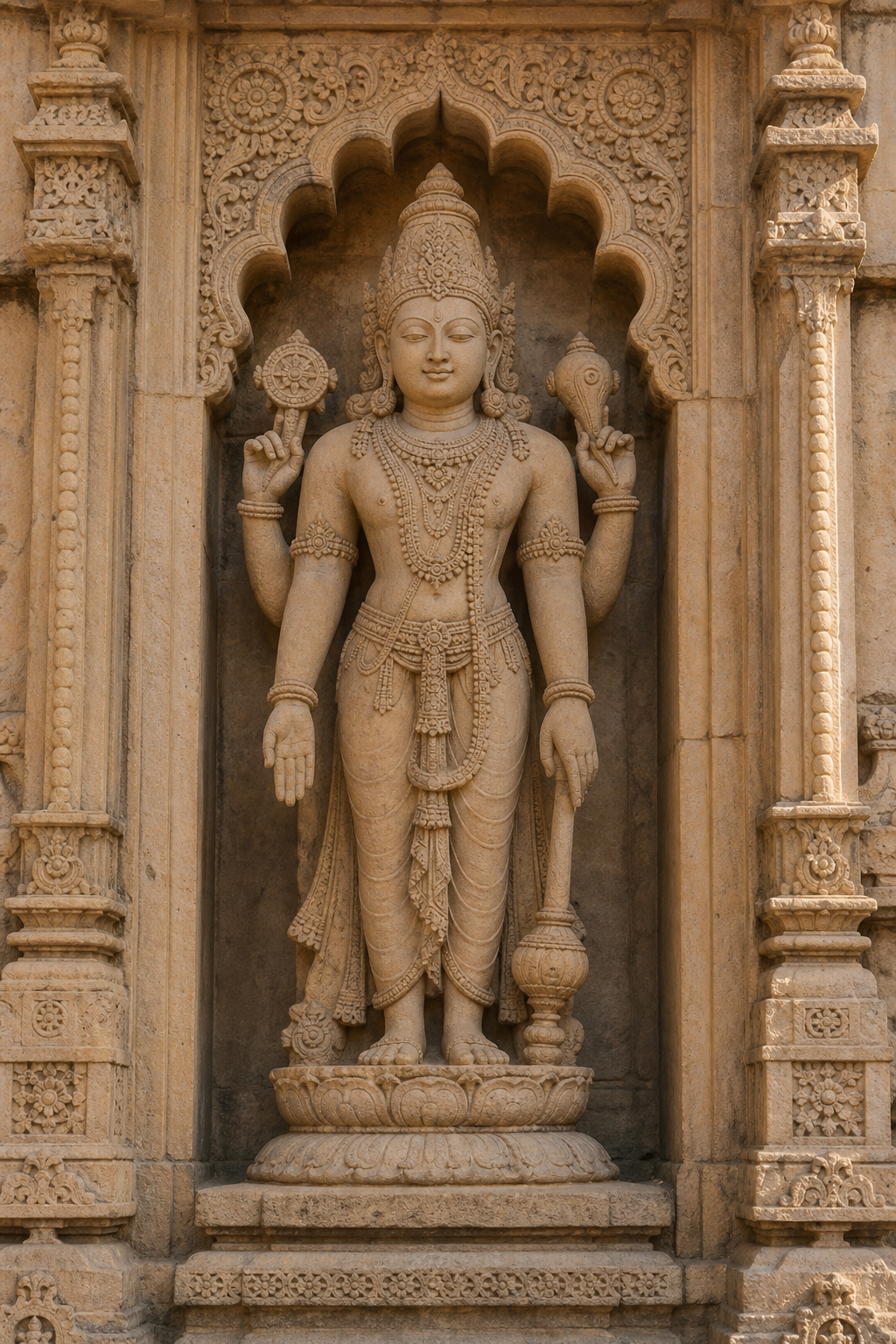
Once you have recognized the tied construction, resist the temptation to assign a fixed meaning immediately. A bahubandha does not identify a deity by itself. Its significance emerges from the wearer, posture, attributes, other ornaments, and devotional setting.
Vishnu, Shiva, and Skanda commonly appear with upper-arm ornaments, although the treatment can vary with regal, martial, or more ascetic manifestations. Devi images may carry symmetrical bahubandhas in both benign and martial forms, including Mahishasuramardini. The armlet belongs to a larger ornamental system alongside the hara or necklace, mekhala or waistband, and nupura or anklets. Together, these elements help establish the image’s mood, role, and elevated status.
Classical silpa-sastra terminology includes keyura, angada, valaya, and bhujabandha among the ornaments used for divine and royal figures. Names are not perfectly uniform across every region or period, so a catalogue may use bhujabandha where another description uses bahubandha. Treat terminology as a classification tool, not as a reason to ignore the form in front of you.
The upper arm is associated with bodily strength and the capacity to act. A binding around that arm can therefore evoke bahu-bala, or arm strength, as well as valor, protection, and disciplined power. Its resemblance to a raksha-sutra or bodily kavacha adds a protective and auspicious dimension. The underlying visual idea is not merely force. Loose strands have been gathered, tightened, and ordered, allowing strength to be directed toward dharmic action.
That interpretation becomes stronger when the rest of the icon supports it. A martial deity’s weapons, stance, and tied armlet may work together to express protective power. On a serene beneficent form, the same type of ornament may contribute more to auspicious presence, grace, and royal dignity. The construction stays recognizable while its emphasis changes with the icon.
A disciplined reading moves through three levels:
- Observation: Record what is physically visible, such as two beaded cords, a central lotus rosette, and a possible knot behind the arm.
- Classification: Decide whether those features support a flexible bahubandha rather than a rigid keyura or a wrist ornament.
- Interpretation: Ask how the armlet works with the deity’s attributes, posture, ornament set, and role.
Keeping these levels separate prevents a common mistake: turning a plausible symbolic association into a claim that every tied armlet carries exactly the same theological message.
Use regional style as a clue, not a date stamp
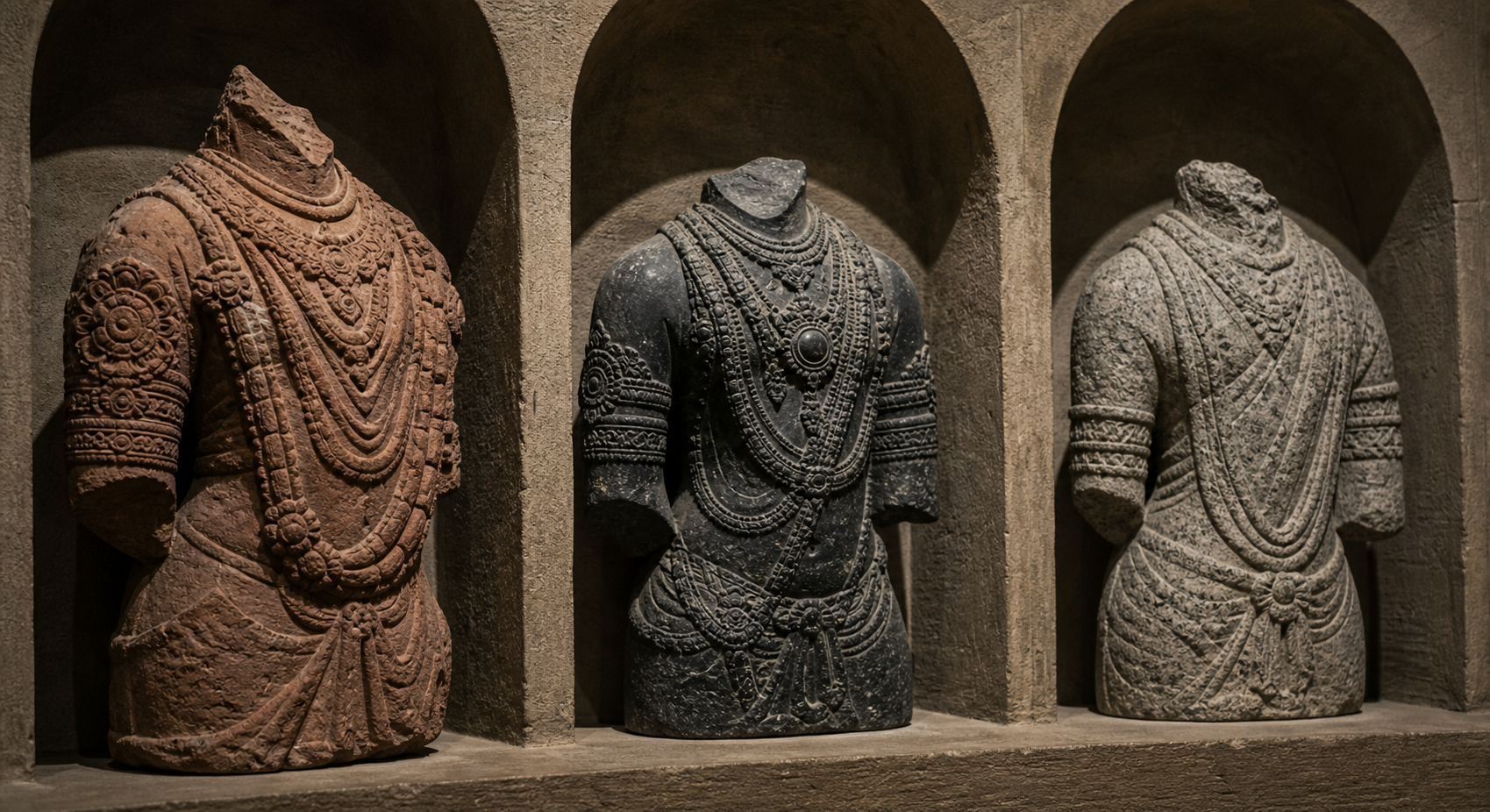
Bahubandhas occur across regions and periods, but sculptors do not treat them uniformly. Regional comparisons can sharpen your eye, provided you do not use one tiny ornament to date or attribute an entire image.
- Gupta and early medieval sculpture: Look for restrained tied bands and compact rosette-like plaques. The effect often depends on a few controlled lines rather than dense surface elaboration.
- Chola bronzes of Tamil Nadu: Slender corded armlets and delicately modeled knots complement the fluid bodies of Shiva Nataraja and Devi images. Lost-wax casting allows the tied ornament to remain fine without losing its three-dimensional presence.
- Hoysala sculpture in Karnataka: Multiple beaded cords, miniature tassels, and densely worked surfaces make the armlet part of a larger field of ornamental detail.
- Odisha temples: Images at centers including Bhubaneswar and Konark may show lotus rosettes paired with bead strings.
- Central Indian ensembles: At Khajuraho, tied and rigid armlets can appear in deliberate contrast, creating changing rhythms along the sculpted limbs.
These tendencies help you generate a question, not announce a verdict. A many-stranded armlet may encourage comparison with Hoysala carving, for example, but material, overall figure style, architectural setting, and the full ornamental program still matter. Workshops also adapt inherited forms, and damage can make an elaborate object appear deceptively simple.
The medium changes what you should notice. Stone carvers indicate softness through incised twists, rows of beads, small knots, hanging ends, and the apparent pressure of the band against the arm. Bronze casters can model cords and knots in the wax before casting, then sharpen beading and twists through chasing or engraving. Historical wearable forms could use silk or cotton cords, fine chains, gold, or silver. Repousse and filigree could enrich central plaques with lotus petals, makara scrolls, or geometric rosettes.
This is why a stone bahubandha should not be judged by whether it looks like a literal piece of metal jewelry. The sculptor may be translating a soft textile band into a hard medium. Rope-like grooves and tassel forms preserve the idea of tying even when the object itself is carved from the same block as the arm.
If you are documenting an example, capture enough context to test your first impression:
- Photograph the whole figure before taking a close-up, if photography is permitted.
- Record the armlet from the front and an oblique angle so that strands hidden at the side of the arm remain visible.
- Note the number of bands, their texture, the central plaque, any fastening, and any pendant or tassel.
- Compare the opposite arm and nearby figures from the same sculptural ensemble.
- Mark damaged or uncertain features separately instead of silently reconstructing them in your description.
Macro photography and three-dimensional scanning can reveal worn cord textures, knot forms, and the remains of tassel ends that are difficult to see at ordinary viewing distance. Those details can support comparisons among regions and workshops, but they are most useful when the complete icon and its location are documented too.
Follow the form across Dharmic traditions and living practice
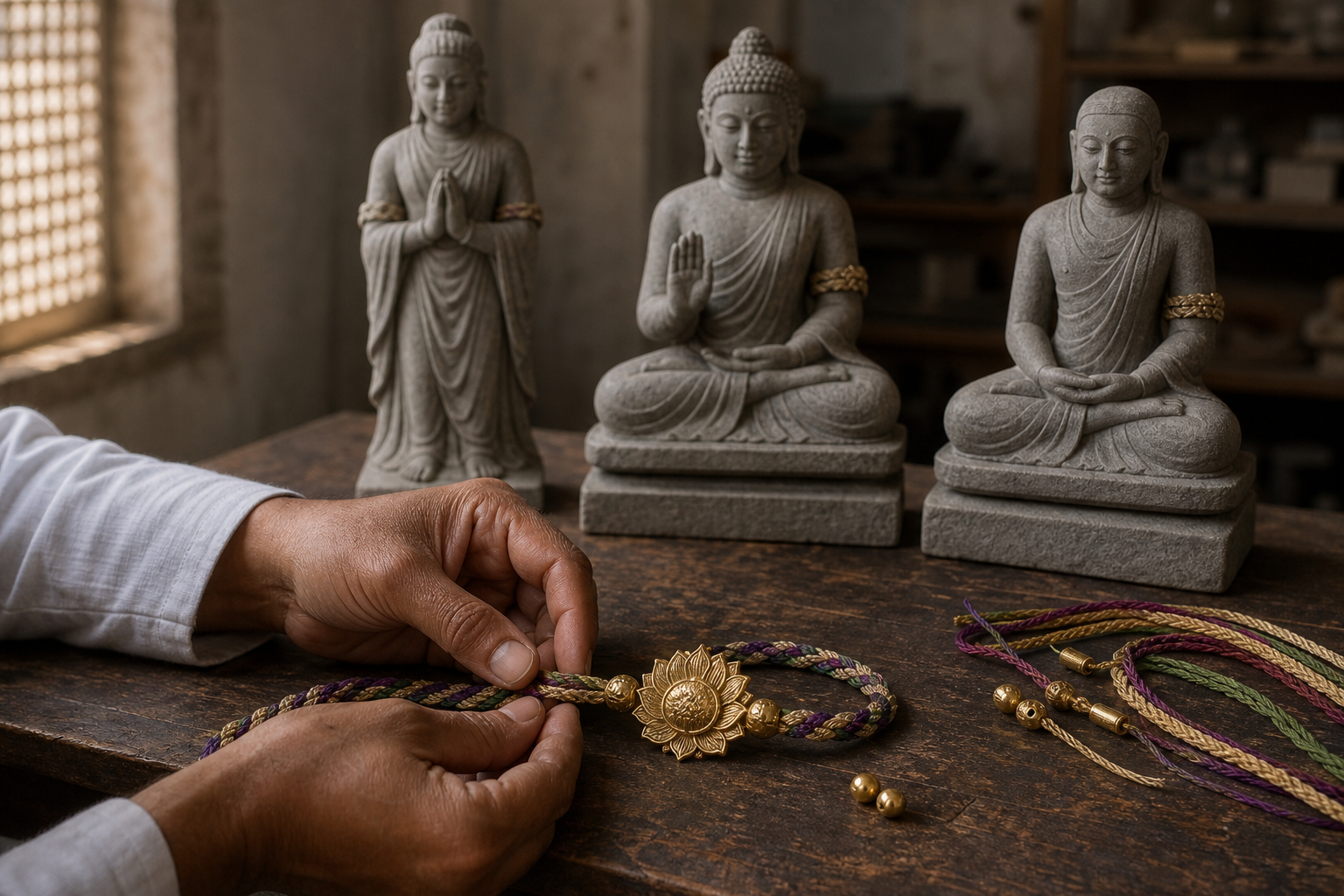
The tied upper-arm band is not confined to Hindu divine images. It belongs to a broader South Asian vocabulary of courtly, protective, and auspicious adornment. Following that form across traditions reveals shared artistic language without erasing theological differences.
In Buddhist art, princely bodhisattvas such as Avalokiteshvara and Maitreya can wear tied upper-arm bands among their ornaments. Jain Tirthankaras are generally represented without jewelry to express renunciation, but attendant yakshas, yakshis, and courtly devotees may carry elaborate armlets, including tied forms. The contrast is instructive: the presence or absence of ornament helps distinguish the spiritual role of the wearer.
You should therefore avoid treating every bahubandha as evidence of the same theology or even the same type of person. On a Hindu deity, it participates in divine iconography. On a bodhisattva, it belongs to princely adornment. On a Jain attendant, it can mark a worldly or protective role beside the unadorned Tirthankara. The form is shared; its function is contextual.
The vernacular bajuband also continued in courtly and warrior cultures, including Rajput and other kshatra lineages. Festive and bridal jewelry in parts of North and Western India still combines metal plaques with cords or textile ties. That continuity helps explain why the sculpture’s tied construction matters: the object is not merely an abstract ring around an arm but a wearable binding with recognizable bodily logic.
Classical and regional performance traditions make that logic easier to see in motion. Bharatanatyam, Odissi, Kuchipudi, Kathakali, and Yakshagana costumes can include a bajuband as part of aharya, or visual adornment. On a moving performer, the upper-arm placement frames the gestures of the shoulder, elbow, and hand. When you return to a temple image, the carved cords and pendants can begin to look less static: they imply a body capable of movement, protection, blessing, and action.
Key takeaways for your next temple visit
- Begin with position: a bahubandha belongs above the elbow, while valaya and kankana are wrist ornaments.
- Then test the construction: multiple strands, braided texture, knots, tassels, and visible ties point toward a flexible armlet.
- Do not rely on the plaque: a lotus or rosette may decorate either a tied or hybrid form; inspect what holds it against the arm.
- Look for bodily contact: slight compression against the biceps helps distinguish a cinched band from a rigid circlet.
- Interpret the whole icon: wearer, attributes, posture, and the complete ornament set determine whether protection, valor, grace, royal status, or auspiciousness is emphasized.
- Treat regional form as supporting evidence: restrained Gupta treatment, fine Chola cords, elaborate Hoysala strands, Odisha rosettes, and Khajuraho contrasts are useful comparisons, not automatic attributions.
- Keep tradition and context together: Hindu deities, Buddhist bodhisattvas, and Jain attendants can share the tied-armlet form without giving it an identical meaning.
At the next image you encounter, spend a moment tracing one arm from shoulder to wrist. Name the visible evidence before naming the ornament, and name the ornament before assigning symbolism. That small habit turns an easily overlooked piece of jewelry into a precise way of reading how temple artists joined bodily grace, skilled craft, and dharmic power.