

You may revere Sri Rama and still stop short at Sita’s Agni Pravesha or her later exile. You may honor Ayodhya, Panchavati, Bhadrachalam, Rameshwaram, and Lanka as sacred places yet hesitate when devotional memory is presented as though it were a modern survey report. Those hesitations do not place you outside the tradition. They identify the points at which serious reading begins.
The way forward is to hold three things together: the sequence of the narrative, the conflict among different duties, and the living relationship between story and place. If you separate them, the Ramayana becomes either a collection of slogans, a prosecution brief against its characters, or a map whose every landmark must be defended as a laboratory finding. Read together, they give you something much more useful: a disciplined way to think about dharma when every available choice carries a cost.
Read the whole moral sequence, not an isolated scene
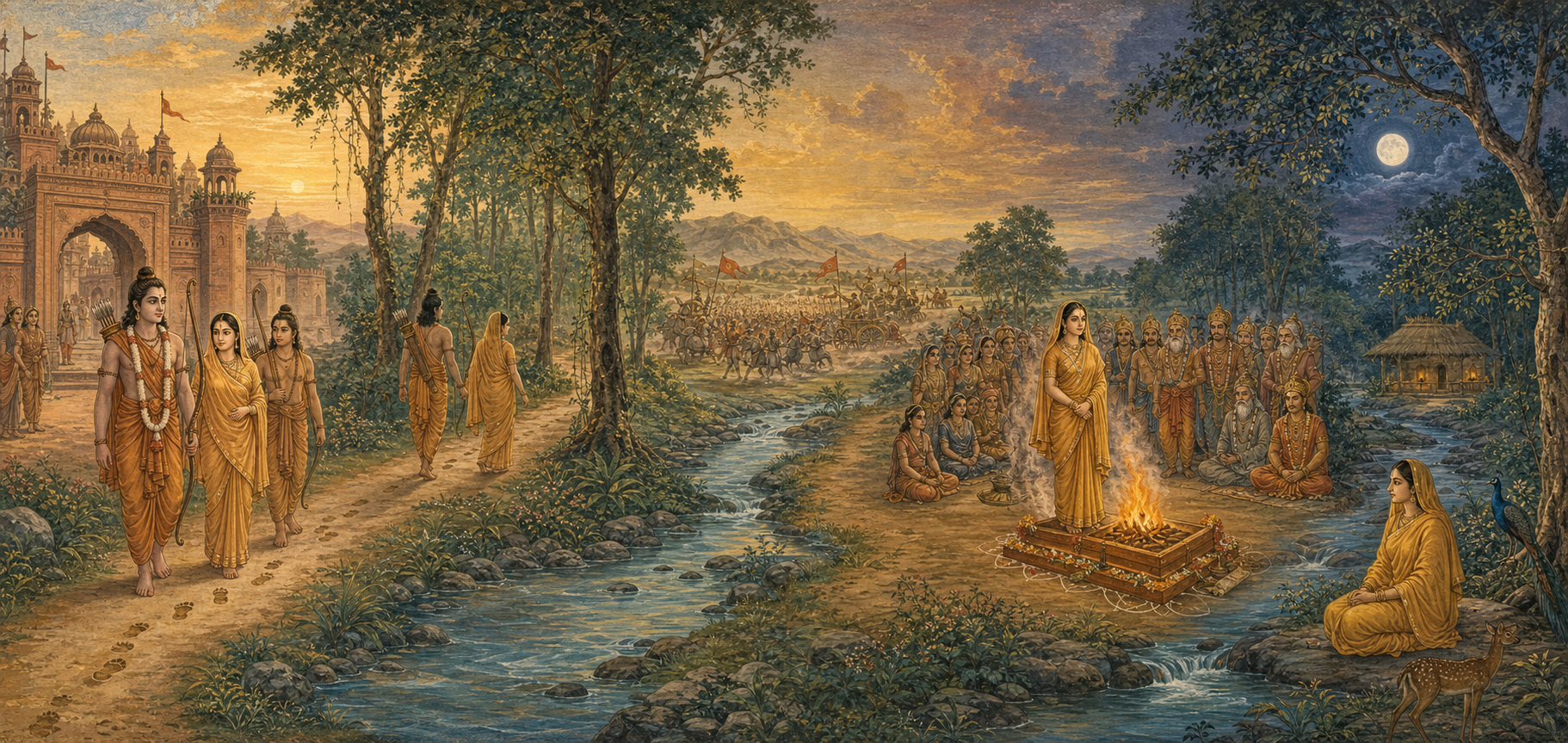
The quickest way to misread the Ramayana is to extract one disturbing decision from the responsibilities, promises, losses, and consequences surrounding it. The opposite mistake is just as serious: invoking the greatness of the whole epic to avoid examining a particular harm. Context should make judgment more precise, not make judgment disappear.
Begin by locating the episode. The traditional Valmiki Ramayana contains about 24,000 shlokas and is arranged into seven kandas: Bala, Ayodhya, Aranya, Kishkindha, Sundara, Yuddha, and Uttara. That architecture matters. Ayodhya Kanda tests fidelity to a father’s word and the renunciation of power. Aranya Kanda moves the family into the vulnerability of forest exile. Kishkindha and Sundara Kandas turn toward alliance, search, discernment, and seva. Yuddha Kanda asks how force may be used to defeat adharma and restore an abducted queen. Uttara Kanda reopens the apparent resolution by placing domestic fidelity under the pressure of royal reputation.
This sequence prevents a common conflation. Sita’s Agni Pravesha and her exile are not one continuous event. The first occurs after Ravana’s defeat in Lanka and culminates in a public divine affirmation of her purity. The second occurs later, after the return to Ayodhya, when social suspicion survives the very vindication that should have ended it. One scene uses sacred witness to close a public question; the other shows rumor reopening that question. If you merge them, you miss the distinct ethical failure exposed by the later episode.
You also need to name the version you are reading. Multiple manuscript traditions survive, and a Critical Edition was prepared to document textual variations. The status of Uttara Kanda is disputed: some readers and scholars regard aspects of it as later strata, while others defend the unity of the received epic. That uncertainty should be acknowledged without turning it into an escape hatch. Textual history asks whether an episode belonged to an earlier compositional layer. Reception history asks how centuries of worshippers, poets, teachers, and communities have understood it. Those are different questions, and both deserve an answer.
For any contested scene, make a four-line reading note before deciding what it means:
- Version: Identify the telling, language, and kanda rather than arguing about a generic Ramayana.
- Sequence: Record what promise, injury, victory, or unresolved suspicion led into the scene.
- Conflict: Name the duties pulling in different directions.
- Consequence: Follow who pays for the decision and whether the narrative treats the cost as trivial, necessary, tragic, or unresolved.
This takes only a few minutes, but it changes the quality of discussion. You stop asking whether a character is simply good or bad and start asking what conception of dharma is being tested, what it protects, and what it fails to protect.
Ask five dharmic questions of a contested decision
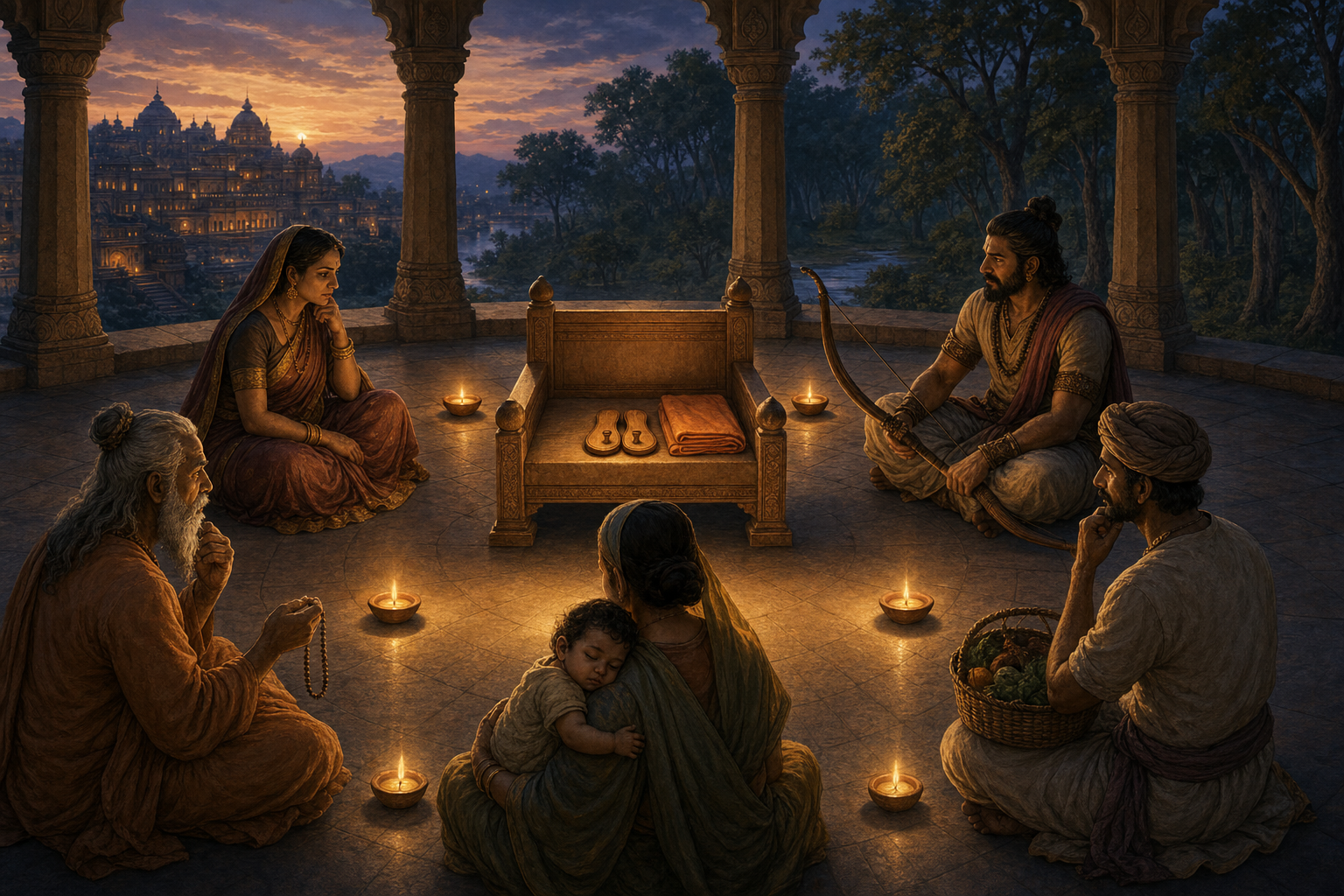
Dharma is difficult precisely because a person can occupy several relationships at once. A ruler is also a spouse, a child, a parent, and a moral agent. The Ramayana repeatedly places those obligations under pressure. Rama’s acceptance of exile, Bharata’s refusal to profit from injustice, Hanuman’s fusion of strength and humility, and Vibhishana’s break with an adharmic ruler all arise from competing loyalties rather than comfortable choices.
The hardest episodes require more than the observation that Rama faced rajadharma. Explanation is not the same as vindication. A responsible reading must examine the public purpose of a decision and the burden placed on the person with the least institutional power.
- Which duties collide? In Sita’s exile, the stated conflict lies among rajadharma, the ruler’s public duty; personal and marital duty; and lokadharma, the expectations circulating through society. Naming all three prevents public duty from becoming a phrase that automatically defeats every other obligation.
- What counts as evidence? At Lanka, Sita invokes Agni, the sacred witness of vows and Vedic rites. Agni returns her unharmed, and Rama receives her after a public affirmation before the assembled world. Within the ritual universe of the narrative, this is the highest available vindication. The later success of rumor therefore reveals a breakdown in collective moral memory, not a lack of evidence.
- Who bears the cost? Political legitimacy may explain Rama’s anxiety about public confidence, but pregnant Sita bears the physical, familial, and reputational cost of the response. If your interpretation describes the ruler’s sacrifice but cannot name hers, it is incomplete.
- Whose agency closes the scene? Sita is not merely an object passed among male decisions. She invokes Agni in Lanka. Later, after Lava and Kusha bring the Ramayana into the royal assembly, she calls upon Bhumi Devi and makes the Earth the final witness of her integrity. Her return to the Earth refuses an endless cycle in which the innocent must repeatedly satisfy changing public demands.
- What should have been different? A dharmic reading need not stop at explaining an ancient norm. It can ask how citizens should respond to rumor, how rulers should distinguish public trust from public prejudice, and how institutions can protect truth without making the vulnerable prove innocence again and again.
Agni Pravesha must therefore be read in two registers at once. In the epic’s ritual register, Agni is not an arbitrary prop but a divine witness able to establish truth publicly. In an ethical register attentive to coercion, the scene still places a terrible burden on a woman who has survived abduction and confinement. Saying that Sita chooses the declaration preserves her agency; it does not erase the conditions that made such a declaration necessary.
The exile sharpens the problem. A washerman’s taunt represents a broader social murmur about royal conduct. Classical kingship expects the ruler to remain beyond suspicion because public confidence helps sustain political order. Yet confidence corrupted by gossip is not automatically righteous. If a society ignores a completed vindication and transfers the entire cost of its suspicion to the innocent person, preserving confidence can become the preservation of injustice.
This is where devotion and moral seriousness must remain together. If devotion requires you to declare every painful act self-evidently just, the epic loses its power to examine dharma under strain. If criticism reduces Rama to a single decision and Sita to a passive victim, it loses the narrative’s architecture, theological vocabulary, and Sita’s final sovereignty. The useful question is not whether you can make the discomfort vanish. It is whether the discomfort trains you to recognize how public duty can become detached from compassion.
Use multiple Ramayanas without making them interchangeable

There is no need to choose between a single frozen Ramayana and a limitless field in which every version means the same thing. The tradition gives you plurality with names, languages, theological commitments, and literary forms. Those differences are evidence of civilizational vitality, but they also impose discipline: you should never transfer a detail from one telling into another without saying what you have done.
Valmiki’s Sanskrit composition supplies the great narrative architecture. Tulsidas’s Ramcharitmanas gives North India a deeply influential Awadhi devotional rendering. Kamban’s Tamil Kambaramayanam works through a distinctive poetic and aesthetic world. The Adhyatma Ramayana develops a more inward and Vedantic emphasis. Across Southeast Asia, the Ramakien, Reamker, Kakawin Ramayana, Hikayat Seri Rama, and Phra Lak Phra Lam localize the epic within different courts, landscapes, dramatic forms, and cultural codes.
Dharmic plurality also changes the ethical emphasis. The Buddhist Dasaratha Jataka reshapes elements in a didactic setting. Vimalasuri’s Jain Paumacariya aligns the inherited narrative with a stronger commitment to ahimsa and restraint. Sikh reflection can illuminate maryada, seva, truthful living, and the union of spiritual and temporal responsibility, but it should not be carelessly described as though Sikh tradition simply possesses another equivalent Ramayana recension. Shared civilizational values do not erase philosophical distinctions.
When you compare tellings, use four stable questions:
- Which character makes the decisive choice in this version?
- Which virtue receives the strongest emphasis: fidelity, bhakti, ahiṁsa, royal duty, inner realization, courage, or seva?
- Does the telling preserve the moral conflict, resolve it theologically, or redirect attention to a different problem?
- How do language, region, performance, and worship change what the audience is expected to notice?
This method is especially valuable in arguments about Sita. Some later theological traditions employ Maya Sita or Chaya Sita, in which Agni protects the real Sita during the abduction and restores her at the fire ordeal. That protects her inviolability within a particular theological frame. It does not cancel the ethical questions raised by the Valmiki narrative or the social demand that a woman’s purity be publicly demonstrated. The versions may answer different anxieties.
Before debating a controversial episode, ask one sentence: Which telling are we discussing? That question does not weaken a claim to truth. It prevents a composite memory assembled from several traditions from being mistaken for the wording, theology, or sequence of one identifiable text.
Approach sacred geography through four distinct kinds of claim
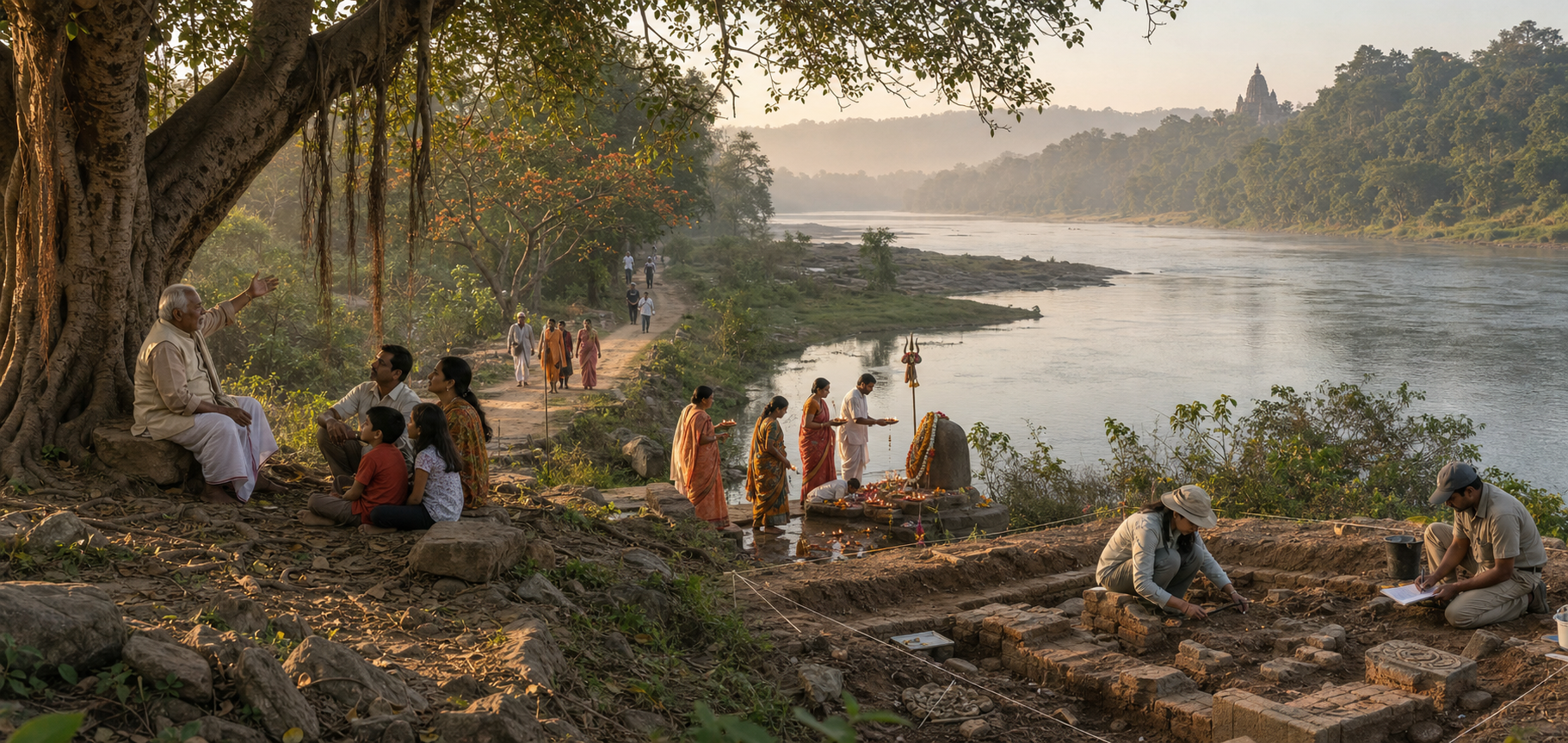
The Ramayana is not encountered only on a page. Its movement through Ayodhya, Chitrakoot, Dandakaranya, Panchavati, Kishkindha, Rameshwaram, and Lanka creates a sacred route sustained by pilgrimage, festivals, temples, and local memory. The traditional identification of Rama Setu, also called Adam’s Bridge, makes that memory tangible. Yet devotional significance and modern empirical proof are not the same kind of claim.
You do not have to diminish a tirtha in order to speak accurately about it. You do have to know which question you are asking. Four layers commonly meet at a Ramayana kshetra:
- Epic geography: What places, rivers, forests, kingdoms, and directions does the narrative name?
- Sthala Puranam and local memory: How does a community identify a hill, riverbank, cave, hermitage, or shrine with an episode? What oral histories and ritual routes preserve that identification?
- Attested institutional history: What can be dated through rulers, patrons, inscriptions, administrative records, architecture, or known devotional figures?
- Living sacred practice: How do darshan, parayana, kirtana, vrata, festival, seva, and care for the surrounding ecology keep the place spiritually active?
Bhadrachalam shows why these distinctions help. Its place in the Godavari basin connects it to the remembered landscape of Dandakaranya. Local tradition identifies Bhadradri with the tapas of Bhadra and associates nearby Parnasala with the forest dwelling of Rama, Sita, and Lakshmana and the episode of the golden deer. These are claims of sacred memory expressed through Sthala Puranam and pilgrimage.
The kshetra also carries different kinds of historical memory. Pokala Dammakka is remembered as the devotee who, guided by a dream, discovered the moola vigrahas in an anthill and began worship with forest offerings. In the 17th century, Kancherla Gopanna, revered as Bhadrachala Ramadasu, became central to the temple’s development while serving under the Qutb Shahi administration. His imprisonment, release, devotional compositions, and association with temple patronage occupy a field where documented political history and hagiographic memory meet. Accuracy requires you to preserve that meeting rather than force every detail into either the category of chronicle or the category of fiction.
The main icon gives another form of interpretation. Vaikuntha Rama at Bhadrachalam bears four arms: the upper hands hold shankha and chakra, while the lower hands carry bow and arrow. The murti joins Rama as the bounded, exemplary king with Vishnu’s transcendent form. Sacred geography is therefore not merely the assertion that an event happened at a coordinate. It is the continuing interpretation of the Ramayana through icon, song, ritual, landscape, and community.
Sri Rama Navami Kalyanam and the Pattabhishekam observance make this continuity public. Ramadasu’s kirtanas let participants receive theology through melody. The Godavari functions as a tirtha, while procession routes extend the sacred order of the temple into the town. A site becomes living geography because people return, worship, remember, serve, and transmit—not because an argument on a map has been won.
Use the same discipline when visiting any Ramayana place:
- Before the yatra, read the relevant episode and learn whether the local identification comes from the Sanskrit narrative, a regional telling, a Sthala Puranam, oral tradition, or later temple history.
- At the site, ask what the community actually commemorates. Notice the murti, river, hill, procession path, songs, and seasonal observances instead of treating the visit as a search for a single archaeological exhibit.
- Keep labels honest. Say traditional identification when that is what you mean. Say attested history when a person, patronage event, or institution can be historically situated. Devotional conviction does not need an inflated empirical claim.
- Protect what carries the memory. Responsible pilgrimage includes respect for ritual order, support for traditional arts, care for the Godavari and other sacred ecologies, and restraint in the use of crowded temple spaces.
- Bring one practice home. Choose a Rama-nama japa, a Sundara Kanda reading, a form of seva, or a specific correction in your conduct. Without ethical return, sacred travel risks becoming religious sightseeing.
This approach avoids two brittle positions. A sacred site is not meaningless because every local identification cannot be demonstrated by the methods of modern cartography or archaeology. Nor does reverence authorize every historical assertion. A kshetra can be spiritually true as a center of inherited memory, worship, moral formation, and ecological responsibility while its individual location claims remain traditional, debated, or historically layered.
Key takeaways for your next reading or yatra
- Identify the Ramayana version and the episode’s place in the narrative before making an ethical judgment.
- Separate an explanation based on rajadharma from a conclusion that the resulting action was fully just.
- Measure a decision by its public purpose, its evidence, its effect on the vulnerable, and the agency retained by the person who bears the cost.
- Use Hindu, Buddhist, Jain, Sikh, and regional perspectives to sharpen distinctions, not to flatten different traditions into one interchangeable story.
- At a sacred place, distinguish epic geography, local Sthala Puranam, attested institutional history, and living worship.
- Let pilgrimage end in practice: disciplined speech, resistance to rumor, seva, remembrance, or care for the land and water sustaining the kshetra.
For your next encounter with the Ramayana, choose one difficult episode or one sacred place. Write down the version, the competing duties, the person who pays the price, and the practice the encounter asks of you. That small discipline lets reverence mature into discernment. It also makes sacred geography live where it matters most: in the conduct you carry back into the world.
References
- DharmaRenaissance Blog — Ramayana in Brief: A Powerful, Immersive Summary of Lord Rama’s Epic, Dharma, and Legacy
- DharmaRenaissance Blog — Bhadrachalam Sthala Puranam: Sacred Legends, Living Devotion at Sita Ramachandra Swamy
- DharmaRenaissance Blog — Sita’s Agni Pravesha and Exile: The Contested Ethics of Rajadharma and Public Trust