
You may see Vaisakhi marked around April 13 or 14, Vaishakha beginning several days later in a Gujarati or Telugu panchang, and a North Indian calendar assigning a different month-name to the same waning fortnight. That does not automatically mean one calendar is wrong. It usually means the calendars are measuring different cycles or placing the boundary of the lunar month at different points.
If you are arranging a vrata, temple visit, family puja, Jain parana, Buddhist Vesak observance, or Sikh Vaisakhi gathering, do not begin with the Gregorian date alone. First identify which Vaishakha you mean, which tradition you are following, and where the observance will occur. Once those three facts are fixed, most apparent contradictions disappear.
Three clocks can all be called Vaishakha
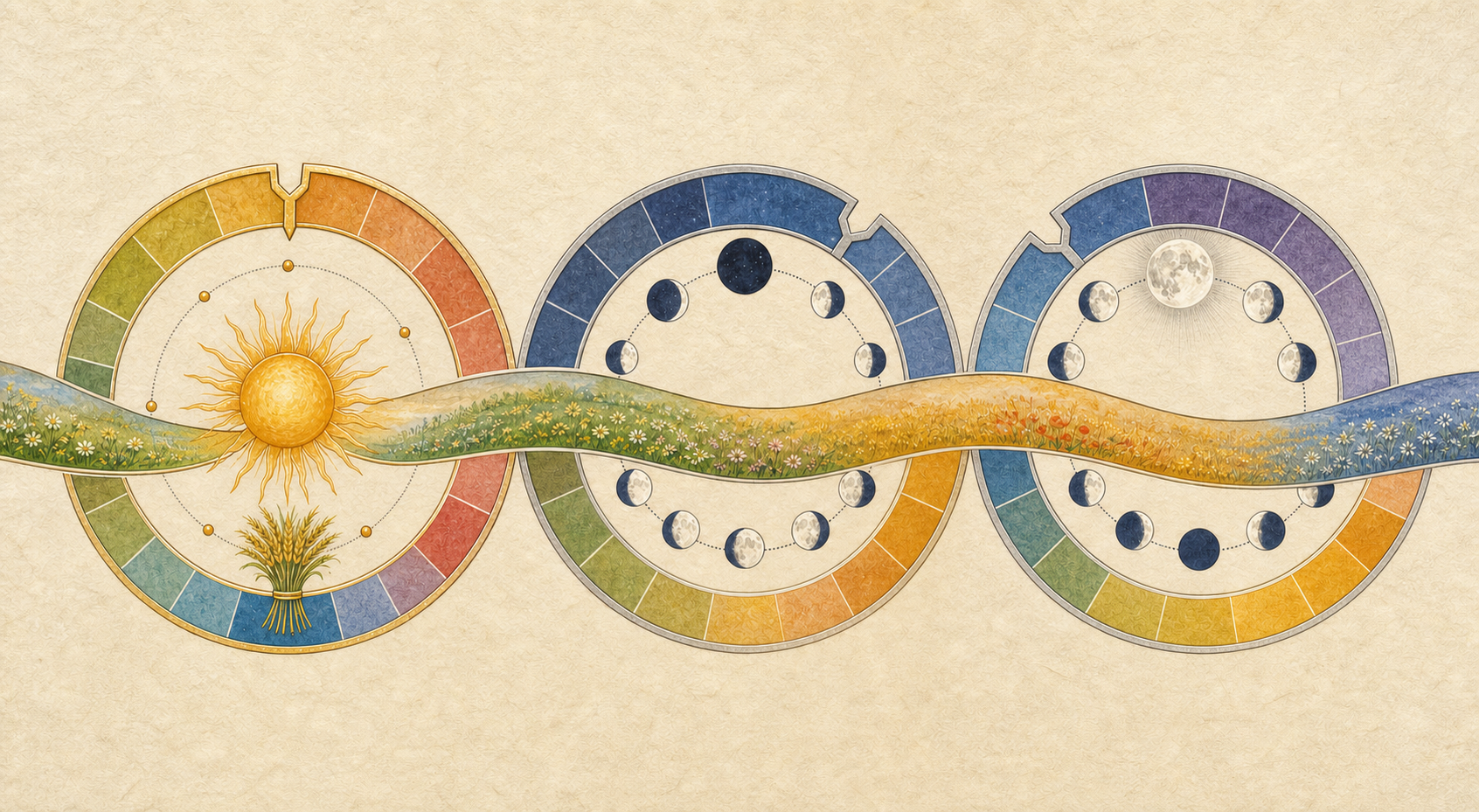
The word Vaishakha belongs to more than one regional calendar vocabulary. Vaishakh, Vaisakha, Vaisakhamasa, Vaishakhamu, Vaisakh, and Boishakh may be related names, but spelling alone does not reveal how the month has been calculated. You need to distinguish the amanta lunar month, the purnimanta lunar month, and the solar month or seasonal threshold.
| Calendar framework | How the boundary is set | Where you commonly meet it | What it changes for you |
|---|---|---|---|
| Amanta lunar Vaishakha | Begins the day after Amavasya and ends at the next Amavasya. Shukla Paksha comes first, followed by Krishna Paksha. | Gujarat, Maharashtra, Karnataka, Andhra Pradesh, and Telangana | The whole bright and waning sequence from Shukla Pratipada through the closing Amavasya carries the Vaishakha label. |
| Purnimanta lunar Vaishakha | Begins after Purnima and ends at the next Purnima. Krishna Paksha comes first, followed by Shukla Paksha. | Much of North India and parts of eastern India | The same tithis still occur, but the waning fortnight attached to the name Vaishakha is not the same waning fortnight used by an amanta calendar. |
| Solar Vaisakh or a related regional solar season | Follows the Sun’s movement, especially the Mesha solar threshold, rather than a new-moon or full-moon boundary. | Punjab’s Vaisakhi season, Bengali Pohela Boishakh, Kerala’s Vishu, and other regional solar traditions | The observance is tied to a solar ingress or regional solar year, not to Vaishakha Shukla Pratipada. |
The 2026 dates provide a useful test case. In the Gujarati amanta calendar, Vaishakh runs from April 18 through May 16, within Vikram Samvat 2082. The Kannada reckoning uses the same April 18-May 16 amanta interval, as does the Telugu calendar followed in Andhra Pradesh and Telangana. Vaisakhi’s solar threshold comes earlier, around April 13 or 14. Placing both on one calendar without identifying one as solar and the other as lunar creates a false conflict.
Regional year numbering creates another harmless difference. Vaishakha is ordinarily the second lunar month in Kannada and Telugu year sequences, but it is the seventh month in Gujarat because the Gujarati year begins with Kartika after Deepavali. The ordinal number tells you where a region starts its year; it does not change the tithis or the sanctity of the month.
When someone gives you a Vaishakha date, therefore, ask a more precise question: Is this lunar or solar? If it is lunar, is the panchang amanta or purnimanta? That two-step check is more useful than debating which regional spelling is correct.
The fortnight is where lunar month labels stop matching

Vaishakha takes its name from the full moon occurring near the Vishakha nakshatra. A lunar tithi is not a fixed 24-hour weekday. It represents 12 degrees of change in the angular separation of the Moon and Sun, so a tithi can start or end at any civil time and can be shorter or longer than an ordinary date on your wall calendar.
- Amanta order: the month opens after Amavasya, advances through Shukla Pratipada to Purnima, continues through Krishna Paksha, and closes at Amavasya.
- Purnimanta order: the named month opens after Purnima, advances through Krishna Paksha to Amavasya, continues through Shukla Paksha, and closes at Purnima.
The crucial point is that both systems share the same waxing fortnight leading to Vaishakha Purnima. Akshaya Tritiya, Mohini Ekadashi, Narasimha Jayanti, and Vaishakha Purnima do not become different celestial events merely because two regions draw the month boundary differently. The mismatch appears mainly when you ask which named month owns a particular Krishna Paksha.
This is why a North Indian panchang and an amanta panchang can assign different month-names to the same waning tithi. Do not transfer a Krishna Paksha festival from one regional calendar by copying only the month-name. Transfer it by its exact tithi, its paksha, the applicable ritual rule, and the local place of observance.
Regional vocabulary can hide the underlying agreement. Gujarati Vaishakh Sud is Shukla Paksha, while Vaishakh Vad is Krishna Paksha. Telugu usage may call the waning phase Bahula Paksha. Translating those terms before comparing entries will often reveal that the panchangs agree about the lunar phase even when their labels look unfamiliar.
A second source of apparent disagreement is the sunrise rule. For many observances, the deciding date is the civil day on which the required tithi prevails at local sunrise, often called the udaya-tithi principle. But sunrise in Ahmedabad, Bengaluru, Hyderabad, London, Toronto, and Singapore does not occur at the same astronomical moment. A tithi that survives until sunrise in one place may have ended before sunrise in another. That is why a diaspora observance can fall one civil date away from the date printed for India.
Udaya tithi is also a starting rule, not a universal shortcut. Some rites require the tithi during a particular part of the day. Ekadashi has sampradaya-specific rules and a prescribed Dvadashi parana window. Narasimha Jayanti looks to the presence of Chaturdashi near the evening worship period. Sankranti observances follow the exact solar ingress. When timing matters, the name printed at the top of a monthly calendar is less important than the rule governing the specific rite.
Read the sacred season as a sequence, not a pile of dates

Vaishakha becomes easier to understand when you arrange its observances by calendrical type and tithi. This keeps distinct Dharmic traditions visible without forcing them into one ritual system.
The solar threshold: Vaisakhi and regional new-year rhythms
Vaisakhi belongs first to a solar seasonal setting around April 13 or 14. It is a harvest turning point in North India and carries profound Sikh significance through the formal establishment of the Khalsa. Pohela Boishakh marks the Bengali New Year around the same solar transition, while Vishu is Kerala’s corresponding new-year marker. These occasions sit beside the lunar Vaishakha season, but they should not be described as Vaishakha Shukla Paksha festivals.
For a shared family or community calendar, give solar observances their own label. Write Vaisakhi as a solar or Bikrami observance, then enter Akshaya Tritiya and Buddha Purnima by lunar tithi. This simple separation prevents the common mistake of treating every April festival with a related name as the beginning of one universal month.
The waxing fortnight: beginnings, discipline, and protection
In an amanta calendar, Vaishakha opens with Shukla Pratipada. Its bright fortnight then supplies many of the season’s most widely shared Hindu and Jain observances:
- Shukla Tritiya: Akshaya Tritiya, also called Akha Teej, is associated with acts intended to bear enduring merit. Hindu practice emphasizes Vishnu-Lakshmi worship, dana, new commitments, and, in many traditions, Parashurama Jayanti. Jain tradition remembers Rishabhanatha receiving sugarcane juice after prolonged tapas, the sacred pattern behind Varshitap parana.
- Shukla Saptami: Ganga Saptami or Jahnu Saptami directs attention to purification and the sacred presence of Ganga.
- Shukla Navami: Sita Navami honors Devi Sita and brings patience, fidelity to dharma, and resilience into the month’s discipline.
- Shukla Ekadashi: Mohini Ekadashi is observed through fasting, japa, katha, and carefully timed parana on Dvadashi.
- Shukla Chaturdashi: Narasimha Jayanti honors Vishnu’s Narasimha avatara and the protection of Prahlada. Evening worship, fasting rules, and the exact Chaturdashi span should be checked in the devotee’s own sampradaya.
Do not reduce Akshaya Tritiya to shopping or to a generic promise that any decision made that day must succeed. Its older spiritual grammar is more demanding: begin something worthy of continuation, pair aspiration with dana, and make the sankalpa concrete. You might establish a recurring food donation, begin a disciplined course of svadhyaya, support a water facility, or take responsibility for a tree rather than treating auspiciousness as a substitute for effort.
Narasimha Jayanti gives the fortnight a different tone. Prahlada’s steadfastness and Narasimha’s intervention place courage under the authority of dharma. If you are organizing a household observance, confirm the evening tithi first; only then arrange the fast, recitation, naivedya, and temple visit around it.
Vaishakha Purnima: one full moon, distinct sacred memories
Vaishakha Purnima is a genuine meeting point among Dharmic paths. Buddhists observe Buddha Purnima or Vesak, commemorating the Buddha’s birth, enlightenment, and, in different lineages, parinirvana. Vaishnava traditions may celebrate Kurma Jayanti, honoring the avatara whose steadiness supports the cosmic churning. Many Hindu households also perform Satyanarayana Puja on Purnima.
A common lunar landmark does not make these ceremonies interchangeable. A Buddhist vihara, a Vaishnava temple, and a household Satyanarayana vrata bring different teachings and ritual forms to the same full moon. The respectful approach is to recognize the shared civilizational calendar while allowing each tradition to explain its own meaning. The convergence is strongest at the ethical level: compassion, wisdom, disciplined living, and support offered in times of strain.
The waning fortnight and the amanta close
After Purnima, amanta Vaishakha moves through Krishna Paksha toward Amavasya. Apara Ekadashi provides the principal Ekadashi discipline of this half, with the fast completed through the correct Dvadashi parana. Telugu communities may also observe Hanuman Jayanti during Vaishakha Krishna or Bahula Paksha, often on Bahula Dashami. This is a regional observance, so it should not be moved into another calendar merely because a different region celebrates Hanuman Jayanti elsewhere.
Vaishakha Amavasya closes the amanta month. Many families use it for pitri remembrance, tarpana, deepa-dana, and quiet charity. Shani Jayanti is associated with this new moon in some traditions, while others place it in Jyeshtha. That variation is a reason to follow your lineage or temple calendar, not a defect that must be flattened into one national date.
The practice connecting the whole season
The traditional Vaishakha triad is snana, dana, and japa: early bathing or purification, compassionate giving, and steady recitation. Vaishnava households honor Vishnu as Madhava through tulasi, chandana, Vishnu Sahasranama, nama-japa, and sattvic restraint. The Padma Purana and Skanda Purana preserve the Vaishakha-mahatmya that gives these practices their scriptural setting.
The season’s dana is deliberately practical. Vaishakha overlaps intense summer heat across much of Bharat, so potable water, buttermilk, panakam, food, shade, earthen water pots, sandals, umbrellas, and cooling relief become forms of worship through service. Temple sandalwood rituals express the same seasonal intelligence: cooling the deity and relieving the suffering of living beings belong to one moral imagination.
You do not need to reproduce every regional observance to enter that rhythm. Choose one daily discipline and one outward service. A workable household pattern is a morning bath and short recitation, followed by a sustained commitment to water or food seva. It is better to keep that modest sankalpa throughout the month than to assemble an exhausting festival list that cannot survive ordinary family and work responsibilities.
Choose the correct date without mixing panchangs

Key takeaways
- Identify whether the observance is lunar or solar before copying a Gregorian date.
- For a lunar observance, record the paksha and tithi; also note whether your regional calendar is amanta or purnimanta.
- Use a panchang calculated for the city where the rite will occur, not automatically for a city in India or for the location of the person sending the invitation.
- Check the ritual’s governing time: sunrise for many festivals, evening for Narasimha Jayanti, a prescribed Dvadashi window for Ekadashi parana, or exact solar ingress for Sankranti-linked rites.
- Follow one temple, lineage, or trusted panchang consistently when calculation methods differ; do not combine the start time from one calendar with the parana time from another.
Write each calendar entry in this order: observance – tradition or sampradaya – city and time zone – paksha and tithi or solar ingress – required part of the day – completion or parana window. That line contains the information a priest, temple, or knowledgeable family member actually needs to verify the date.
Ekadashi shows why the last item matters. Saving only the fasting date is incomplete; the vrata ends through parana on Dvadashi within a prescribed window. A calendar that says Mohini Ekadashi without showing the local parana time has not yet given you enough information to plan the observance.
When two panchangs differ by one day, compare their location, sunrise, time zone, tithi end time, and astronomical method before deciding that either is mistaken. Drik and traditional computational conventions can produce small differences, while lineage rules can affect which of two eligible sunrises is selected. If your temple has announced a date, ask which local panchang and sampradaya rule it follows, then use that same authority for the associated fast and parana.
The same care applies to samskaras. Vaishakha may be considered broadly auspicious, but a month-name alone is not a complete muhurta. A family choosing a griha-pravesha, naming ceremony, or business commencement may also consider weekday, nakshatra, tithi, and other planetary conditions. Keep that selection separate from the simpler question of which month is currently running.
For a family spanning several Dharmic traditions, preserve distinctions visibly. Mark Vaisakhi as solar, Akshaya Tritiya by Shukla Tritiya, Vesak by Purnima, and any local vrata according to its own lineage. You can still choose a shared act of jalaseva, annadana, or community care. Unity is strongest when it does not require anyone to surrender calendrical or theological precision.
Before marking your next Vaishakha observance, fill in that six-part planning line and verify it against one city-specific panchang. You will have a date you can actually use, a practice your household can sustain, and a clearer view of how Bharat’s regional calendars preserve both shared sacred time and legitimate diversity.
References
- DharmaRenaissance Blog – Vaishakh Maas 2026 in the Gujarati Panchang: Sacred Timelines, Festivals, and Ritual Guide
- DharmaRenaissance Blog – Vaisakha Masa 2026 (Kannada Calendar): Dates, Sacred Significance, and Festival Guide
- DharmaRenaissance Blog – Vaishakha Masam Mahatmya: Sacred Significance, Vishnu’s Grace, and Dharmic Unity
- DharmaRenaissance Blog – Vaishakha Masam 2026: Dates, Key Vratas, and Dharmic Significance in the Telugu Calendar