

You may already understand that Bhudevi is sacred. The harder question begins when the lamp is extinguished: what should that reverence change about the water you use, the food you discard, the offerings you carry, or the neglected ground near your home? Varaha worship gives you a way to answer without turning bhakti into a slogan.
Ecological dharma here means a disciplined relationship between worship and stewardship. Puja establishes whom you revere. Sankalpa names the duty you accept. Seva tests whether you carried it into the world. Keep all three together, and Varaha’s image becomes a practical pattern for restoration.
Varaha changes ownership into guardianship
Varaha is Vishnu’s third avatara in the Dashavatara. In the Puranic narrative, Hiranyaksha has submerged Earth in the cosmic waters. Vishnu takes the form of Varaha, enters the depths, defeats the asura and raises Bhudevi on his tusks, restoring the world to order.
The sequence matters. Varaha does not admire Earth from a safe distance. He recognizes that she is imperilled, enters the disturbance, confronts what keeps her submerged and lifts her. Ecological responsibility shaped by this avatara must therefore go beyond affection for beautiful landscapes. It must notice damage and participate in repair.
That does not make Hiranyaksha a convenient label for every person or institution you oppose. Nor does the avatara reduce neatly to a modern environmental slogan. The narrative gives you a moral pattern, not permission to turn ecological questions into another field of careless accusation. The first question is your own duty: what has been placed within your reach, and what can you help restore?
Seeing Earth as Bhudevi also changes the grammar of ordinary life. Soil is not merely a surface beneath your property. Water is not merely a commodity delivered through a pipe. Plants, animals and human communities are not background objects in a private search for comfort. You still have to cook, travel, build, farm and maintain a household, but you do these things as a dependent participant in creation rather than its absolute owner.
Varaha’s iconography joins the head of a boar with a conscious, compassionate form that bears Bhudevi upward. The image holds firmness and tenderness together. Ecological dharma needs both. Tenderness without resolve becomes sentiment. Resolve without tenderness can make protection harsh, arrogant or indifferent to the people who live on the land.
Before choosing an ecological vow, ask yourself:
- What do I regularly take from soil, water or living beings?
- What waste does my household or worship produce after it leaves my sight?
- Which recurring habit creates preventable harm?
- What damaged or neglected place is close enough for me to serve responsibly?
- Who already cares for that place, and how can I support rather than obstruct them?
Build an ecological sankalpa into the puja
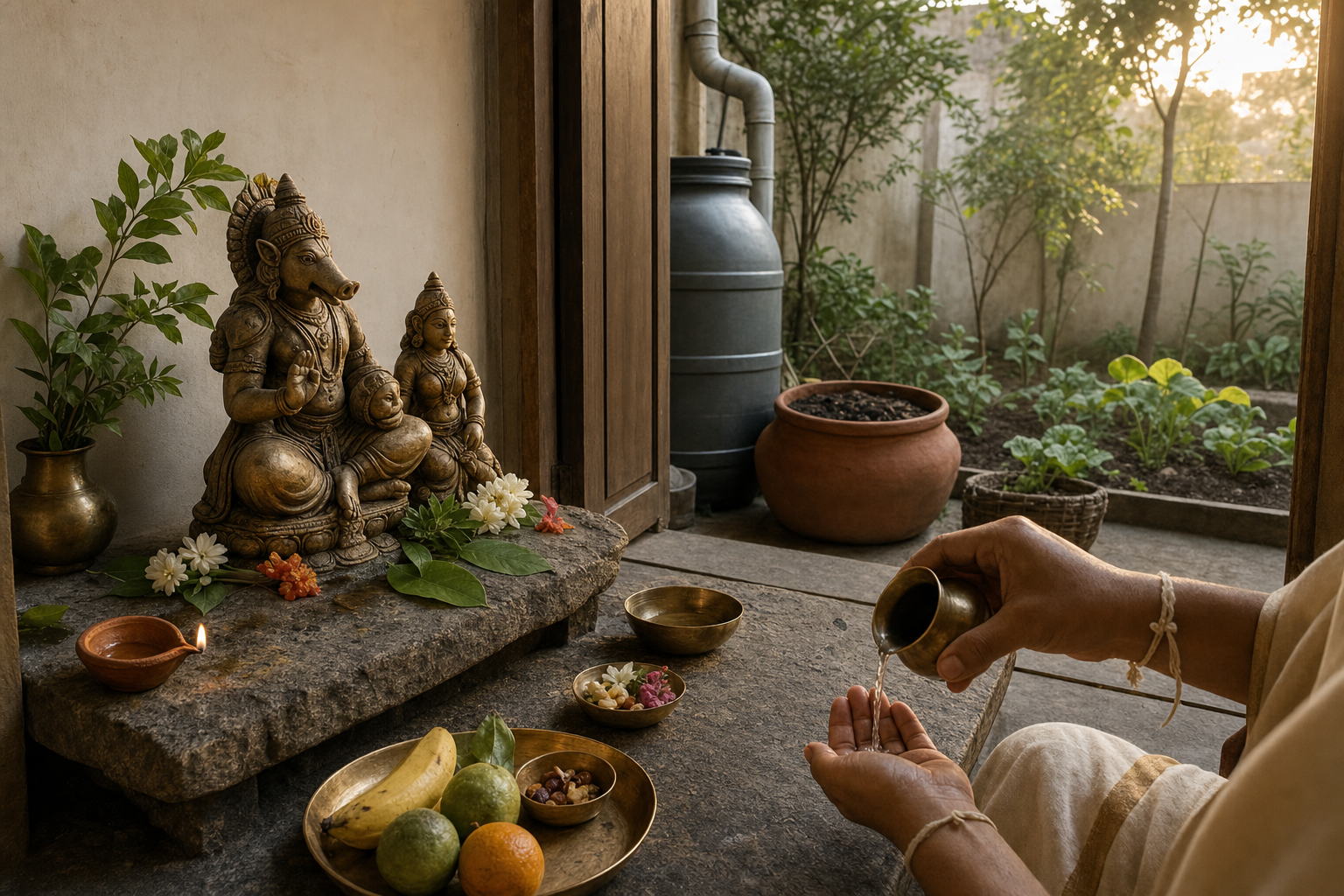
Begin with the ritual grammar you have inherited. Ecological service should grow from Varaha worship, not displace it. In the same way, performing an elaborate puja does not cancel the consequences of wasteful conduct outside the shrine.
A workable home observance can follow this sequence:
- Prepare the worship and its aftermath together. Before placing flowers, lamps, naivedya or packaged items on the altar, decide what will happen to each item afterward. Avoid preventable plastic packaging. Keep edible offerings suitable for respectful consumption or sharing. Do not leave ritual remnants beside a road, in an unmanaged water body or anywhere they become another person’s waste problem.
- Name a bounded duty in the sankalpa. Replace a vague promise to protect nature with a place, a behaviour and a point of review. You might resolve to stop a recurring waste of household water, care for a neglected patch of soil, reduce discarded food, support a suitable planting project or participate in an organised local cleanup.
- Perform the puja according to your parampara. Common observances include snana, a clean sacred space, tulasi, flowers, incense, a lamp, naivedya and aarti. If panchopachara, shodashopachara or abhishekam belongs to your family or temple practice, follow the guidance you have received rather than inventing ritual details for an ecological theme.
- Contemplate the act of lifting. Read the Varaha narrative from the Bhagavata Purana, Vishnu Purana or Varaha Purana. Pause over the difference between feeling concern for Bhudevi and accepting the burden of helping her rise.
- Use mantra with continuity and care. Om Namo Narayanaya and Om Namo Bhagavate Vasudevaya are widely used Vaishnava mantras. Om Namo Bhagavate Varahaya is also used where transmitted. If you are uncertain, ask your family elders, acharya or local temple instead of presenting an unfamiliar form as your lineage’s practice.
- Begin the outward act promptly. Send the message to the cleanup organiser, repair the source of water waste, arrange the food donation or speak with the person responsible for aftercare. A sankalpa becomes easier to postpone when its first physical step is left undefined.
- Review the vow during regular worship. Keep a brief note in your puja book: what you promised, what changed and what remains unfinished. The purpose is accountability, not self-display.
Varaha Jayanti provides a natural occasion for making or renewing this sankalpa. Most regional Hindu calendars place the 2026 observance on September 13, during Bhadrapada Shukla Dwadashi. Tithi boundaries, puja periods and vrata parana can differ by place, time zone and sampradaya, so use a trusted regional panchang or temple advisory rather than assuming that one timetable applies everywhere.
If you keep a vrata, choose its form through appropriate family, temple and health guidance. The ecological vow does not depend on making the fast more severe. Its measure is whether discipline at the altar produces greater care beyond it.
Choose restoration, not a devotional photo opportunity
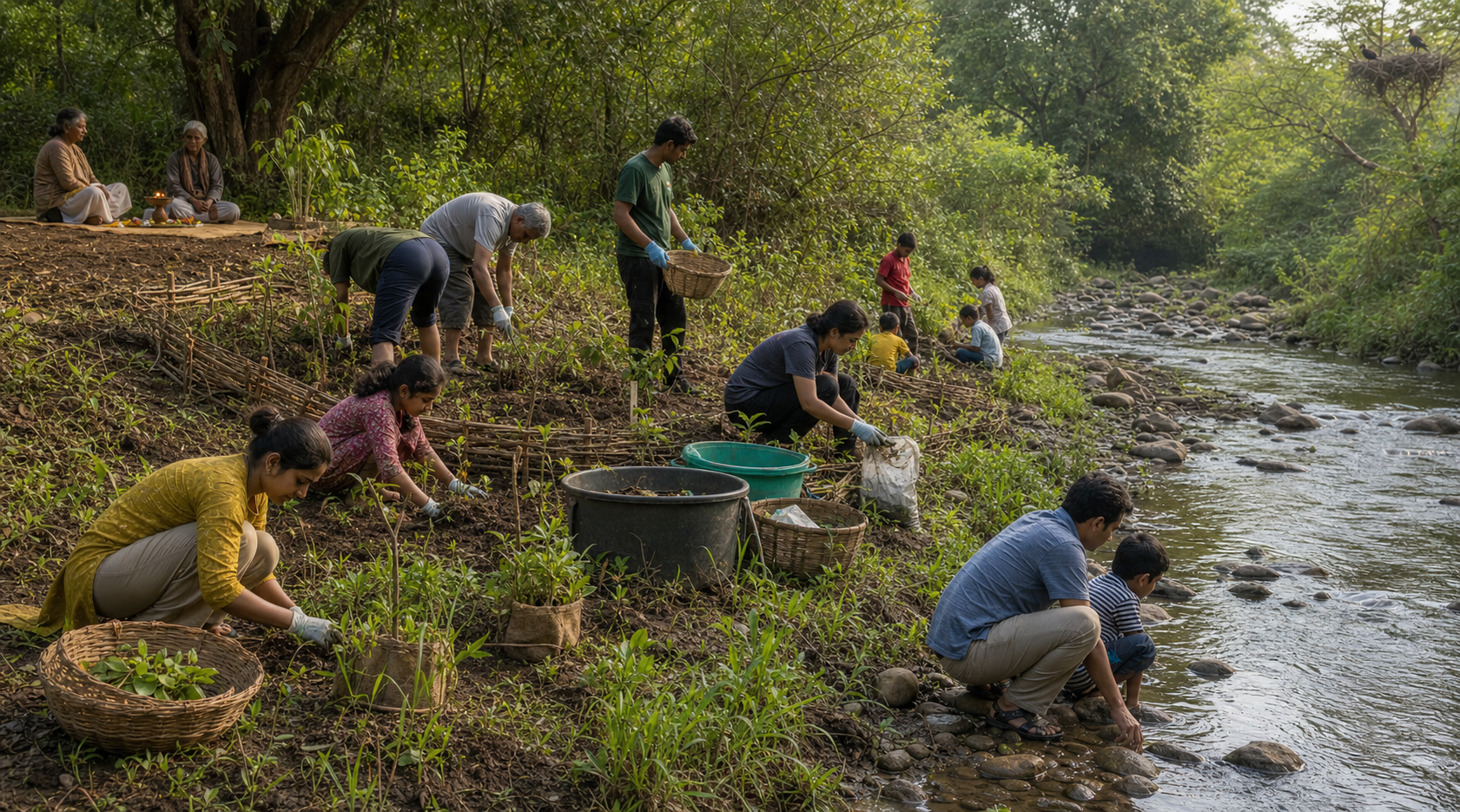
Varaha changes Earth’s condition; he does not merely express concern about it. That distinction helps you choose between ecological seva that restores something and an event that produces images, announcements and good intentions without follow-through.
Tree planting, water-body cleanliness, annadana and gifts of grains or essentials can all become living expressions of Varaha bhakti. Each needs a different kind of responsibility:
- For water: begin with a recurring source of waste or pollution you can actually influence. Join an organised cleanup where collected material has a proper disposal route. Do not enter contaminated water or handle sharp, medical or unidentified hazardous waste; work with trained local or civic groups instead.
- For soil and planting: do not treat placing a sapling in the ground as the completed act. Confirm that the species suits the place, that planting is permitted and that someone has accepted responsibility for watering, protection and later care.
- For food: connect annadana to real recipients and realistic quantities. Plan procurement, preparation, transport and distribution together so generosity does not end in unsafe handling or avoidable food waste.
- For temple practice: ask what happens to packaging, flowers, food and other remnants after a large observance. Work with temple authorities on an approved system rather than imposing a private solution on a shared sacred space.
- For household consumption: identify a disposable item or wasteful purchase that recurs. Changing a repeated habit usually has more integrity than buying a symbolic ecological product that adds another object to the house.
The weak point in many service events is not enthusiasm at the beginning but ownership afterward. Saplings are placed without a caretaker. Rubbish is gathered without an agreed destination. Food is prepared before recipients or distribution conditions are understood. Assign follow-through before announcing the activity.
Use these questions to test a proposed project:
- Is the harm local and specific enough to understand?
- Have the people responsible for the place agreed to the intervention?
- Where will collected waste, leftover material or ritual remnants go?
- Who owns aftercare once the gathering ends?
- What observable condition will show that the place is better cared for?
Participation, publicity and money spent are not reliable substitutes for restoration. A repaired leak, a properly completed cleanup, food that reaches its intended recipients or a planting that remains cared for tells you more. Keep photographs if they serve accountability, but do not confuse documenting seva with completing it.
Let the wider dharmic family sharpen the practice
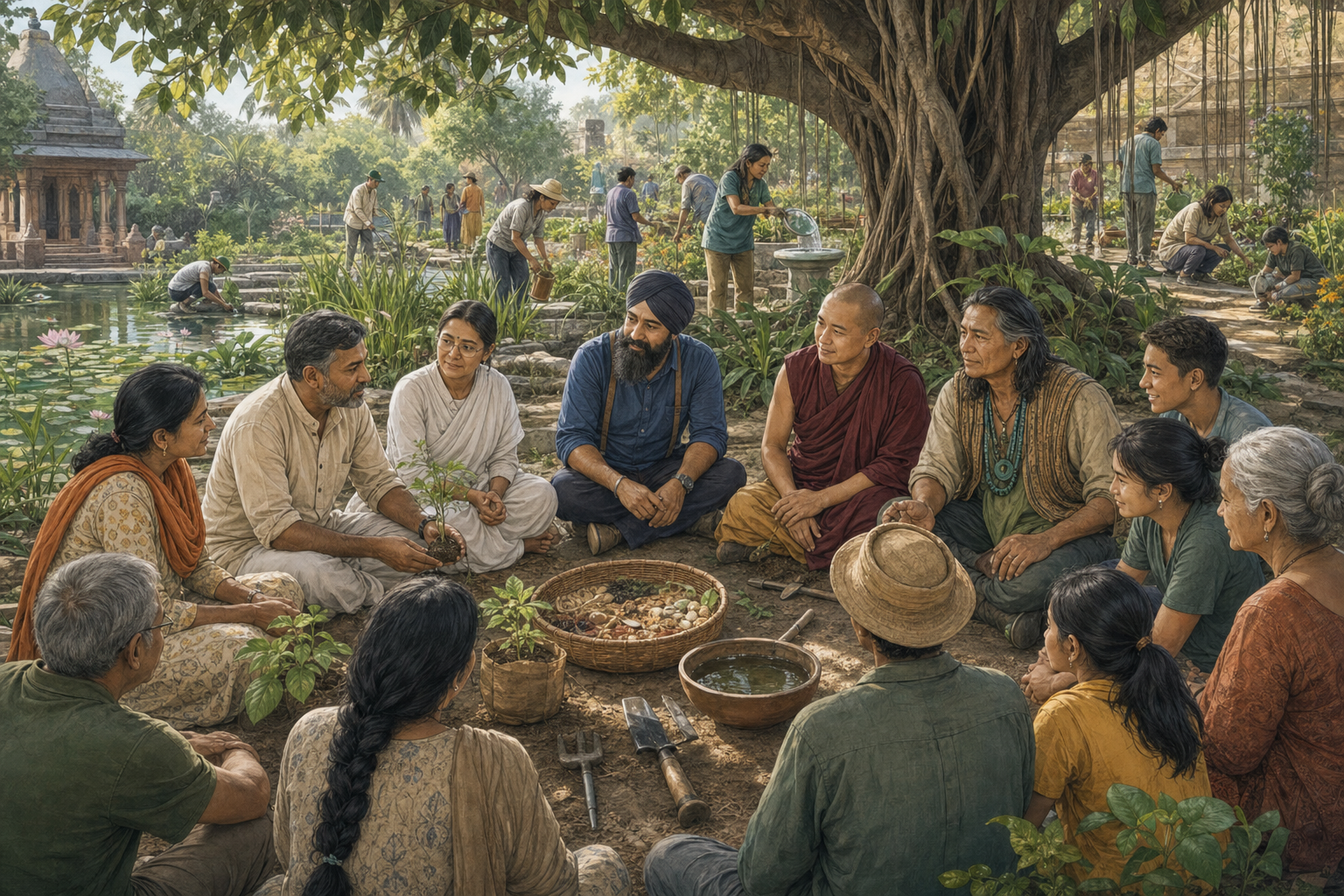
Hindu, Buddhist, Jain and Sikh traditions do not need to be collapsed into one environmental doctrine before their adherents can serve together. Their theological distinctions remain real. The shared ground is an ethical refusal to treat life and the elements as morally empty.
Sikh tradition honours air as guru, water as father and Earth as great mother; Buddhist compassion and Jain ahimsa likewise cultivate care for living beings. Varaha bhakti contributes its own unmistakably Vaishnava image: Bhagavan entering danger to raise Bhudevi and re-establish dharma.
These traditions can function as complementary moral checks in a shared service project. Ahimsa asks whether your method creates avoidable injury. Compassion asks who or what bears the cost of neglect. Reverence for air, water and Earth challenges the habit of treating pollution as something that disappears once it leaves your property. Varaha asks whether you are willing to enter the difficult work of restoration.
This makes ecological seva a practical meeting place for the dharmic family. Participants do not have to merge prayers, erase identities or pretend that every doctrine is identical. They can agree on a neglected waterway, a food need, a damaged patch of land or a waste problem; define safe responsibilities; serve according to their capacities; and return to their respective traditions with a deeper sense of duty.
For Hindu families, that cooperation need not dilute Varaha worship. It can reveal one of its civilisational strengths: devotion is capable of sustaining particular forms of theology while creating public benefit beyond the circle of worshippers.
Key takeaways
- Varaha offers a pattern of restoration: recognise peril, enter the difficulty, confront what sustains the damage and help Bhudevi rise.
- Ecological service should arise from puja and sankalpa, not replace worship or serve as decoration around it.
- A useful sankalpa names a place, a recurring behaviour, an immediate action and a point of review.
- Plan the aftermath of offerings before the puja so devotional materials do not become unmanaged waste.
- Judge tree planting, cleanup and annadana by consent, safe execution, proper disposal and continued care rather than publicity.
- Shared dharmic values can support common service without erasing the distinct teachings of Hinduism, Buddhism, Jainism or Sikhism.
At your next Varaha puja, write two short clauses in your puja book: The part of Bhudevi entrusted to my care is… and The first act I will complete is… Then begin that act before the intention dissolves into another good thought. Varaha worship becomes ecological dharma when reverence leaves a trace of repair.