
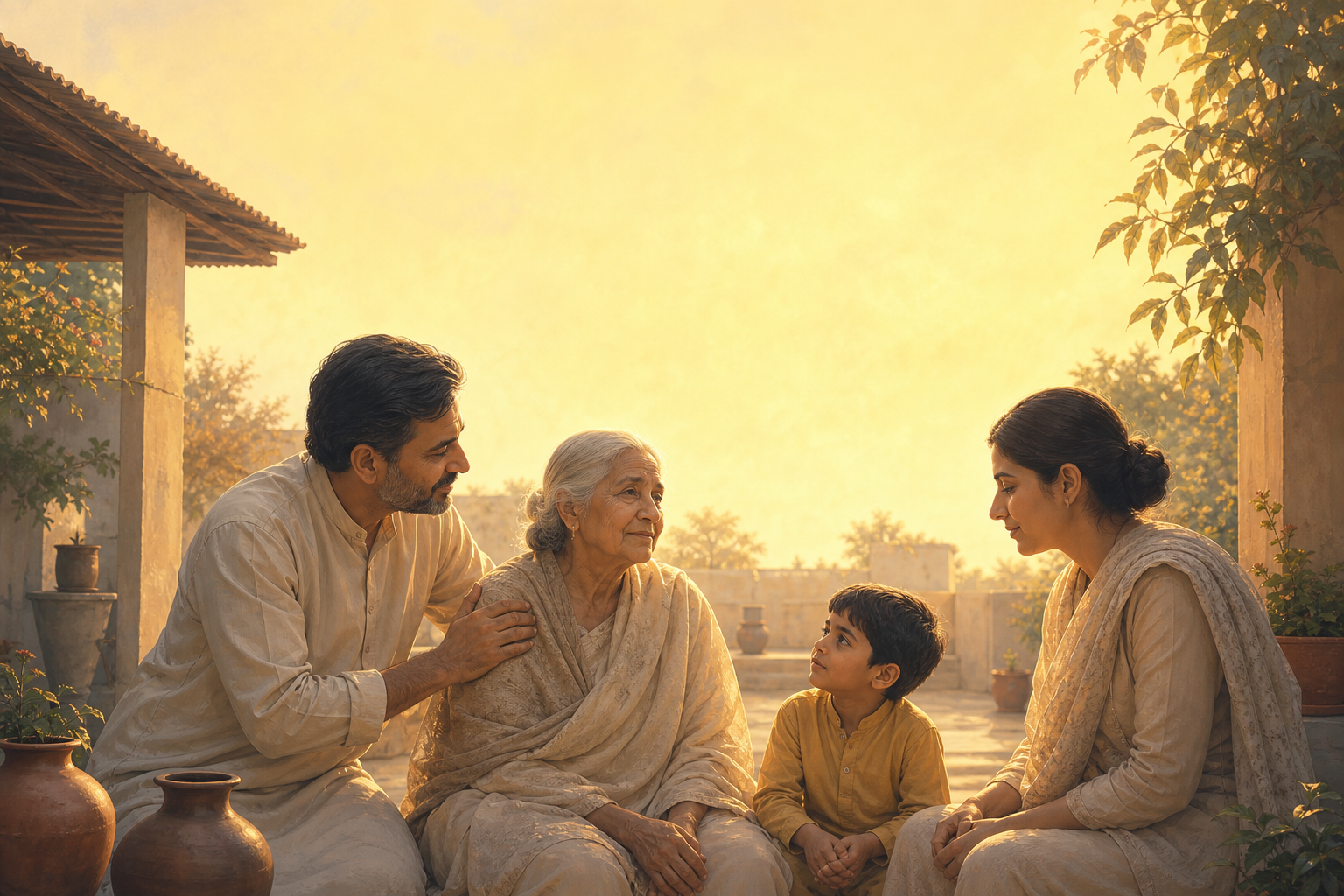
When someone dies, ordinary language does something philosophy later tries to explain: we say the person has gone, although the body remains. If that experience has pushed you to ask whether you are the body, an atman embodied within it, or a being held by a Supreme Source, the Dharmic answer begins with a set of careful distinctions.
You do not have to reject bodily life, family bonds, reason, or medical care to explore those distinctions. Their practical value lies elsewhere: they can help you face change without reducing yourself to it, serve your family without making biology the limit of kinship, and direct your life toward liberation rather than mere survival.
The distinction between the self and its embodiment

Begin with the language you already use. You say, “my body,” “my thoughts,” and “my memories.” The grammar places a possessor beside the thing possessed. That does not prove the existence of an eternal self, but it gives you a serious question to investigate: who is aware of the changing body and mind?
The Bhagavad Gita approaches this question through kshetra and kshetrajna. Kshetra is the field: the embodied domain in which sensation, thought, choice, pleasure, pain, and action occur. Kshetrajna is the knower of that field. The point is not that the body is unreal or useless. It is that the changing field and the conscious knower should not be treated as identical without examination.
A common Vedantic map distinguishes the gross, subtle, and causal dimensions of embodiment. The gross body, or sthula-sharira, is the material form available to the senses. The subtle body, or sukshma-sharira, includes mind, intellect, and ego. The causal body, or karana-sharira, contains the seed conditions through which experience continues across lives. The atman or jiva is the conscious self rather than another material component hidden inside these layers.
This map gives you a more exact way to observe experience. A bodily sensation is not automatically a command. A thought is not automatically true. A social label is not the whole person. Even the ego’s story about “who I am” can be noticed, tested, and corrected.
Dharmic inquiry does not have to rest on intuition alone. It can draw upon pratyaksha, direct experience; anumana, reasoned inference; and shabda, trustworthy testimony preserved in a teaching tradition. You can observe that bodily and mental states change, reason about the knower of those changes, and test that reasoning against texts such as the Upanishads and Bhagavad Gita. None of these should become an excuse to stop asking questions. Together, they provide a disciplined way to ask better ones.
Key takeaways
- The body is the field of embodied experience; it is not, in Vedantic thought, the complete identity of the conscious person.
- Mind, intellect, and ego belong to the subtle level, so a passing thought or emotion need not define you.
- Realizing that you are not merely the body should deepen bodily responsibility, not encourage neglect.
- Biological parenthood, spiritual guidance, and the Supreme Source answer different questions about your origin.
- Dharmic traditions do not all affirm the same metaphysics, so their terms should not be blended carelessly.
Embodiment is a field of duty, not an obstacle to despise
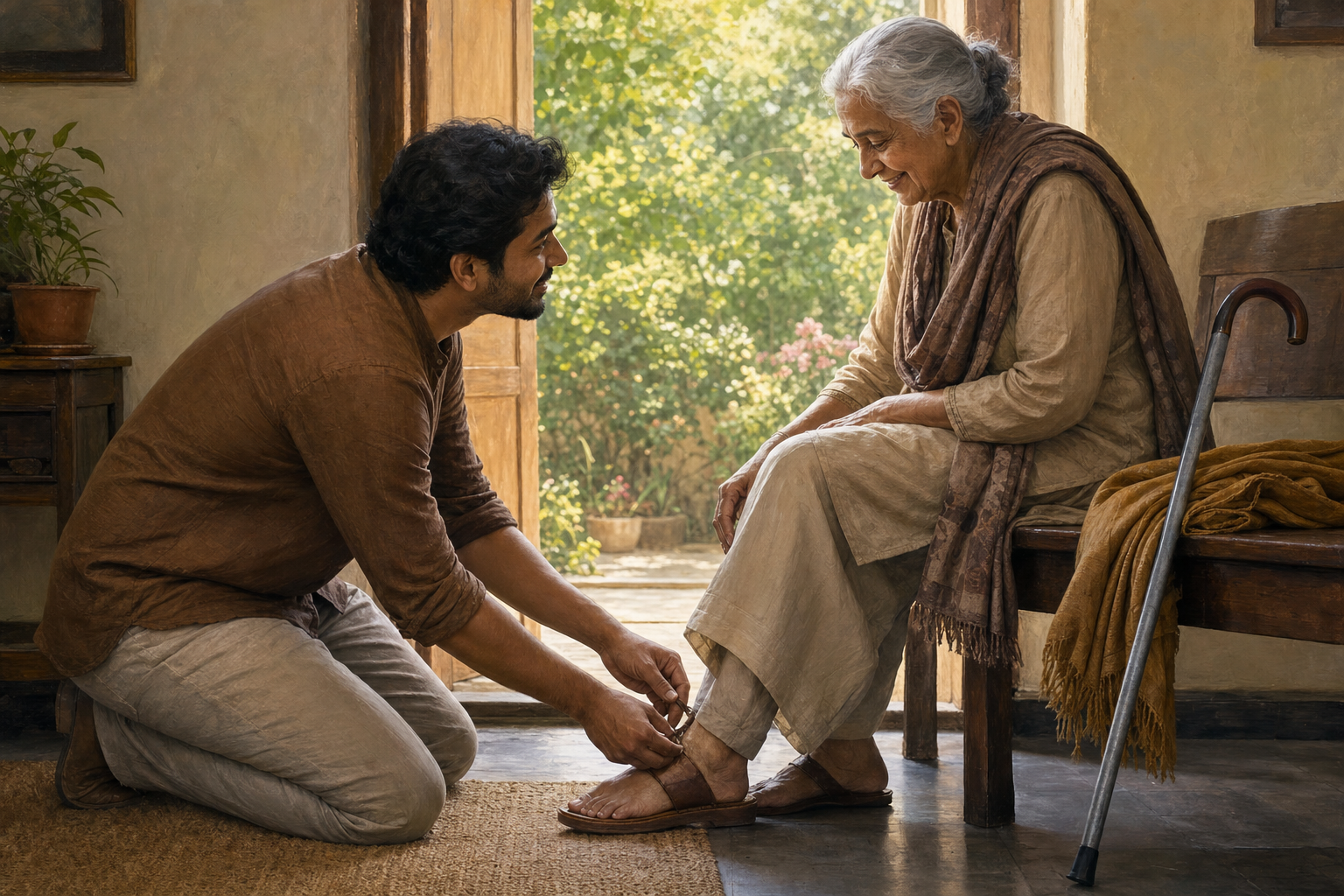
“I am not the body” is among the easiest spiritual teachings to repeat and among the easiest to misuse. It does not mean that hunger, illness, age, family obligations, or grief can be dismissed as spiritually inferior. The body is where your present duties become concrete. It is where you speak truth or conceal it, offer service or withhold it, and either reinforce harmful tendencies or loosen them.
A soul-centered life should therefore make you more attentive to embodiment. Care for the body as an instrument of dharma. Notice what the mind is doing before it becomes speech. Use the intellect to distinguish an immediate impulse from a worthy action. Watch the ego most carefully when it tries to turn spiritual knowledge into superiority.
When a difficult moment arrives, separate it into three questions:
- What is happening in the body? Name the sensation or physical need without treating it as your entire identity.
- What story is the mind adding? Distinguish what you directly know from fear, memory, resentment, or anticipation.
- What does dharma require now? Choose the truthful and responsible action available in the present field.
This distinction is especially useful in grief. Recognizing that a loved one was more than the body does not make bereavement unreal. You have lost a voice, a presence, shared routines, and the visible form through which love was exchanged. A Dharmic understanding gives that sorrow direction without demanding that you pretend not to feel it.
Practices such as shraddha and tarpana honor the lineage through which embodied life was received. In Vaishnava practice, chanting the holy names and offering the fruit of devotion for departed kin can join remembrance to worship. Use the rites of your own sampradaya and family tradition where possible. Their purpose is not to force certainty about what you cannot presently see, but to turn love, gratitude, and duty into deliberate action.
Spiritual interpretation should complement practical care, not replace it. Care for a dying person, treatment of bodily illness, and psychological support for the bereaved address parts of human need that metaphysical reflection alone does not meet. The body may not be the whole person, but caring for the embodied person remains dharma.
The Supreme Source enlarges rather than erases family
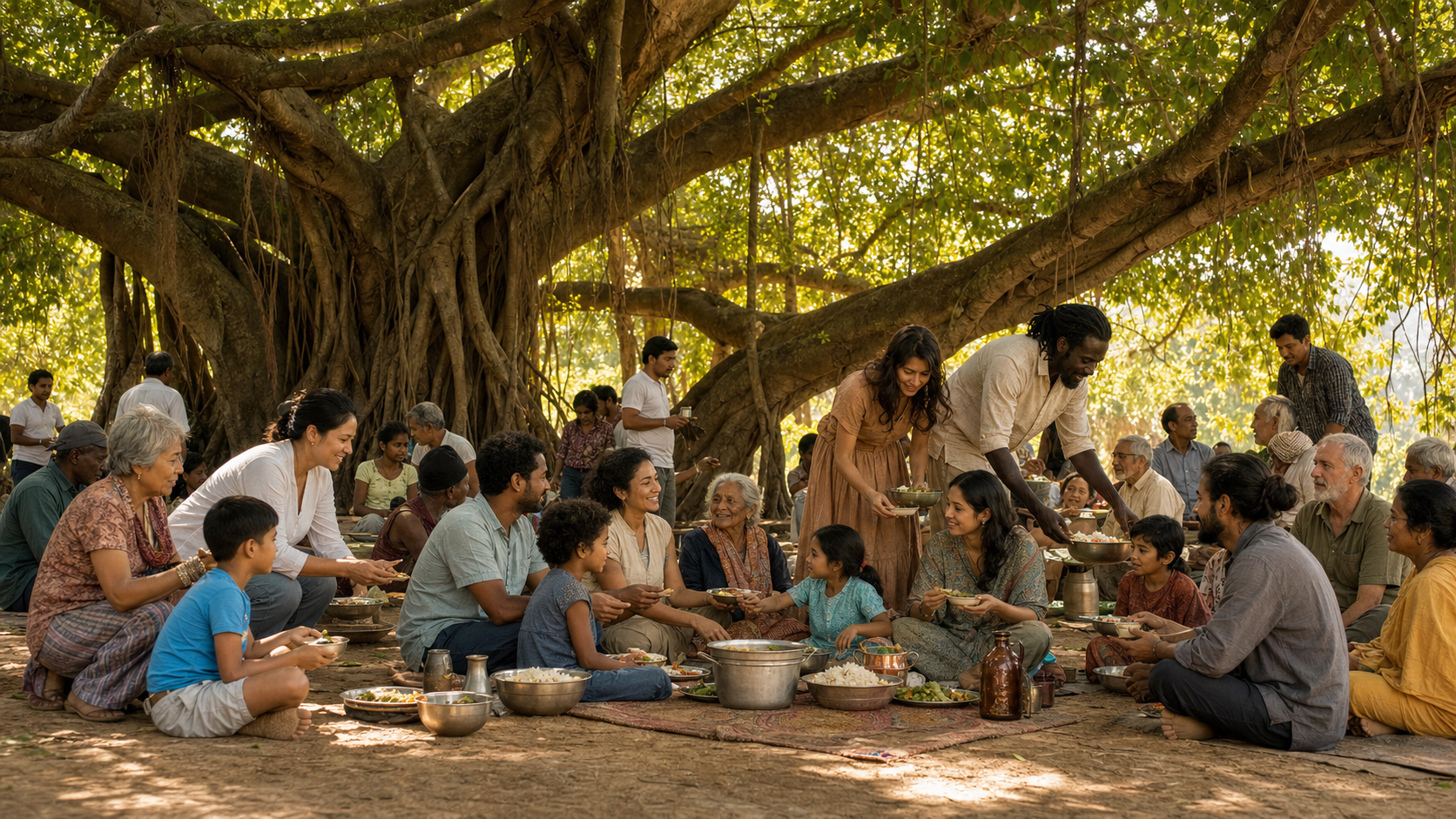
The question “Who is my real father?” creates confusion only when every kind of fatherhood is forced into one category. A biological parent, a spiritual teacher, and the Supreme do not compete to perform the same role.
Bhagavad Gita 14.4 presents material nature, prakriti, as the universal womb and Krishna as the seed-giving father. In the Gaudiya Vaishnava understanding, prakriti supplies the conditions and material forms of embodiment, while Krishna is the ultimate source and well-wisher of every jiva. Your biological parents mediate the gift of a particular body, family, and place in the world; they do not manufacture the conscious self from matter.
| Relationship | What is given | Your corresponding duty |
|---|---|---|
| Biological father, or deha-pita | Embodied birth, family location, and worldly care | Gratitude, truthful respect, and appropriate care |
| Spiritual teacher, or dharma-pita | Knowledge, discipline, and guidance beyond body-centered identity | Serious study, discernment, and practice |
| Supreme Source, or param-pita | The ultimate ground, origin, maintenance, and refuge of the conscious self | Remembrance, devotion, surrender, and alignment with dharma |
These forms of fatherhood are complementary rather than competitive. Calling the Supreme your ultimate father does not cancel the debt owed to the parent who raised you. Honoring a biological parent does not make bodily lineage your final identity. Receiving guidance from a guru does not turn the guru into the source of the jiva; the teacher directs the jiva toward truth.
You can make this hierarchy practical without turning it into an abstraction. Thank a parent or elder for one specific gift. Identify one teaching from a genuine spiritual guide that you are actually prepared to practice. Then place both relationships within your chosen form of remembrance of the Supreme. In this way, gratitude moves upward without abandoning anyone below.
This wider kinship also changes how you see strangers. If every jiva has its deepest origin in the same Supreme Source, bodily differences remain real at the social level but cannot justify contempt. The teaching becomes ethically credible only when it produces humility, restraint, and care toward beings outside your immediate family.
Dharmic traditions share an inquiry, not one metaphysical formula
A serious Dharmic synthesis must preserve disagreement. Hindu, Jain, Buddhist, and Sikh teachings can all loosen exclusive identification with bodily status, but they do not all teach an eternal atman created or sustained by a personal Supreme. Treating their vocabularies as interchangeable hides the very questions they ask you to examine.
- Advaita Vedanta: Brahman is the ultimate ground of reality, and the deepest Self is not finally separate from Brahman. Parent, child, body, and individual biography belong to the empirical order. They retain practical importance even though they are not ultimate divisions.
- Vishishtadvaita and Dvaita: The Supreme is personal, and individual selves stand in an enduring relation to that Supreme. The language of divine fatherhood therefore expresses genuine dependence, origin, and loving relationship rather than a merely temporary metaphor.
- Gaudiya Vaishnavism: Krishna is the ultimate progenitor and well-wisher of the jiva. Embodied identity is temporary, while the soul’s relationship with Krishna gives devotion its permanent direction.
- Jain thought: Jiva is conscious and distinct from ajiva, or non-conscious matter. Liberation requires freeing the jiva from karmic accretions. The Tirthankaras reveal the path, but Jain philosophy does not require a creator God as the father of souls.
- Buddhist thought: Anatta denies a permanent, independent self of the kind affirmed by atman doctrines. Buddhist analysis examines the conditioned body-mind stream and the attachment that produces suffering. A kalyana-mitra, or spiritual friend, can perform a deeply nurturing role, but that does not turn Buddhism into a doctrine of an eternal soul or creator.
- Sikh teaching: Ik Onkar may be approached intimately as Father, Mother, and Friend. Simran and seva join remembrance of the One with service in the embodied world.
The practical rule is simple: learn across traditions, but state each tradition’s claim in its own terms. If you follow a Vaishnava path, do not use Advaitic language to erase your devotional relationship with Krishna. If you study Advaita, do not reduce its account of Brahman to a larger individual deity. Do not turn Jain liberation into creator-centered devotion, and do not translate Buddhist anatta back into an atman doctrine it explicitly questions.
Respect does not require pretending that every school says the same thing. It requires enough intellectual honesty to see where they meet in practice, where they diverge in metaphysics, and which discipline you are prepared to follow consistently.
A repeatable practice for living beyond body-centered identity

Understanding atman conceptually is not the same as living from that understanding. Use the following sequence as a daily inquiry. It is not a substitute for initiation, lineage instruction, or the disciplines of your own tradition. Its purpose is to expose the places where body-centered identity still controls your conduct.
- Observe before you identify. At the beginning of the day, notice bodily sensation, mental activity, and the awareness in which both are known. Do not force a conclusion. Learn to distinguish the observed condition from the claim that it is your complete self.
- Study the field and its knower. Read Bhagavad Gita 13 through a translation and commentary trusted in your lineage. Keep two columns in your notes: what belongs to kshetra and what is said about kshetrajna. This prevents the teaching from dissolving into a vague slogan.
- Perform one embodied duty attentively. Serve a parent, prepare food, complete honest work, care for a dependent, or keep a promise. Do it as stewardship of the field rather than as an attempt to inflate the ego.
- Practice through your actual path. A Gaudiya Vaishnava may take up nama-japa, kirtan, and study of the Bhagavad Gita or Srimad-Bhagavatam. Other Hindu paths may emphasize meditation, seva, or Upanishadic contemplation. Buddhist, Jain, and Sikh practitioners should use their own disciplines of mindfulness and insight, vrata and ahimsa, or simran and seva rather than borrowing metaphysical language that conflicts with them.
- Review the effect on conduct. At the end of the day, ask whether the teaching made you less ruled by praise, insult, discomfort, and status. Then ask whether it made you more reliable toward family and more compassionate toward other beings. If it produced indifference or pride, you have probably turned discernment into avoidance.
Begin with the next ordinary moment in which the body, mind, or ego insists, “This is all that I am.” Pause long enough to identify the field, remember the knower, and choose the action that serves dharma. That is where a teaching about atman and the Supreme Source stops being an idea and starts becoming a way of life.