

You pray, chant, read, visit sacred places, and still wonder why the Divine feels distant. The usual response is to add more: another discourse, another mantra, another teacher, another promise of a powerful experience. That can make the mind busier without making devotion deeper.
A more useful question is not, “How do I make grace happen?” It is, “How do I give this longing a form that can change how I live?” You cannot command grace, but you can build a steady practice that makes you more attentive, truthful, compassionate, and able to receive what is already being given.
Your longing needs a vessel, not another experience
Devotional longing becomes transformative when it repeatedly directs your attention, affection, and choices toward the sacred. A strong feeling during kirtan may begin that movement, but the feeling alone cannot sustain it. Longing has to enter your calendar, speech, relationships, use of money, and response to inconvenience.
Yoga Sutra 1.21 gives intense ardour, or tivra samvega, an important place in spiritual progress. Yet intensity is not agitation. Yoga Sutra 1.12 pairs repeated practice with non-attachment: you return to the discipline without demanding a particular sensation or result. Ardour supplies energy; abhyasa gives it direction; vairagya prevents it from becoming spiritual greed.
You can see the difference by examining the past week:
- Healthy longing simplifies. You return to a chosen name, teaching, vow, or form of worship. Restless craving keeps multiplying inputs.
- Healthy longing survives an ordinary day. You remember while commuting, cooking, studying, earning, or caring for someone. Experience-seeking waits for the next emotionally charged event.
- Healthy longing softens conduct. It makes apology, restraint, generosity, and service more natural. Spiritual ambition makes you protective of your status or claimed experiences.
- Healthy longing can tolerate dryness. You keep the minimum practice when consolation is absent. Craving interprets a quiet day as failure and goes shopping for a new method.
The nine modes of bhakti named in Bhagavata Purana 7.5.23-24 offer a practical menu: sravana, kirtana, smarana, pada-sevana, arcana, vandana, dasya, sakhya, and atma-nivedana. You do not need to perform all nine every day. Choose the form that addresses your present weakness. If your understanding is shallow, begin with attentive listening. If emotion is scattered, use kirtana. If remembrance disappears during work, cultivate smarana. If devotion has become private sentiment, practise service and self-offering.
Key takeaways
- Do not measure devotion by emotional intensity. Measure whether remembrance is becoming more continuous and conduct more dharmic.
- Choose one primary daily discipline and keep it through both inspiring and uneventful days.
- Treat grace as a gift, not payment earned through a quota of chanting, fasting, pilgrimage, or meditation.
- Test unusual spiritual experiences by their fruits: humility, integrity, compassion, steadiness, and willingness to serve.
- Respect the distinct theology of each Dharmic path. Shared disciplines do not make every doctrine, mantra, or initiation interchangeable.
A 40-day discipline that leaves room for grace
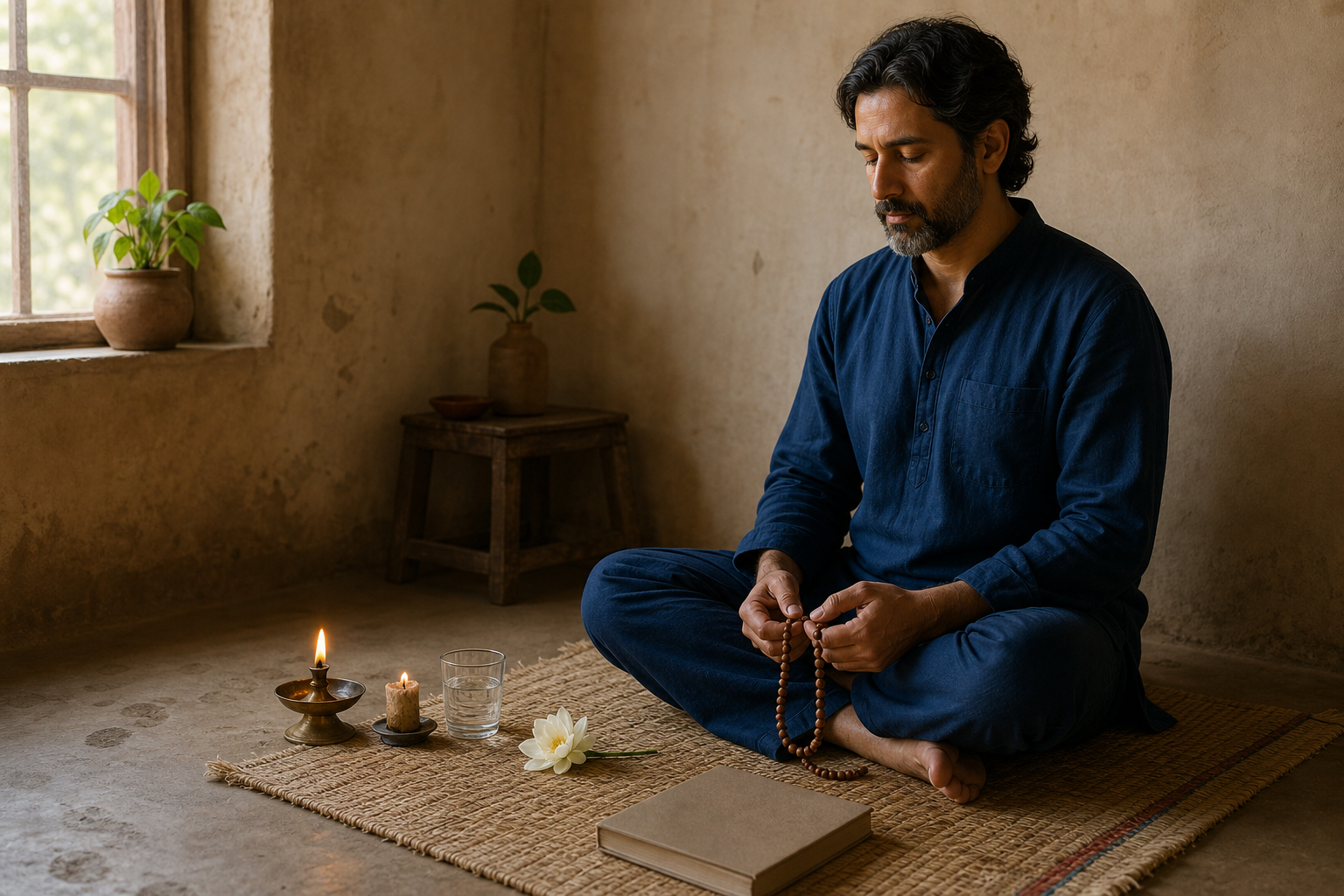
A 40-day vrata is long enough to expose the difference between a passing mood and a workable rule of life. Its purpose is not to force a mystical result. It is to stop renegotiating your commitment every morning.
Write a vow you can understand at a glance: “For 40 days, I will keep one daily practice, one ethical intention, one course of study, and one form of service.” If you have received a discipline from a legitimate lineage or teacher, preserve that discipline rather than replacing it with a self-designed mixture.
- Protect a morning anchor. A fixed 15-minute period is a workable starting structure. Begin with quiet breath awareness, continue with the name, mantra, refuge, prayer, or meditation proper to your path, and close with a brief period of stillness. If your schedule allows, keep the phone away until this practice is complete; a digital fast before sunrise gives the mind even more protection.
- Pause ethically during the day. Ask where non-violence, truthfulness, moderation, purity, or equality is required in the next action. Correct one avoidable harm instead of merely thinking devotional thoughts.
- Study one stream deeply. Use a single text or theme for the month rather than moving through an algorithmic assortment of quotations. Read a manageable passage in the evening and write down the instruction you can apply the next day.
- Join a recurring community practice. Keep a device-free period of satsang, sangha, or sangat. Listening, chanting, questioning, and serving with others provide correction and accountability that solitary enthusiasm cannot supply by itself.
Choose the content of the rule within your own tradition. The following are coherent examples, not ingredients for a blended spiritual checklist.
| Path | Anchor practice | Study or reflection | Service and community |
|---|---|---|---|
| Hindu | Nama-japa, remembrance of the Ishta, puja, or meditation | Bhagavad Gita, Upanishads, or devotional hymns | Seva, satsang, temple worship, or care offered without possessiveness |
| Buddhist | Breath awareness, refuge, chanting, or metta | Dhammapada or Satipatthana teachings | Dana, sangha participation, and compassionate conduct |
| Jain | Namokar Mantra, samayik, or pratikraman | Agamas or Tattvartha Sutra | Jiv-daya, ahimsa, self-restraint, and community practice |
| Sikh | Waheguru simran and kirtan | Nitnem selections or Sukhmani Sahib | Seva, sangat, langar, and conduct grounded in equality |
Where a lineage treats a mantra, abhisheka, diksha, or transmission as initiatory, do not imitate it from a recording and call yourself initiated. Seek guidance through the proper relationship and discipline. Bhagavad Gita 4.34 places respectful inquiry beside humility and service; discernment is part of discipleship, not a failure of faith.
Keep the journal functional. After practice, answer these questions in plain language:
- What did I actually practise?
- Where did remembrance change a decision or reaction?
- Where did my speech or conduct contradict the vow?
- What repair or act of seva will I undertake next?
If you miss a period, do not stage a punishing make-up session. Record the lapse, identify the practical cause, and resume at the next appointed time. Continuity matters more than dramatizing failure.
At the end of 40 days, review the journal for changes in attention, conduct, service, and dependence on special feelings. If the rule has become stable, extend it into a 90-day cycle. If it repeatedly collapses, reduce its size or repair its timing while preserving its central practice. Change one variable, not the entire path.
Recognize grace by what it changes, not how it feels

Anugraha places the initiative with the Divine. Sparsha conveys the immediacy of a touch, while some lineages use shaktipata for a descent or transmission of spiritual power. None of these terms turns grace into wages owed after sufficient effort.
Practice prepares attention and character. It does not put the sacred under obligation. Japa can collect a scattered mind. Ethical restraint can reduce the inner conflict that obstructs contemplation. Seva can loosen self-importance. Satsang can correct self-deception. These conditions make you more receptive, but they do not give the ego ownership of grace.
Three mistakes commonly follow when longing and grace are confused:
- The transaction: “I completed the count, so the Divine should give me the experience.” Keep the discipline, but release the invoice.
- The spectacle: “A powerful sensation proves spiritual rank.” Receive the moment quietly, test it over time, and return to your duties.
- The verdict: “I felt nothing, so I am unworthy or abandoned.” Do not turn spiritual dryness into a judgement on your worth. Examine practice, conduct, guidance, and expectations separately.
If the practice feels dry, keep the minimum rule. Add a concrete act of service. Examine whether resentment, dishonesty, indulgence, or avoidable harm is dividing your attention. Bring persistent confusion to a trustworthy teacher or mature community. Dryness may reveal what inspiration had been covering; it need not be solved by collecting another mantra.
Use the fruit test
Warmth around the anahata region, tears, inward spaciousness, deep quiet, or spontaneous gratitude can accompany devotional and contemplative practice. Breath regulation, rhythmic chanting, stillness, and synchronized communal worship can also settle attention and autonomic arousal. A bodily mechanism does not disprove a sacred interpretation, but a sensation by itself does not prove one either.
Let time and conduct interpret the experience. Ask:
- Ethical fruit: Am I becoming more truthful, restrained, non-violent, and dependable?
- Ego fruit: Has the experience reduced self-importance, or created a need to be seen as specially chosen?
- Relational fruit: Am I more patient and useful to family, community, strangers, and vulnerable beings?
- Stability fruit: Does remembrance remain available during criticism, inconvenience, fear, or disappointment?
- Dharmic fruit: Can this interpretation stand beside scripture, the tested wisdom of a lineage, and ordinary ethical accountability?
An intense experience that makes you less accountable has failed an important test. A quiet practice that makes you more honest, compassionate, and steady may be carrying far more transformative power than you initially recognize.
The same standard applies to teachers who claim a special transmission. No blessing, touch, initiation, or charismatic presence cancels dharma, lineage accountability, or right conduct. A trustworthy relationship permits sincere questions and directs spiritual energy toward service and loka-sangraha, the welfare of the wider world.
Keep the shared discipline without erasing real differences

Hinduism, Buddhism, Jainism, and Sikhism share practical patterns of remembrance, ethical restraint, study, community, and service. Their theological meanings are not identical. Respecting those differences protects devotion from becoming shallow spiritual tourism.
- Within Hindu traditions, grace may be approached through loving surrender to Krishna, the stillness associated with Shiva, devotion to another Ishta, or insight into Atman and Brahman. Bhakti, jnana, yoga, ritual, and seva can reinforce one another, but different sampradayas arrange them differently.
- Within Buddhist paths, transformation is framed through awakening, insight, compassion, meditation, and disciplined conduct. Pariyatti, bhavana, and metta form a pattern of learning, cultivation, and benevolence. Vajrayana abhisheka belongs within an empowered ritual and lineage context rather than casual experimentation.
- Within Jainism, the framework is non-theistic. The transforming presence of the Tirthankaras and the teaching associated with perfect knowledge guide the seeker through right faith, right knowledge, right conduct, ahimsa, introspection, and self-restraint. It should not be redescribed as favour from a creator deity.
- Within Sikhism, Nadar and Gurprasad express grace received through the Divine and the Guru’s wisdom. Simran, kirtan, seva, sangat, and langar join inward remembrance to equality and public responsibility.
If you feel drawn to more than one path, compare their disciplines respectfully without pretending that their doctrines are interchangeable. For the 40-day period, choose one primary grammar of practice. Let one name, refuge, mantra, meditation, or rule become deep enough to correct you. You can honour unity without converting diversity into a buffet.
Before you sleep, write the rule you will begin tomorrow: the time, the place, the central practice, the text, and the form of service. Protect the first 15 minutes. After 40 days, ask less often whether you felt chosen and more honestly whether you became truthful, compassionate, steady, and useful. If those fruits are appearing, continue. That is how longing stops waiting for transformation and begins cooperating with it.
References
- DharmaRenaissance Blog – Spiritual Thirst: Building Unshakable, Heartfelt Devotion across Dharmic Traditions
- DharmaRenaissance Blog – Divine Touch (Anugraha): Timeless Bhakti, Sacred Grace, and Inner Transformation