
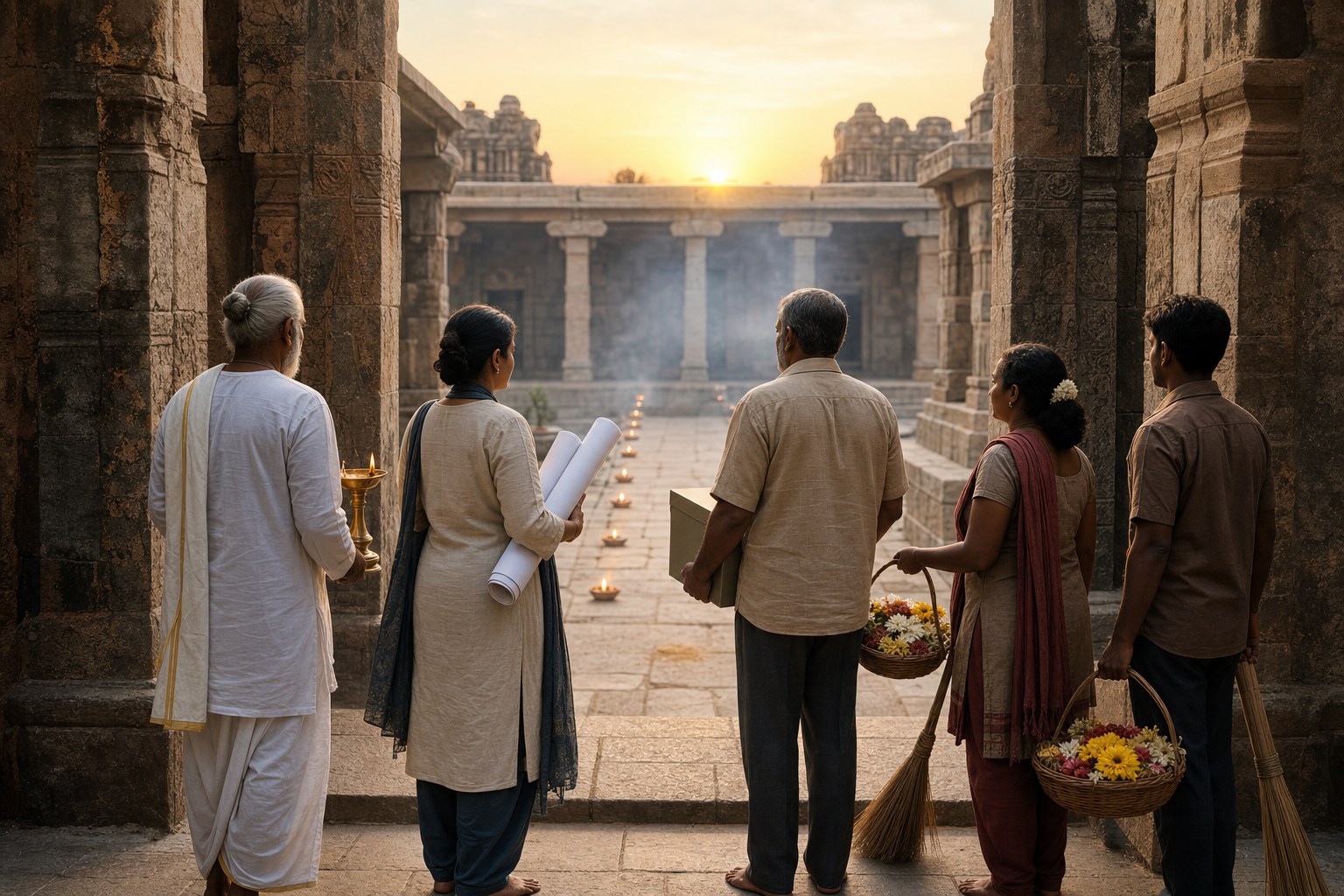
If you are helping to reopen a temple that has been silent for years, the visible milestone – the first aarti, festival, or reconsecration – is probably not the first decision you should make. Announcing a date before authority, assets, ritual condition, and community consent are settled can turn sacred renewal into another dispute.
Treat the work as two linked restorations. One restores sacred continuity; the other restores institutional trust. Pran Pratishtha cannot settle a contested trustee list or missing property record, while an audit cannot determine the rites appropriate to a murti and garbha-griha. A durable revival gives each responsibility to the right authority and makes the points of coordination explicit.
Diagnose the temple before promising a reopening date
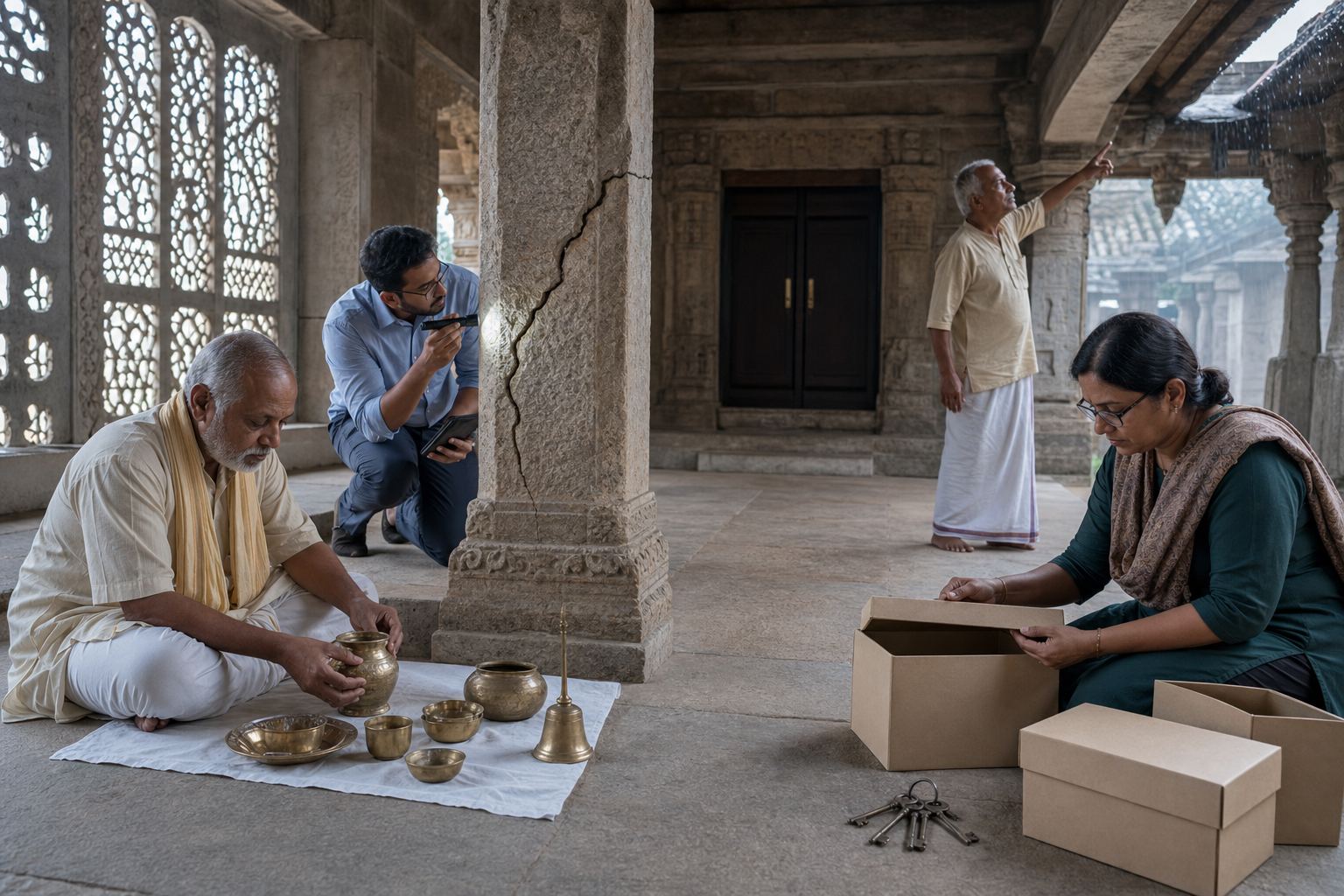
Reopening, revival, and reconsecration are related, but they are not synonyms. Confusing them creates unnecessary expense, ritual uncertainty, and arguments over who is empowered to decide.
- Reopening restores physical access and routine operations after a closure. It does not automatically imply that a new consecration is required.
- Revival restores the temple’s wider life: regular worship, festivals, seva, records, maintenance, pilgrim access, and the community relationships that sustain them.
- Reconsecration is a ritual determination. The temple’s recognized acharya, Agamic authority, or sampradaya-specific ritual authority must decide whether fresh consecration, a restorative rite, purification, or simple resumption is appropriate.
Begin with a short written revival brief. It should answer five questions before fundraising or public scheduling begins:
- What exactly stopped? Record whether daily worship, public darshan, festivals, maintenance, or all of them ceased. Do not describe the temple simply as “closed” when different functions ended at different times.
- What is the physical condition? Identify structural damage, unapproved alterations, water or weather exposure, the condition of the sanctum, and whether the murti or sacred objects were moved or affected. A competent building or conservation professional assesses physical safety; the ritual authority assesses ritual fitness.
- Which tradition governs the shrine? Record the sampradaya, established paddhati, archaka lineage or appointment system, traditional sevas, festival calendar, and any surviving manuals or local records.
- Who can act lawfully? Establish the current trustees, legal classification, deed or governing instrument, property records, bank authority, pending cases, and applicable regulator before anyone signs contracts or handles public donations.
- Which disagreements remain unresolved? List competing claims about trusteeship, ritual precedence, property, ornaments, income, and rights of seva. Separate verified records, oral testimony, and disputed assertions rather than blending them into one narrative.
The modern restoration of Somnath shows why sequence matters. Sardar Patel’s visit to the ruins on 13 November 1947 was followed by organized trusteeship and reconstruction; the new temple’s Pran Pratishtha was then performed by President Rajendra Prasad on 11 May 1951. Institutional stewardship preceded the consecration and continued after it. The sacred milestone was not asked to compensate for unfinished administration.
Your revival brief does not need to resolve every question. It must show which questions are settled, which remain contested, who is qualified to answer each one, and what must happen before the next decision. That alone prevents enthusiasm from hardening into an irreversible commitment.
Repair relationships without bargaining away dharma
A locked temple door is often the last visible symptom of a much older conflict. In Sindhudurg, long closures were connected to disagreements over hereditary trusteeship, ritual precedence, property records, and rights of seva. The successful reopenings used a phased movement from Naam-Satsang to stakeholder dialogue, institutional repair, and district-level coordination.
Devotional fellowship can lower the temperature, but it cannot replace records or a binding agreement. Use it to make truthful discussion possible, then move deliberately through the following process:
- Establish an interim restraint. Ask the parties to avoid unilateral appointments, construction, asset transfers, or changes to established ritual practice while mediation is active, except where an authorized measure is required for immediate safety.
- Map everyone with a legitimate stake. This may include trustees, archakas, hereditary seva-holders, donors with documented obligations, local devotees, gram panchayat representatives, and advisers needed for law or conservation. Influence and legal authority are not the same, so record both.
- Build a common record. Gather registrations, deeds, trustee orders, property papers, inventories, account records, festival calendars, court documents, and written ritual traditions. Mark uncertain or disputed material clearly instead of treating repetition as proof.
- Begin with shared duties. Cleanliness, protection of the murti, basic safety, preservation of records, and restoration of public worship are often easier to discuss than office or precedence. Agreement on duties creates a working relationship without prejudging harder claims.
- Mediate interests as well as positions. A demand for a title may conceal concern about ritual continuity, family dignity, access to records, or protection against financial misuse. The settlement must address the underlying concern without granting authority that the claimant does not lawfully or traditionally possess.
- Write the result. Minutes should identify agreements, reserved questions, interim responsibilities, deadlines, the documents still required, and the forum for further disputes. A settlement that depends entirely on continued goodwill is not yet a governance system.
Dharmic values become practical here. Satya means accurate minutes, candid accounts, and no convenient rewriting of the temple’s history. Ahimsa means no intimidation, humiliation, or mobilization against families in dispute. Seva means placing the deity, worship, and devotee access ahead of office. Self-restraint means refusing to use a temporary advantage to seize permanent control.
Legal classification cannot be settled by sentiment. The Sindhudurg work included review of trust registration, trustee lists, and the distinction between public trusts and private endowments within Maharashtra’s Bombay Public Trusts Act, 1950 framework and Charity Commissioner oversight. If your temple is in Maharashtra, have a qualified local trust adviser or lawyer confirm the shrine’s classification, current registration, pending orders, and who can lawfully act. Other states may use different laws and regulators. Do not change trustees, property control, or bank authority by copying a template from another jurisdiction.
Where a contested issue cannot be resolved directly, structured mediation or another appropriate form of Alternative Dispute Resolution may preserve relationships and reduce cost. Lok Adalat may also be relevant in a suitable matter. A local legal professional must determine whether either route fits the dispute; neither should be treated as a shortcut around ritual rights, trust law, or due process.
Build governance that protects ritual authority
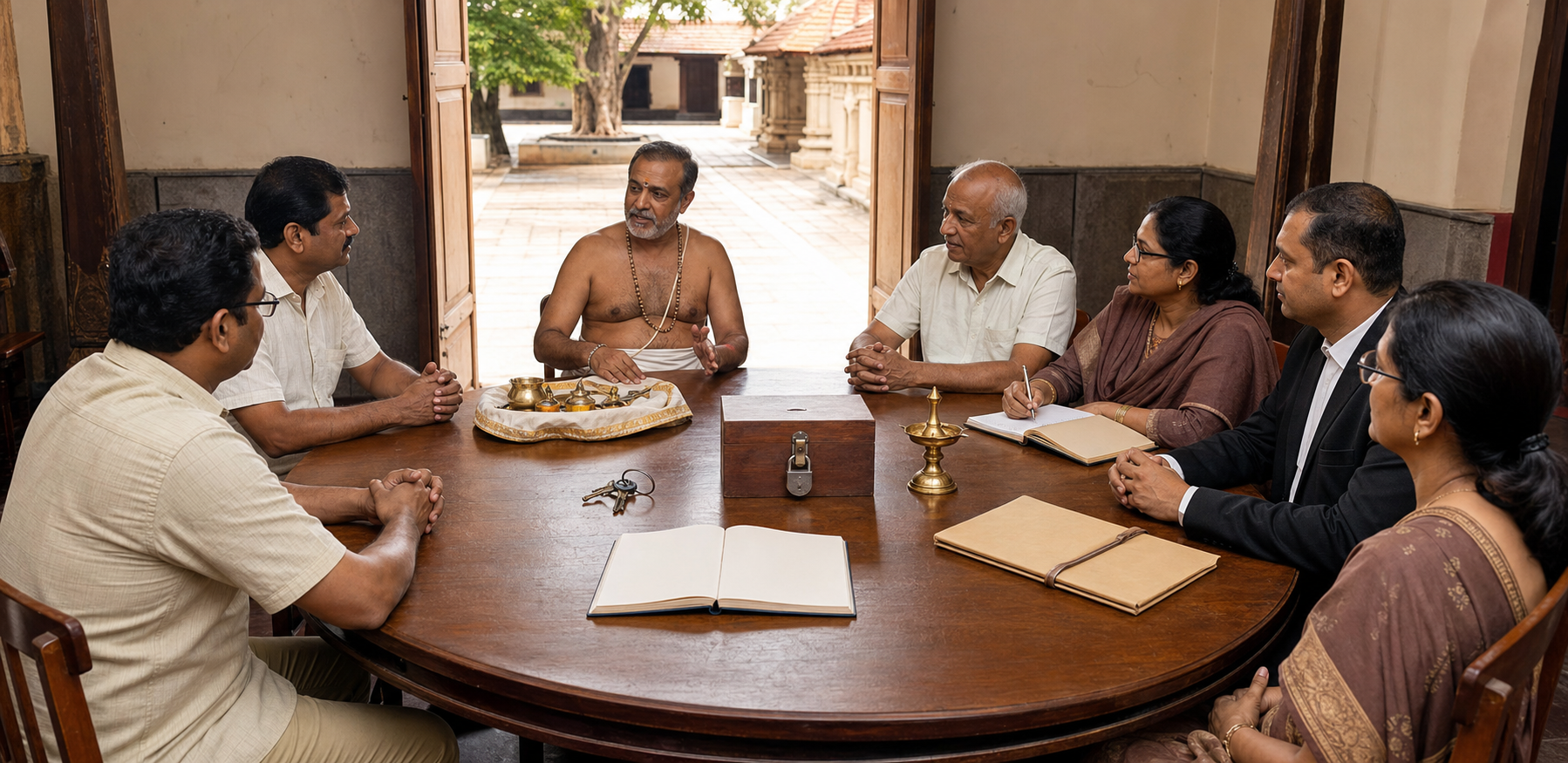
A temple committee should not become a second priesthood, and ritual office should not become an exemption from financial or custodial accountability. The cleanest arrangement is a two-track system: recognized religious authority governs rites and sacred boundaries, while trustees and administrators govern legal compliance, money, assets, facilities, and public operations. The charter must state where the tracks meet.
Before accepting the first public donation, define at least the following responsibilities and records:
| Function | Responsible authority | Record that must exist |
|---|---|---|
| Daily worship and ritual practice | Recognized acharya, archaka, or sampradaya-specific authority | Approved paddhati, seva roster, and ritual festival calendar |
| Trust and committee decisions | Lawfully constituted trustees or management committee | Current registration, trustee list, charter, delegations, and signed minutes |
| Temple property and sacred assets | Named custodians under trustee oversight | Registers for movable and immovable assets, ornaments, custody, and authorized access |
| Donations and expenditure | Authorized bank signatories and accounting function | Bank mandate, receipt controls, e-ledger or equivalent books, approved expenditure, and periodic verification |
| Complaints and conflicts | Designated grievance channel with appropriate independence | Complaint register, acknowledgement, decision, and closure record |
| Building and heritage care | Trustees working with qualified conservation or technical advisers | Condition record, scope of work, required permissions, and completion record |
These controls are not bureaucracy added to worship. Donation boxes, ornaments, property, and hereditary claims become flashpoints when custody is informal. The Sindhudurg revival therefore paired resumed worship with asset inventories, bank mandates, e-ledgers, receipt controls, operating procedures, audits, and grievance channels. Each control removes an ambiguity that could otherwise close the temple again.
Write the charter in language that local devotees can understand. It should state the temple’s purpose and tradition; how trustees and office-bearers are appointed; which matters are reserved to ritual authority; how meetings, delegations, expenditure, and conflicts of interest are handled; who holds keys and records; how grievances are reviewed; and how amendments are made. Check every clause against the governing deed and applicable law.
Financial transparency should be useful rather than theatrical. Record every authorized channel through which the temple accepts offerings. Issue controlled receipts where receipts are used, reconcile collections with deposits and books, approve expenditure through the stated process, and schedule independent verification. Give devotees a comprehensible periodic summary without publishing security-sensitive details about ornaments, cash handling, or storage.
Governance also determines who can contribute. Women and young people can support documentation, cleanliness, pilgrim assistance, queue management, archives, and other non-ritual work without erasing the temple’s distinct rules of ritual authority. Basic access for senior citizens and persons with disabilities, low-waste offerings, a clean precinct, and routine safety checks make stewardship visible in daily practice.
Do not let reopening enthusiasm damage the heritage being revived. New paint, tiles, drilling, electrical work, idol handling, or structural alterations can destroy historic material and may violate applicable conservation requirements. Record the condition first, obtain the permissions that apply, and use qualified advice before irreversible work. Preserve intangible heritage as carefully as stone: oral histories, local bhajans, festival sequences, artisan knowledge, and regional ritual forms are part of the temple’s continuity.
Let tradition set the rite, then test the operating system
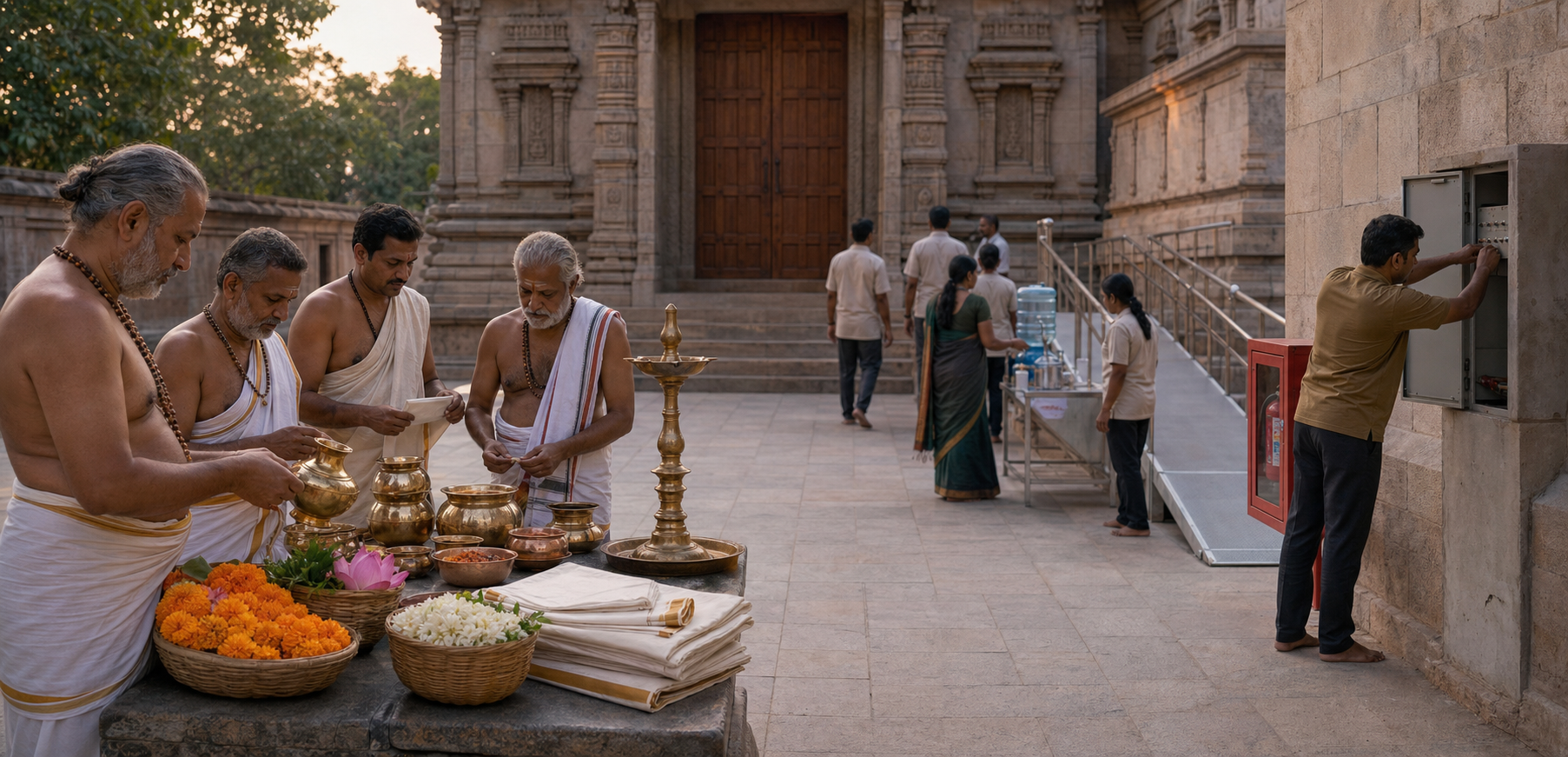
Reconsecration is a sacred determination, not event management
In its ritual understanding, Pran Pratishtha is not a ceremonial ribbon-cutting. It establishes the murti and sanctum as a living locus of divine presence. A traditional Shaiva sequence can include adhivasa rites, vastu-shanti and garbhanyasa, sankalpa, nyasa, moola-mantra japa, netronmilanam, shodasha-upachara worship, and mahapurnahuti. The exact sequence, eligibility rules, mantras, materials, and preparatory observances belong to the applicable Agamic and lineage authority.
Do not copy the Somnath sequence, or any other prominent ceremony, as a universal script. Hindu sampradayas themselves differ, and Jain, Buddhist, and Sikh institutions have their own authorities and liturgical boundaries. The committee’s task is to identify the correct authority, provide accurate facts about the shrine’s condition, and support the decision – not to manufacture a hybrid rite for convenience or publicity.
Ask the ritual authority for a written coordination note covering:
- The temple tradition and ritual basis being followed.
- The condition that makes a particular rite necessary.
- The required sequence and what work must be completed beforehand.
- Who may perform each responsibility and who may enter restricted areas.
- The sacred materials, facilities, and volunteer support required.
- The boundaries for photography, media, political attendance, and public access during restricted rites.
- The daily worship and observances that must continue after consecration.
Complete approved structural, conservation, and installation work before the final purification and consecration sequence unless the ritual and technical authorities direct otherwise. A physically unfinished sanctum invites workers, tools, dust, and later alterations back into a space that has just undergone sacred preparation. Civil completion and ritual readiness should therefore be signed off separately.
Use the first full festival as a governance audit
The first darshan proves that the doors can open. It does not prove that the temple can remain open. Before announcing the ceremony, run through the first ordinary worship cycle and the first substantial festival on paper. Confirm who opens and closes the premises, who performs or arranges each seva, who receives materials, who controls keys, who records donations, who approves spending, who manages queues, and who responds when a volunteer or devotee raises a complaint.
- Publish the confirmed daily worship and festival schedule only after the ritual roster is viable.
- Assign substitutes or an approved escalation route for essential duties rather than assuming one person will always be available.
- Sign the opening inventory before assets begin moving for worship or festivals.
- Test donation, receipt, deposit, and accounting procedures before the opening crowd arrives.
- Brief volunteers on sacred boundaries, accessibility, cleanliness, queues, and whom to contact when they do not know the answer.
- Set the first account review, grievance review, building inspection, and committee meeting before the opening date.
- After the first major festival, record what failed, who owns each correction, and when the committee will verify completion.
Somnath’s continuity after 1951 rests not only on a remembered consecration but also on ongoing conservation, regular worship, pilgrim services, documentation, and trust stewardship. That is the standard worth carrying into a village revival: the ceremony establishes sacred life, while disciplined service protects the conditions in which that life can continue.
Measure success after ordinary days and the first revived festival, not by the size of the opening crowd. Regular puja, accurate accounts, intact assets, resolved complaints, maintained premises, and a community able to disagree without relocking the doors are stronger evidence of revival than one elaborate event.
Key takeaways
- Reopening restores access, revival restores the temple’s full life, and reconsecration answers a specific ritual question. Determine which work is actually required.
- Resolve or formally contain disputes over trusteeship, seva, property, and ritual precedence before collecting funds or announcing a date.
- Let the recognized tradition govern rites. Let lawfully constituted trustees govern money, property, facilities, records, and compliance.
- Put registrations, minutes, inventories, bank controls, receipts, accounts, and grievance procedures in place before the doors open.
- Protect both material and intangible heritage. Unapproved renovation can damage the very continuity the revival is meant to restore.
- Judge the revival by sustained worship and sound administration after the first festival, not by the spectacle of consecration day.
At your next working meeting, ask for four concrete outputs: a one-page status brief, a stakeholder map, a register of missing or disputed records, and the names of the ritual, legal, and conservation authorities who must answer the unresolved questions. Do not announce the date yet. Once those outputs are agreed, you will have something more valuable than momentum: a path by which the temple can reopen without carrying the old conflict into its renewed sacred life.
References
- Hindu Pad – Somnath Pran Pratishtha 2026: 75 Years of Sacred Resurgence, Unity, and Nation-Building
- Hindu Jagruti Samiti – Historic Revival in Sindhudurg: Decades-Closed Temples Reopen via Maharashtra Mandir Mahasangh