
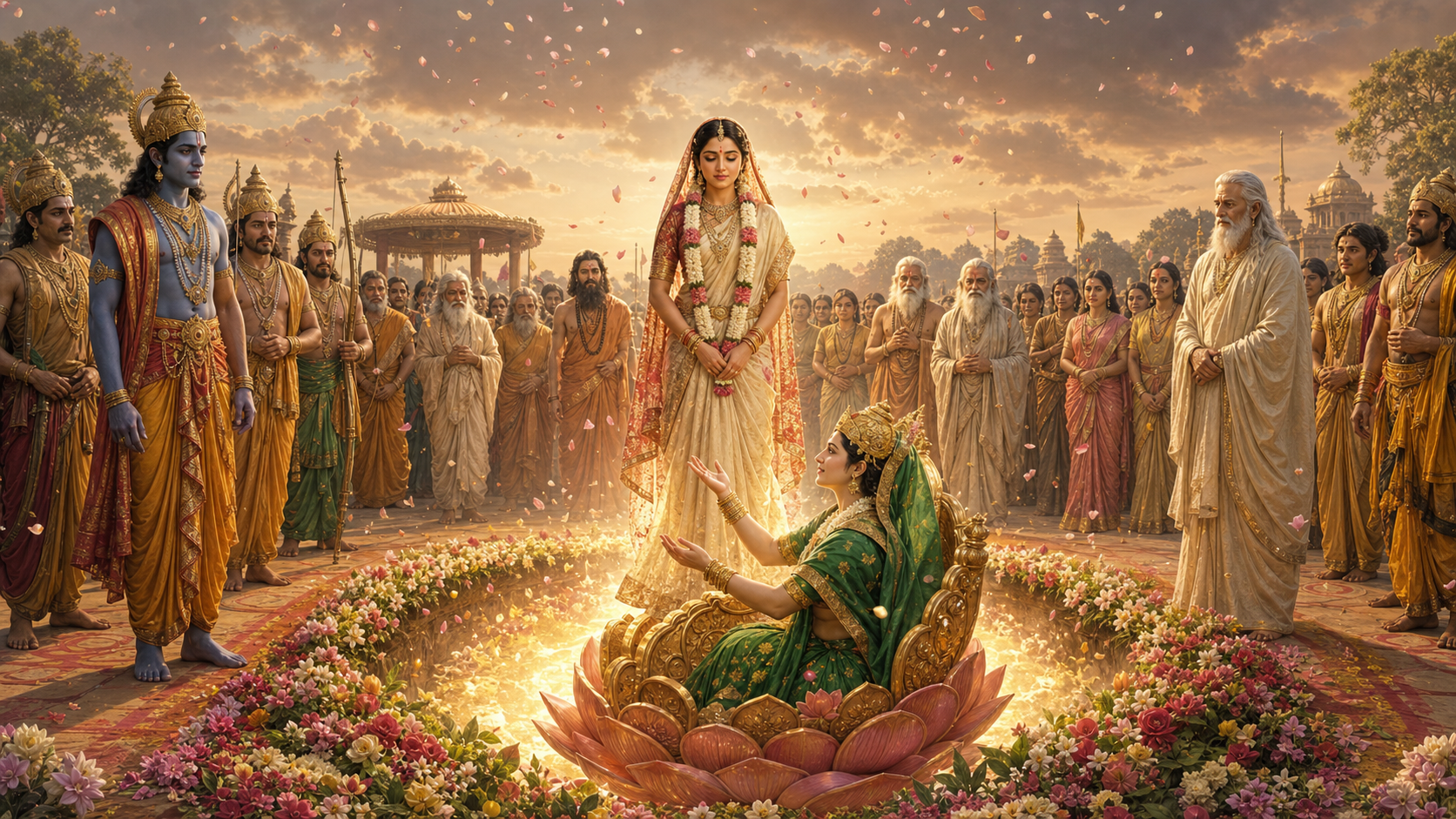
If you have reached the end of Sita’s story and wondered whether her descent into the Earth amounts to suicide, do not begin with the image of the ground opening. Begin with what Sita says, who answers her, and how the Ramayana describes her departure.
That sequence changes the meaning. Sita does not perform an act of self-killing. She makes a public truth-claim, invokes Bhoomi Devi as witness, and is received by the divine mother from whom she came. The scene preserves the pain of her treatment, but its narrative grammar is vindication, return, and sacred withdrawal rather than self-destruction.
Follow the sequence before assigning a modern label
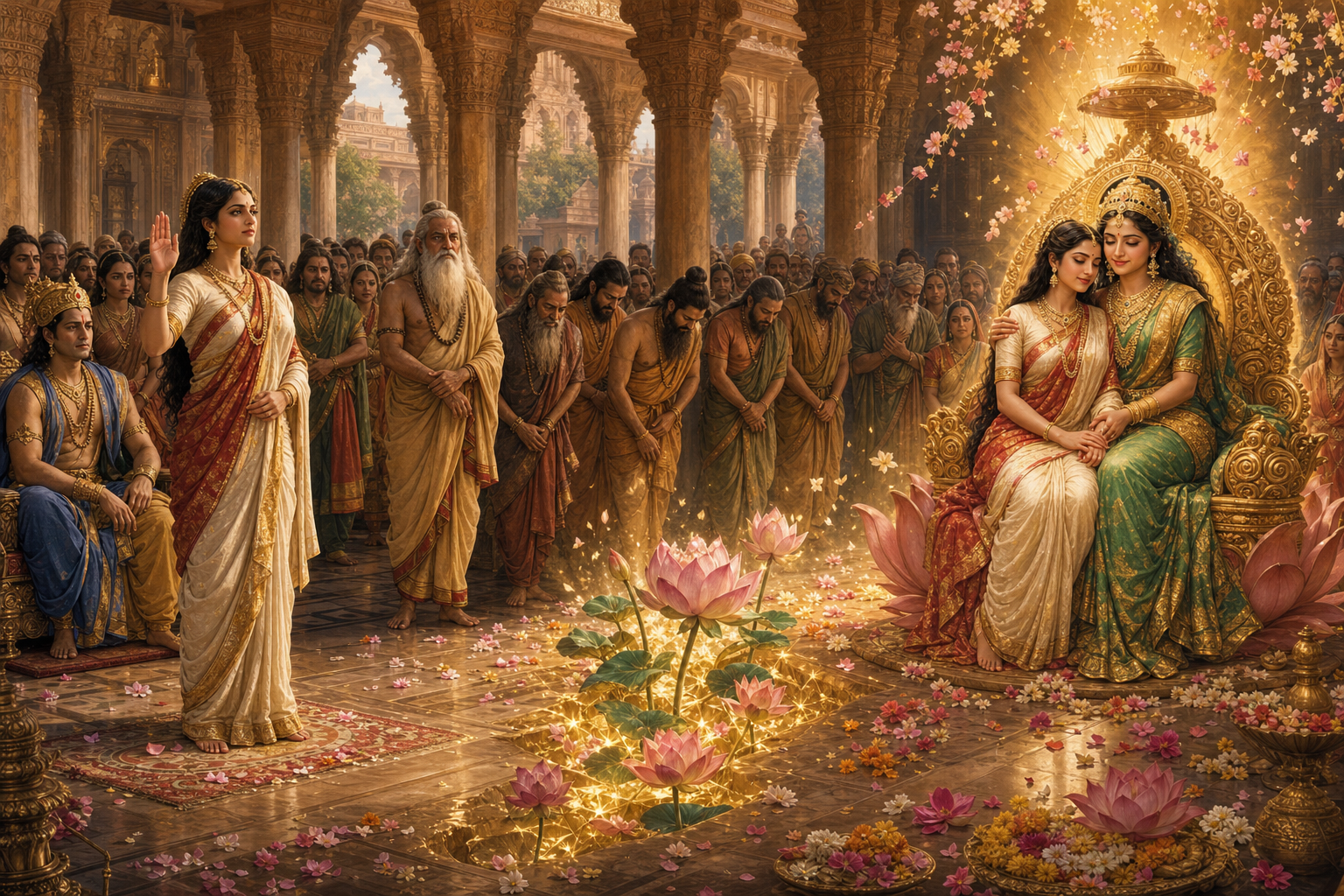
The relevant scene occurs in the Uttara Kanda of the Valmiki Ramayana. Sita has already endured repeated public scrutiny. At this final assembly, she does not submit to another humanly administered ordeal. She places the truth of her life before a witness higher than the court.
- Sita declares that she has remained faithful and pure in thought and deed.
- She asks the Earth to receive her if that declaration is true.
- The Earth opens, a golden throne appears, and Bhoomi Devi receives and embraces Sita.
- Sita disappears from the visible human plane in a form of sacred withdrawal commonly described as antardhana.
Each element matters. Sita’s condition is truth, not despair. Her action is invocation, not bodily violence. The responding agent is Bhoomi Devi, not an impersonal physical force. The outcome is divine reception, not a narrated death caused by Sita.
This gives you a practical test for any proposed interpretation: identify the act that the label is supposed to describe. A suicide reading requires an act of self-killing, yet the Ramayana supplies no such act. It instead supplies a vow grounded in truth, followed by a supernatural answer. The Earth functions as witness, mother, and final authority.
The public nature of the scene is equally important. Sita is not escaping unseen from an unbearable private moment. She speaks before the assembled world and sets the terms of her final vindication. Human institutions have questioned her; she now appeals beyond their jurisdiction. Bhoomi Devi’s response is the epic’s verdict.
Sita’s birth tells you how to read her departure

The ending has been prepared from Sita’s first appearance. Her name is connected to the Sanskrit root associated with a ploughed furrow. King Janaka discovers her while ploughing, so she enters the story as a child of the field and a daughter of the Earth.
Her return therefore closes a deliberate narrative ring: the daughter found in the furrow is finally received by the Earth. Between those two moments, Sita passes through forest exile, captivity, the ordeal by fire, queenship, renewed separation, and the raising of her sons. Her final appeal gathers that entire moral history into one truth-claim.
This is why the name “Sita” is not an ornamental detail. It gives the ending its internal logic. If you isolate the descent from her origin, the ground can look like a means of death. If you read origin and ending together, the movement is homecoming. The Earth is not where Sita happens to disappear; the Earth is where her identity has always pointed.
Recognizing that structure does not require you to dismiss the Ramayana as “only symbolic.” The epic belongs to the world of itihasa and kavya, where remembered events, ethical instruction, theology, and poetic form can occupy the same narrative. Verse was also used to preserve technical knowledge in ancient Bharat, including Ayurvedic material, because meter aided memory and transmission. Poetic form does not make a work empty of factual or historical intention. It does mean that images, names, repetitions, and narrative symmetry carry meaning alongside the surface action.
Use both levels. Attend to what happens within the story, and then ask why it happens in this particular form. Here the form completes Sita’s Earth-born identity and turns a final public challenge into cosmic recognition.
Three complementary readings reveal the whole scene
Classical Indian interpretation often approaches a sacred narrative through three connected lenses: adhibhautika, the human and worldly level; adhidaivika, the divine and cosmic level; and adhyatmika, the inward and spiritual level. You do not have to choose one and discard the others.
| Lens | Question to ask | What Sita’s return expresses |
|---|---|---|
| Adhibhautika | What is happening in Sita’s human and social world? | She exercises moral agency and refuses to remain indefinitely subject to public suspicion. |
| Adhidaivika | Which divine realities are acting through the event? | Bhoomi Devi receives her daughter, and human judgment gives way to cosmic recognition. |
| Adhyatmika | What inward or spiritual movement does the scene disclose? | Sita passes from worldly turmoil into renunciation, repose, and freedom from the demands of social spectacle. |
The human reading prevents theology from erasing Sita’s mistreatment. She has been made to bear a burden that public opinion repeatedly renews. Her departure ends that cycle. The divine reading prevents her choice from being reduced to political protest alone. Bhoomi Devi actually answers, and that intervention is central to the scene. The spiritual reading shows why withdrawal need not mean defeat: relinquishing an unjust arena can express freedom from it.
Keeping the three together also protects you from a common interpretive mistake. A purely social reading can turn Sita into nothing more than a victim of royal power. A purely theological reading can make her pain seem irrelevant. A purely allegorical reading can dissolve a fully drawn person into an abstract lesson. The Ramayana gives you Sita as a woman treated unjustly, a manifestation of divine femininity, and an exemplar of spiritual dignity at the same time.
The emotional movement of the poetry supports this layered reading. Karuna, the rasa of pathos, lets you feel the cost of what has happened. Adbhuta, wonder, enters when the Earth opens and the goddess appears. Shanta, spiritual quietude, settles over the withdrawal. The scene does not ask you to stop grieving; it carries grief through wonder toward repose. Calling the event suicide collapses that carefully ordered movement into a single modern category.
Why sacred departure and suicide are not interchangeable
The distinction is not a euphemism designed to protect a revered character. It follows the ethical and narrative categories actually present in the episode.
- Atma-hatya means self-killing and is prohibited within Dharmashastric ethics. The scene contains no narrated act by which Sita kills herself.
- Prayopavesa is a solemn and highly regulated fast under particular renunciate conditions. Sita neither begins a fast nor undergoes a process resembling it.
- Antardhana is disappearance or withdrawal from the visible plane, a motif associated with divine or sacred departures. Invocation followed by divine reception places Sita’s departure in this narrative family.
Other Dharmic traditions can help you recognize the broader civilizational grammar without pretending that every departure is identical. The Mahabharata presents the Pandavas’ mahaprasthana, or great departure, and Yudhishthira’s ascent. Buddhist tradition understands the Buddha’s parinirvana as a consummate spiritual passage. Jain dharma distinguishes the disciplined and non-attached practice of sallekhana from an impulsive attempt to destroy oneself. These events differ in doctrine, eligibility, intention, and metaphysics. Their limited point of comparison is that a sacred transition cannot be classified responsibly from the physical image of departure alone.
Intention, agency, discipline, and divine context matter. In Sita’s case, the decisive features are her truth-vow and Bhoomi Devi’s response. The scene is not an instruction for a human being to imitate, and its sacred vocabulary should never be used to romanticize actual self-harm. A present-day danger to a living person must be treated as a real safety concern; an epic event involving explicit divine intervention is not a model for ordinary action.
Rejecting the suicide label does not require you to deny Sita’s refusal. She does refuse something: another round of life under suspicion, another demand that her integrity depend on public approval, and another submission to a court that has already failed to protect her dignity. But refusal and self-destruction are not synonyms. Sita’s refusal takes the form of a final appeal to truth and a return granted by the divine mother.
The feminine theology sharpens this point. Vaishnava traditions speak of Sri Devi, Bhu Devi, and Nila Devi as complementary expressions of divine femininity. Sita is widely identified with Sri while also being the Earth-born daughter received by Bhu. No royal ruling can manufacture or cancel that sacred identity. The final scene moves authority away from courtly reputation and locates it in truth, the Goddess, and dharma itself.
Key takeaways for reading Sita’s return
- Read the actions in order: Sita declares the truth, invokes the Earth, receives a divine answer, and disappears from the human plane.
- Let her origin interpret her ending: the child discovered in a furrow returns to Bhoomi Devi, completing the identity encoded in her name.
- Distinguish agency from self-harm: Sita decisively ends her exposure to public judgment, but the text does not depict her killing herself.
- Keep the three levels together: her departure is a human assertion of dignity, a divine homecoming, and a spiritual withdrawal.
- Respect the epic’s form: itihasa and kavya communicate through plot, theology, symbolism, rasa, and structural patterns at once.
- Compare Dharmic departures carefully: shared attention to intention and sacred transition does not erase the doctrinal differences among Hindu, Buddhist, and Jain examples.
When someone calls Sita’s return suicide, ask one precise question: where is the act of self-killing? Then return to the four narrative beats: truth-claim, invocation, divine response, and reception. That method keeps the discussion anchored in what the Ramayana actually presents rather than in an image detached from its story.
You can acknowledge the ending’s sorrow without misnaming it. Read Sita’s final choice as the epic frames it: a sovereign appeal to truth, answered by the Earth, that places her dignity beyond the reach of public suspicion.