
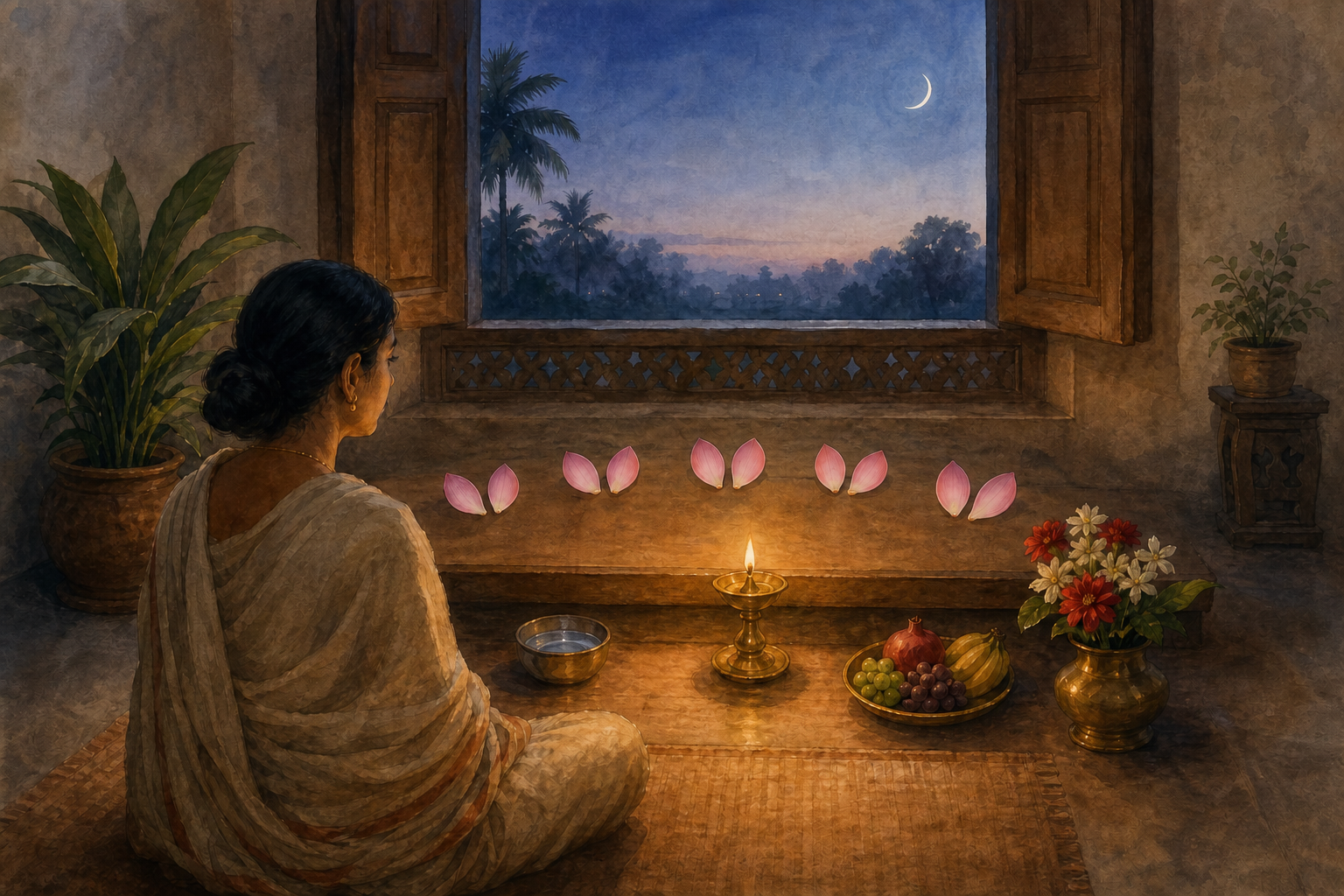
You may feel drawn to Dashamahavidya worship and still hesitate at three points: Which form is right for you? Which Jayanti date applies where you live? How much Tantric practice belongs in a household altar? Those are sensible questions. You do not resolve them by chasing the fiercest icon, the rarest mantra, or a calendar date copied from another timezone.
Begin with one quality you genuinely need to embody. Confirm the relevant tithi for your location. Then choose the simplest non-harming practice appropriate to your adhikara, family tradition, and initiation. This keeps your devotion personal without becoming casual about Tantra.
Choose the virtue before you choose the form
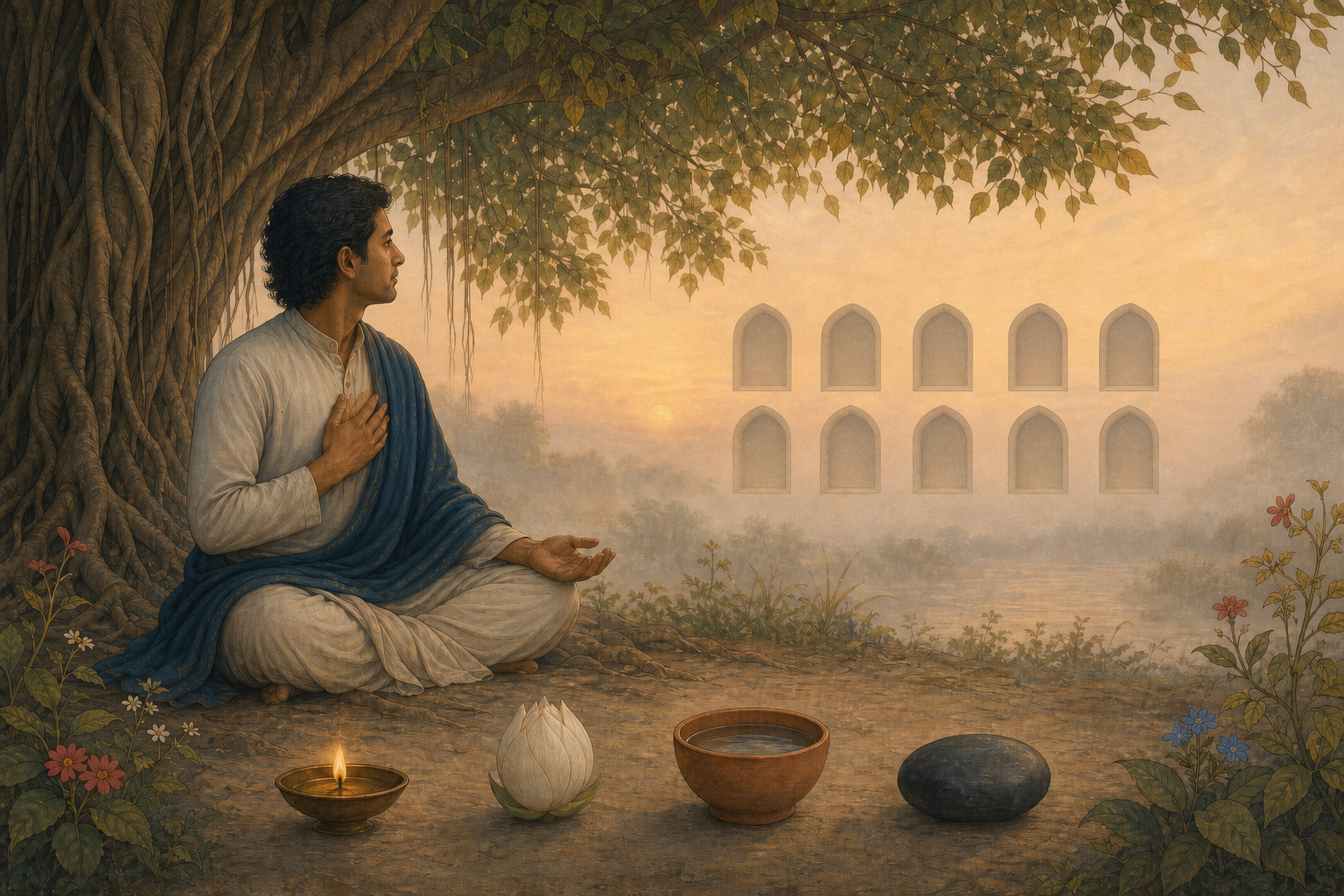
The ten Mahavidyas are not a ladder on which one Goddess is stronger or more spiritually impressive than another. Each reveals the same Divine Shakti through a distinct form of wisdom. Your task is therefore not to identify the most powerful deity. It is to recognize the form whose teaching meets the work presently in front of you.
A sound choice brings present needs, spiritual direction, readiness, and Jyotisha into a converging discernment. Start by writing a sankalpa limited to one or two priorities. Protection and prosperity, for example, are still broad ideas. Courage during a prolonged difficulty, restraint during a dispute, steadiness after loss, disciplined study, household harmony, or ethical use of wealth are clear enough to guide practice.
| Mahavidya | Choose this current when the real work is | Restrained householder expression | Reason to pause and seek guidance |
|---|---|---|---|
| Kali | Finding courage under sustained pressure, seeking protection, enduring hardship, or cutting a limiting pattern | Offer a lamp and red flower, then pray for fearlessness, detachment, and strength used compassionately | The intention is aggression, retaliation, fascination with danger, or an uninitiated use of a bija or advanced rite |
| Tara | Finding direction in uncertainty, studying, advising others, travelling through a transition, or speaking clearly without cruelty | Offer a lamp and simple sweet; join prayer with a commitment to truthful, helpful speech | The goal has shifted from guidance and rescue to defeating or humiliating someone |
| Tripura Sundari, also called Shodashi or Lalita | Harmonizing relationships, intellect, work, devotion, beauty, and balanced prosperity | Offer a lamp, kumkum, and red or pink flowers; Lalita Sahasranama is a widely respected devotional form for householders | You are considering Panchadashi or Shodashi mantra, technical Sri Chakra worship, or another lineage-restricted procedure without initiation |
| Bhuvaneshwari | Creating emotional spaciousness, restoring household cohesion, establishing a stable home, or leading without excluding others | Offer a lamp with rice or a milk-based naivedya and contemplate making room for people and circumstances without losing discernment | Worship is being used to avoid a necessary conversation, boundary, or practical household responsibility |
| Bhairavi | Developing disciplined will, completing a demanding task, overcoming lethargy, or undertaking purifying tapas | Worship at a consistent time with a lamp and fresh red flowers, then complete one duty you have been postponing | Intensity is turning into anger, contempt, reckless austerity, or exhaustion |
| Chinnamasta | Confronting a compulsive pattern, a radical crossroads, or the need to surrender an entrenched identity | Keep the practice to brief prayer and sober contemplation unless a competent guru has prescribed more | You are drawn toward dramatic experiments, advanced prayoga, or self-testing without guidance |
| Dhumavati | Learning from grief, disappointment, solitude, stagnation, or the collapse of something once considered essential | Sit quietly, pray for wisdom and resilience, and identify one non-essential attachment you can release without neglecting duty | Ritual is being treated as a replacement for needed support during severe grief or psychological distress |
| Bagalamukhi | Stilling harmful speech, slander, destabilizing conflict, or your own impulse to react before the facts are clear | Pray for falsehood and injury to stop, including harmful speech arising from you; practise deliberate restraint before replying | The aim is coercion, domination, revenge, or experimentation with stambhana-oriented rites |
| Matangi | Refining learning, teaching, music, writing, counsel, creative intelligence, or public expression | Combine devotional worship with focused study and use one act of speech or creativity in service to another person | You want persuasive ability without the disciplines of truth, humility, and service |
| Kamala | Stabilizing livelihood, gratitude, generosity, graceful reciprocity, or a household relationship with prosperity | Offer a lamp, flowers, and food, then connect the worship to generosity or responsible stewardship | The sankalpa seeks accumulation without responsibility, gratitude, or fair dealing |
If two or three forms still seem equally appropriate, do not decide from iconography alone. Ask a harder question: Which virtue are you willing to practise away from the altar? If you want Tara but will not discipline your speech, or Kamala but will not practise reciprocity, the selection is still aspirational rather than honest. The form whose teaching you are ready to enact is usually the better beginning.
Readiness matters as much as attraction. Tripura Sundari, Bhuvaneshwari, and Kamala are commonly approached as harmonizing currents suited to sattvic household practice. Tara and Matangi can serve as accessible bridges for students, teachers, artists, and advisers. Kali, Bhairavi, Chinnamasta, Dhumavati, and Bagalamukhi may also be worshipped devotionally at home, but their advanced Tantric procedures call for stronger safeguards and competent upadesha.
Use Jyotisha as a refinement, not a command

A horoscope can clarify timing, temperament, and the kind of energy that needs constructive expression. It should not overrule sincere devotion or frighten you into a practice. A severe graha condition is not an automatic instruction to begin the corresponding Mahavidya’s mantra, and no responsible selection rests on one planet viewed in isolation.
A competent Jyotisha assessment considers the Lagna and Lagnesha, the strength and condition of Chandra, the Atmakaraka in Jaimini analysis, the Navamsa or D9 indications used in Ishta Devata discernment, the current Mahadasha and Antardasha, and relevant afflicted grahas and bhavas. If someone announces your Mahavidya solely from one difficult placement, you are receiving a partial reading.
Common correspondences associate Kali with Shani, Tara with Guru, Bhuvaneshwari with Chandra, Bhairavi with Mangala, Matangi with Budha, and Kamala with Shukra. Chinnamasta is variously connected with Rahu or Ketu; Dhumavati with Ketu or Shani; Bagalamukhi with Guru or Mangala; and Tripura Sundari with Surya or Budha in different Sri Vidya streams. These variations are not an error to be solved by choosing whichever chart interpretation sounds most dramatic. They are a reason to follow your sampradaya’s mapping consistently.
Use Jyotisha after you have named your sankalpa and assessed your readiness. Let it refine the shortlist, method, and timing. It can indicate why a particular form may be especially instructive during a dasha, but devotion, ethics, and adhikara still determine what you actually do.
Put each Jayanti on your local calendar

A Jayanti belongs to a lunar tithi, not to a permanently fixed Gregorian date. Tithi boundaries move through the civil day, and the applicable observance can shift with timezone, local sunrise, the amanta or purnimanta month system, and lineage rules. A date published for Bharat may therefore be wrong for a devotee in Toronto, London, Singapore, or another location.
The following sequence gives the widely observed tithis and the principal variations households need to recognize. Treat it as a calendrical map. Use a location-aware panchang to determine the civil date and observance window where you will perform the puja.
| Mahavidya | Common Jayanti observance | Focus for the day | Important variation |
|---|---|---|---|
| Lalita or Tripura Sundari | Magha Purnima | Graceful mastery of the senses and mind, harmony, and refined discernment | Some lineages also honour her during Navaratri on Panchami or through a Shodashi alignment |
| Matangi | Chaitra Shukla Tritiya | Learning, music, sacred art, articulate speech, and knowledge offered in service | Month naming and the corresponding civil date can vary regionally |
| Bagalamukhi | Vaishakh Shukla Ashtami | Strategic stillness, restraint, clarity in conflict, and the neutralization of harm | Any stambhana-oriented procedure must remain within the ethical and initiatory limits of the lineage |
| Tara | Vaishakh Shukla Navami | Wise counsel, study, compassionate expression, courage, and rescue from confusion | Tara and Neela Saraswati forms and mantra procedures differ across paramparas |
| Chinnamasta | Vaishakh Shukla Dashami | Fearless awareness, interruption of compulsion, and radical inner renewal | Householders should keep the observance restrained unless personally guided |
| Dhumavati | Jyeshtha Amavasya | Solitude, relinquishment, resilience, and wisdom drawn from loss or incompleteness | The contemplative character of the day should not be turned into theatrical severity |
| Mahakali | Jyeshtha Amavasya in one stream; Kartik Amavasya in another | Protection, courage, dissolution of fear, and freedom from binding patterns | For many householders, Kali Puja on Kartik Amavasya during Deepavali is the principal observance; Nishita timing may apply |
| Tripurabhairavi | Ashwin Krishna Navami in one stream | Tapas, disciplined action, purification, and completion | Other lineages honour Bhairavi during Navaratri, often on Shashthi or Saptami |
| Bhuvaneshwari | Ashwin Shukla Dwitiya | Sacred space, household harmony, emotional breadth, and compassionate stewardship | This observance commonly falls within Sharad Navaratri |
| Kamala | Sharad Purnima or Ashwin Purnima | Gratitude, sattvic prosperity, generosity, and responsible material wellbeing | The observance is associated in many places with Kojagiri Lakshmi Puja |
The broad 2026-2027 windows tell you when to begin checking your panchang, not which date to copy. Matangi falls around early April 2026 and late March or early April 2027. The Vaishakh sequence of Bagalamukhi, Tara, and Chinnamasta clusters around mid-May. Dhumavati falls in late June 2026 and around mid-to-late June 2027. Bhuvaneshwari, Bhairavi, Kamala, and the Kartik observance of Kali occupy the autumn arc: Kali Puja is around early November 2026 and late October or early November 2027, while Kamala is expected around late October 2026 and mid-October 2027. Lalita on Magha Purnima falls in February 2026 and in January or February 2027.
Confirm an observance through four checks:
- Set the panchang to the city and timezone where the worship will actually occur.
- Find the required tithi and inspect its local beginning and ending times rather than reading only the displayed civil date.
- Apply your tradition’s rule. For ordinary household observance, this is commonly the tithi prevailing at local sunrise. A special muhurta, such as Nishita for Kali Puja, can change the decision.
- If your guru, kula-parampara, or temple announces a different supported observance, follow that convention consistently. Communal coherence is better than switching systems to obtain a preferred date.
Amanta and purnimanta calendars may attach different month labels or place an observance on adjacent civil dates. That does not mean one community has forgotten the Goddess. It means lunar observance has been translated into local time through different inherited conventions.
Keep the home puja simple enough to be honest
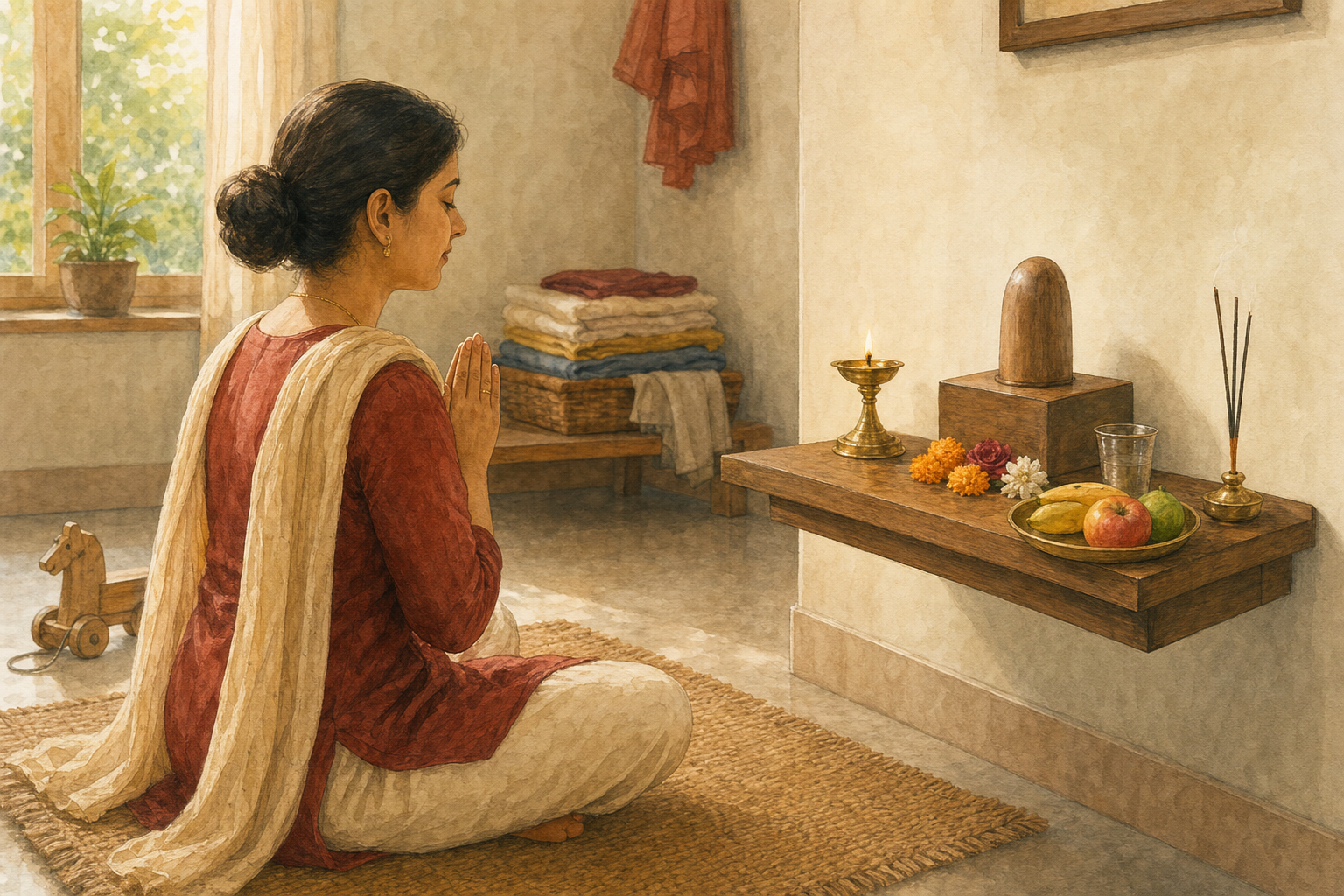
A Jayanti does not require you to imitate a temple paddhati or assemble advanced Tantric elements from unrelated internet instructions. A clean altar, a precise sankalpa, restrained offerings, attentive recitation, and conduct aligned with the chosen Mahavidya form a coherent household observance.
- Confirm the tithi before arranging the day. Note whether your tradition uses sunrise, a special muhurta, or the temple’s announced time. If duties prevent a long observance, protect a shorter period in which you can remain attentive.
- Prepare yourself and the altar. Bathe, wear clean clothing, and clean the worship space. Place the chosen Mahavidya’s image or established symbol on an altar facing east where practical. Arrange a deepa, gandha, pushpa, and a simple naivedya. Exact colours and rare flowers are aids, not reasons to postpone sincere worship.
- State a narrow sankalpa. Name the tithi, the Mahavidya, the quality you seek to cultivate, and the dharmic action through which you will express it. A useful form is: On this sacred tithi, I worship this form of Shakti so that courage, clarity, restraint, discipline, or gratitude may become active in my conduct, without harm to another being.
- Invoke and contemplate. Light the lamp, make the simple offerings, and recite a dhyana verse or familiar devotional praise belonging to the deity. Attend to the iconography as instruction, not spectacle: Kali’s severance of bondage, Bhuvaneshwari’s spaciousness, Bagalamukhi’s stilling power, or Kamala’s abundance joined to responsibility.
- Use only an appropriate mantra. If you have received a mantra and count from a competent lineage, follow that instruction. If you have not, do not assemble a bija or technical mantra from fragments found online. Use respectful nama-japa, a public devotional hymn known in your family or tradition, or simple prayer. Lalita Sahasranama is a recognized gentle option for Tripura Sundari worship.
- Sit in silence after recitation. Let the deity’s quality expose the habit that opposes it. With Tara or Matangi, notice careless speech. With Bhairavi, notice avoidance. With Bhuvaneshwari, notice where anxiety has narrowed your attention. With Kamala, notice where receiving has become separated from gratitude and giving.
- Offer naivedya and close properly. Conclude with gratitude and kshama-prarthana, asking forgiveness for errors in pronunciation, attention, or procedure. Share the offering respectfully and keep the altar orderly.
The action after puja is part of the observance. Kali worship should produce courage without cruelty. Tara and Matangi should make speech more truthful and useful. Bhairavi should help you complete a duty. Bhuvaneshwari should create room for another person without erasing sound boundaries. Bagalamukhi should still your harmful reply before it seeks to still anyone else. Kamala should move prosperity toward gratitude and generosity.
Fasting is optional and should suit your constitution and responsibilities. It is not proof that worship has been accepted. If fasting would worsen a health condition or interfere with necessary medication, choose a moderate food discipline or mindful simplicity instead of risking harm.
After the Jayanti, record what happened to your attention, speech, decisions, and emotional steadiness. Do not grade the practice by dreams, visions, or dramatic coincidences. If the sankalpa remains alive, continue the simple practice weekly for one or three lunar months as appropriate, then review whether the chosen quality has become more visible in ordinary conduct.
Know where householder practice should stop
The safest default for an uninitiated householder is devotional upasana: deepa, flowers, nama, a recognized stotra, meditation, ethical restraint, and seva. Initiation becomes important when you move toward lineage-specific bija mantras, nyasa, mudra, technical yantra or Sri Chakra procedures, or a prayoga intended to alter a conflict. The boundary protects both the practitioner and the integrity of the tradition.
Fierce iconography is not permission for fierce behaviour. Kali is not an endorsement of aggression. Bhairavi’s tapas is not uncontrolled anger. Chinnamasta’s radical severance is not a warrant for dangerous self-denial. Dhumavati’s emptiness is not neglect of health, family, or livelihood. Their fierceness is first directed at fear, delusion, compulsion, vanity, and attachment within the practitioner.
Bagalamukhi requires especially clear intent. In a dispute, pray for harmful speech to cease, truth to become visible, and your own words to remain controlled. Do not turn stambhana into a fantasy of silencing every opponent. When a conflict has legal or financial consequences, worship can support steadiness, but it does not replace qualified legal or financial advice.
The same boundary applies to Chinnamasta and Dhumavati. Prayer can support the interruption of a compulsive pattern or the passage through loss. If addiction, grief, or psychological distress threatens your health or safety, involve appropriate human and professional support. Sadhana should deepen truthful action, not provide a sacred-looking reason to avoid it.
Key takeaways
- Choose a Mahavidya for the virtue you need to practise, not for status, fear, or the appearance of occult power.
- Limit your sankalpa to one or two priorities and shortlist only the forms that fit both the need and your readiness.
- Use Jyotisha to refine timing and emphasis; do not let one afflicted graha dictate an uninitiated practice.
- Determine every Jayanti from a location-aware panchang, local sunrise or prescribed muhurta, and your sampradaya’s convention.
- Keep uninitiated home worship devotional and non-harming. Reserve bija, nyasa, mudra, technical yantra worship, and stambhana prayoga for competent guidance.
- Judge the fruit by changes in courage, speech, discipline, spaciousness, gratitude, and conduct rather than by spectacle.
Choose the quality you most need to embody now. Find the next locally valid tithi, place it on your calendar, and prepare the smallest complete observance you can perform with attention. Then let the days after the lamp is extinguished reveal whether the worship has entered your life.
References
- DharmaRenaissance Blog – Choosing a Mahavidya for Navratri: Scholarly, Horoscope-Aligned, Ethical, Transformative Guide
- DharmaRenaissance Blog – Dashamahavidya Jayanti 2026-2027: Accurate Tithi Guide, Deep Meanings, and Home Puja Methods