
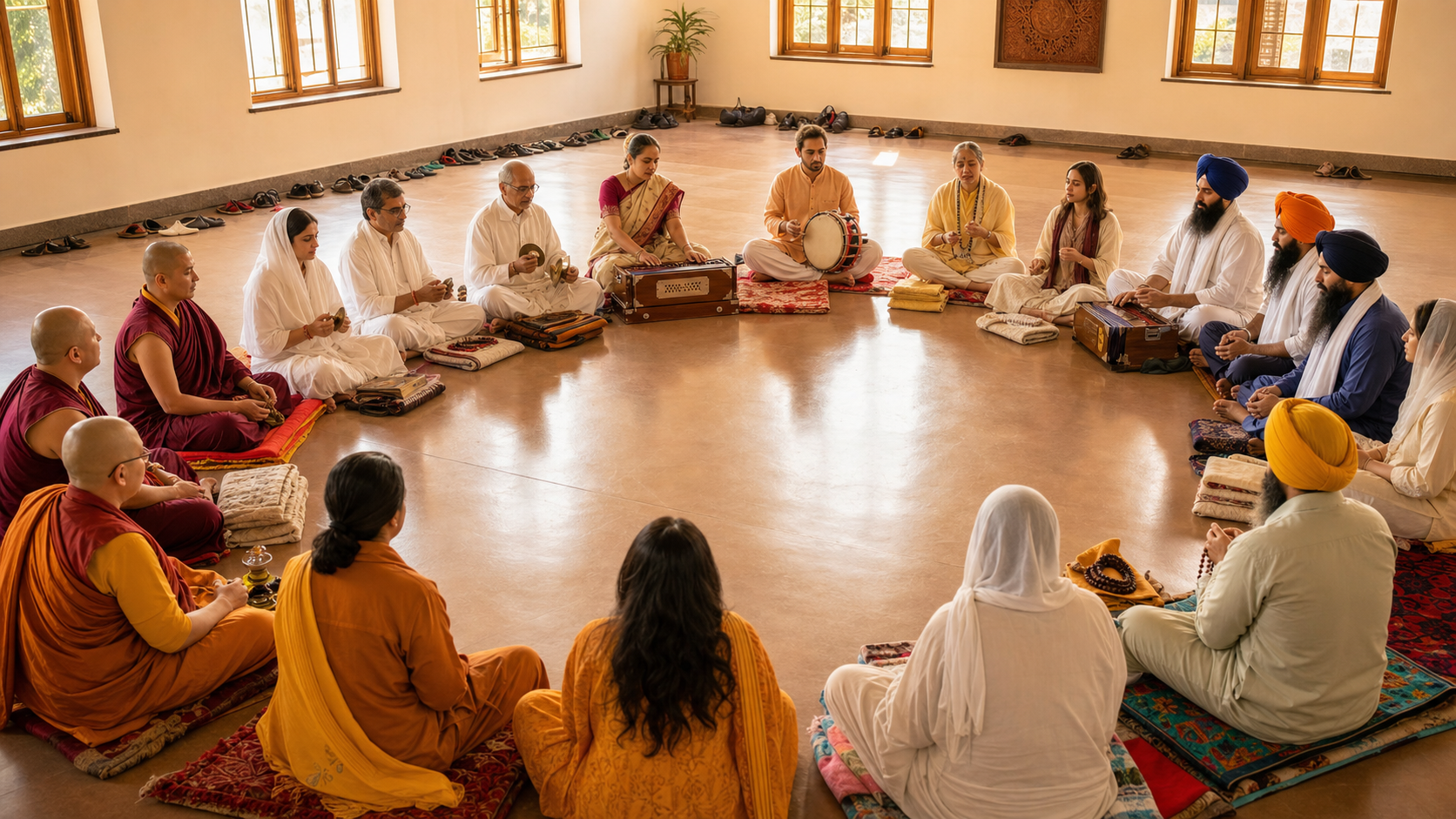
You want to bring Hindus, Buddhists, Jains, and Sikhs together, but you don’t want the gathering to become a polite photo opportunity or a confused mixture of sacred forms. The central challenge is not getting everyone to sound the same. It is creating enough shared attention for people to encounter one another without asking anyone to dilute a living tradition.
Collective chanting can provide that meeting place when each community retains authority over its own words, music, and meaning. If you are organizing such a gathering, your task is to design unity without manufacturing sameness.
Begin with a shared purpose, not a shared theology
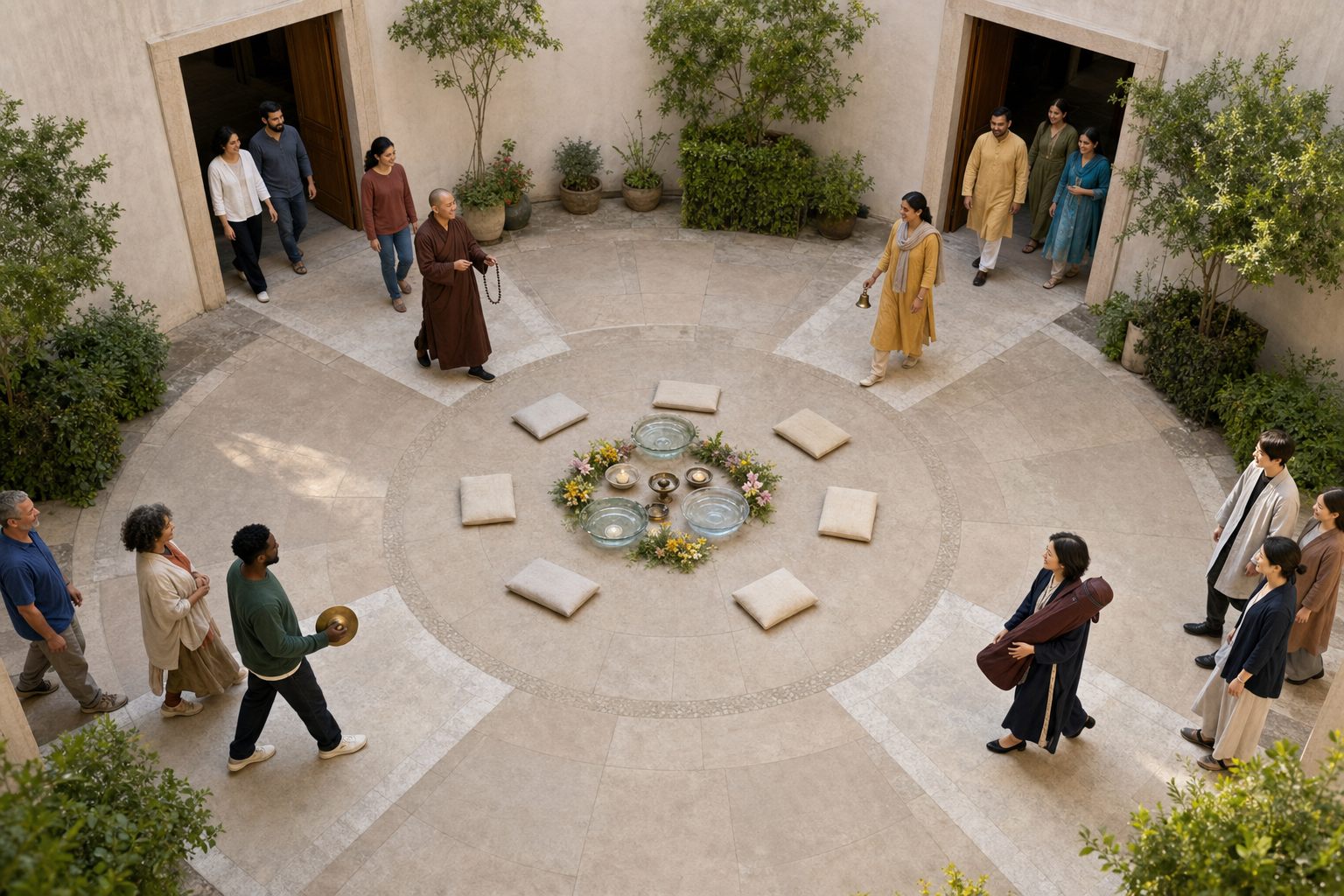
Inter-Dharmic unity does not require a blended creed. Hindu darshanas, Buddhist traditions, Jain philosophy, and Sikh teachings do not make identical claims about the self, liberation, revelation, or the Divine. Atman, jiva, buddha-nature, and Naam should not be presented as interchangeable names for one doctrine. Their differences are real, and an honest gathering protects them.
The common ground lies in practice: people can discipline attention, restrain hostility, serve others, and orient themselves toward what their traditions hold sacred. Across these communities, sacred sound already appears in distinct and established forms: kirtan and nama-smarana in Hindu lineages, Gurbani Kirtan and Naam Simran in Sikh practice, stavan and the Namokar Mantra in Jain communities, and sutra, mantra, Paritta, or Metta recitation in Buddhist traditions.
That resemblance gives you a method, not permission to erase boundaries. Call each practice by its proper name. Let its own practitioners explain what it means. Never advertise a Jain recitation, a Sikh shabad, a Buddhist sutra, and a Vaishnava nama-kirtan as different versions of one universal chant.
The term Yuga Dharma illustrates why context matters. Gaudiya Vaishnavism identifies congregational glorification of the Divine names as the discipline especially suited to Kali-yuga. A Gaudiya host can present that conviction faithfully while making clear that Buddhist, Jain, and Sikh participants are not being asked to adopt its theology. Hospitality becomes credible when conviction and restraint appear together.
Before choosing chants or booking a venue, have the participating communities approve a purpose statement. A workable version is: This gathering brings Dharmic communities together through attentive listening, authentic sacred recitation, shared ethical commitments, and service. Each tradition will be named and led on its own terms. Presence does not imply doctrinal assent, and no segment will be used to recruit, rank, or reinterpret another community.
Build the gathering as a sequence of hospitality

A successful program needs more than a list of performers. It needs a sequence that tells participants when to listen, when they may join, and what each sacred form asks of them. Use the same structure for every community so procedural equality is visible rather than merely promised.
- Open with the purpose statement, the non-proselytization commitment, and clear participation options.
- Introduce each segment briefly: its proper name, language, community of origin, broad devotional or contemplative purpose, and whether guests are invited to vocalize.
- Give every tradition a community-approved leader, comparable time, equivalent sound support, and the same opportunity to provide translated text.
- Place a short interval of silence between traditions. This prevents the program from feeling like an uninterrupted medley and gives participants time to receive what they have heard.
- Move from chanting into a shared meal or service activity rather than ending with speeches and photographs.
- Close by naming the next concrete point of contact: a service day, a visit to another community’s venue, or a planning meeting led by the next host.
The tradition-led portions should remain recognizable to their own communities. A Hindu representative might choose kirtan or nama-smarana according to lineage. A Sikh segment might center Gurbani Kirtan or Naam Simran and explain the place of Shabad. A Jain representative might lead a stavan or the Namokar Mantra, which can serve as a shared liturgical anchor across Shvetambara and Digambara communities. A Buddhist community might select Pali Paritta, Metta chanting, a Mahayana sutra, or another established recitation appropriate to its school.
Do not choose these forms on a community’s behalf. A generic Buddhist mantra selected by a Hindu organizer, or a shabad chosen without Sikh guidance, may look inclusive on a program sheet while communicating that the host has not recognized internal authority. Ask each delegation to select its own material, leader, pronunciation, translation, and participation instructions.
Listening must count as full participation. Some guests will gladly repeat a refrain; others may prefer silent remembrance, respectful attention, or simply standing or sitting with the assembly. State these options before the chanting begins. Compelled vocal participation turns a gesture of welcome into a test of conformity.
Rotate both the opening position and the venue over successive gatherings. Meeting in mandirs, gurdwaras, viharas, and derasars distributes visibility across the participating traditions and lets people encounter each community as a host rather than only as a guest. Provide an etiquette note before each visit so unfamiliar customs do not become avoidable sources of embarrassment.
Put guardrails in writing before goodwill is tested

Warm intentions are not a governance system. Disagreements usually become difficult when a program is already announced, publicity has circulated, and withdrawing would cause public friction. Set the boundaries while changes are still easy.
- Community authority: Every sacred segment has an approved representative who controls its wording, leader, translation, and explanation.
- No proselytization: Speakers do not use the gathering to seek conversions, distribute recruitment material, or present another tradition as incomplete.
- No forced equivalence: The host may identify shared ethical concerns but may not declare distinct metaphysical teachings to be identical.
- Equal treatment: Introductions, time, seating, sound equipment, publicity, and hospitality follow the same standard for every participating community.
- Voluntary participation: Guests may chant when invited, remain silent, or step out without being singled out.
- Accurate publicity: Promotional material names the participating traditions and practices instead of advertising a vague universal spirituality.
- Recording consent: Organizers explain in advance whether photography or streaming will occur and provide a practical way for people to remain off camera.
- Food clarity: Ingredients, dietary arrangements, and the ritual status of food are stated plainly. Prasada, langar, and anna-dana should not be treated as interchangeable labels.
These rules should be co-authored, not handed down by the largest institution. Equality and shared purpose are among the conditions that can make contact across group boundaries constructive. Collective vocal practice adds coordinated attention and rhythm, which may support trust, cooperation, and calmer social engagement. Those effects are possibilities created by good design, not guarantees produced by sound alone.
Avoid claiming that chanting automatically heals political or historical wounds. People can sing together and still retain serious disagreements. The immediate, defensible goal is narrower: create a setting in which participants encounter one another under equal conditions, learn the names and meanings of real practices, and complete a useful task together. Trust can then grow through repetition.
Turn devotional warmth into service and follow-through

The emotional lift of collective sound can disappear as soon as people return to separate social circles. Service gives the gathering a second center. The Sikh pairing of sangat, Gurbani Kirtan, and langar offers a particularly clear model of sound joined to equality and seva: people orient themselves through sacred recitation and then enact solidarity through shared work and food.
Choose the service component during planning, not as an optional addition after the program is built. It may be preparing and serving a shared meal, organizing anna-dana, handling cleanup together, or continuing a locally agreed charitable effort. Give mixed-community teams concrete responsibilities so participants cooperate rather than merely occupy the same room.
Make the work dignified and reciprocal. A gathering in which one community performs while another community serves can reproduce the hierarchy the event claims to overcome. Rotate visible and invisible duties: welcoming guests, preparing the space, explaining etiquette, serving food, washing utensils, managing translations, and restoring the venue.
Follow-through also needs evidence. Applause, photographs, and a crowded hall can show that an event happened; they cannot show that relationships changed. Track indicators tied to the purpose of the gathering:
- Overall participation and whether people return for gatherings hosted by another community.
- Volunteer effort contributed to the shared service activity.
- New collaborations that continue after the chanting event.
- Anonymous responses about whether participants felt respected, understood what they heard, and would visit another participating community again.
- The practical outcome of the service work, not only the number of people present.
Review those signals with representatives from every participating tradition. If guests enjoyed the music but could not explain whose practice they heard, improve the introductions. If one community consistently supplies the labor or receives less time, correct the allocation. If participants attend only when their own institution hosts, build the next invitation around a shared service responsibility.
Digital access should follow the same discipline. A livestream can reach diaspora communities, but every segment still needs an accurate title, a short contextual note, a translation where appropriate, and moderation that prevents sectarian commentary. Share the etiquette primer before the event so online and in-person participants know what each practice is and is not.
Key takeaways: the organizer’s readiness test
- You are ready when every practice has a community-approved name, leader, text, translation, and explanation.
- You are ready when the charter protects doctrinal difference as explicitly as it celebrates shared values.
- You are ready when a guest can listen respectfully without being pressured to recite words outside their conscience.
- You are ready when time, hospitality, publicity, service roles, and future hosting are visibly shared.
- You are ready when service and follow-up already have owners, rather than depending on goodwill after the gathering.
- You are ready when success can be judged by continuing relationships and useful work, not only attendance.
Your first step is not selecting a chant or reserving a hall. Bring the participating communities together, approve the purpose statement and guardrails, and let each one define what faithful participation looks like. Once that foundation is secure, shared sound can do what it does best: focus attention, soften the atmosphere, and open a space in which service and friendship can become habits.