

You hear a difficult line from a sampradaya and face an apparent choice: defend every syllable as sacred, or condemn the tradition for failing a modern test of acceptable speech. That choice is false. You can examine an inherited claim rigorously without first forcing it into a vocabulary that changes what it means.
The practical question is not whether every traditional expression should be repeated in every setting. It is whether Bharatiya traditions may still state their disagreements as truth claims, explain the categories in which those claims were formed, and answer criticism without being compelled to pretend that their differences never mattered.
Domestication begins when a tradition must stop making claims
A living intellectual tradition speaks in the first order. It says that a particular account of Brahman is true, that another interpretation is mistaken, that a certain path leads to liberation, or that a teacher restored an understanding that had been obscured. A domesticated tradition is permitted to speak only in the museum voice: a community once believed this; an old text contains that; several schools offer equally interesting perspectives.
The museum voice has a legitimate use in historical description. The problem begins when it becomes the only permitted voice. A sampradaya that may describe its doctrine but may not affirm it has been preserved as cultural material while being disabled as an intellectual community.
You can notice domestication through four recurring moves:
- Lexical substitution: A precise inherited category is replaced with a softer English expression that carries different assumptions. Translation then becomes silent correction.
- Doctrinal flattening: Substantial disagreements are reduced to complementary paths before anyone has explained what the schools actually disagree about.
- Moral recoding: A claim that an interpretation is false is treated as equivalent to hostility toward every person associated with it.
- Managerial surrender: An institution reacts to a clipped recording or a wave of online anger before establishing the text, context, translation, or intended audience.
None of this means that inherited vocabulary is beyond judgment. A term can be textually authentic and still be badly translated, pedagogically unwise, or unsuited to a particular event. But those are separate findings. If you merge them into one verdict of “offensive,” you lose the ability to say exactly what went wrong.
When you teach or discuss a contested passage, therefore, preserve the sequence: state the school’s actual claim, explain its technical vocabulary, identify its target, and only then evaluate its use in the present setting. Reversing that sequence makes current acceptability the filter through which the tradition is allowed to become intelligible.
Key takeaways
- A tradition is being domesticated when it may be displayed as heritage but may no longer assert that one doctrine is true and another false.
- Textual authenticity, accurate translation, pedagogical wisdom, and civic conduct are four different questions. Do not collapse them into one reaction.
- A sharp theological category is not automatically civic abuse, but its traditional pedigree does not automatically justify every public use.
- Institutions should examine the complete performance, cited passage, translation, genre, and audience before issuing a verdict.
- Protecting sampradaya plurality requires reciprocal freedom to criticize doctrines and an equally firm refusal of harassment against people.
Read sampradaya polemic in its own intellectual grammar
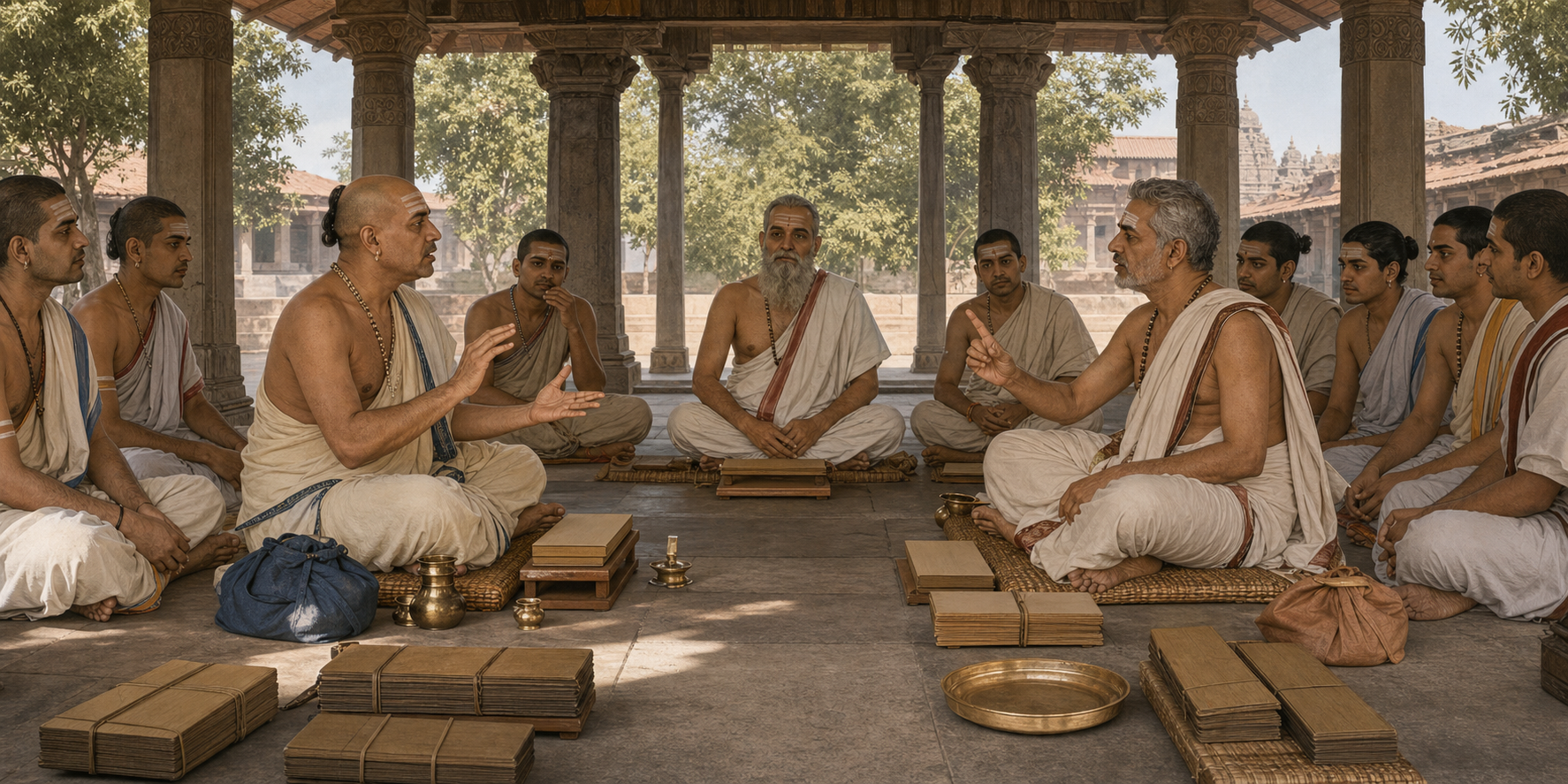
The controversy in Udupi shows why these distinctions matter. At a cultural programme hosted by a prominent Madhva matha, two young performers trained in Harikatha presented a received Madhva account in which Madhvacharya descended to restore the proper understanding of Vedanta after Shankaracharya’s Advaita had led it astray. Their presentation also applied the expression asura-bhava, rendered in the dispute as “demonic nature,” to Shankaracharya. Social-media objections characterized the wording as defamatory and unparliamentary; the matha distanced itself from the performance, and the girls were pressured to apologize publicly.
You need not accept the Madhva judgment of Advaita to see the intellectual problem. A Madhva institution cannot explain its inherited account of Vedanta while suppressing the fact that the account rejects rival conclusions. Advaitins, in turn, are not required to accept an adverse characterization of Shankaracharya. They may challenge its textual basis, meaning, translation, logic, or suitability. That exchange is not a failure of pluralism. It is what serious pluralism must be capable of containing.
Do not turn a technical question into a loyalty test
Two shortcuts should be resisted. The first declares that asura-bhava is merely a crude insult because its sharpest English rendering sounds intolerable. The second declares that it is unquestionably proper because it occurs within an inherited polemical framework. Neither conclusion follows without examining the actual passage and the work the term performs there.
Ask whether the expression names a metaphysical disposition, supplies a doctrinal explanation, marks an adversarial rhetorical convention, condemns a particular teaching, attacks a historical person, or is being extended to living followers. These possibilities are not interchangeable. A one-word translation cannot decide among them.
Genre matters as well. A line within a scholastic refutation, a devotional narration, a classroom explanation, a public celebration, and a taunt aimed at a living individual are different speech acts. Textual continuity may connect them, but context changes what an audience is reasonably being asked to hear.
Keep four judgments separate
A disciplined response should reach four independent judgments:
- Textual judgment: Was the disputed formulation actually grounded in an authoritative text or received commentary of the sampradaya?
- Interpretive judgment: Was its meaning represented fairly, including its technical and polemical function?
- Pedagogical judgment: Was enough context supplied for this audience, in this format, at this venue?
- Conduct judgment: Did the performance or the reaction cross from doctrinal criticism into humiliation, threats, or harassment?
A passage can pass the first test and fail the third. A translation can fail the second even when the performance passes the fourth. An online response can identify a real pedagogical problem while itself becoming abusive. Keeping the judgments separate prevents both automatic exoneration and automatic condemnation.
Use six checks before calling inherited language unacceptable

When a clip, quotation, or translation begins circulating, do not begin with “Is this offensive?” That question is too compressed to produce a reliable answer. Work through these six checks instead.
- Identify the speaker’s standpoint. Name the sampradaya whose claim is being expressed. Do not convert a Madhva claim, an Advaita response, or any other school-specific judgment into “what Hinduism says.”
- Recover the complete passage. Find the words before and after the disputed line, the text or commentary being invoked, and the full performance rather than a clipped segment. If none is available, suspend the verdict.
- Interrogate the translation. Ask what semantic range the original term carries and which part of that range the English word selects. A vivid English equivalent may communicate intensity while concealing philosophical function.
- Define the target precisely. Determine whether the criticism concerns a proposition, an interpretation, a teacher, a historical role, an entire lineage, or present-day adherents. Do not silently move from one target to another.
- Evaluate the venue and audience. A matha has reason to teach its own siddhanta, but a public cultural programme may include listeners unfamiliar with its polemical conventions. The answer may be contextual explanation rather than deletion.
- Choose a proportionate remedy. An ambiguous translation may require a note. A misleading adaptation may require a correction. A poorly framed performance may require better preparation. Personal harassment requires firm moderation. Not every problem requires an institutional disavowal or a compelled apology.
This method also improves disagreement. Instead of saying that a tradition is hateful, you can argue that a translation mistakes a technical classification for a description of moral character. Instead of invoking authenticity as a complete defence, you can acknowledge that a canonical expression was presented to an unprepared audience without the argument that gives it meaning. Specific criticism leaves room for a specific answer.
There is also a simple test for intellectual honesty: can you restate the disputed school’s claim in language its informed adherents would recognize before you reject it? If not, you are probably reacting to a representation of the claim rather than the claim itself.
Give institutions a controversy protocol, not a panic reflex

Mathas, temples, schools, publishers, and cultural organizations cannot prevent every controversy. They can prevent a social-media surge from becoming their method of textual interpretation. That requires a procedure established before the next dispute.
- Preserve the record. Secure the complete recording, script, programme description, and cited textual passages. Do not let the shortest viral clip define the event.
- Assign adult responsibility. If children or students performed approved material, the institution must own the curatorial and pedagogical decisions. Young performers should not become shields for adults or targets of a public recantation ritual.
- Commission two forms of scrutiny. Ask a competent scholar of the presenting sampradaya to explain the textual basis and ask an informed scholar of the criticized tradition to identify the strongest substantive objection. Consultation supplies scrutiny, not a veto over another lineage’s doctrine.
- Separate findings. State clearly whether the issue concerns textual grounding, translation, contextualization, programme design, or personal conduct. Avoid a vague apology that leaves everyone free to imagine the worst.
- Publish the reasoning. If the institution corrects or defends the presentation, identify the exact disputed wording and the reason for its decision. “Sentiments were hurt” does not tell teachers what to do differently.
- Protect reciprocal speech. Permit a reasoned reply from the criticized school while enforcing rules against threats, demeaning attacks on present-day adherents, and targeting of performers.
Preparation can reduce predictable confusion without sanitizing doctrine. A host can announce that a performance presents a particular sampradaya’s traditional account, provide a brief explanation of contested terminology, and make clear that rival Vedantic schools reject that account. Those sentences do not neutralize the claim. They tell the audience what kind of claim it is.
Readers have responsibilities too. Before forwarding an inflammatory clip, look for the full passage and identify who translated it. Before defending it, ask whether you would defend the same mode of presentation when directed at your own acharya. Before condemning it, ask whether your standard would allow any sampradaya to reject another school’s metaphysics in unequivocal terms.
A durable Dharmic public sphere needs two commitments at once: no lineage must surrender its siddhanta to gain social permission, and no inherited category grants permission to harass people. Doctrinal assent is not owed. Civic dignity is.
The next time an inherited expression unsettles you, delay the verdict long enough to recover its text, school, argument, target, and setting. Then state exactly what you accept, reject, or would present differently. That habit will do more for Bharatiya intellectual renewal than either reflexive outrage or reflexive defence, because it keeps the traditions intelligible enough to be debated and alive enough to answer.