

If a dramatic prophecy is what brought you to Veerabrahmendra Swami Jayanti, pause before deciding what the observance is about. Kalagnanam matters, but Brahmamgaru’s devotional and ethical discipline must come before attempts to match a prediction to the latest event.
The 2026 Jayanti was observed on 26 April 2026, following the regional Telugu Panchangam and the annual schedule of Sri Veerabrahmendra Swami Matham. That date should not be carried forward into another year. For a later Jayanti, confirm the new date and local timings, while keeping the same three-part foundation: bhakti, careful reading, and seva.
Remember the person before interpreting the prophecy
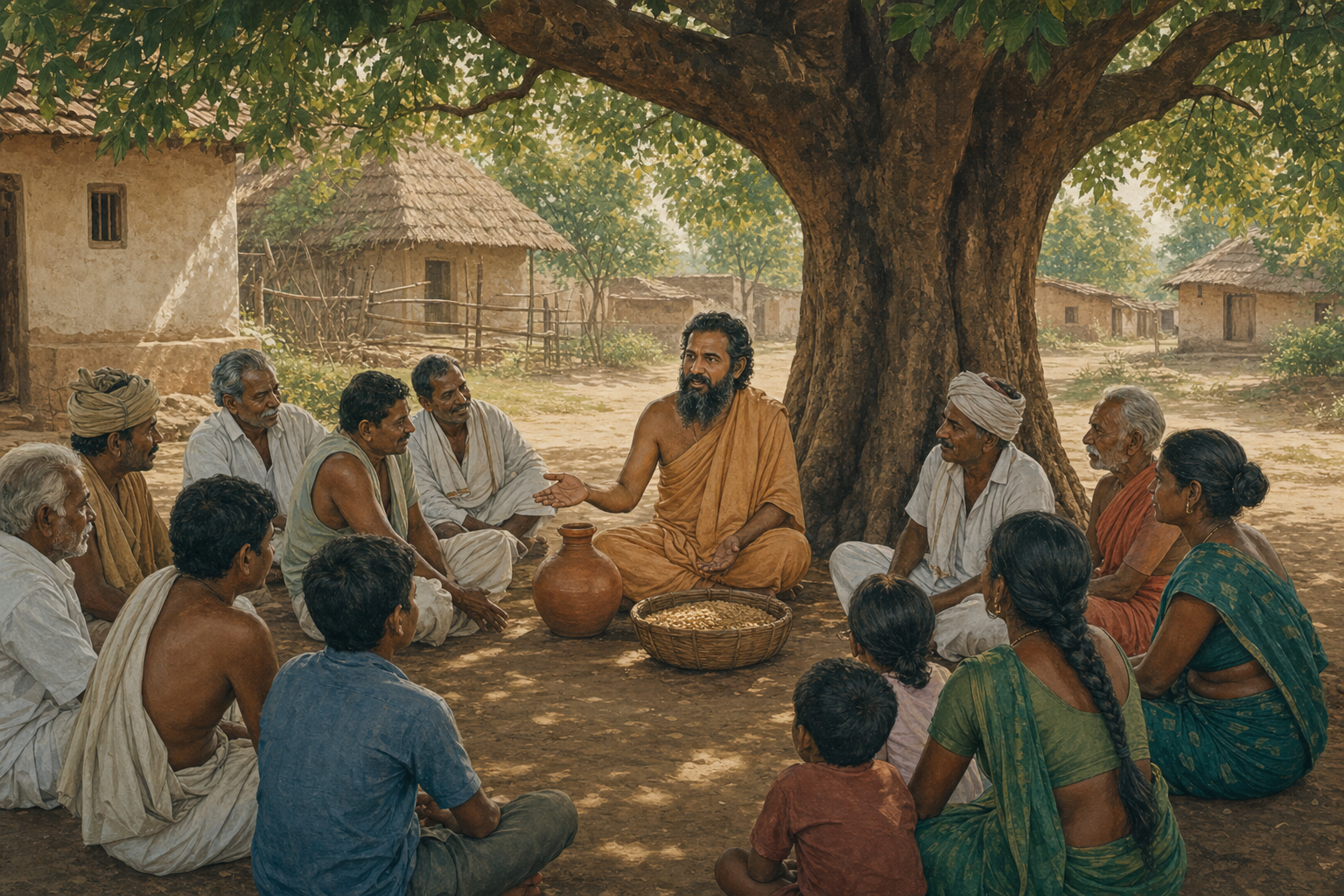
Pothuluri Veerabrahmendra Swami, affectionately called Brahmamgaru and revered as Kalagnani in the Telugu-speaking region, is remembered as a 17th-century saint and teacher. His legacy joins devotion with ethical conduct and loka-sangraha, the welfare of society. Reducing him to a predictor of catastrophes misses the discipline that gives Kalagnanam its dharmic setting.
Precise dates in the Swami’s biography belong more to regional memory than to a complete epigraphic record. This calls for care with overly exact historical claims, not dismissal of the tradition. Continuity is visible in worship at Brahmamgari Matham, in oral transmission, and in the families that carry his memory through bhajans, kirtana, Harikatha, and festival observance.
A useful test is simple. After hearing an interpretation of Kalagnanam, ask what it expects you to do. Does it strengthen truthfulness, responsibility, devotion, compassion, and service? Or does it merely produce fear and excitement about a date? The first result accords with Brahmamgaru’s remembered emphasis on bhakti and social welfare. The second deserves much more scrutiny.
Key takeaways
- The 2026 Jayanti took place on 26 April 2026; confirm a fresh Panchangam date and Matham schedule for every later year.
- Veerabrahmendra Swami’s legacy includes devotion, ethical conduct, and responsibility toward society, not prophecy alone.
- Kalagnanam is a corpus transmitted through disciples and preserved in multiple recensions, so an isolated quotation should not be treated as a universally fixed text.
- A meaningful home observance can remain simple: light a lamp, remember the Swami, perform japa, read carefully, and make a definite commitment to seva.
- If you visit Brahmamgari Matham, follow current notices for ritual timings, darshan flow, annadanam, and volunteer registration.
Read Kalagnanam without turning it into fortune-telling
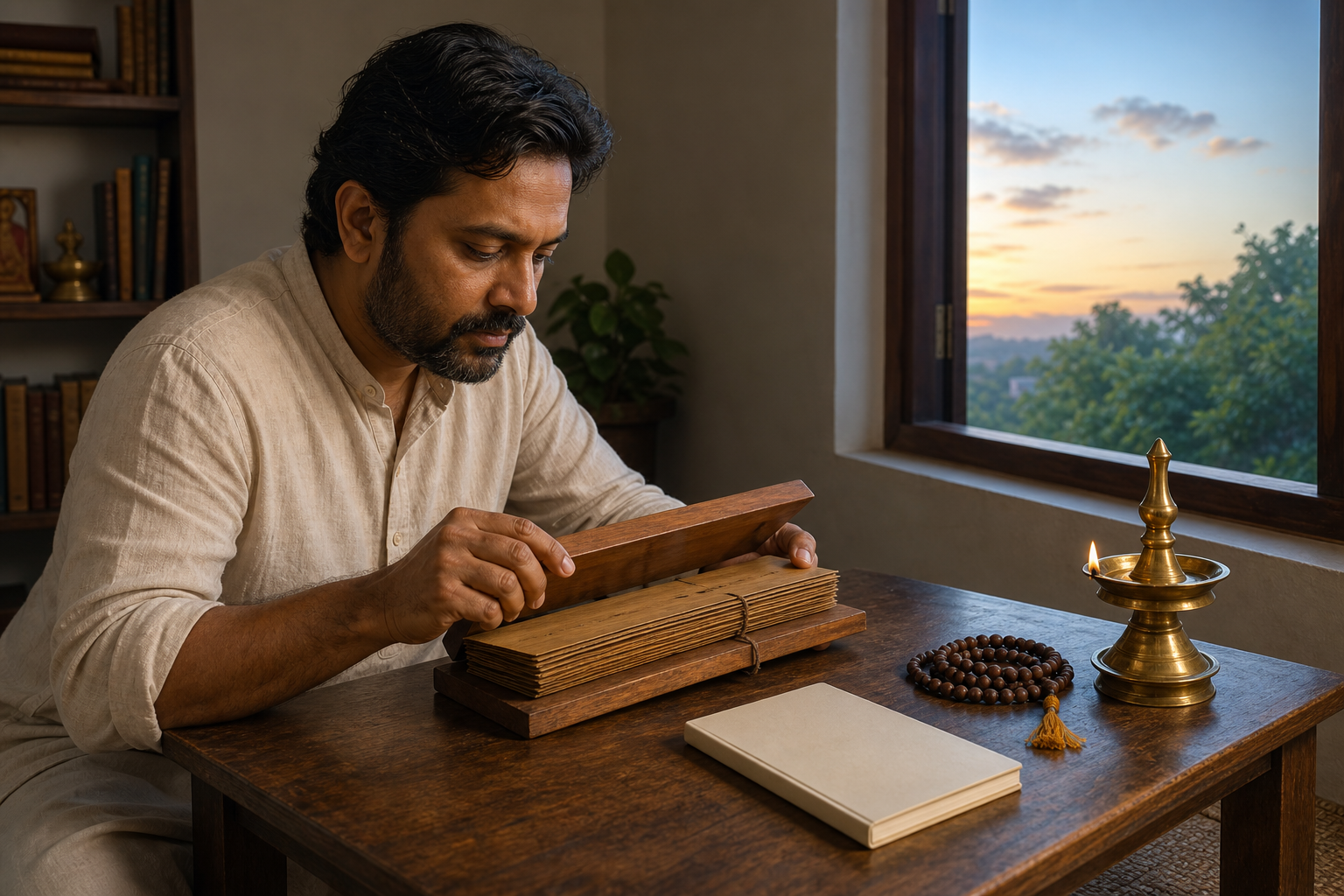
The first discipline in reading Kalagnanam is textual honesty. It is a body of prophetic material transmitted through disciples and compiled in multiple recensions. A recension is a particular textual form preserved through a line of transmission or compilation. Multiple recensions mean that wording, arrangement, and context cannot automatically be assumed to be identical everywhere.
Keep three distinct things separate: the revered saint, the transmitted textual corpus, and a present-day person’s interpretation of that corpus. Respect for the first does not require immediate acceptance of every claim made about the second or third. That distinction protects devotion from credulity and protects the text from sensational use.
Use this four-question check whenever a striking Kalagnanam quotation reaches you:
- Which recension or edition contains it? Ask for an identifiable text, not merely a forwarded image, clipped video, or paraphrase. If no recension or edition can be named, call the wording unverified rather than automatically true or false.
- What surrounds the quoted line? Read enough of the passage to see whether the words are moral instruction, symbolic warning, devotional language, or an explicit time claim. A detached sentence can acquire a certainty that its context does not support.
- Where does the current-event connection come from? If someone has attached the passage to a war, disaster, political change, or public figure, distinguish the original wording from the later mapping. The mapping is an interpretation and should be presented as one.
- What is the dharmic fruit of the reading? A sound reading should turn attention toward satya, dharma, karuna, self-restraint, and responsible conduct. A reading that rewards panic, rumor, or contempt for others has lost the ethical center of the tradition.
This method does not drain Kalagnanam of spiritual seriousness. It gives the tradition enough respect to read it carefully. You do not need to force every image into a news headline, nor must you resolve every passage into a literal timetable. Preserve uncertainty where the textual history is uncertain, and let conduct carry more weight than spectacle.
Build a simple home observance around attention and action
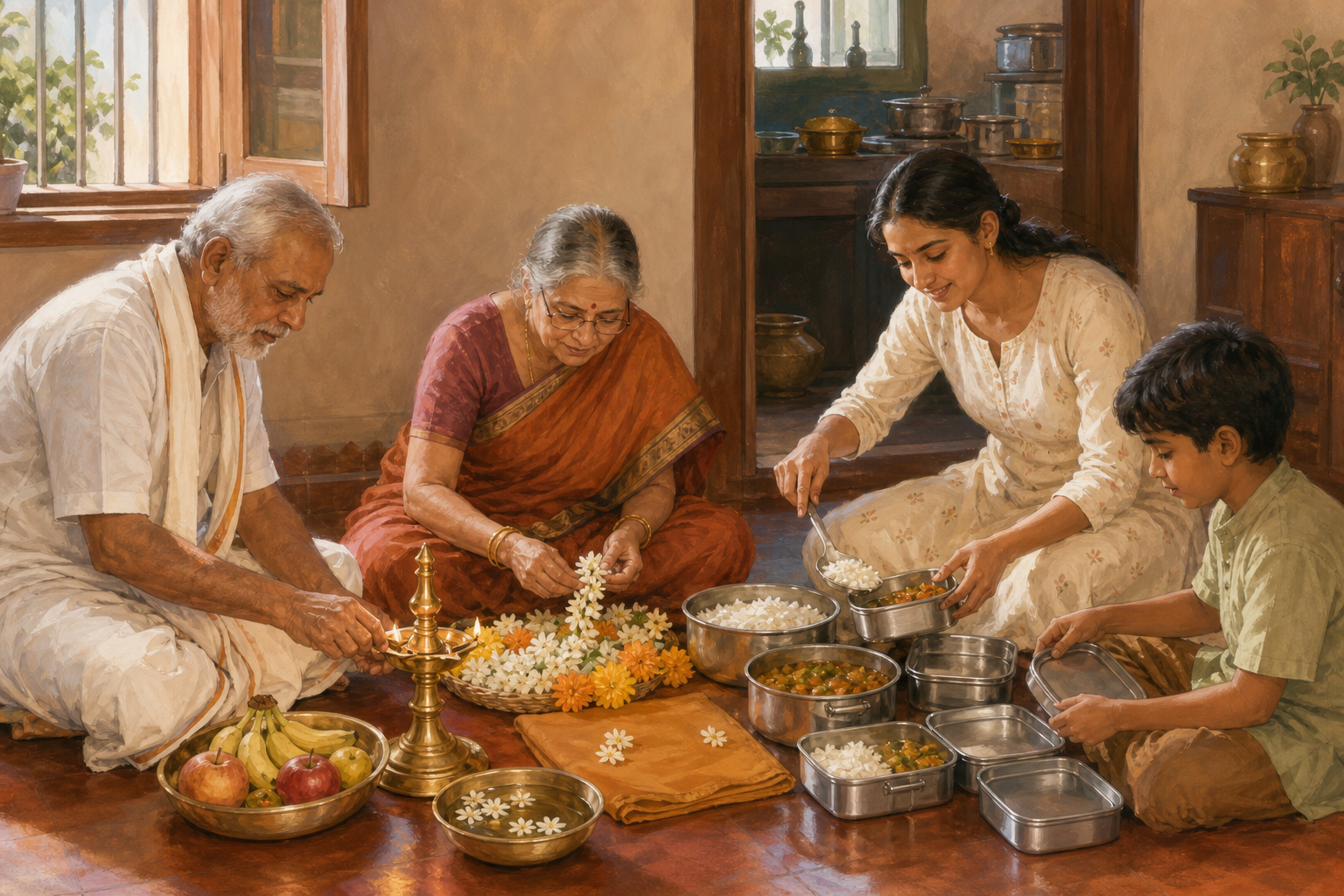
You do not need to reproduce the scale of the Matham in your house. A smaller observance performed attentively is more coherent than an elaborate sequence assembled without understanding. If dawn is practical, it can echo the temple’s suprabhata atmosphere; if it is not, choose a time when the household can participate without rushing.
- Begin with a lamp and remembrance. Light a lamp in a clean, quiet place and recollect Veerabrahmendra Swami as a teacher of devotion and responsible living.
- State the purpose of the observance. In your own language, resolve that the worship will lead to clearer conduct and some form of service. This keeps the ritual from becoming a request for privileged knowledge about the future.
- Perform japa according to your Ishta. Devotees may use Om Namah Shivaya or Om Namo Narayanaya according to their chosen form of the Divine. There is no need to collect mantras merely to make the observance look more elaborate.
- Read a short, identifiable selection. Use a reliable recension of Kalagnanam and note the edition or transmission you are consulting. Read slowly enough to separate the actual wording from your assumptions about it. If you cannot identify a dependable text, reflect on Brahmamgaru’s life and ethical teaching instead of selecting a random internet quotation.
- Let generations speak to one another. An elder can recount how the Jayanti was observed in the family or community, while a younger participant can name one value the account conveys. This turns oral memory into a conversation rather than a performance delivered at children.
- Complete the observance with seva. Decide what will be done, who will be served, and when it will happen. Annadanam can be organized at a scale your household can actually fulfill; sincerity is not measured by the size of a public event.
The recognizable home pattern is therefore lamp, remembrance, japa, careful study, and service. If you missed the 2026 date, do not relabel an arbitrary later date as that year’s Jayanti. Japa, study, and seva can still be undertaken as ordinary remembrance, while the next formal Jayanti should follow its properly confirmed calendar date.
Plan a Brahmamgari Matham visit from current notices
The principal pilgrimage setting is Sri Veerabrahmendra Swami Matham at Kandimallayapalle, commonly identified on maps as Brahmamgari Matham, in YSR Kadapa district, Andhra Pradesh. Annual Jayanti Utsavalu draw devotees, families, scholars, and local communities, so the Matham’s directions matter more than a schedule copied from an earlier year.
The observance commonly includes suprabhata seva, Veda parayana, abhishekam, special alankaram, archana, deepa harati, pravachanam, readings from selected Kalagnanam passages, bhajans, and annadanam. That sequence describes the devotional shape of the day; it is not a promise that each rite will begin at the same time every year.
- Confirm before departure. Check the Matham’s current notices for the Jayanti date, abhishekam and harati timings, darshan arrangements, annadanam, and volunteer registration. Do not reuse the 2026 timetable for a later festival.
- Search for both place names. Kandimallayapalle and Brahmamgari Matham may both be useful when checking maps, transport, or local directions.
- Choose the route that fits your starting point. The pilgrimage centre is accessible by road from Kadapa, Proddatur, and Badvel. Kadapa railway connections serve many travelers. Kadapa airport has limited services, while many long-distance pilgrims use Tirupati as a major-airport gateway and continue by road.
- Leave room for the darshan flow. A festival crowd can change how quickly you move through the complex. Follow local queues and instructions rather than trying to hold a privately planned ritual schedule inside a shared pilgrimage space.
- Protect the atmosphere near the samadhi. Keep conversation and phone use restrained where quiet is requested. The stillness of the precinct is part of the observance, not empty time between ceremonies.
- Reduce avoidable waste. Carry reusable containers where local rules permit, conserve water during ablutions, and follow instructions for prasadam and waste disposal.
Approach the visit as participation, not religious sightseeing. You may encounter abhishekam, music, discourse, silence, food service, and family devotion in the same day. Allow each practice its own pace, and do not let the desire to document the festival displace the reason you entered the Matham.
Let annadanam show what you understood
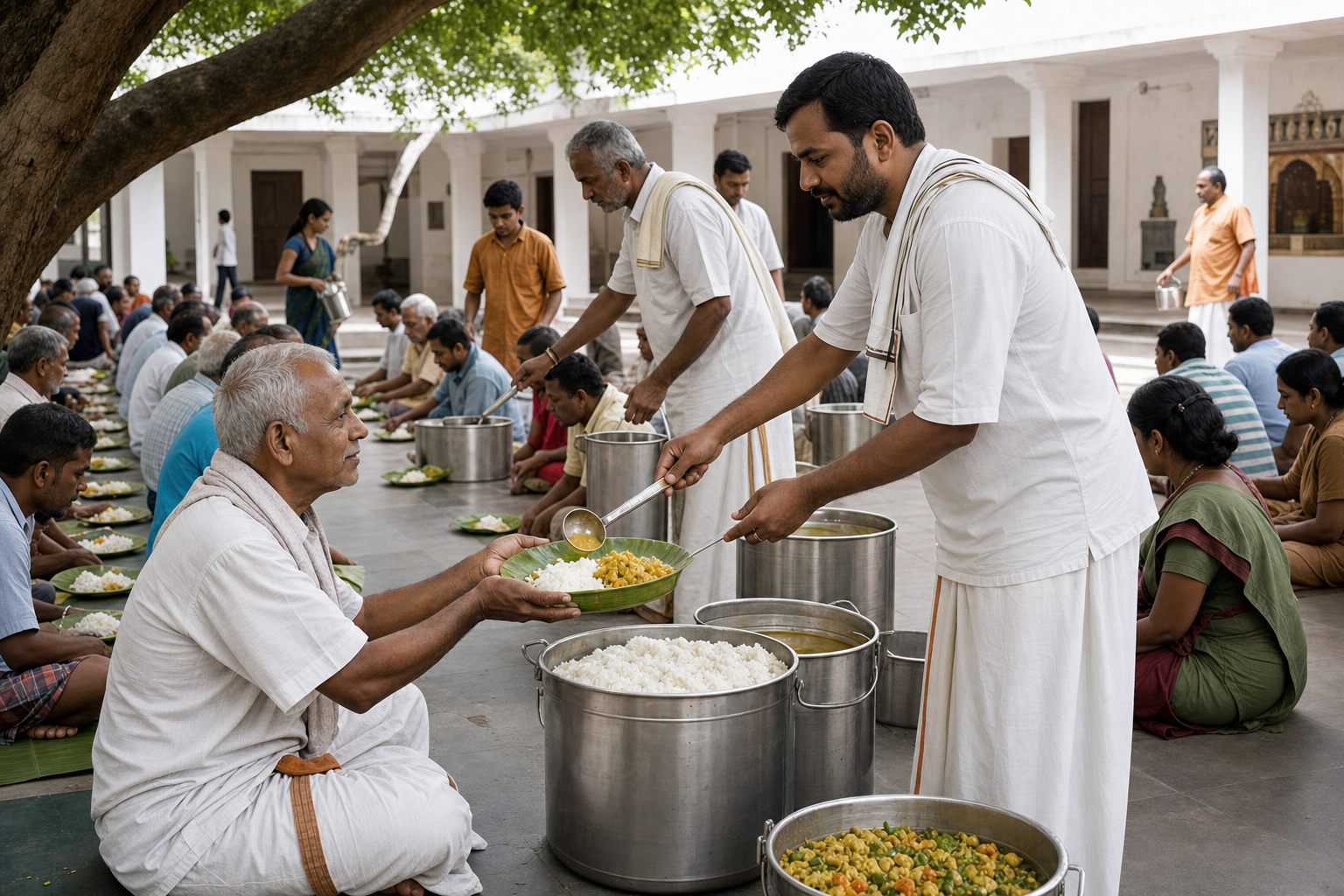
Annadanam is not merely hospitality after the important ritual work has finished. It expresses Brahmamgaru’s concern for loka-sangraha by turning remembrance into care for another person. The parallel with Sikh langar, Buddhist dana, and Jain commitments to ahimsa and compassionate giving points to a shared Dharmic emphasis on dignity and service. These are distinct traditions and institutions, but they meet in refusing to separate spiritual discipline from responsibility toward living beings.
Make your seva definite enough to survive the emotion of the festival. Identify the setting, confirm how many people can realistically be served, prepare only what can be handled safely and respectfully, and assign responsibility for distribution and cleanup. Use reusable vessels when practical and avoid wasting water. If a large annadanam is beyond your capacity, share food in your neighborhood or support an established community effort rather than making an unmanageable promise.
This is also the clearest safeguard against prophecy becoming passive fascination. A reading of Kalagnanam may leave some questions unresolved, but your next dharmic action need not be vague. Before the next Jayanti, identify the recension you intend to read, confirm the Matham’s new calendar notice if you plan to travel, and choose one act of service you can complete. Then let that service, rather than the drama of a prediction, reveal what you learned from Brahmamgaru.