

Someone you owe has done something wrong. It may be a relative, a leader, a benefactor, a colleague or the community that gave you your place. If you oppose them, you risk appearing ungrateful. If you stand beside them, your loyalty may lend strength and legitimacy to the harm.
The Ramayana and Mahabharata help you decide what to do before that tension hardens into complicity. Their answer is demanding but practical: give truthful counsel, leave a real path to restitution, examine what your continued support enables, and place dharma above personal allegiance when the two can no longer be reconciled.
Loyalty becomes dharmic only when it serves what is right
Loyalty is not treated as a trivial sentiment in the epics. Bandhu-bhakti, devotion to one’s kin, carries genuine weight. So do gratitude to a benefactor, fidelity to a friend, responsibility to a kingdom and kshatra-dharma, the duty of a warrior to defend. A person who discards such bonds whenever they become inconvenient is not acting from dharma.
Yet these obligations are not absolute. They exist within a larger moral order that includes truth, justice, restitution, protection of the innocent and loka-sangraha, the sustaining of collective well-being. A relational duty cannot rightfully demand that you violate the conditions that make relationships, institutions and kingdoms worth protecting.
- Relational duty asks what you owe to a parent, sibling, friend, teacher or benefactor.
- Role duty asks what your office requires of you as a warrior, adviser, employee, citizen or leader.
- Higher dharma asks whether your conduct protects truth, justice, the vulnerable and the possibility of restoring order.
Ordinarily, these three layers support one another. The crisis begins when loyalty to a person demands disloyalty to the purpose of your role and to the higher claims of dharma. At that point, the useful question is no longer simply, Am I being loyal? You must ask, What is my loyalty now protecting?
The conflict in Lanka makes the distinction visible. Vibhishana and Kumbhakarna both recognize that Ravana’s abduction of Sita is wrong. Both warn him about the destruction his refusal to make restitution will bring. Their moral awareness is similar; the decisive difference lies in what each does after counsel fails.
Vibhishana refuses to make family solidarity a shield for continuing adharma. Kumbhakarna condemns Ravana’s conduct but nevertheless fights for his brother and Lanka. His courage is real, as is his sense of duty. But courage cannot transform the moral character of the cause it serves. The Ramayana therefore asks you to assess more than intention: you must also examine your action, its object and its foreseeable effect.
Read the epic figures as a decision map
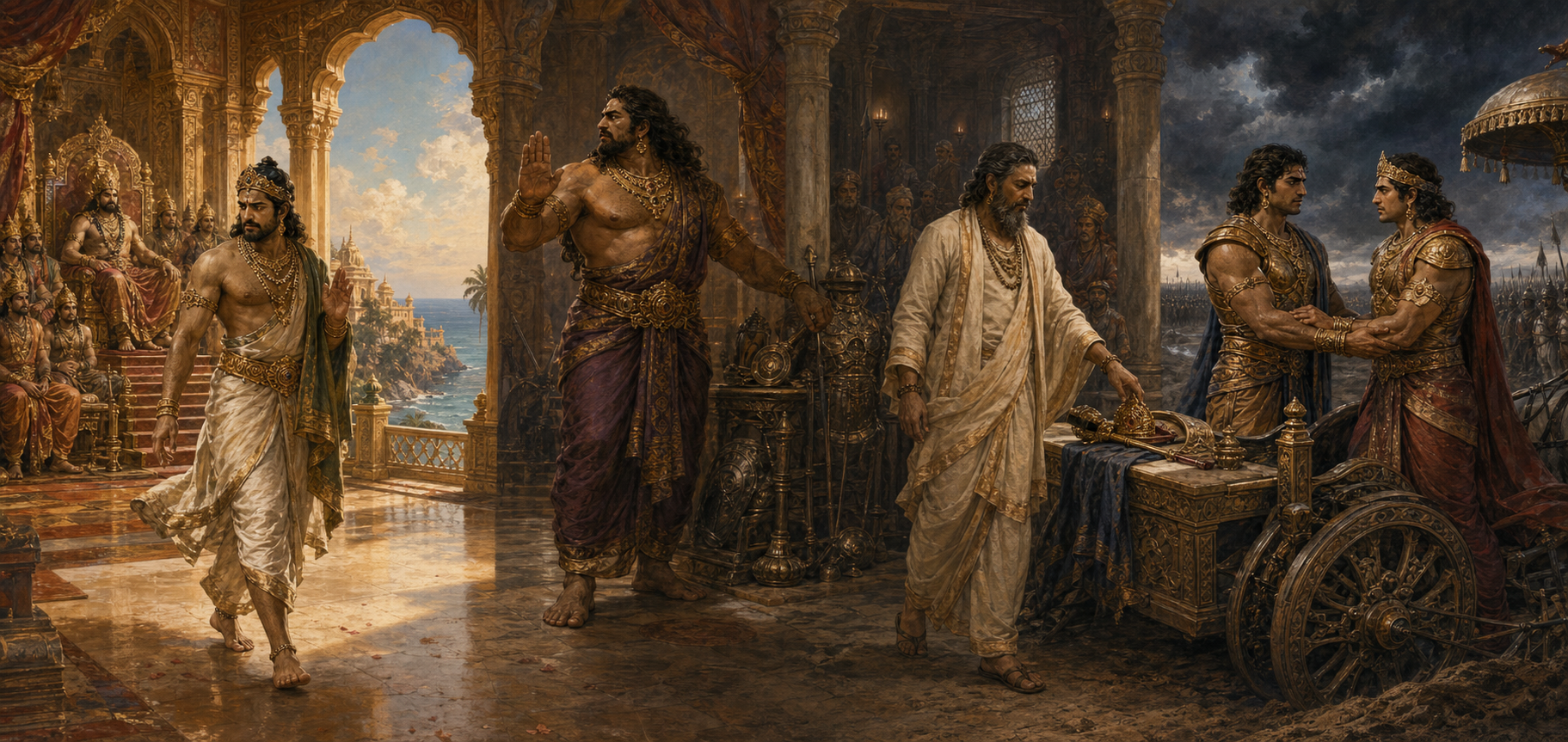
These characters are most useful when you resist turning them into flat labels such as hero, traitor, loyalist or dissenter. Each one occupies a different point in the movement from moral recognition to practical action.
| Figure | What became clear | What followed | The diagnostic lesson |
|---|---|---|---|
| Vibhishana | Ravana’s seizure of Sita and refusal to return her violated dharma and endangered Lanka. | He repeatedly advised restitution, then withdrew allegiance when Ravana rejected correction and took refuge with Rama. | When counsel fails and support would enable the wrong, principled withdrawal can be fidelity to dharma rather than betrayal. |
| Kumbhakarna | Ravana had acted wrongly and had brought catastrophe upon the kingdom. | After rebuking his brother, he fought for him out of kinship, honor and warrior duty. | Sincerity, affection and bravery do not cleanse participation in an unjust cause. |
| Karna | Duryodhana’s cause was compromised by adharma. | Gratitude kept him aligned with Duryodhana, even through grave wrongdoing such as the humiliation of Draupadi. | A debt of gratitude does not transfer ownership of your conscience to the person who helped you. |
| Vidura and Yuyutsu | Kinship and faction had diverged from justice. | They gave dharma priority over clan alignment. | Dissent from your own side may preserve the values that the side has abandoned. |
Vibhishana’s example does not authorize impulsive desertion whenever you dislike a decision. He first names the wrong, explains its moral and political consequences, and calls for the concrete remedy of returning Sita. Only after Ravana repeatedly rejects correction does Vibhishana leave. That sequence matters. Dharmic dissent seeks restoration before rupture whenever restoration remains possible.
Nor should Kumbhakarna be misread as morally blind. His tragedy is precisely that he sees the truth and then subordinates it to a narrower duty. That should make you cautious about a familiar defense: I disagree with what is happening, but I must stand with my people. Private disagreement does not neutralize the effect of your public assistance.
Karna presents an equally difficult temptation. Duryodhana’s support gave Karna a powerful reason for gratitude. But gratitude creates a duty to remember and repay a good; it does not create a duty to assist every later wrong. Karna’s continued allegiance despite recognized adharma shows how a noble quality can become destructive when it is detached from moral discrimination.
Vibhishana, Vidura and Yuyutsu supply the counterpoint. Their choices show that your birthplace, family, faction or patron does not have the final claim on your conduct. Vibhishana’s later stewardship of Lanka also adds an important condition: principled dissent is not merely an escape from a compromised side. It should leave you willing to accept responsibility for rebuilding a just order after the break.
A five-step test for your own loyalty conflict

You rarely receive an announcement that says loyalty has now become complicity. The change usually happens through smaller decisions: silence at a meeting, a signature, a public defense, professional labor, money, access, status or force. Use the following sequence before habit and group pressure make the decision for you.
- Name the act, not merely the person. Replace broad judgments with an observable statement. Identify what was done, whose rightful claim was violated, who is bearing the cost and what repair is possible. Ravana is not opposed merely because Vibhishana finds him difficult; the relevant acts are the abduction of Sita and the refusal to return her.
- Offer counsel that contains a remedy. A warning should say more than that the situation feels wrong. State what must stop, what must be restored and what future restraint is required. Vibhishana combines an ethical judgment with practical statecraft: return Sita, end the unjust conflict and prevent Lanka’s ruin.
- Judge the response by restitution, not reassurance. Before you speak, decide what meaningful correction would look like. It may require stopping the conduct, returning what was taken, repairing an injury, accepting accountability or surrendering an improper advantage. Regret without changed conduct does not resolve the conflict.
- Map what your continued presence enables. Ask whether your title, silence, labor, money, reputation or public words make the wrongful course easier to continue. This is the point missed by Kumbhakarna and Karna: inward disapproval does not cancel the outward support that reaches the unjust cause.
- Choose the least harmful boundary that actually withdraws support. If correction occurs, loyalty may continue in a healthier form. If the wrong persists, the next step may be refusal of a particular act, relinquishment of a role, principled exit, conscientious objection or a lawful channel for exposing serious wrongdoing. The aim is to stop enabling adharma and make restoration possible, not to humiliate an opponent or stage a display of personal purity.
Three questions will usually reveal whether you are rationalizing continued allegiance:
- If you stay, can you point to a plausible path by which your presence will correct the wrong?
- If you remain silent, who receives the benefit of that silence and who continues to carry its cost?
- Would you call the same conduct acceptable if it were committed by the rival of the person you are defending?
If your only reason for remaining is that departure would feel disloyal, you have not yet answered the moral question. Emotional pain may prove that the bond is real; it does not prove that continued support is right.
Proportion still matters. Not every error justifies abandoning a family, organization or community. The epic pattern requires a serious and identifiable wrong, a meaningful opportunity for correction where one can safely be offered, and a continuing demand that you participate in or legitimize the wrong. Disagreement by itself is not adharma, and self-righteousness is not discernment.
Where disclosure, resignation or confrontation could expose someone to violence, legal jeopardy or irreversible loss, do not confuse moral courage with carelessness. Seek appropriate local legal, professional or safety guidance and choose a method that protects vulnerable people. Dharma concerns both the justice of your end and the discipline of your means.
One standard, expressed across Dharmic traditions

The wider Dharmic family does not erase the distinctions among Hindu, Buddhist, Jain and Sikh teachings. It does, however, offer a recognizable discipline for loyalty: see the situation clearly, refuse to make affection an excuse for harm, counsel toward correction and restrain your own response.
Buddhist emphasis on right view and right intention directs attention to the quality of both perception and motive. Noble friendship, or kalyana-mitra, is not the practice of helping a friend avoid the consequences of an unwholesome act. A worthy friend helps another turn away from it. Applied to your own dilemma, this means that honest correction may be a deeper form of friendship than obedient support.
Jain thought adds two safeguards. Ahimsa keeps the consequences of harm in view, while Anekantavada asks you to look beyond a single, self-serving angle. You can therefore recognize Kumbhakarna’s love for his brother and Karna’s gratitude to Duryodhana without pretending that their choices were harmless. Many-sided understanding should deepen compassion and accuracy; it should not flatten right and wrong into equivalence.
Sikh emphasis on sat, seva and the ethical limits of dharam yudha joins truth, service and valor. Courage deserves honor when it protects the vulnerable and serves justice. Valor detached from righteousness becomes force in the service of faction, however impressive the warrior may appear.
Across these traditions, the shared practical pattern is truthful counsel, refusal to enable harm and action bounded by justice and compassion. This prevents two opposite errors. The first is tribal obedience, in which anything done by one’s own side is excused. The second is moral vanity, in which a person breaks relationships too quickly and calls the rupture righteousness.
Use compassion to understand why someone has chosen wrongly. Use Anekantavada to test whether you have overlooked a relevant perspective. Use ahimsa to limit unnecessary injury. But do not use any of them to avoid naming an act that violates dharma. Understanding a person’s burden and refusing to assist that person’s wrongdoing can be part of the same ethical response.
Key takeaways
- Loyalty begins with truthful counsel, not concealment or automatic public defense.
- Kinship, gratitude and role duty are real obligations, but they remain answerable to truth, justice, restitution and protection of the innocent.
- Kumbhakarna and Karna show that courage and gratitude cannot redeem material support for adharma.
- Vibhishana shows the proper sequence: identify the wrong, propose correction, allow restitution, then withdraw allegiance if continued support would enable injustice.
- Principled exit should aim at restored order and reduced harm, not revenge, humiliation or personal advantage.
- Compassion explains motives; it does not erase consequences or surrender moral judgment.
When your own decision comes, write two plain sentences before speaking: If I stay, my presence will help to… and If I leave or refuse, my action will help to… Complete them with concrete effects, not flattering descriptions of your intentions. Then test both answers against truth, the burden placed on the vulnerable and the possibility of repair.
Speak while correction is still possible. Ask for a remedy that can be recognized in action. If the wrong is repaired, help rebuild trust. If it is defended and your support is required to sustain it, keep the boundary you have named. That is not the abandonment of loyalty. It is loyalty recalled to dharma.