
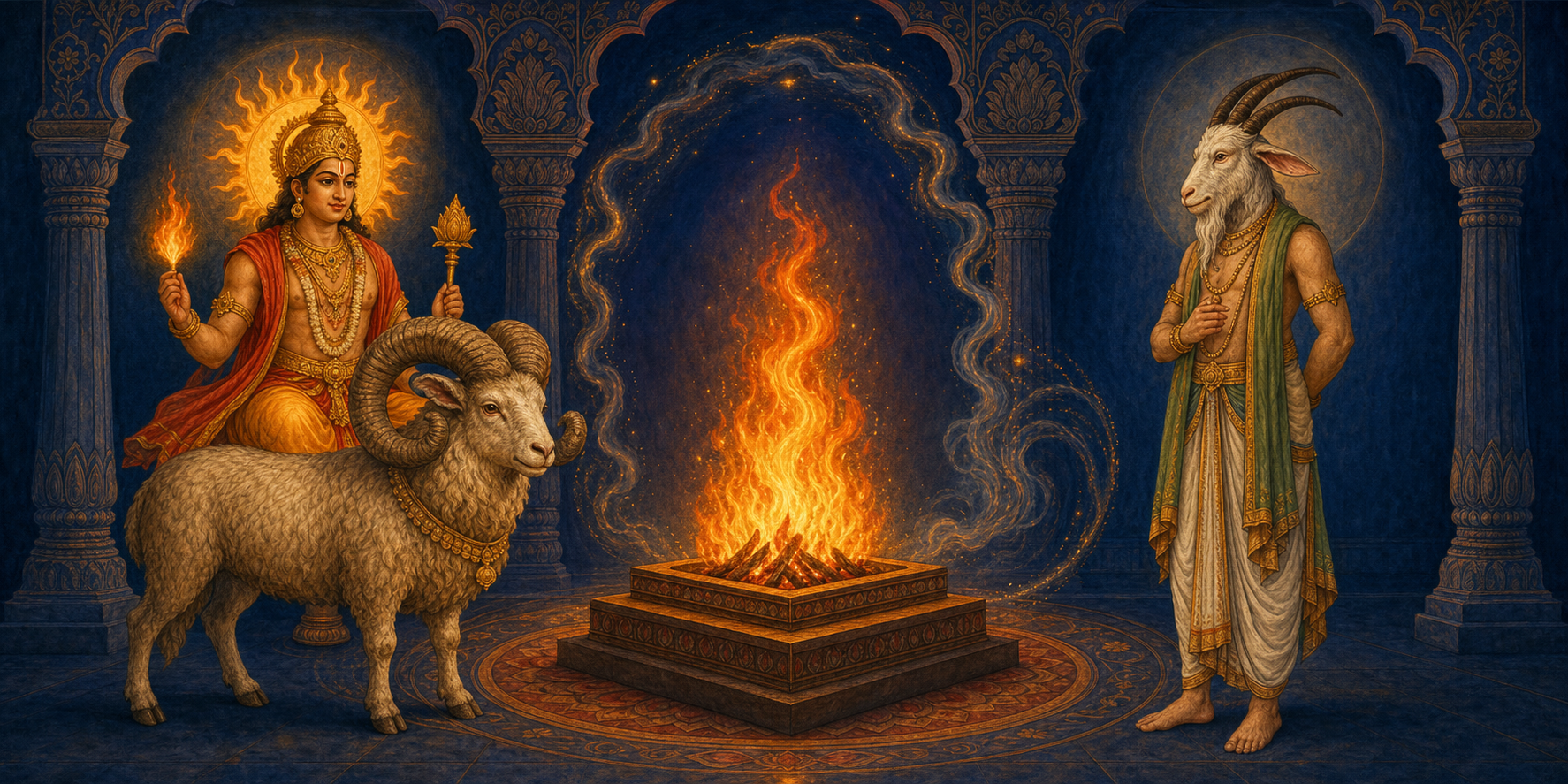
A temple label calls Agni’s mount a goat. Another description calls it a ram. Then you encounter Daksha with an animal head and wonder whether the same symbol is being repeated. The resemblance is real, but treating every horned animal as interchangeable hides the most useful part of the symbolism.
You can usually resolve the confusion by asking three questions: Which animal is actually named? What role does it play? What changes in the story or ritual because of its presence? Those questions separate Agni’s ram from Daksha’s goat-head while showing why both belong to the wider world of yajna, transformation, and dharmic responsibility.
Goat and ram are related symbols, not synonyms
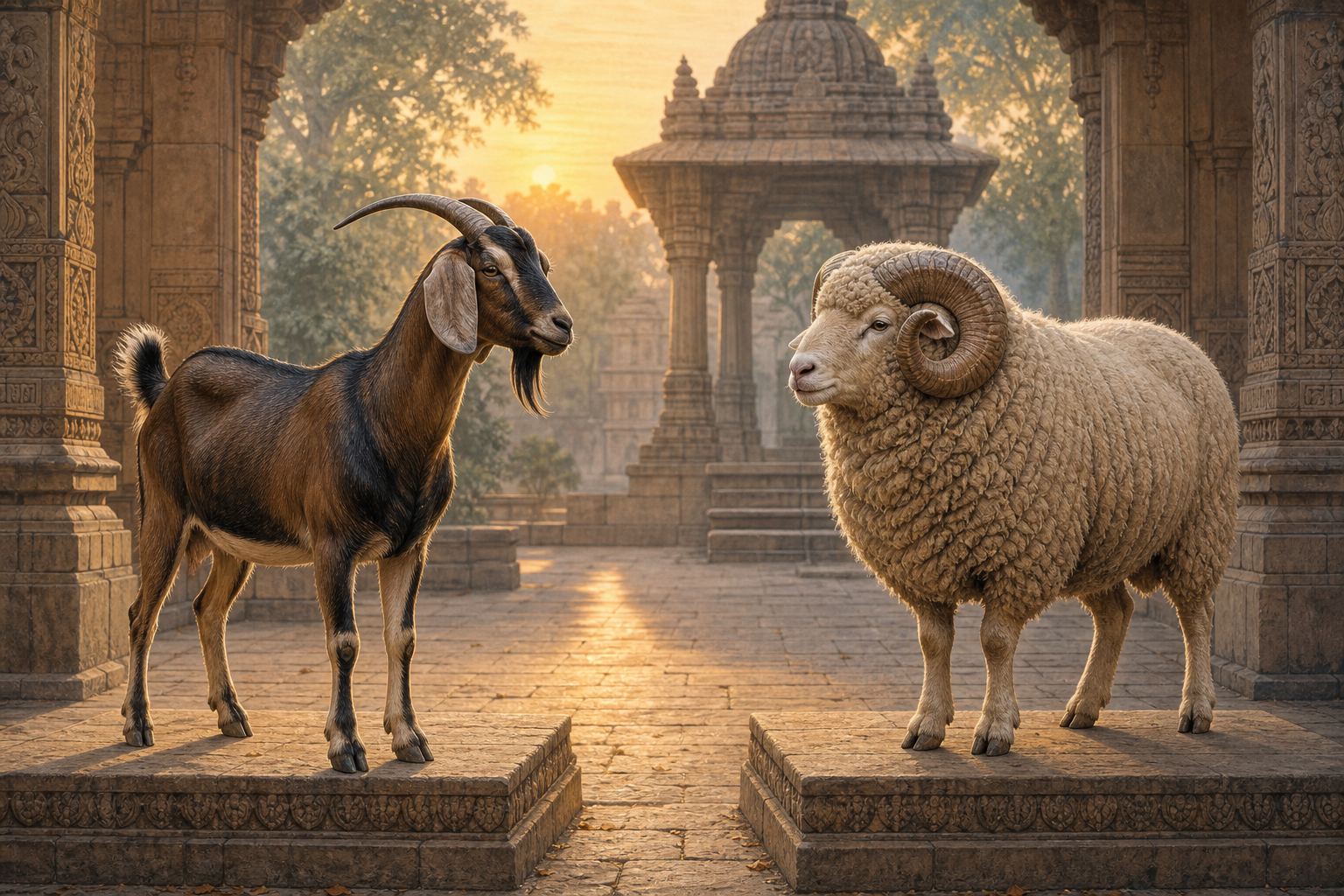
Begin with the Sanskrit when it is available. Aja commonly denotes a goat, while mesha denotes a ram. A ram is an adult male sheep, not a male goat. Goats and sheep belong to the same broad pastoral and ritual environment, so their associations can overlap without their names becoming identical.
| Context | Animal or term | Primary symbolic work | Safest reading |
|---|---|---|---|
| Agni’s vahana | Ram, mesha | Vitality, heat, movement, and sacrificial energy | Identify the mount as a ram unless a specific local tradition clearly teaches otherwise. |
| Daksha after the broken yajna | Goat-head, associated with aja | Humbling, restoration, and corrected ritual authority | Read the head through Daksha’s transformation, not through Agni’s iconography. |
| Vedic sacrificial setting | Goats, sheep, and other ritually designated pashu | Consecration, offering, and cosmic correspondence | Do not assume that every animal near a ritual fire is Agni’s vehicle. |
| Mesha or Aries in calendrical and astrological use | Ram | Fire, seasonal transition, and solar ingress | Keep the astrological sign distinct from a deity’s vahana, even when their associations resonate. |
| A living goat near a village shrine | Goat | Livelihood, resilience, nourishment, and stewardship | Look for the local custom before assigning a Puranic or iconographic meaning. |
Do not rely on the horns alone. Weathered sculpture, regional styles, and abbreviated modern illustrations can make a ram resemble a goat. The deity, narrative setting, posture, accompanying objects, and any inscription provide stronger evidence than anatomy. A radiant figure surrounded by flames and mounted on a caprid points toward Agni and the ram. A human body bearing a goat’s head within the Daksha-yajna cycle points toward Daksha.
Sanskrit adds one further layer. Aja can also carry the philosophical sense of “unborn.” Context must decide which meaning is active. In a phrase describing a goat-head, the literal animal sense comes first. An interpreter may notice an echo of primordial or unborn reality, but that echo should remain a secondary theological possibility rather than replacing the plain narrative meaning. This small discipline prevents attractive wordplay from turning into a false translation.
Agni’s ram expresses the movement of sacred fire
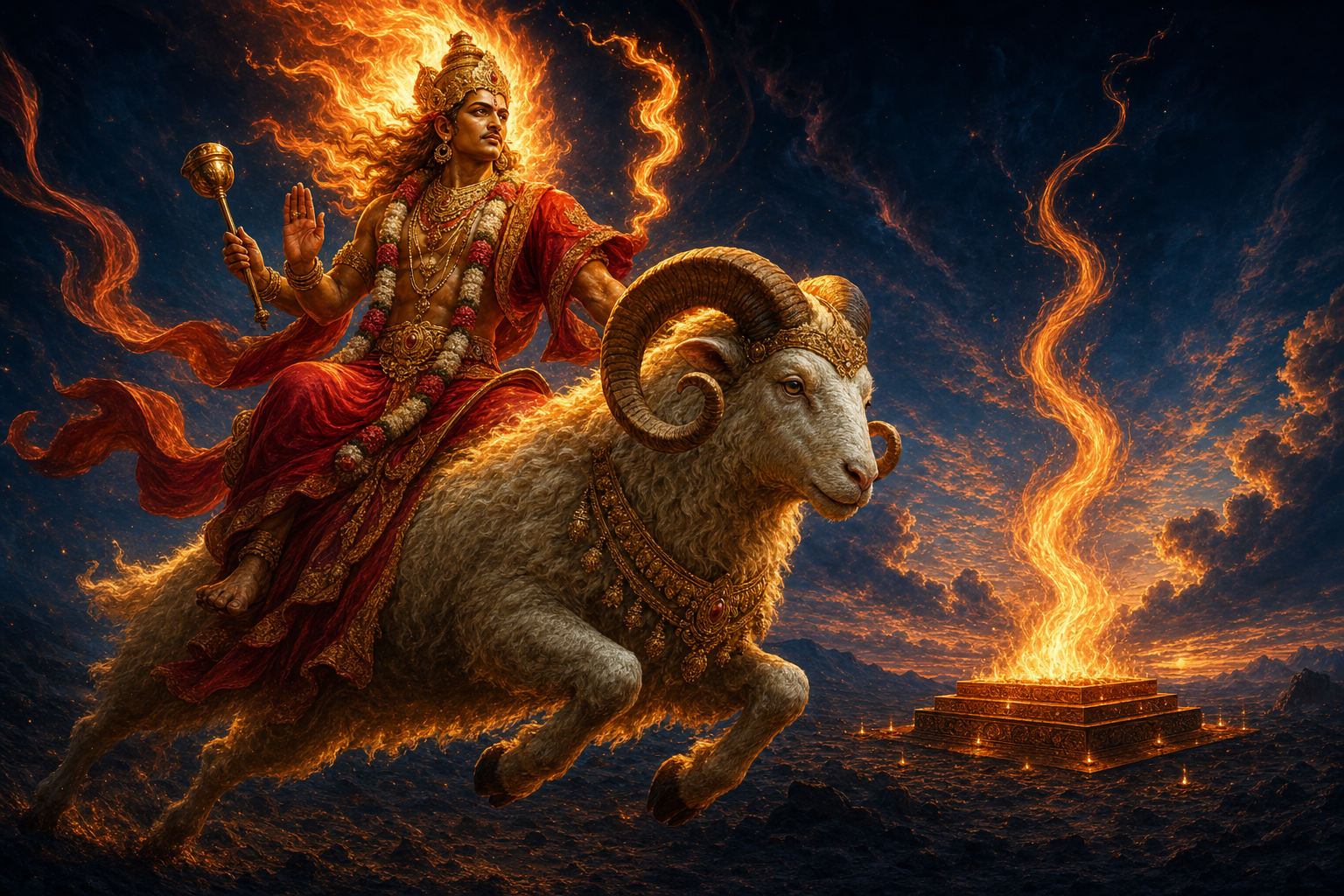
In classical iconography, Agni’s standard vahana is the ram, or mesha. The pairing is intelligible before any elaborate allegory is added. Agni is heat, radiance, appetite, movement, and transformation. In yajna, he receives the offering and carries it toward the devas. The sturdy, energetic ram gives animal form to that forward-driving power.
A vahana should not be read as a detachable emblem with one dictionary definition. It participates in the deity’s identity. The ram beneath Agni communicates mobility and potency; the flames communicate transformation; red or golden coloration communicates heat and brilliance. Some representations give Agni two heads, expressing his operation in more than one sphere, while imagery associated with his seven tongues emphasizes the many ways fire receives and transforms an offering. These features belong to a connected iconographic language, not a collection of unrelated ornaments.
The ram’s presence does not automatically mean that the animal shown is about to be sacrificed. That mistake confuses two different roles: the animal as divine vehicle and an animal designated as pashu in a particular ritual framework. When you examine an image, first determine whether the animal bears the deity, accompanies the deity, appears among offerings, or stands independently. Position reveals function.
Nor should every ram be reduced to aggression. Agni’s mesha is better read through directed energy: fire moves, consumes, carries, and changes what enters it. This gives the image an inward application. A sincere offering is not merely placed before a flame; intention, attachment, and disorder are meant to be transformed. The ram therefore helps you see yajna as purposeful movement rather than passive ceremony.
Mesha also names Aries, a sign associated with the fire element. Mesha Sankranti, the Sun’s ingress into Aries, forms part of a new-year threshold in several regional calendars. This creates a genuine symbolic resonance among ram, fire, movement, and renewal. It does not make astrology and temple iconography the same system. Use the connection to notice a shared vocabulary, not to turn every sculpture of Agni into a horoscope.
Daksha’s goat-head marks correction without annihilation
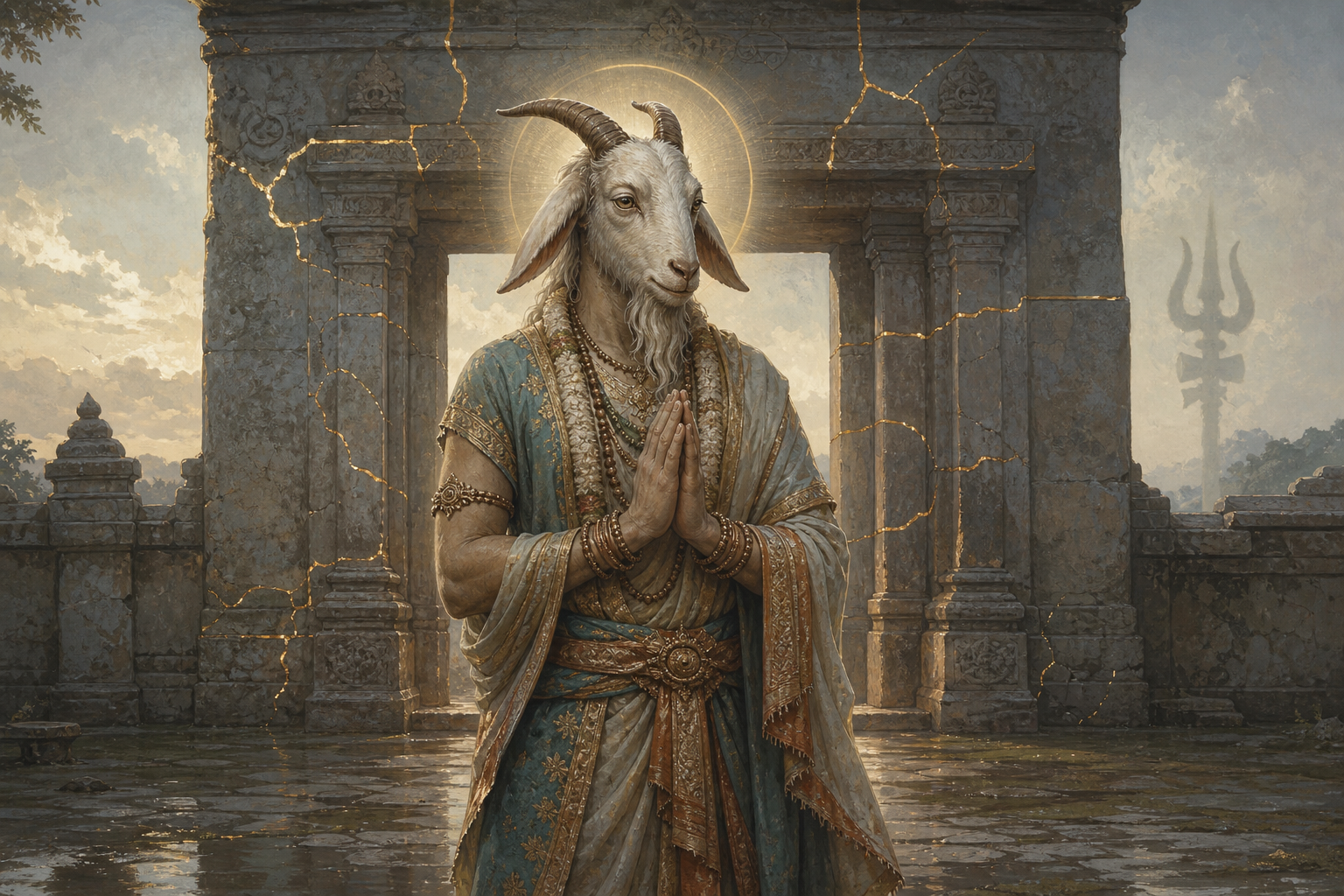
Daksha’s goat-head belongs to a moral drama, not to the iconography of Agni’s mount. Daksha conducts a yajna under the influence of pride and exclusion. The rite may retain its external form, but its governing attitude violates the larger order it is supposed to serve. Veerabhadra and Shiva’s forces break the sacrifice, and Daksha loses the head that had directed his authority.
The story does not end with destruction. Daksha is restored to life with a goat’s head. That restoration is the interpretive center. He receives life again, but not a return to his former self-image. The visible alteration records that ritual authority has been chastened and reintegrated into a cosmos that no individual officiant or patron controls.
If you read the goat-head only as humiliation, you stop halfway through the narrative. If you read it only as mercy, you lose the seriousness of the correction. The symbol holds consequence and restoration together. Daksha’s conduct cannot continue unchanged, yet he is not denied the possibility of renewed participation. Dharma repairs the person by correcting the orientation through which that person acts.
This is also why the story should not be used to portray goats as foolish, dirty, or spiritually inferior. The animal is not being placed on trial. It becomes the embodied sign of Daksha’s changed condition. Hindu narratives often let a physical transformation make an ethical truth visible; the relevant question is therefore not, “What insult does this animal represent?” but, “What did this character have to lose before right relationship could be restored?”
For anyone responsible for a temple committee, family observance, institution, or public religious event, the warning is direct. Technical correctness does not rescue a rite governed by prestige, exclusion, or rivalry. Daksha knows how to conduct a sacrifice, yet knowledge of procedure is not enough. Before defending a ritual in the name of tradition, ask whether its manner honors the divine whole or merely displays the authority of its organizer.
Ritual history and ahimsa must be read together
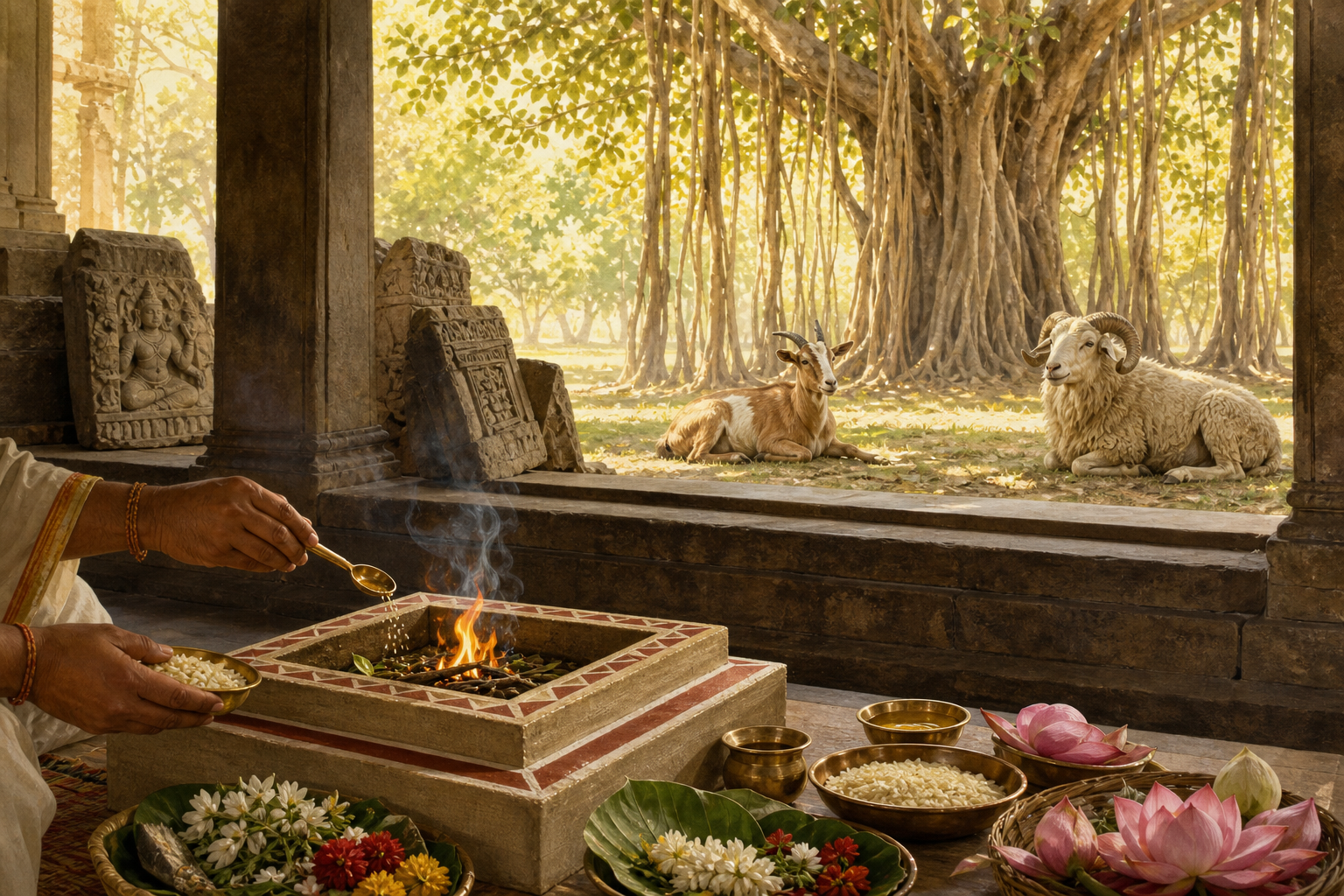
Goats and sheep did have roles within specified Vedic sacrificial settings. The Shrauta ritual world included carefully consecrated pashu, and the pashubandha formed part of certain fire and Soma rites. A historically honest reading should not erase that material simply because many present-day Hindus practice differently.
The opposite mistake is just as serious: a description of an earlier, specialized rite is not a universal command for every Hindu community or household. Vedic ritual categories, Puranic narratives, temple iconography, village customs, and modern domestic homa do not operate under one undifferentiated rule. You must establish the period, ritual system, community, and purpose before drawing a conclusion about practice.
Across regions and sects, many offerings came to be represented through grains, fruits, coconuts, or pumpkins. Such substitutions are sometimes described informally as vegetarian bali. Contemporary household homa commonly uses clarified butter, grains, fragrant woods, and other non-injurious materials. The ritual act remains one of consecration and transformation, while its material expression is brought into closer alignment with ahimsa.
This ethical development belongs to a wider dharmic conversation. Jain insistence on ahimsa, Buddhist emphasis on compassion and right action, Hindu devotional currents, and Sikh emphasis on devotion, seva, and equality all strengthened the principle that religious action should advance awakening and welfare rather than cruelty. These traditions do not have identical ritual theologies, and their differences should not be flattened. Their shared pressure toward minimizing harm is nevertheless important for understanding why symbolic offerings carry religious weight rather than serving as second-rate replacements.
Symbolic substitution does more than remove an animal from the altar. It moves the center of sacrifice inward. The practitioner is asked to relinquish possessiveness, pride, anger, or another lower tendency while offering something that does not require injury. In that reading, compassion does not weaken yajna. It helps reveal what the act of offering was meant to accomplish in the person.
If you are deciding how to interpret or participate in a living rite, do not infer its procedure from a sculpture or an isolated Sanskrit term. Ask the officiant or community what is being offered, which tradition governs the rite, and whether the language is literal or symbolic. For a family homa, follow the established non-injurious materials and instructions of the tradition you actually practice. Historical curiosity is not a reason to improvise a sacrificial procedure.
A five-step method for reading any goat or ram image
Hindu animal symbolism is relational. Meaning comes from the animal, its role, its narrative setting, and the action around it. A single universal definition such as “goat equals sacrifice” will fail as soon as you move from a fire altar to a Daksha panel or a village shrine.
Key takeaways
- Name the animal first. Use aja for a goat and mesha for a ram when those terms are supplied; do not let a loose English caption settle the matter.
- Identify its role. A vahana, a transformed head, a ritual pashu, an astrological sign, and a living shrine-side animal do different symbolic work.
- Read the whole scene. Flames and a mounted deity point toward Agni; the disrupted yajna and a goat-headed figure point toward Daksha.
- Separate history from prescription. A specialized sacrificial context tells you what occurred within that system, not what every Hindu should perform now.
- Test the interpretation against dharma. Agni’s ram should clarify transformation, Daksha’s goat-head should clarify humility and restoration, and modern offering practice should take ahimsa seriously.
Suppose you see a flame-crowned figure riding a horned animal on a temple wall. Begin with the figure, not the horns. If the remaining features identify Agni, read the animal as his ram unless the temple’s own tradition provides a different identification. A casual caption saying “goat” may reflect the broad association of caprids with sacrificial fire, but the more precise classical identification remains mesha.
Now suppose you see a human figure with a goat’s head in a yajna scene connected with Shiva or Veerabhadra. The animal feature is not a vehicle and need not carry Agni’s fiery meaning. Read the before-and-after movement of Daksha’s story: pride and exclusion corrupt the rite; rupture exposes the failure; restoration permits humbled participation. The goat-head makes that corrected identity visible.
A living goat beside a rural shrine calls for still more restraint. Goats sustain pastoral households through their practical place in village economies and can evoke resilience, nourishment, continuity, and gratitude. That living relationship may be devotional without encoding either the Agni or Daksha narrative. Ask what the community does and remembers before imposing a textual explanation from elsewhere.
At your next temple visit, festival, or scripture discussion, pause before accepting “goat” and “ram” as interchangeable. Name the animal, locate its role, follow the narrative movement, and notice the ethical direction. That short practice turns a puzzling horned figure into a precise lesson about sacred energy, corrected authority, and the transformation that ritual is meant to produce.