
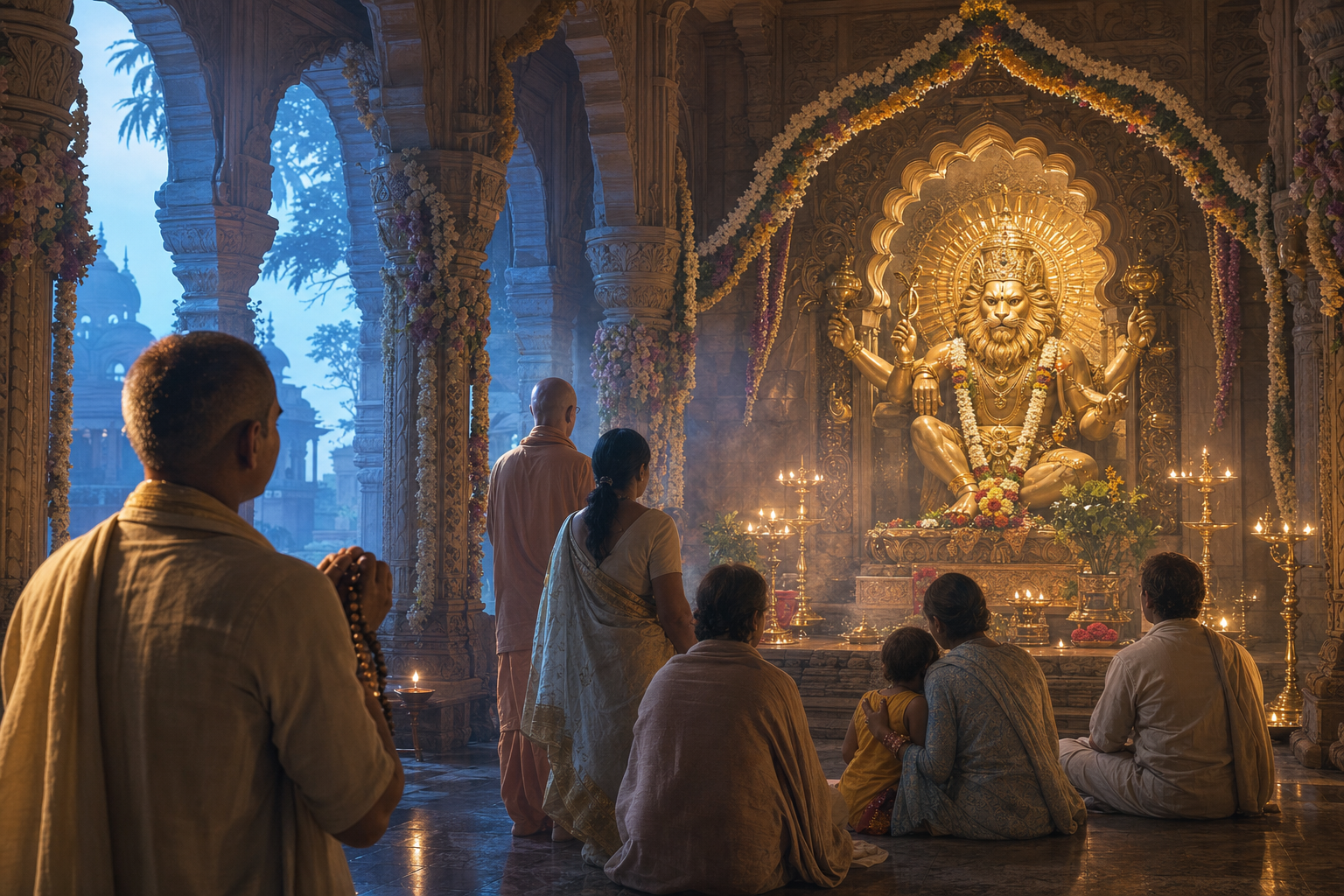
If you have turned to Lord Narasimha during childlessness, illness, danger, or a crisis at home, Mayapur’s testimonies can raise a difficult question: should you receive them as evidence, inspiration, or a promise that the same outcome will happen for you?
A responsible Vaishnava answer makes room for faith and discernment. You can take a testimony seriously without turning it into a guarantee. You can pray for concrete help without treating Bhagavan as a mechanism. Most importantly, you can learn to notice grace not only in the outcome you wanted, but also in the courage, clarity, and dharmic action that prayer makes possible.
The first distinction: testimony is not a contract
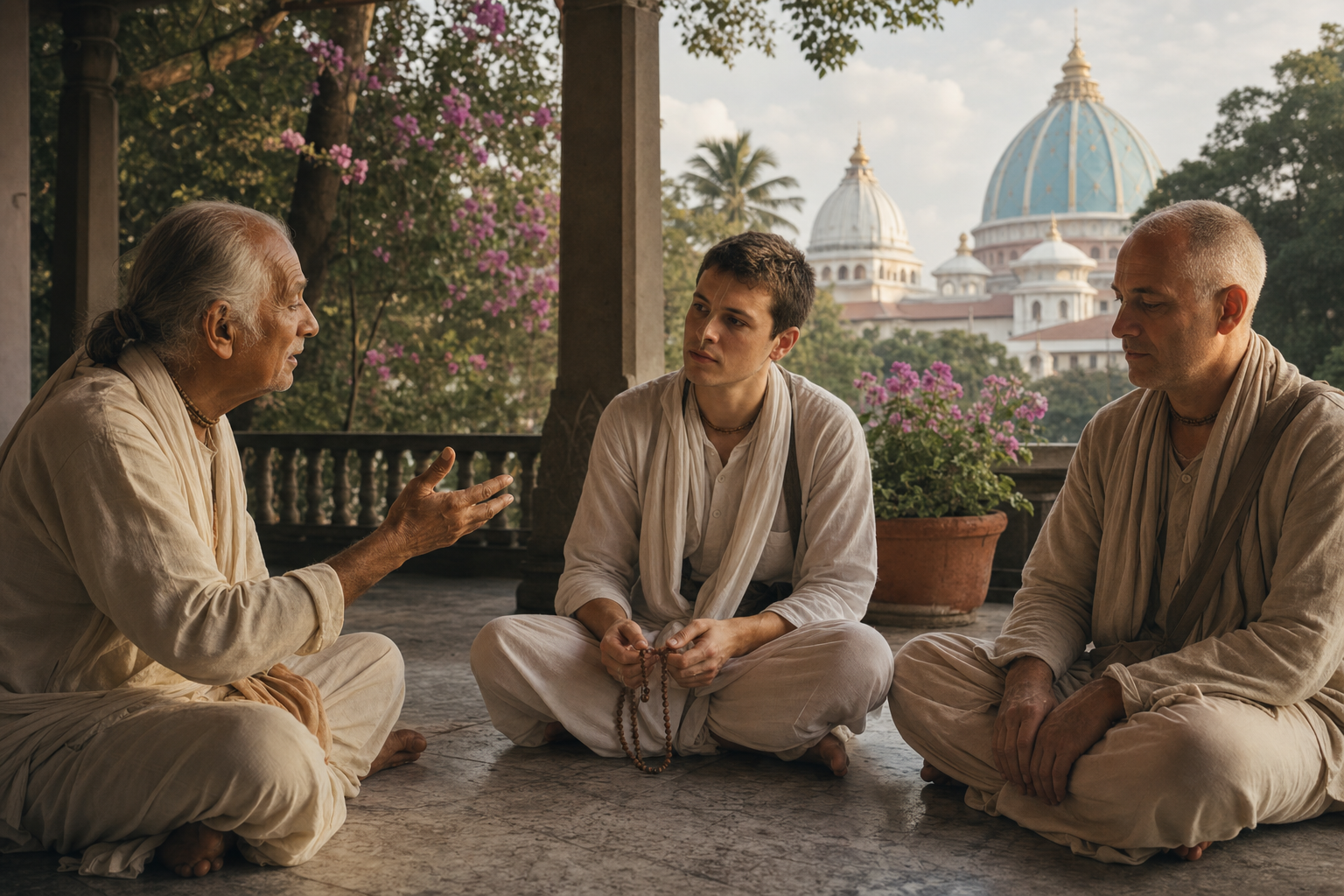
Devotees at Mayapur approach Lord Narasimha as Jagrata Nrsimhadeva, the ever-wakeful guardian. The name expresses a lived conviction: the Lord who protected Prahlada remains attentive to those who seek shelter. Within Gaudiya Vaishnava practice, the consecrated Deity is approached as Bhagavan’s personal, worshipable presence, not as a decorative representation.
The scriptural anchor is the Prahlada narrative in Canto 7 of the Bhagavata Purana. It reveals Narasimha’s fierce opposition to adharma and His tenderness toward the devotee. A contemporary testimony has a different status. Scripture supplies the governing truth; testimony records anubhava, or lived experience, within that truth. Confusing those categories produces two opposite mistakes: dismissing all experience because it is not scripture, or treating every striking event as a universal scriptural promise.
When you hear a Mayapur testimony, separate three layers. First, identify the event that can be stated plainly. Second, identify the devotee’s interpretation of that event as kripa, or grace. Third, ask what dharmic lesson the experience carries. This keeps the sacred meaning intact while preventing embellishment.
- What actually occurred? Look for names, sequence, setting, and details supplied by the witness rather than later retellings.
- What is being inferred? An unexpected outcome may be received as divine reciprocation without becoming empirical proof of causation.
- What changed in the person? Increased truthfulness, steadiness, service, or surrender is spiritually significant even when it cannot be measured from outside.
- What is not being promised? One devotee’s blessing does not establish a formula by which a particular vow must produce the same material result for everyone.
This distinction does not drain a testimony of power. It protects it. A credible account can invite you into prayer; it does not need to claim that Bhagavan can be compelled.
Grace appears in more than one form
The best-known Mayapur experiences do not all follow the same pattern. Some concern a longed-for outcome. Some feel like a personal acknowledgment of seva. Others involve no outward miracle at all, yet leave a person able to face danger or duty without being ruled by fear. Knowing these distinctions helps you avoid ranking one kind of grace above another.
A long-awaited outcome
Ashok Ghosh and his wife, Shila Ghosh, had been married for twelve years without having a child. They had pursued medical treatment and culturally familiar remedies, including amulets. On Nrsimha Caturdasi in 2006, they went from Kolkata to Mayapur, observed a vrata, made offerings, prayed, and approached the vow with repentance and a commitment to more ethical living. Within a year they welcomed a child and attributed the blessing to Lord Nrsimhadeva.
You do not have to choose between mocking their interpretation and claiming that the sequence proves medical causation. The sound devotional position is more exact: the couple sincerely received the birth as mercy, and their testimony belongs to the living memory of Mayapur. It can strengthen hope, but it cannot guarantee conception to another couple who repeats the observance.
If your own prayer concerns fertility or another health matter, continue appropriate care with qualified professionals. Prayer, pilgrimage, and nama can sustain meaning, discipline, and resilience; they are not substitutes for evaluation or treatment. Delaying care because somebody else received a desired outcome can carry real consequences. Bhakti asks you to surrender pride and fear, not to abandon practical responsibility.
An offering personally acknowledged
Another devotee couple offered Lord Nrsimhadeva a crystal necklace with a large pendant. They did not initially see the Deity wearing it. The wife then prayed for guidance about what would please the Lord. The following day, the necklace appeared in the Deity’s adornment. The timing felt to them like an intimate answer.
Temple protocol remains part of the event, not an obstacle to its devotional meaning. An ornament may be inspected, secured, sanctified, matched with other alankara, or reserved for an appropriate day. The pujari’s decision provides a practical pathway through which the offering can appear. Bhakti does not require grace to bypass ordinary service. The convergence of prayer, timing, and temple action is precisely what the devotee receives as reciprocation.
If you donate an ornament and do not see it immediately, do not interpret the delay as rejection. Ask the appropriate temple office whether the offering was received, then release the demand for public display. Seva ceases to be an offering when your peace depends on being able to see or advertise its use.
Fear transformed into dharmic action
Many experiences remembered in connection with Mayapur’s long-serving pujari Pankajanghri dasa concern urgency: danger approaches, resources seem exhausted, or fear becomes overwhelming. Yet the most useful pattern is not spectacle. Devotees also describe sudden steadiness, the courage to speak truth, the intuition to seek help, and the calming of anger.
Do not treat those inner changes as consolation prizes. If prayer gives you enough clarity to call for help, protect someone vulnerable, admit a mistake, or take the next honest step, protection has already begun to operate in your conduct. The relevant question is not only, “Did the situation disappear?” It is also, “What dharmic action can I now take that fear prevented me from taking before?”
Why the Mayapur temple setting matters

Mayapur’s testimonies arise inside a disciplined culture of arcana. Lord Nrsimhadeva receives daily offerings and alankara, as well as periodic abhishekam, within Vaishnava temple practice. Lamps, incense, flowers, food, sacred sound, cleanliness, timing, and the trained service of pujaris create continuity. A pilgrim’s urgent prayer enters a worshiping community that was active before the pilgrim arrived and will continue after the pilgrim leaves.
This matters because the temple is not a private wish-fulfilment chamber. The Deity’s service has its own integrity. Pujaris must consider an ornament’s material, weight, dimensions, fastening, safety, iconographic fit, and place in the festival calendar. Food, clothing, jewelry, and other offerings are handled according to practical and ritual requirements. Your sincerity does not cancel their responsibility.
If you want to make a material offering, take four concrete steps before purchasing it:
- Contact the temple authority responsible for receiving that kind of offering.
- Provide the material, size, weight, workmanship, and fastening details requested by the temple.
- Include a brief, factual note identifying the offering and its intended seva so that it can be recorded properly.
- Accept that it may be used later, sanctified without public display, redirected according to temple rules, or found unsuitable for direct use on the Deity.
The memory surrounding Pankajanghri dasa also preserves a devotional posture. A pujari watches for grace while continuing exact service; he does not neglect procedure while waiting for a sign. You can apply the same principle outside the temple. Pray attentively, perform your duty carefully, and leave room for Bhagavan to answer through ordinary people and processes.
Mayapur also demonstrates that grace is not rationed according to a devotional resume. Ashok and Shila Ghosh were not presented as advanced lifelong practitioners. Their experience is remembered because a sincere appeal, vrata, ethical resolve, and the holy name can open a beginning. The Vaishnava concept of ajnata-sukriti helps explain how spiritual benefit may accumulate even before a person fully understands the path.
How to pray without turning devotion into a transaction
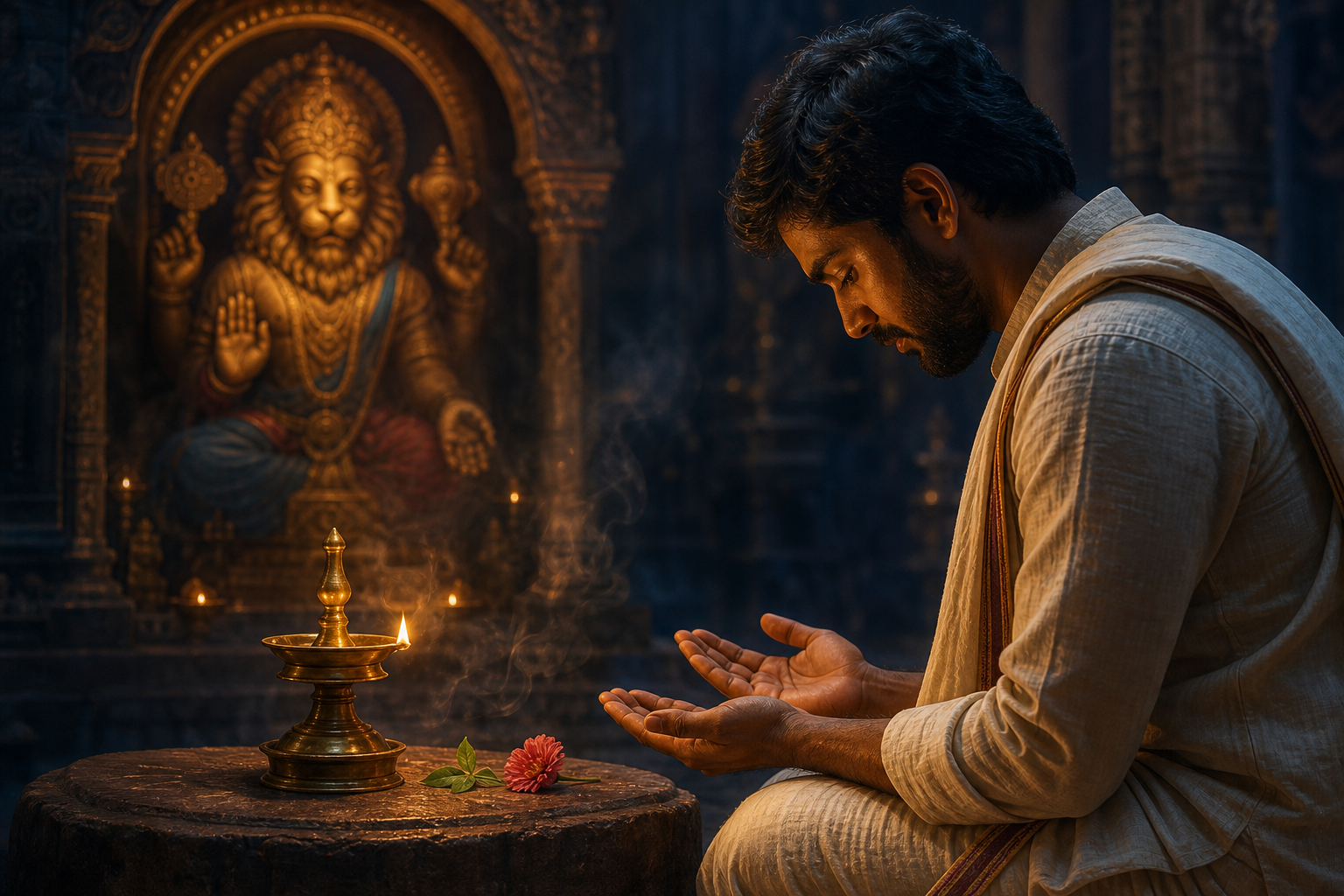
You do not need an elaborate performance to approach Lord Narasimha. Gaudiya Vaishnava teaching places nama-sankirtana at the center of practice in Kali Yuga, an accessible emphasis carried widely through Lord Caitanya’s tradition and the work of A.C. Bhaktivedanta Swami Prabhupada. What matters is not dramatic bargaining but a sincere sankalpa joined to conduct.
- Name the real fear. State your concern plainly. A prayer such as, “Lord Narasimha, this is what I fear; please protect what is dharmic and show me my next truthful duty,” is a suggested plain-language petition, not a prescribed mantra. Specific honesty is more useful than devotional performance.
- Apply the dharma test. Ask whether your request protects life, truth, duty, and legitimate well-being, or whether it asks Bhagavan to support revenge, vanity, coercion, or another person’s harm. If the desire is adharmic, revise the desire before enlarging the vow.
- Make a sustainable sankalpa. Choose a regular period for nama, japa, kirtan, or a Narasimha prayer already given within your tradition. Do not make an inflated promise that you are unlikely to keep. A modest observance completed with care trains the heart better than a severe declaration abandoned after the crisis passes.
- Join remembrance to ethical repair. Tell the truth that you have avoided. Return what is not yours. Apologize where you have caused harm. Offer appropriate charity or seva. The point is not to purchase an answer but to remove the contradiction between the protection you request and the conduct you maintain.
- Keep ordinary channels of help open. Continue medical care, safety planning, legal duties, family communication, and competent advice as your situation requires. If a vrata would restrict food, medication, or rest in a way that could affect your health, seek qualified guidance and choose a safer discipline.
- Watch for more than one answer. Notice external resolution, timely assistance, a prevented error, new information, courage, restraint, or the clarity to accept an outcome you did not choose. Do not force every coincidence into a miracle claim, but do not overlook the inward protection that makes right action possible.
- Retell the experience accurately. Distinguish what you witnessed from what you heard. Preserve names and dates only when they are known. Do not add a diagnosis, prophecy, or causal certainty that the person involved did not claim. Accuracy is part of seva because it protects both the devotee and the sacred memory.
A vrata is not necessarily an extreme fast, and pilgrimage is not the only valid form of approach. If you cannot travel to Mayapur, you can still cultivate remembrance, truthfulness, service, and surrender where you are. The theological point of Jagrata Nrsimhadeva is wakeful protection, not geographical confinement.
This accessible discipline also has resonances across the Dharmic family. Sikh Naam Simran, Jain reverence for the Namokar Mantra, and Buddhist forms of mindful recitation differ in theology, yet each refuses the idea that sacred remembrance is empty speech. Repetition disciplines attention and conduct. For a Vaishnava approaching Narasimha, nama becomes both an appeal for shelter and training in how to live under that shelter.
Key takeaways
- Mayapur’s Narasimha testimonies are lived devotional evidence, or anubhava; they do not function as universal guarantees.
- Grace may appear as a desired outcome, a tender acknowledgment of seva, timely practical help, or the inner steadiness needed for dharmic action.
- Temple procedures do not compete with divine reciprocation. They are often the human structure through which an offering is safely received and used.
- Prayer should accompany medical care, safety measures, and other practical duties rather than replace them.
- A sound sankalpa joins sacred remembrance to truthfulness, restraint, service, and willingness to accept an answer that may differ from the one requested.
Before your next prayer, write two sentences: the protection you are asking for and the dharmic action you will take now. Then take that action without demanding a sign. If grace comes quietly, you will be prepared to recognize it; if it comes dramatically, you will be prepared to receive it without turning mercy into a formula.
References
- Dandavats — Mercy Beyond Boundaries: How Lord Narasimha’s Mayapur Grace Answers Prayers Through Nama
- Dandavats — When the Deity Answers: An Offering, a Prayer, and the Astonishing Grace of Lord Narasimha
- Dandavats — When Devotion Meets Divinity: How Lord Nrsimhadeva’s Grace Manifests in Real Time