
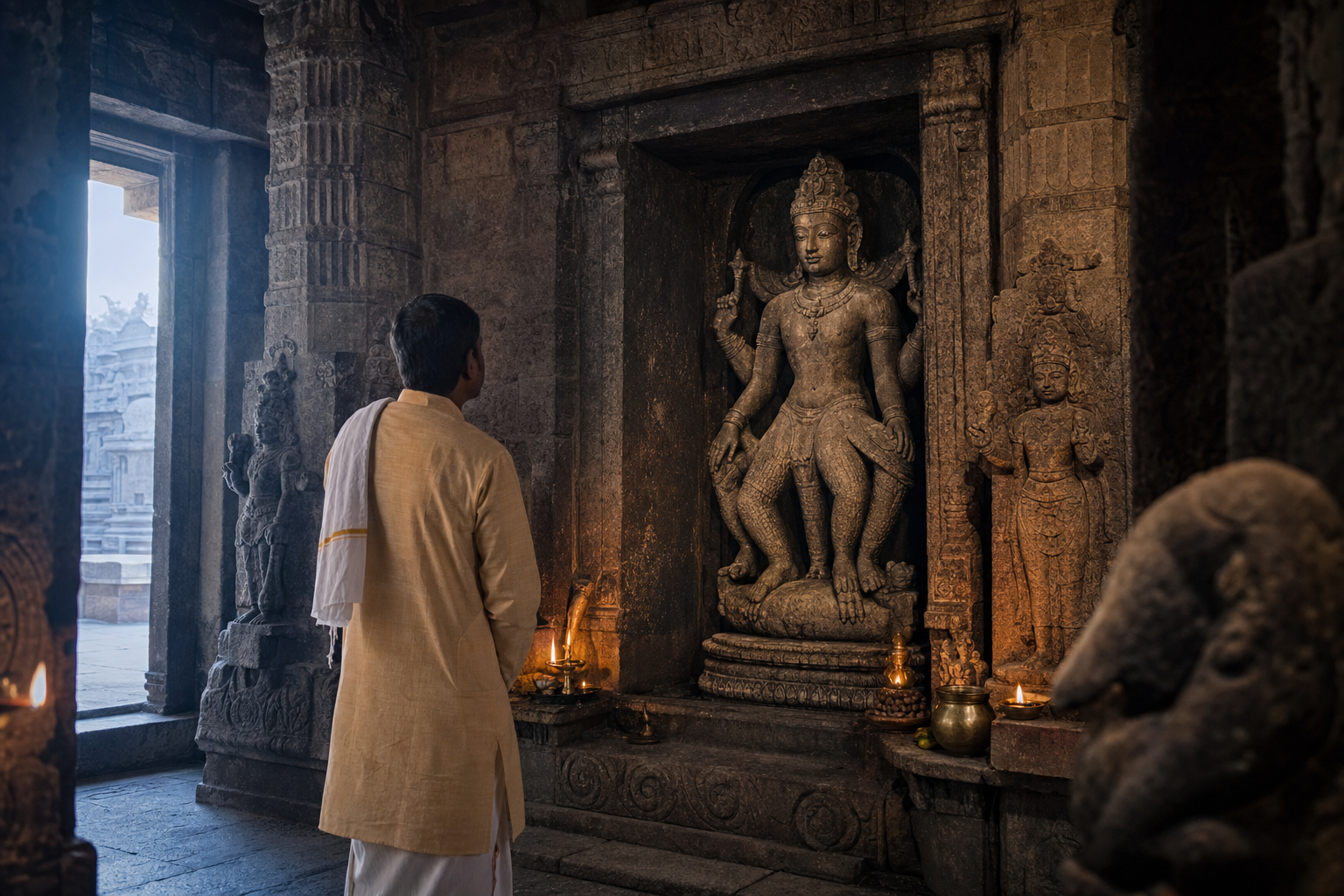
You encounter a revered sage whose body becomes a serpent, or Shiva dancing with ten arms in a form named for the bull. What should you actually see? If you jump straight to a symbolic meaning, you will probably notice less, not more.
Hindu sacred iconography rewards a slower sequence: observe the form, preserve its exact name, identify its relationships, recover its temple context, and only then interpret it. This method lets you approach an unfamiliar murti with both reverence and intellectual honesty.
Unusual anatomy is usually a clue, not a puzzle to eliminate
The word “unusual” describes your encounter with an image; it does not describe the image’s standing within its tradition. A composite body may be unfamiliar to you while remaining completely intelligible within a particular lineage, temple, or regional convention.
Begin by resisting visual literalism. A human-serpent sage is not an attempt to document an ordinary biological body. Ten-armed Shiva is not an anatomical proposition. Sacred iconography gives visible form to realities that ordinary anatomy cannot display at once: identities, powers, relationships, modes of action, and levels of being.
This does not mean every feature can be translated into one neat sentence. The safer first question is relational: What has this form joined together? A composite body joins domains. Multiple arms place several actions or attributes in one field of vision. A dance joins stable identity with movement. An animal may be a vehicle, companion, support, emblem, participant, or the key to the form’s name. You must determine which relationship is present rather than assuming that every animal plays the same role.
In a temple, a murti is approached through worship and darshan, not merely inspected as an art object. Its identity therefore comes from more than its outline. Name, placement, ritual use, local memory, accompanying figures, and the larger shrine all help establish what you are seeing.
Two rare forms show how disciplined reading works
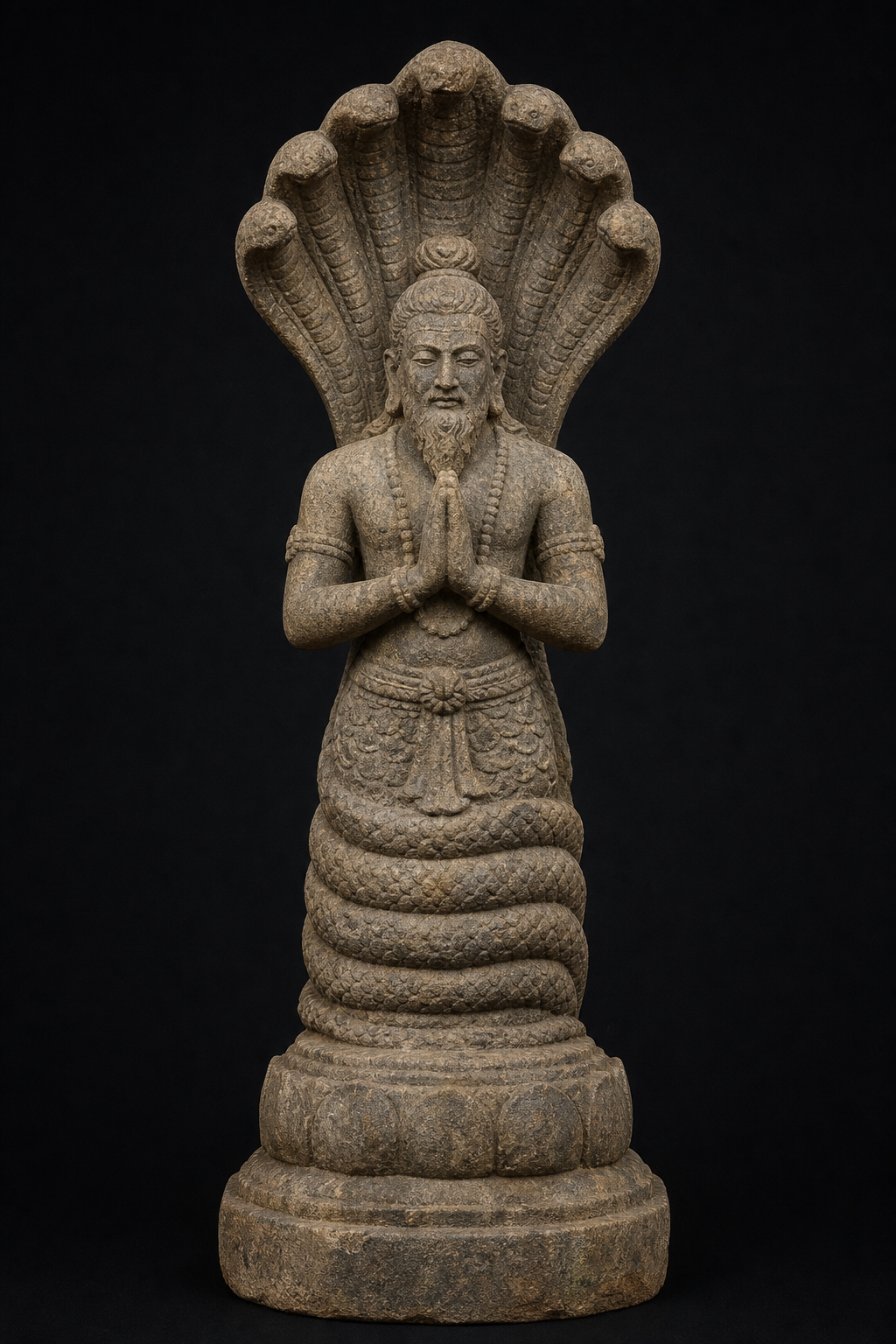
Patanjali as a human-serpent sage
Patanjali is revered as the compiler of the Yoga Sutras, a work of 196 aphorisms that systematically presents a path toward liberation. His sacred form can combine a human aspect with a serpent aspect.
Your first useful observation is not “the serpent means X.” It is that the form refuses to reduce Patanjali to an ordinary portrait. The recognisable sage and the non-human serpent presence have deliberately been held together. The composite body asks you to contemplate both dimensions at once.
That observation is stronger than an immediate claim that the serpent must mean kundalini, timelessness, hidden knowledge, or any other single idea. Serpent imagery carries several associations across Hindu traditions. Unless the temple’s identification, a transmitted account, or an applicable iconographic convention narrows the meaning, choosing one association is speculation. Record the composite identity first; investigate its precise theological interpretation second.
The textual and visual dimensions should also remain connected. If you know Patanjali only as a serpent figure, you miss the teacher associated with a disciplined account of yoga. If you treat him only as the name attached to a philosophical text, you miss how sacred art presents the sage as more than a modern author portrait. Neither dimension cancels the other.
Dasabuja Rishaba Tandava: ten arms, bull, and dance
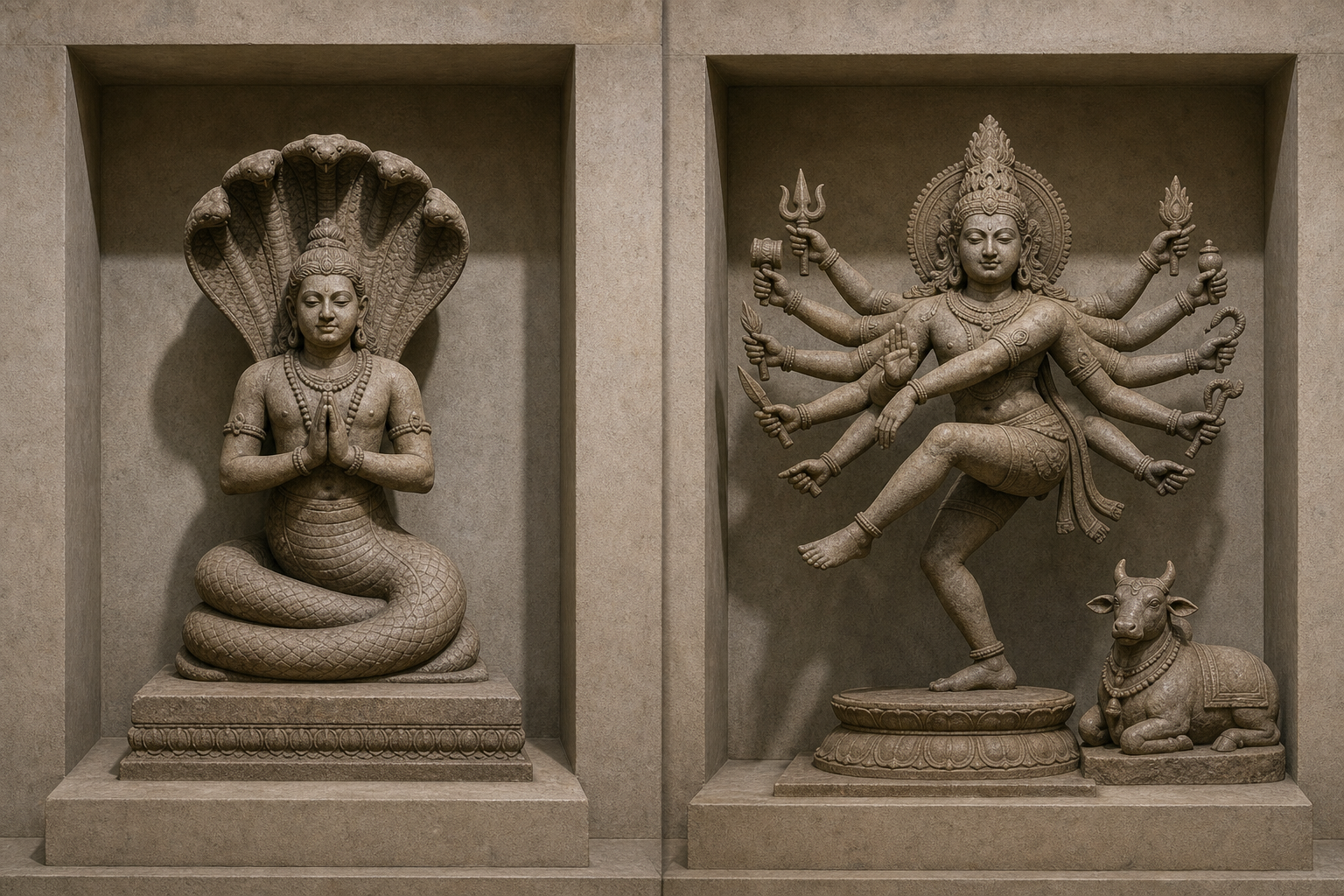
The name Dasabuja Rishaba Tandava already gives you a compact viewing guide: ten arms, the bull, and dance. The form is an exceptionally rare bronze of dancing Shiva associated with Mela Kadambur in Tamil Nadu. It belongs to the Amirthakadeswarar Temple and is kept within sanctified storage there.
Do not collapse all ten arms into the vague statement that Shiva is powerful. Count them, then examine each hand. Which hands carry recognisable attributes? Which make gestures? Which balance the composition? Are corresponding hands paired, opposed, or moving in different directions? If a photograph does not show a hand clearly, mark it as unclear. A guessed object can distort the identification of the entire form.
Next, study the dance as a configuration rather than a generic label. Look at the distribution of weight, direction of the torso, position of the feet, extension of the arms, and relation between the dancer and the bull. The bull is not background decoration merely because Shiva dominates the image. Its presence is important enough to enter the form’s name.
Rarity needs similar restraint. A rare form deserves careful documentation, but rarity by itself does not prove that a murti is older, more esoteric, more authoritative, or spiritually superior to a familiar form. It tells you that broad generalisations are especially risky. In this case, the exact temple, the bronze medium, the full name, and the arrangement of the figure matter more than a generic internet description of “dancing Shiva.”
Use this seven-step method in a temple, museum, or photograph
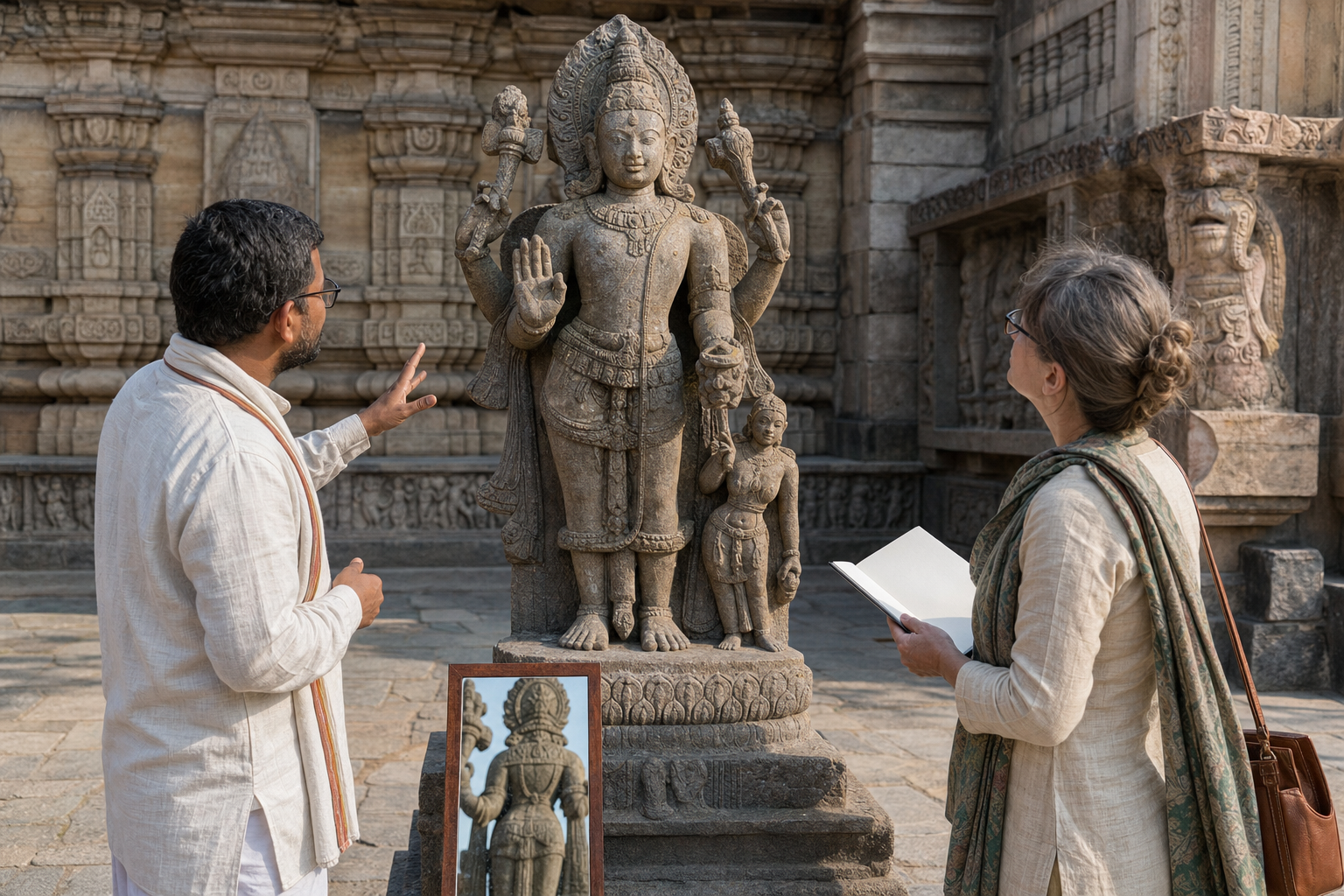
- Establish what kind of object you are viewing. Determine whether it is a worshipped murti, a temple bronze, architectural sculpture, museum object, printed image, or modern reinterpretation. Do not transfer the ritual status of one object to another merely because they depict the same deity.
- Preserve the exact name. Copy the local or Sanskrit name before shortening it to “Shiva,” “a sage,” or “a goddess.” Names such as Dasabuja Rishaba Tandava may encode anatomy, posture, action, relationship, or setting. Translation should unpack the name, not replace it.
- Make an inventory without interpretation. Record the number of figures, heads, faces, arms, legs, coils, wings, vehicles, supports, held objects, gestures, ornaments, and accompanying beings. Note posture and direction of movement. Write “unidentified object” when an attribute is not visible enough to name.
- Find the compositional centre. Ask what the eye is being directed toward. A hand gesture, a face, a lifted foot, a cluster of attributes, an animal, or the meeting point of two bodily forms may organise the whole image.
- Map relationships before assigning meanings. Determine who supports, faces, accompanies, receives from, protects, challenges, or moves with whom. In multi-figure and composite forms, relationships often carry more information than isolated symbols.
- Recover the narrowest reliable context. Start with the shrine, exact temple, local name, sectarian setting, and ritual role. Then compare the image with closely related forms. A broad list of universal symbol meanings should come last, if it is useful at all.
- Label your level of certainty. Separate direct observation, conventional identification, local attribution, and personal interpretation. This single habit prevents a plausible idea from being repeated later as an established fact.
A compact field note can use five lines: “Observed,” “Named,” “Locally identified,” “Interpreted,” and “Still unknown.” For Patanjali, for example, the human-serpent composition is observed, the name identifies the sage, and a claim about one exclusive serpent meaning may remain unverified. For Dasabuja Rishaba Tandava, ten arms, dance, and the bull belong to the named form, while the meaning of each hand requires a clear view and more specific knowledge.
If you are viewing a photograph, identify its limits. Cropping may remove the pedestal, vehicle, attendant, or shrine arrangement that establishes identity. A frontal image may hide attributes held behind the torso. A caption may simplify a precise regional form into a familiar pan-Hindu name. Treat missing visual information as missing evidence, not as permission to complete the image from memory.
Avoid the shortcuts that turn iconography into fantasy
The first shortcut is to call every unfamiliar feature “symbolic” and then supply whatever symbolism feels spiritual. Genuine iconographic interpretation is constrained. The figure’s name, physical configuration, attributes, place, and tradition limit what a responsible reading can claim.
- Do not make one feature carry the whole meaning. Patanjali’s serpent form should not erase his identity as a sage associated with the Yoga Sutras. Shiva’s ten arms should not make you overlook the dance or the bull.
- Do not assume one symbol has one universal translation. Serpents, animals, gestures, and weapons can function differently according to deity, narrative, sect, and local tradition.
- Do not identify an attribute from a blurry resemblance. A mistaken object can lead you toward the wrong manifestation, narrative, or theological conclusion.
- Do not confuse visual intensity with moral darkness. Multiple limbs, composite bodies, fierce expressions, and dynamic poses exceed ordinary human form because their subject exceeds ordinary human limits.
- Do not turn rarity into a hierarchy. A rare bronze is not automatically more sacred than a widely worshipped murti, and a familiar form is not shallow merely because you recognise it quickly.
- Do not strip a living sacred form of its temple life. Formal analysis can tell you how an image is organised, but the shrine tells you how a community encounters it.
Devotion and careful inquiry do not need to compete. Reverence gives you a reason not to trivialise the form. Method gives you a way not to project onto it. When evidence stops, saying “we do not yet know” is not a failure of faith; it is respect for the specificity of the tradition.
Key takeaways for your next encounter
- Describe an unfamiliar murti before trying to decode it.
- Read composite anatomy as a deliberate conjunction of identities or domains, not as a failed naturalistic body.
- Keep the exact name because it may identify the decisive features and relationships.
- Treat arms, attributes, posture, dance, animals, attendants, and setting as one composition.
- Use temple and lineage context to narrow possible meanings.
- Distinguish what you observed from what was locally identified and what you inferred.
- Let uncertainty remain visible when the image or contextual information is incomplete.
At the next unfamiliar murti, spend your first minute recording five visible facts and your second preserving the full name and location. Interpret only after those notes exist. That small discipline turns surprise into attention, and attention is the right beginning for both understanding and darshan.
References
- Hindu Blog — The Divine Iconography of Sage Patanjali – Symbolism – Half-Human, Half-Serpent
- Hindu Blog — Rarest of Rarest Dasabuja Rishaba Tandava Murti Of Shiva