
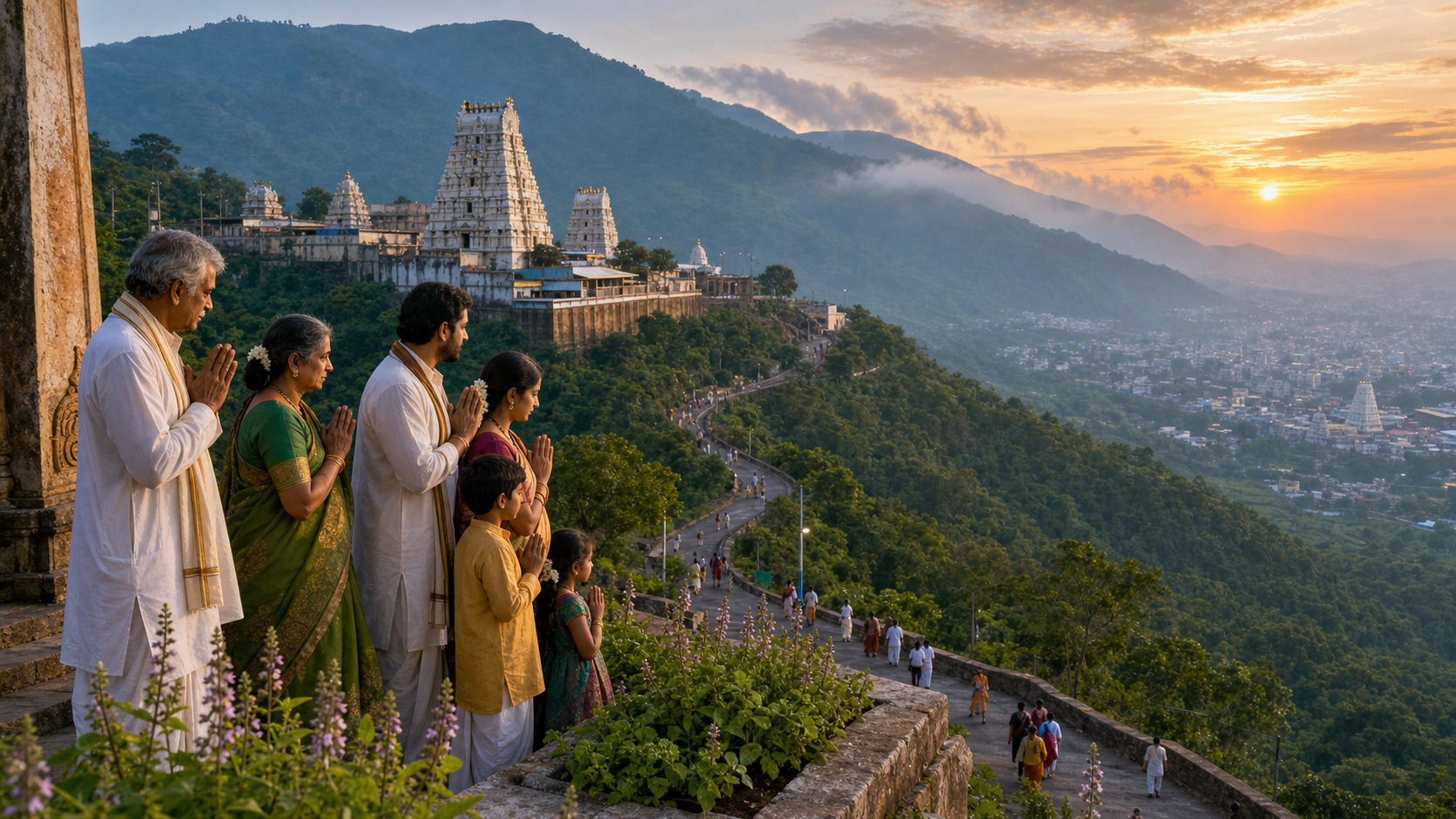
If you are planning a Tirupati pilgrimage, the pressure of tickets, queues and timings can shrink the entire journey to one objective: securing a few seconds before Lord Venkateshwara. Protect that moment, but do not let it define the whole yatra.
Tirupati becomes easier to understand when you see Tirumala, the city below and Tiruchanoor as parts of one sacred network. The fixed deity, the processional deity, temple streets, water, music, prasadam and community service all perform different roles. Reading those roles will help you decide where to go, what to notice and how to carry darshan beyond the sanctum.
The sacred geography begins before you reach the sanctum
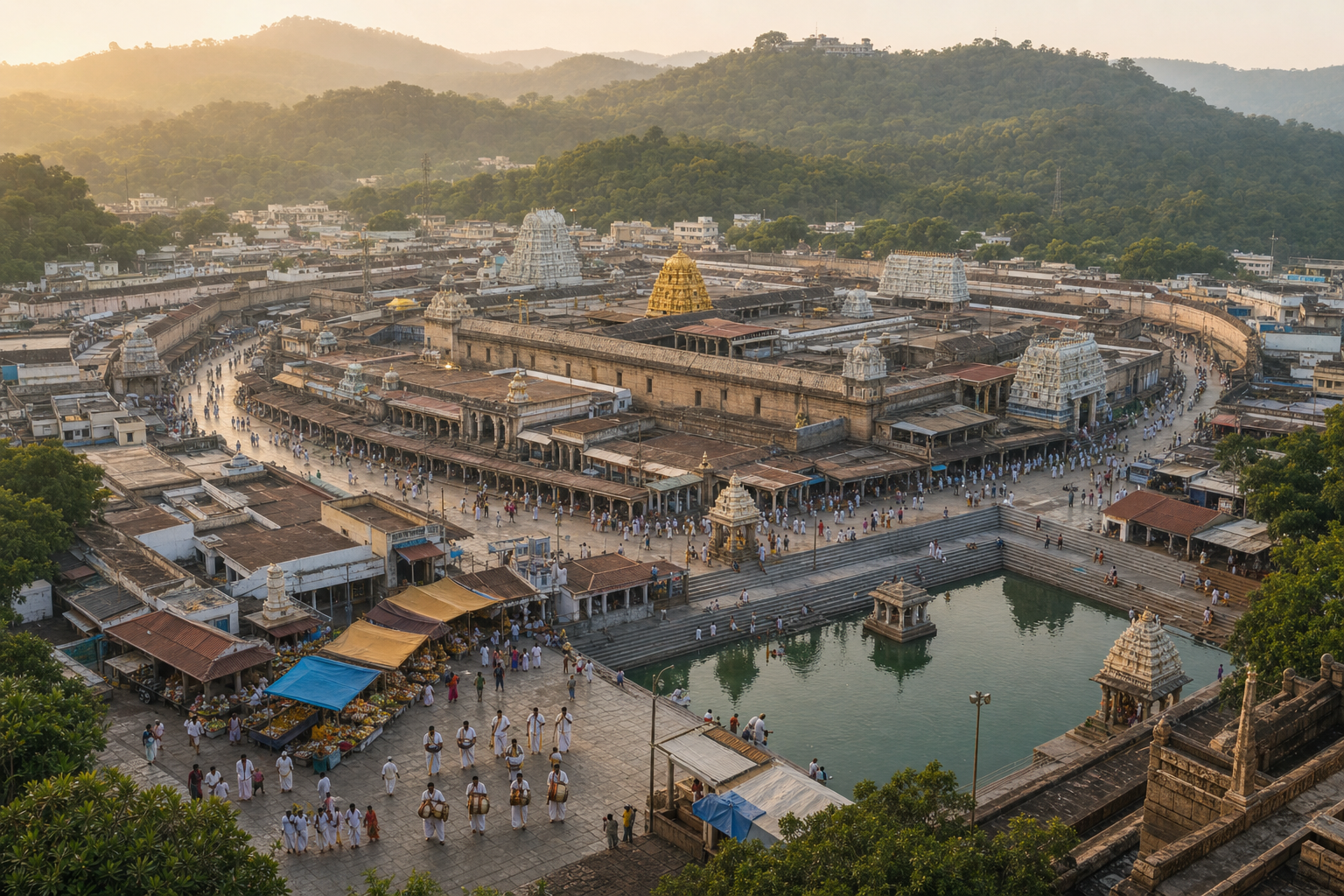
Lord Venkateshwara is revered as Kaliyuga Pratyaksha Daivam, the accessible manifestation of Vishnu for the present age. Yet accessibility does not mean that sacred presence is confined to one room. It radiates through a landscape of hills, shrines, routes and ritual relationships.
Tirumala rises within the Seshachalam range. Its seven sacred hills are named Seshadri, Neeladri, Garudadri, Anjanadri, Vrishabhadri, Narayanadri and Venkatadri. The ascent therefore has a ritual meaning as well as a geographical one: you are moving from ordinary activity toward concentrated divine presence. This symbolism remains available whether you approach on foot or by vehicle. Mark the transition consciously instead of carrying the noise of travel unchanged to the temple door.
- Tirumala is the ritual center. The Dhruva Beram stands in the sanctum, daily worship follows the Vaikhanasa Agama, and Swami Pushkarini, the Ananda Nilaya Vimanam, festival icons and prasadam belong to the immediate sacred environment of the Lord.
- Tirupati is an inhabited threshold. Sri Govindaraja Swamy Temple stands in the heart of the city. Its processions and dense ritual calendar show how Vaishnava worship enters civic space rather than remaining isolated on the hill.
- Tiruchanoor makes the relationship with Sri visible. Sri Padmavathi Ammavari Temple expresses the complementarity of Vishnu and Mahalakshmi. Including it can turn an individual request for blessing into a fuller contemplation of compassion, prosperity and sustaining grace.
- The wider kshetra is integrative rather than sealed. The local sacred landscape includes Vaishnava and Shaiva centers such as Govindaraja Swamy Temple and Kapileswara Temple. Their proximity reflects the lived fabric of Hindu practice.
Do not reduce this map to a ranking of a principal temple and optional side trips. Ask what each place contributes. Tirumala concentrates presence, Tirupati opens that presence into public life, Tiruchanoor reveals its relationship with Sri, and the wider kshetra places Vaishnava devotion within a broader Dharmic landscape.
Living ritual joins a fixed center to a moving presence
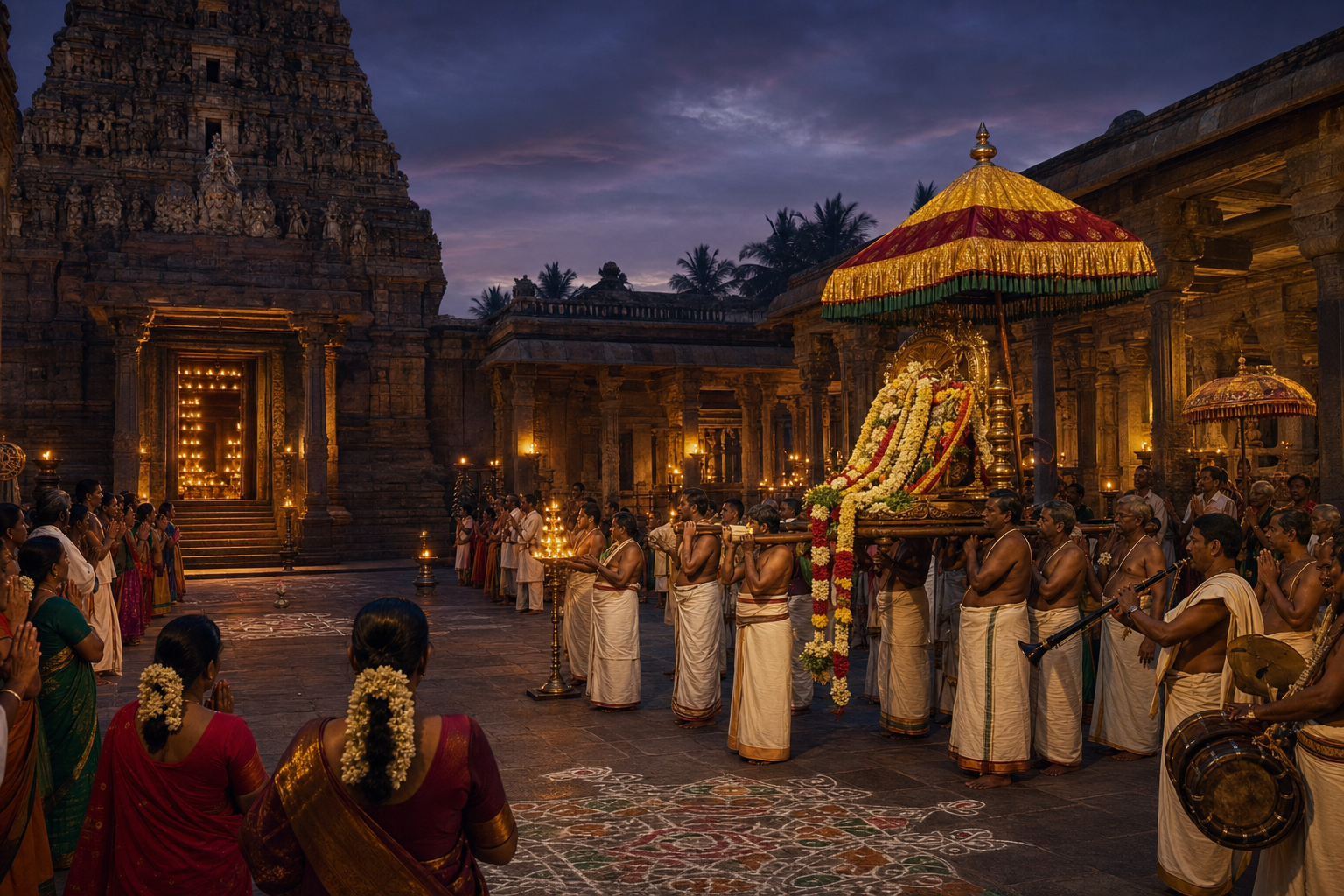
Living ritual does not mean casual improvisation. At Tirumala, continuity depends on precise repetition. The Vaikhanasa Agama governs daily and occasional worship through ordered acts such as abhishekam, alankaram, naivedyam and archana. Festivals then extend that disciplined sacred order into new times and spaces.
The distinction between the main icon and the festival icon is the clearest way to understand this structure. The Dhruva Beram is honored as a self-revealed stone image of Vishnu. The upper hands bear the chakra and shankha. The lower right hand offers the varada gesture, while the lower left rests near the hip. When you reach the sanctum, these are not decorative details to inventory. Notice the theological movement they create: cosmic authority above, accessible grace below, and a standing presence that does not abandon the world.
Malayappa Swamy, the utsava murti, performs another role. This is the form taken into processions, allowing darshan to move beyond the innermost precinct. The fixed icon establishes the center; the processional icon carries the relationship outward. Without that distinction, a procession can look like a ceremonial parade. With it, the route becomes an extension of temple space.
Sacred presence also travels through sound. The day begins with the Venkatesa Suprabhatam, composed in the 15th century by Prativadi Bhayankara Annan. The congregational cry of Govinda, Govinda gives thousands of separate pilgrims a shared devotional rhythm. Annamacharya’s sankeertanas continue this musical life in the temple and in homes. When you chant in a queue, do it as nama-japa rather than as crowd noise: keep the name steady, leave room for others and allow repetition to collect your attention.
Light, food and relationship give the same theology tangible forms. Kalyanotsavam ritually unites the Lord with Sridevi and Bhudevi. Sahasra Deepalankara Seva brings together a thousand lamps, music and movement. Sattvic preparations such as pongal, daddojanam, pulihora and laddus become prasadam after offering. The Tirupati Laddu received a Geographical Indication tag in 2009, but its devotional importance is not exhausted by provenance: it lets the sanctified offering leave the temple in the hands of the pilgrim.
Even queue management supports this living system. Free, special-entry and seva-linked pathways serve different groups amid very high footfall. A time slot or barricade can feel merely administrative, yet orderly movement protects access and safety. Choose the pathway appropriate to your circumstances, follow current instructions and resist treating proximity to the front as a measure of devotion.
Plan a devotional sequence, not a shrine-collection contest
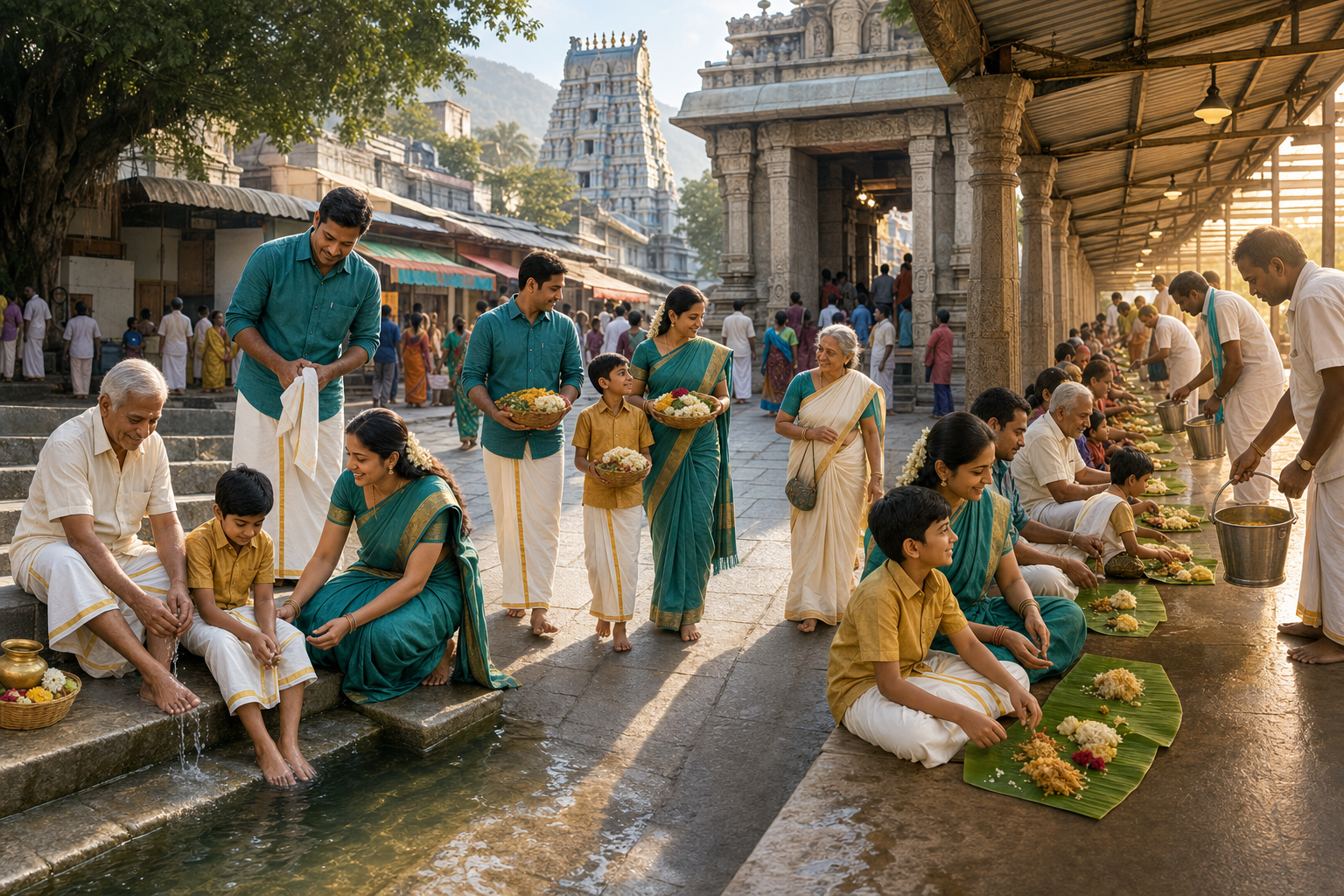
The following sequence is a practical framework, not a temple-mandated order. Your booked darshan, family needs and festival conditions may require a different route. What matters is that each stage prepares for the next.
- Name your sankalpa before solving the logistics. Decide whether you are going in gratitude, in fulfillment of a vow, in search of steadiness or simply to offer yourself without a demand. If your vow includes tonsuring, decide deliberately before entering the designated facility. The practice is traditionally associated with Neela Devi’s gift of hair and expresses surrender, but it is not an action to undertake because companions or crowd momentum pressure you.
- Use Tirupati to enter the sacred network. Visit Sri Govindaraja Swamy Temple before or after Tirumala as your reservations permit. Spend a few minutes noticing the relationship between the shrine, mandapams and surrounding streets. The city is not empty space below the holy hill; it is one of the places where temple culture meets household and civic life.
- Make the ascent an inner transition. As the journey passes through the seven-hill landscape, reduce unnecessary conversation and screen use. Repeat Govinda nama, listen quietly or hold your sankalpa. This simple boundary prevents the sanctum from arriving as an abrupt interruption in an otherwise distracted day.
- Move through Tirumala without manufacturing urgency. If access rules and your own circumstances permit purification at Swami Pushkarini, follow temple directions carefully. Otherwise, pause without pretending that a bath is compulsory. In the queue, chant without pushing, cooperate with volunteers and help children or elders remain with their families. During the brief darshan, look first toward the Lord rather than trying to retain every architectural detail.
- Let prasadam and annadanam complete the encounter. Do not treat the laddu as merchandise collected after the important part is over. Receive it as food that has crossed the boundary from offering to shared grace. Free sattvic meals likewise embody the principle that feeding devotees is service to the deity. Eat without waste and make room for the next pilgrim.
- Include Tiruchanoor when you want to understand the relationship with Sri. A visit to Sri Padmavathi Ammavari Temple is not a mechanical device for making darshan valid. It is a way of contemplating divine grace through Mahalakshmi’s presence and seeing how the Tirupati region joins multiple shrines into a coherent Vaishnava circuit.
If your time is limited, do not force every stop into one exhausting day. For a vow centered specifically on Venkateshwara, protect the Tirumala slot and the attention needed for it. If your purpose is to understand the sacred network, add Govindaraja and Padmavathi rather than maximizing the number of unrelated sanctums. During a major festival, following one procession attentively may teach you more than rushing through several queues.
A procession reveals what the network is for
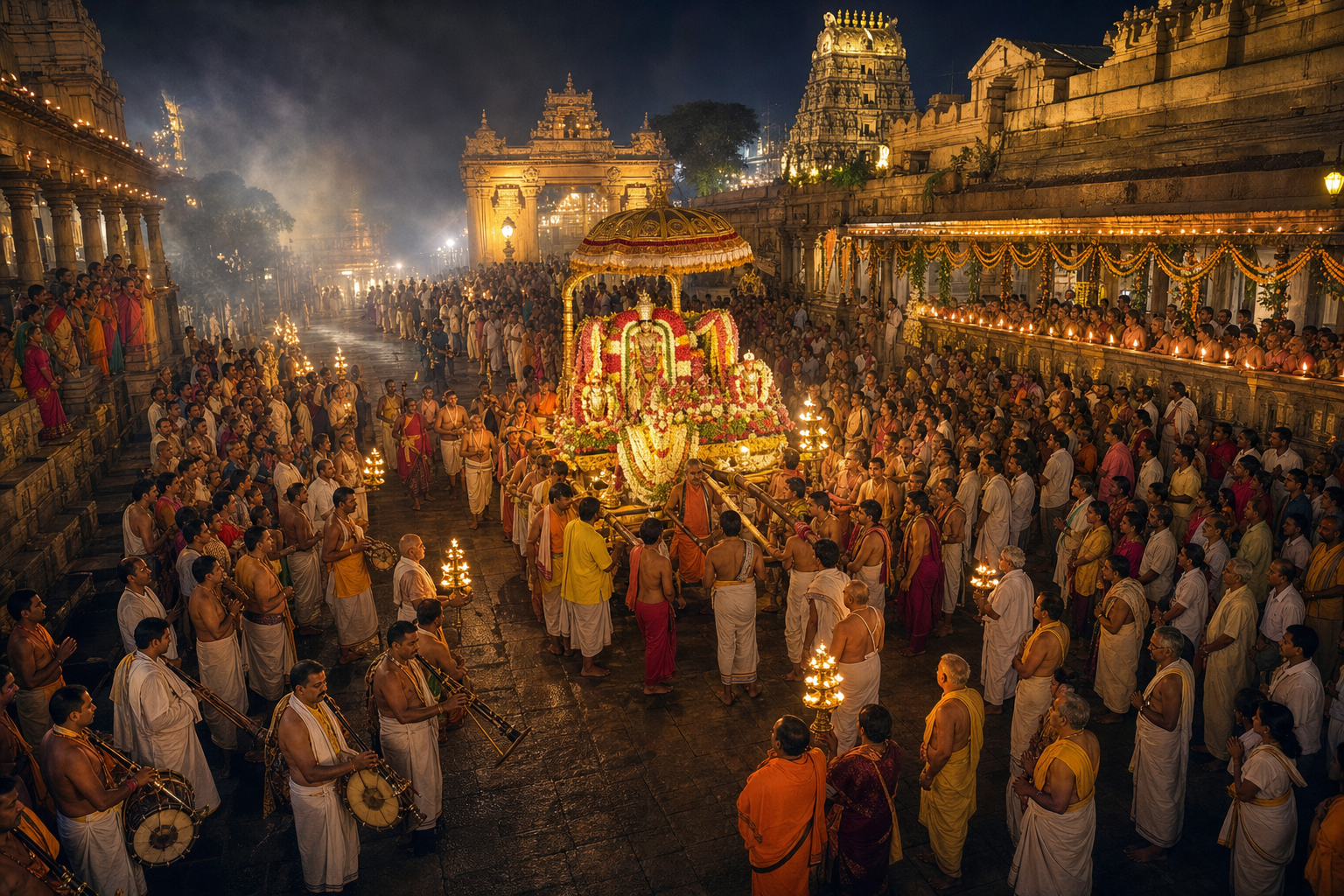
The Ponnakalva Utsavam offers a particularly clear example of ritual connection. For Chitra Pournami on 1 May 2026, Sri Govindaraja Swamy’s utsava murti was scheduled to leave the Tirupati temple at 6:00 AM, pause for Snapana Tirumanjanam at Ponnakalva Mandapam, and reach Sri Padmavathi Ammavari Temple in Tiruchanoor around 5:00 PM. That day’s times should not be reused for another observance; current temple announcements take precedence.
The important feature is the ritual grammar. The deity leaves the temple, receives worship at a processional pavilion and continues toward another major shrine. Ponnakalva Mandapam becomes a temporary point of concentration on the route. Snapana Tirumanjanam uses sanctified water, Panchamrita and fragrant substances in a cooling ceremonial abhishekam, accompanied by Vaishnava sacred sound. The street does not replace the sanctum. It becomes connected to it.
The concluding movement toward Padmavathi Ammavari makes theology spatial. Vishnu and Mahalakshmi are not presented as isolated objects of separate temple visits. The route places their complementarity before the community through motion, reception and reciprocal honor. A participant can therefore read the journey at three levels: the Lord comes within public reach, the city receives sacred presence, and two kshetras are shown to belong to one devotional world.
- Check the current date, departure point, route and expected arrival through the latest temple communication. Festival timing is event-specific.
- Arrive before the announced departure rather than trying to move alongside the palanquin from the most crowded point.
- Select a stable place along the route, stay behind barricades and leave passage for ritual personnel and emergency movement.
- Carry water and sun protection for a long daytime observance. Use a reusable bottle where permitted, and leave no litter on the processional route.
- Follow local directions about footwear and photography. Permission on a public stretch does not imply permission within a temple precinct.
- Make your conduct part of the seva: yield space to elders and children, avoid obstructing another person’s darshan and help visitors who do not know the local flow.
This last point is not secondary etiquette. A moving deity gathers a temporary community. Passing water, maintaining an orderly line and protecting another devotee’s view are ways of ensuring that public darshan remains genuinely public.
Key takeaways for a deeper Tirupati darshan
- Tirumala is the sacred center, but Tirupati and Tiruchanoor show how that center enters city life and relationship.
- The Dhruva Beram provides ritual stability; Malayappa Swamy carries divine presence into processions and shared space.
- Sound, water, light, food and movement are not accessories to darshan. Each gives you a distinct way to participate.
- Your itinerary should follow your sankalpa. A shorter, attentive pilgrimage is preferable to an overloaded circuit performed in haste.
- Prasadam, annadanam and considerate crowd conduct extend worship into material care for the community.
- Festival schedules change. Use historical timings to understand a ritual’s structure, never as a substitute for the current temple announcement.
Before your next visit, write a three-part plan: one sacred center where you will give undivided attention, one connection you will follow beyond that center, and one offering you will carry into ordinary life. The offering might be regular Govinda nama-japa, an Annamacharya sankeertana, feeding someone or serving another pilgrim without seeking recognition.
That is how you keep Tirupati from becoming a memory of queues and a fleeting glimpse. Enter the network with a clear sankalpa, let its ritual forms teach you how grace moves, and leave with one practice through which the movement can continue.
References
- DharmaRenaissance Blog — 29 Scholar-Verified Facts on Venkateshwara Swamy at Tirumala to Deepen Darshan
- DharmaRenaissance Blog — Ponnakalva Utsavam 2026: Chitra Pournami Procession at Govindaraja Swamy Temple, Tirupati