

If you are deciding when to pray, begin important paperwork, make an essential commitment, or arrange a family observance on May 8, the first fact to mark is the morning tithi change. Friday begins under Krishna Paksha Sashti, and Krishna Paksha Saptami takes over at about 8:24 AM in most regions.
That does not make every minute after 8:24 automatically auspicious. Your usable muhurta still depends on local sunrise and sunset, Friday’s avoidance periods, and the nakshatra, yoga, karana, and Moon sign operating in your locality. Here is how to turn those moving parts into a day plan without copying clock times from the wrong city.
Read the date in the right order
A tithi is not the same thing as a civil date. It is determined by the angular separation between the Moon and the Sun, with each 12-degree interval forming one tithi. The boundary can therefore occur at any time of day rather than at midnight. On May 8, the practical boundary is 8:24 AM: Sashti governs before it, while Saptami governs afterward.
The vara, or weekday, is Shukravar. Friday brings a Shukra-oriented emphasis on harmony, cleanliness, hospitality, beauty, and sukha. Krishna Paksha supplies the quieter background. It is generally better suited to japa, svadhyaya, pranayama, reflection, and unobtrusive seva than to unnecessary display. You can therefore preserve Friday’s gracious household mood without turning the waning fortnight into an occasion for excess.
Sashti and Saptami do not cancel one another; they divide the day’s emphasis. Sashti is commonly approached through restraint, concentration, and steady effort. Saptami supports clarity, discipline, and forward movement. If you have both contemplative work and practical work to complete, place the more concentrated inward practice earlier and the methodical outward work after the change.
Do not let regional month names create a false disagreement. Amanta calendars close the month at Amavasya, while Purnimanta calendars close it at Purnima. That changes the month label, not the tithi operating at a given moment. Whether your household follows an Amanta or Purnimanta convention, the Sashti-to-Saptami transition remains the scheduling fact that matters on this date.
Build your worship and work around the 8:24 AM change

| Part of the day | Panchang cue | Good practical use | What to verify |
|---|---|---|---|
| Around 96 minutes before local sunrise | Brahma Muhurta anchor | Meditation, japa, pranayama, quiet study, and sankalpa | Use your own city’s sunrise, not a standard 6:00 AM assumption |
| Before about 8:24 AM | Krishna Paksha Sashti | Disciplined sadhana, concentrated study, restrained preparation, and completion of a focused task | Check whether Gulika or another local restriction affects an elective beginning |
| After about 8:24 AM | Krishna Paksha Saptami | Clearing backlogs, orderly administration, necessary communication, and methodical progress | Saptami alone does not override Rahu Kalam, Yamaganda, Bhadra, or an unsuitable local combination |
| About 24 minutes on either side of local solar noon | Abhijit Muhurta | An urgent undertaking when a better tailored muhurta is unavailable | Check for overlap with Friday’s avoidance periods; many traditions do not use Abhijit for marriage |
The transition at 8:24 AM is a scheduling marker, not a promise that circumstances will suddenly change. If a task requires patience and concentration, you do not have to abandon it at the boundary. Use the change to decide when to begin an elective activity or where to place the day’s emphasis.
For a simple Friday observance, clean the puja space before worship, light a lamp with a clear sankalpa, and make a modest Lakshmi-oriented offering in keeping with your family tradition. Add an act of generosity that is concrete rather than ceremonial. These practices suit Shukravar while remaining compatible with Krishna Paksha’s inward tone.
Calculate Friday’s avoidance periods for your location
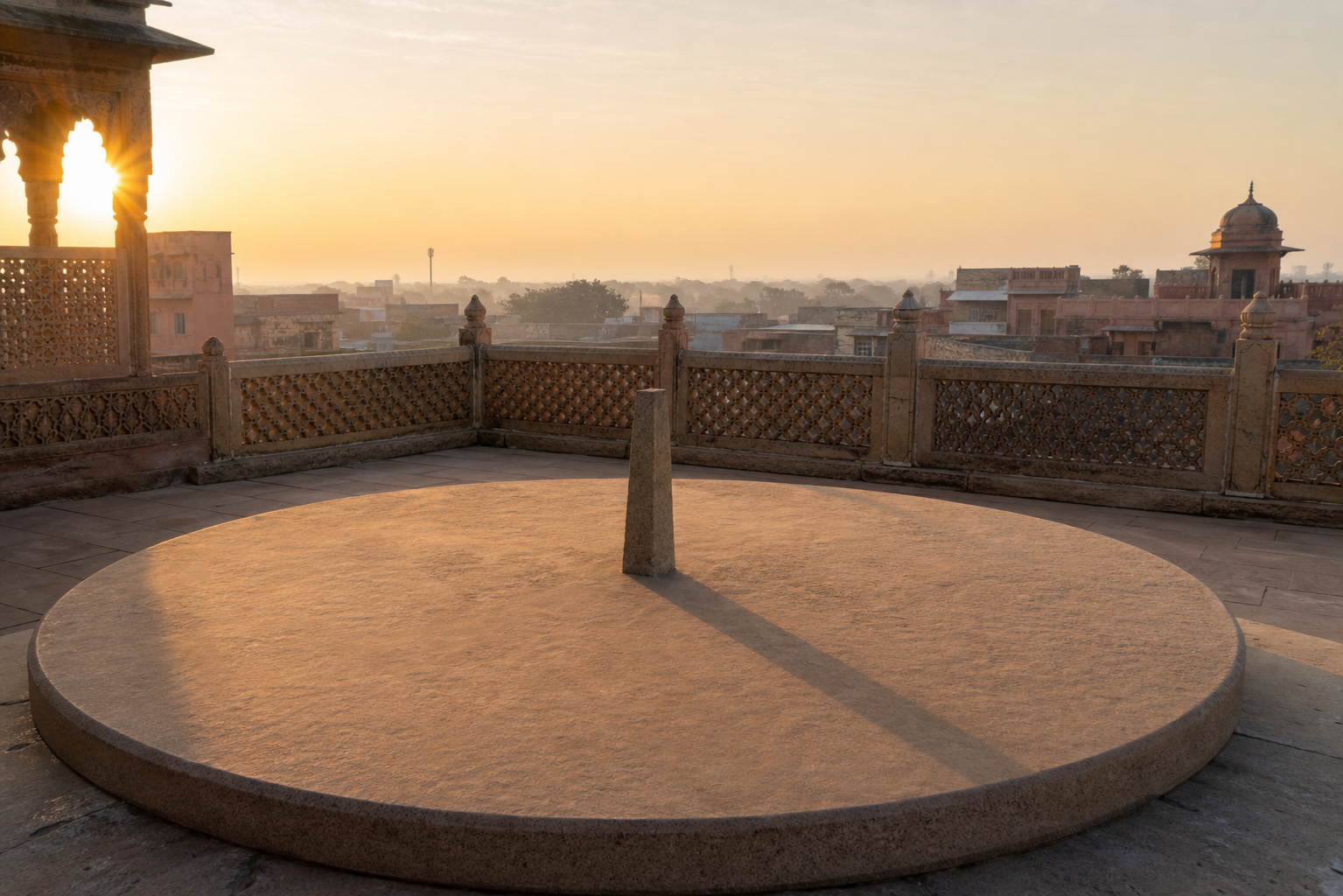
Rahu Kalam, Yamaganda, and Gulika Kalam cannot be assigned accurately from the date alone. Their clock times come from the local daylight interval. On Friday, Gulika occupies the second eighth of daylight, Rahu Kalam the fourth eighth, and Yamaganda the seventh eighth.
- Find the local sunrise and sunset for May 8, 2026. Use sunrise, not civil dawn, and keep both times in the same local time zone.
- Convert the sunrise-to-sunset span into minutes.
- Divide that total by eight. The result is the length of one daylight segment.
- Count eight consecutive segments beginning at sunrise.
- Mark segment 2 as Gulika Kalam, segment 4 as Rahu Kalam, and segment 7 as Yamaganda.
- Check any proposed muhurta against all three windows before fixing the start time.
For example, suppose sunrise were 6:00 AM and sunset 6:30 PM. The 12.5-hour day contains 750 minutes, so each eighth lasts 93.75 minutes. Rounded to the nearest minute, Friday’s Gulika would be about 7:34-9:08 AM, Rahu Kalam about 10:41 AM-12:15 PM, and Yamaganda about 3:23-4:56 PM. These are arithmetic examples only. They are not the May 8 timings for your city.
This calculation also shows why a generic noon recommendation can fail. In the hypothetical day above, solar noon falls near 12:15 PM, so an Abhijit window extending roughly 24 minutes on either side would partly overlap Rahu Kalam. One auspicious label should not make you ignore a conflicting avoidance period. If the matter is elective, choose a cleaner interval. If it is urgent, compare the full combination according to your sampradaya or obtain local guidance.
These periods are most useful as filters for selecting the start of a discretionary activity. Do not let them produce paralysis about routine duties, care work, ongoing worship, or something that cannot responsibly be postponed. The practical question is usually not whether you may act at all, but whether you can choose a more suitable moment to initiate the act.
Use Abhijit, Choghadiya, nakshatra, and karana together
Treat Abhijit as a fallback, not a universal override
Abhijit Muhurta is centered on local solar noon and extends for approximately 24 minutes on either side. It is a practical option for an essential action when a properly selected custom muhurta is unavailable. It should still be checked against Rahu Kalam and the other conditions active at that time. Marriage is a clear case where many traditions do not rely on Abhijit as a substitute for a tailored muhurta.
Use Choghadiya for ordinary scheduling
Choghadiya is particularly useful when you need to place a journey, conversation, purchase, submission, or other ordinary activity without commissioning a full electional calculation. Daylight and nighttime are each divided into eight Choghadiya periods. Amrit, Shubh, and Labh are generally preferred; Char is treated as neutral or movable; Rog, Kal, and Udveg are normally avoided for auspicious beginnings.
A favorable Choghadiya is one layer, not the whole decision. First reject an interval that falls inside a major avoidance period. Then compare the remaining windows by Choghadiya. For a consequential samskara such as griha-pravesh, continue to tithi-nakshatra matching rather than stopping after you find an Amrit, Shubh, or Labh label.
Localize the subtler Panchang limbs before a major rite
Nakshatra, yoga, karana, and the Moon’s rashi refine the quality of a prospective muhurta. Their changeover times depend on precise lunar and solar positions and on how the resulting astronomical instants appear in your local time. A location-neutral date cannot safely supply one universal clock window for them.
Before fixing a major ceremony, enter the correct city in a trusted Panchang and record the tithi end, nakshatra end, yoga, karana, Moon sign, sunrise, and sunset. Pay particular attention to Vishti karana, also called Bhadra. It is normally avoided for auspicious beginnings. If Vishti covers the only convenient period, use that time for study, preparation, planning, or internal practice and move the formal beginning when possible.
This is also where family and regional practice matters. The operative tithi does not change because one household uses an Amanta calendar and another uses a Purnimanta calendar, but traditions may differ in how they rank overlapping factors. For a wedding, griha-pravesh, or another major samskara, use the date plan to identify candidates and let a localized, tradition-aware calculation make the final selection.
Key takeaways for May 8, 2026
- Mark 8:24 AM as the practical Sashti-to-Saptami transition, then confirm the exact displayed time for your locality.
- Use the Brahma Muhurta anchor, around 96 minutes before local sunrise, for meditation, japa, pranayama, study, and sankalpa.
- Place concentrated and restrained work in the Sashti portion; use the Saptami portion for orderly progress, administration, and clearing pending tasks.
- Calculate Friday’s Gulika, Rahu Kalam, and Yamaganda from your own sunrise-to-sunset interval. Do not copy the clock times of another city.
- Use Abhijit near local solar noon for urgent general undertakings only after checking overlaps. Do not assume it is sufficient for marriage.
- For a major rite, verify nakshatra, yoga, karana, Moon sign, Choghadiya, and Bhadra rather than choosing from tithi alone.
Before May 8, write your city’s sunrise and sunset at the top of the day’s schedule, calculate the three Friday avoidance windows, and mark 8:24 AM. You will then have a usable framework for ordinary worship and work. If the event is a major samskara, take those local details to the trusted Panchang authority or priest who understands your family’s tradition before committing to the time.
References
