
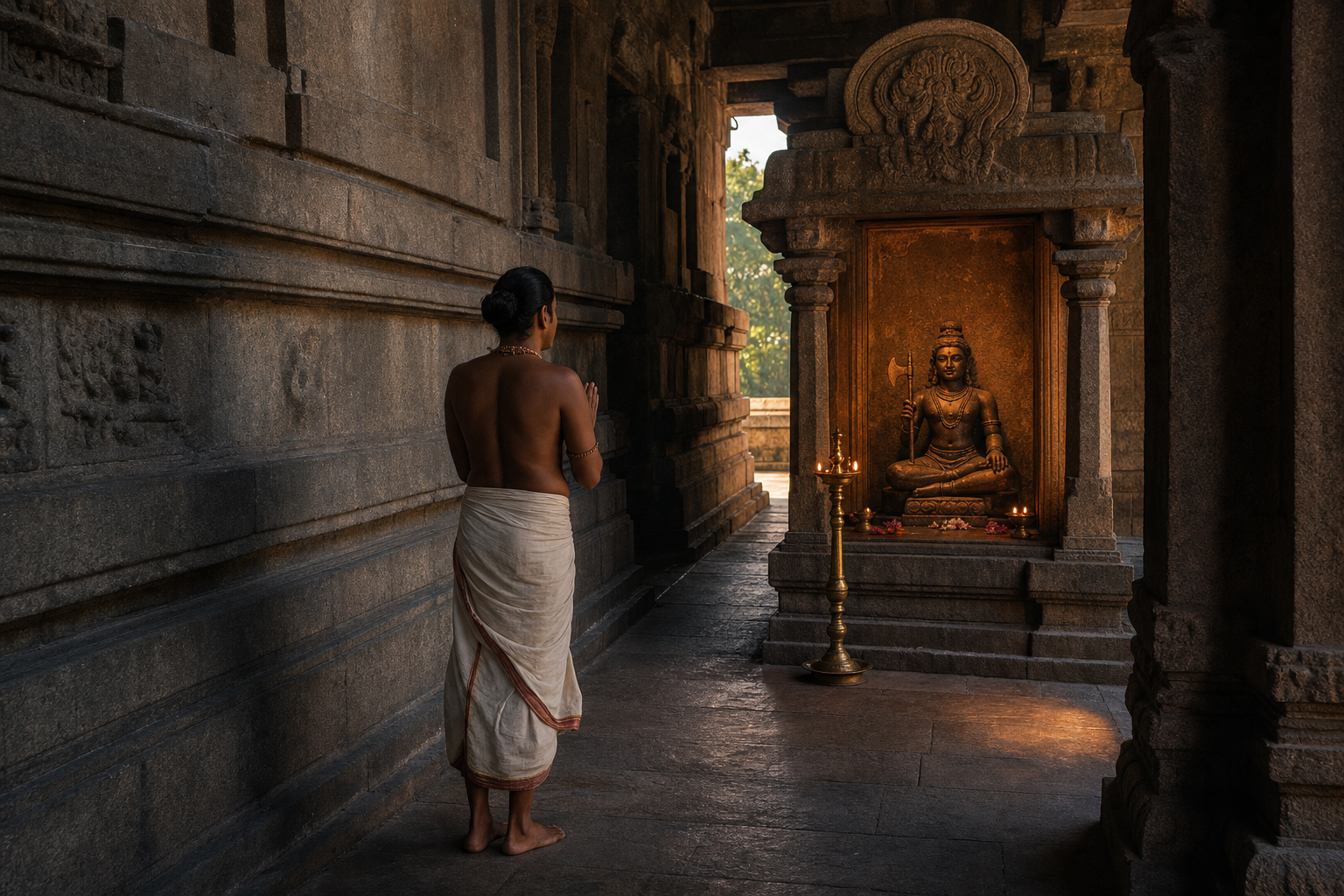
You have completed darshana of Shiva and begun your circumambulation when you notice a shrine on the northern side of the sanctum. The figure may hold an axe. Nearby devotees may snap their fingers or clap softly before moving on. Without Chandesha’s story, these details can look like minor customs at the edge of the main worship.
They are anything but minor. Chandesha stands where personal devotion becomes responsibility for what belongs to the deity. Once you know how to recognize him, his shrine changes the final moments of a temple visit: you are asked not only what you offered, but whether you can account for what was entrusted to you.
Key takeaways for your next temple visit
- Look for the independent Chandikeshvara shrine, usually situated to the north of Shiva’s sanctum. The vigilant figure may carry a parasu, or axe.
- Do not confuse that guardian image with Chandesha Anugrahamurti. The grace scene shows Shiva and Uma with Chandesha kneeling in anjali while Shiva touches, or nearly touches, his head.
- A restrained finger snap or gentle clap before Chandesha is associated with accounting for the Lord’s offerings, not with making a loud display.
- The narrative’s decisive movement is not from obedience to violence. It is from intense devotion, through Shiva’s healing grace, to disciplined custody of the sacred.
- Carry the ritual into practice by asking four questions: What was entrusted to me? For what purpose? Who has custody now? Can I account for the handoff?
The story asks what devotion becomes after the crisis
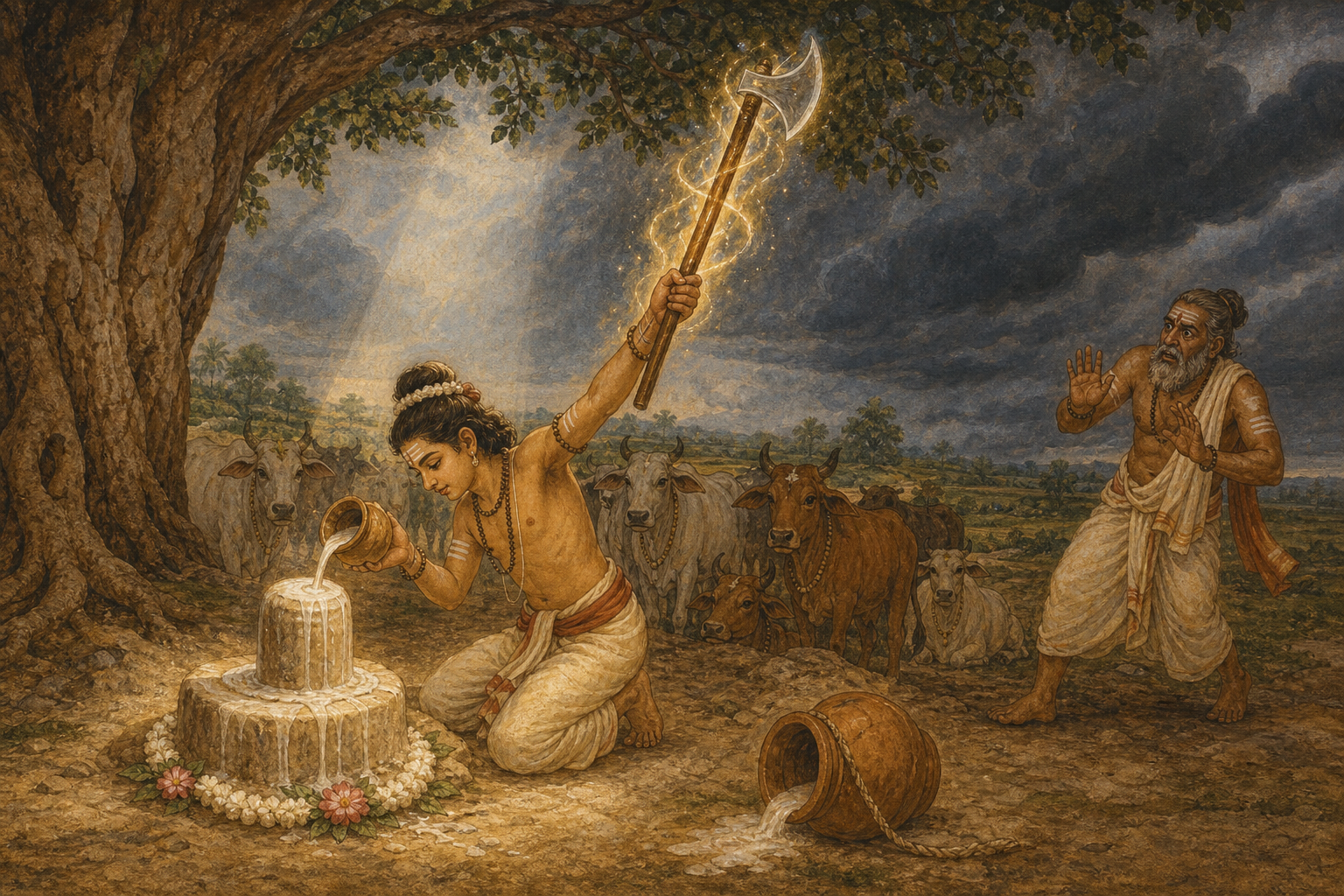
Before he became Chandesha, the young devotee was known as Vicharasarman. While tending cows, he formed a linga from sand and offered the cows’ milk to Shiva. His father saw waste where the boy saw worship. During the confrontation, Vicharasarman struck at his father; in some versions, his staff became a parasu and injured or severed the father’s foot. The precise injury varies across retellings.
That violent instant can dominate a hurried retelling, but it does not supply the narrative’s conclusion or its governing ethic. Shiva appears, restores the father, pardons the act and receives the devotee into his own service. Vicharasarman becomes Chandesha and is entrusted with guarding the Lord’s domain and property.
The order of those events matters. Shiva does not leave harm untreated. He heals before he commissions. Nor does Chandesha remain a solitary worshipper whose intensity answers only to itself. Grace places that intensity under divine authority and gives it a continuing duty.
This is why the episode should not be used to sanctify anger, family rupture or impulsive action in the name of faith. Its resolution moves in the opposite direction. The devotee who had defended an offering in a moment of crisis must now protect the sacred estate with sustained vigilance. Bhakti is recognized, corrected and made answerable.
You can use that sequence as an interpretive safeguard whenever the tale is told: look for restoration, divine judgment and the responsibility conferred afterward. If those elements are omitted, Chandesha has been reduced to the most dramatic moment rather than understood through the office Shiva gives him.
Recognize the guardian image and the grace scene
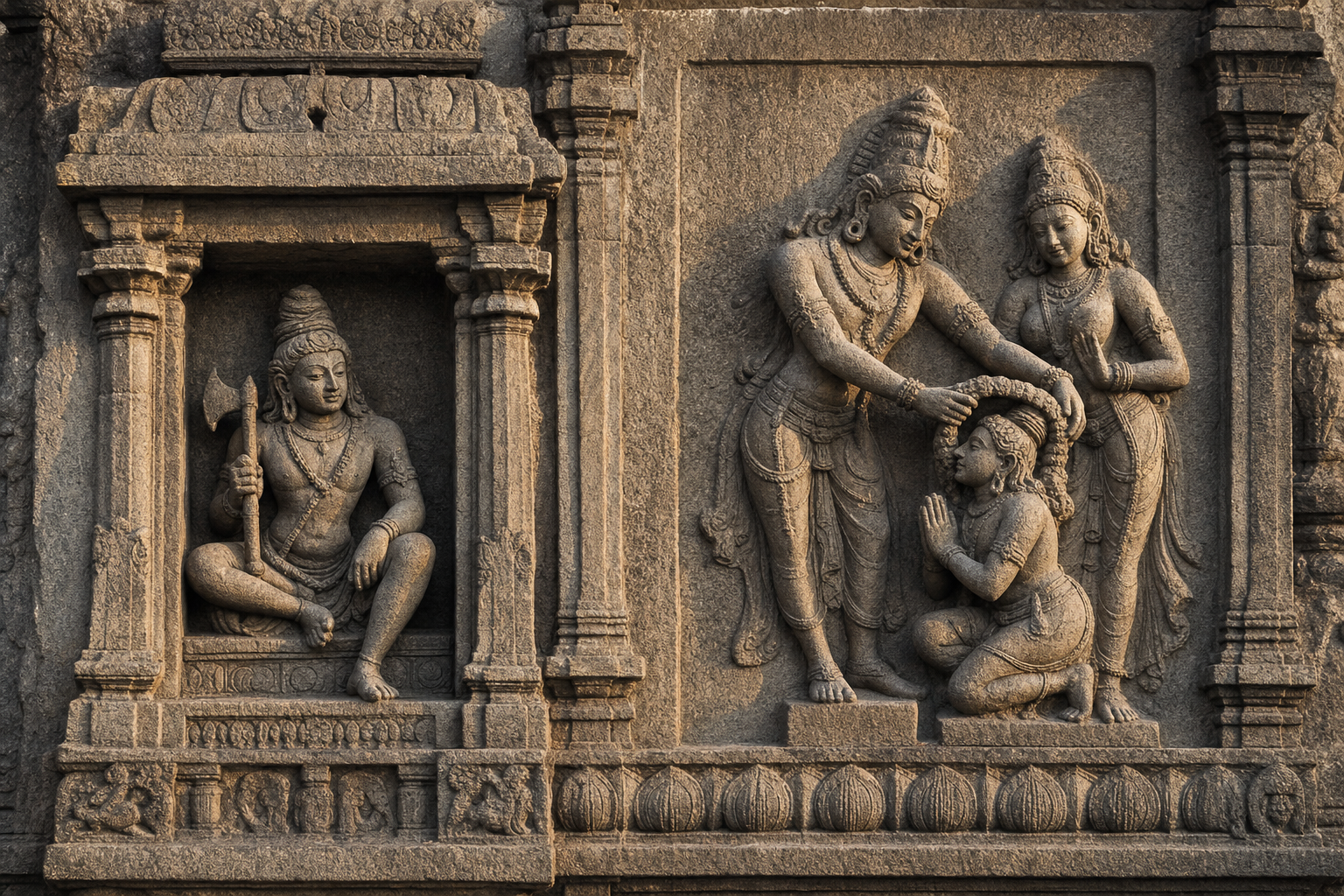
Chandesha commonly appears in two related but visually distinct forms. One shows him already established as Chandikeshvara, the vigilant guardian. The other shows Chandesha Anugrahamurti, the moment in which Shiva bestows grace and authority. Identifying the form first prevents many mistakes about what a particular sculpture is communicating.
| What you are seeing | Most reliable visual cue | What the image emphasizes | Where to look |
|---|---|---|---|
| Independent Chandikeshvara | A youthful but watchful figure, often with a parasu | Custody, vigilance and protection of the Lord’s property | A discrete shrine, usually north of Shiva’s sanctum |
| Chandesha Anugrahamurti | Chandesha kneels in anjali as Shiva’s hand rests on or just above his head; Uma completes the group | Grace, acceptance, authorization and investiture | A narrative relief, sculptural program or bronze composition |
| Somaskanda | Shiva and Uma are presented with the child Skanda | The divine family | Shaiva sculptural and iconographic settings |
In a dense temple wall, begin with the relationship between the figures rather than with jewelry or individual attributes. Find the kneeling devotee. Confirm that his hands are joined. Then look at Shiva’s right hand. In the Chandesha grace scene, it reaches toward the crown of the devotee’s head in a personal act of blessing. This is more specific than a general boon-bestowing gesture directed outward.
Shiva may be seated comfortably beside Uma or stand in a composed tribhanga. The other hand can convey boon-giving or assurance. Canonical signs may include the piled jata-makuta, crescent moon, Ganga and third eye, with such attributes as the trishula or antelope. Uma’s calm presence gives the investiture the character of admission into a divine household. Ganas or a makara-torana may frame the moment, but these supporting details are less decisive than the kneeling posture and the blessing at the head.
The contrast between Chandesha’s two forms is deliberate. Folded hands place surrender at the center of the anugraha scene, while the axe marks the vigilance of the independent guardian. Anjali without the later office would make devotion passive. The axe without anjali would make authority look self-generated. Seen together, they show that the right to guard follows the willingness to receive grace and duty.
You can also read the image historically. Kanchipuram’s Kailasanatha Temple preserves a Pallava treatment from the late seventh to early eighth century. Chola artists developed the subject further in stone and panchaloha bronze between the tenth and twelfth centuries, refining posture, gesture and the quiet exchange between deity and devotee. Thanjavur’s Brihadeeshwara Temple and Gangaikondacholeesvarar Temple belong on a route for seeing how Chola Shaiva programs joined worship, royal-scale temple culture and the moral language of service.
When you visit, examine reliefs along the devakoshtas and prakara walls as well as the independent northern shrine. Do not identify every kneeling attendant as Chandesha. Require the full visual grammar: Shiva and Uma, the devotee in anjali, and Shiva’s hand conferring grace at the head.
Why Chola artists made stewardship visible
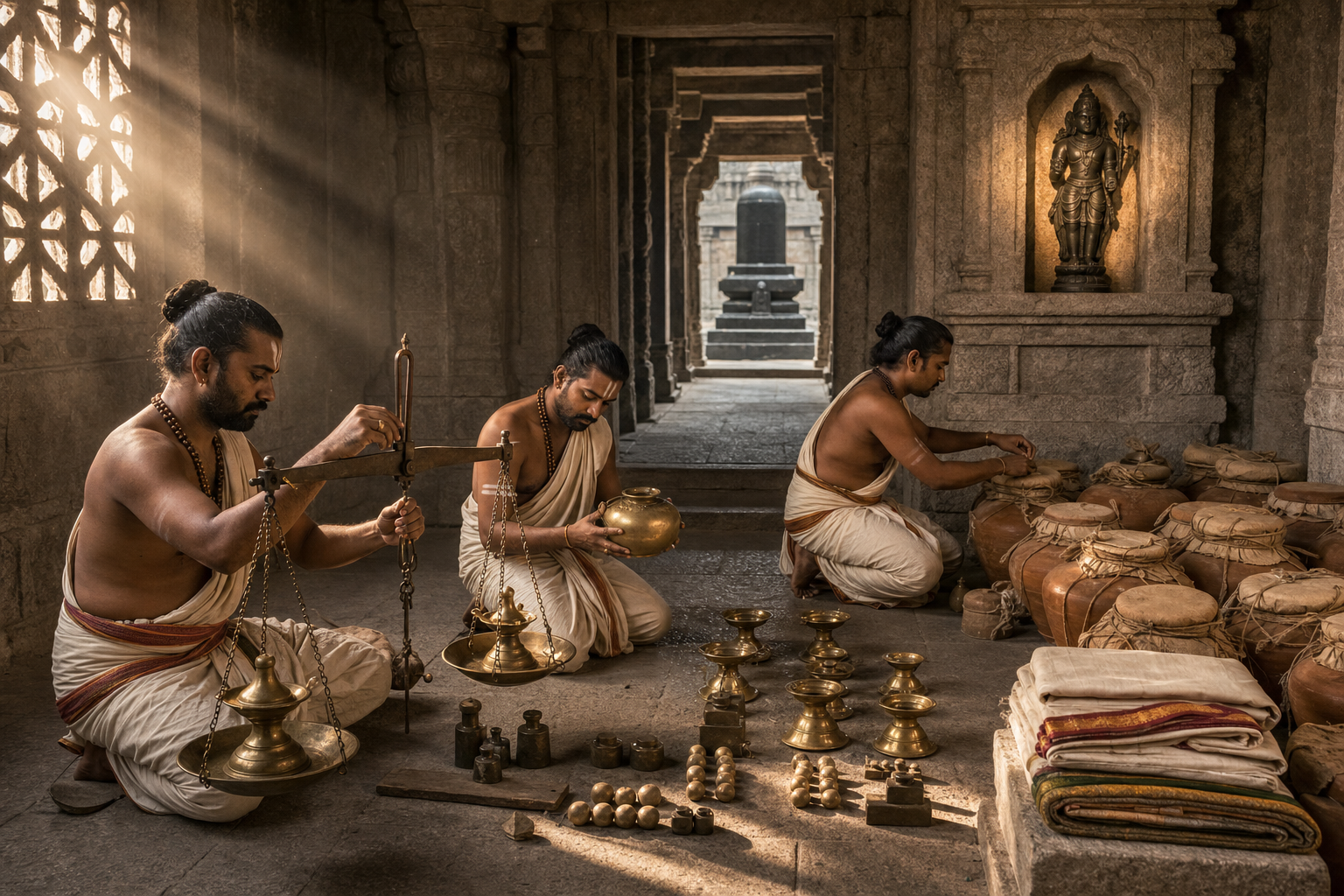
The Chola achievement is not simply that artists represented a popular devotee with technical elegance. They turned an administrative and ethical relationship into a devotional image. Chandesha receives something intimate from Shiva, but that intimacy authorizes an office concerned with the deity’s estate. The sculpture therefore joins a private spiritual event to the public order of the temple.
One touch carries three meanings
Shiva’s hand upon Chandesha’s head can be read through three connected ideas:
- Adoption: Chandesha is accepted into the divine household. His belonging no longer depends on the approval he lacked during the conflict at home.
- Authorization: Guardianship is not seized by the devotee. Shiva entrusts it to him, defining the authority as delegated rather than personal.
- Initiation: Grace recognizes disciplined devotion while directing it toward an enduring form of service.
These meanings keep grace from becoming mere emotional reassurance. Shiva’s blessing answers devotion by creating an obligation. Chandesha is not only seen by the deity; he is trusted with what belongs to the deity.
Bronze makes the transfer of responsibility tactile
In Chola panchaloha images produced through lost-wax casting, the theology is carried by space as much as by ornament. Smooth bodily planes, finely finished details and the carefully balanced gap around Shiva’s extended hand direct your eye to the near-contact with Chandesha’s head. Grace is made physically imminent.
Pause over that small interval when you see the composition. The scene’s authority does not come from a throne, weapon or proclamation. It passes through a measured gesture. The guardian’s later severity is grounded in a moment of receptivity.
This also explains why Chandesha occupies a different narrative space from Somaskanda or from anugraha images centered on miraculous rescue and cosmic power. The devotee, not the divine child, stands at the center of the relationship. What is formalized is not rescue from a single danger but fitness for continuing service within the sacred domain.
Turn the shrine ritual into an accountability practice
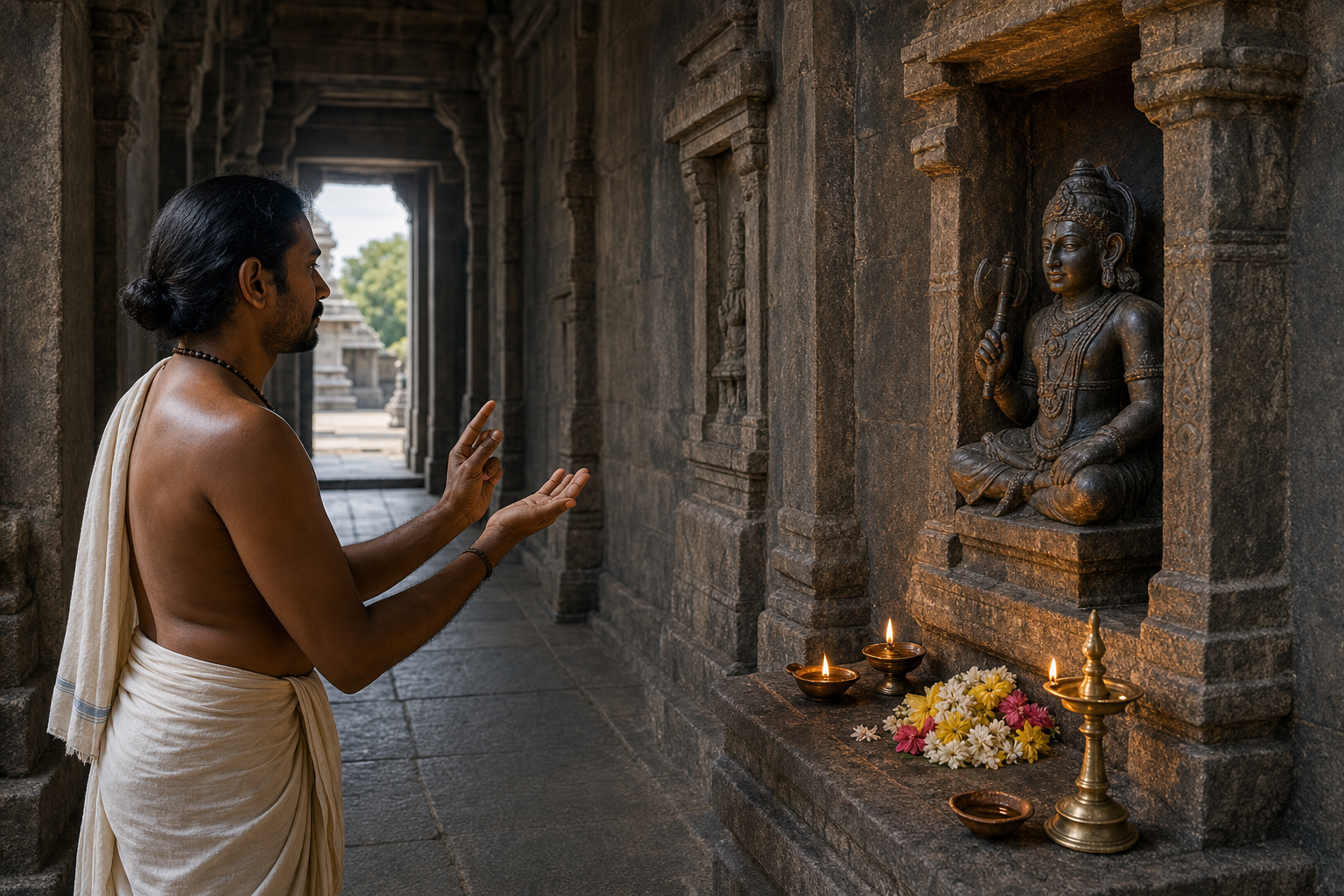
Chandesha’s custodial role continues in the order of living temple worship. After offerings have been made to the principal linga, their remnants are presented to Chandesha. Devotees may then snap their fingers or clap gently before him. Within this ritual logic, the restrained gesture signals that nothing belonging to Shiva has been concealed or withheld.
Keep the gesture proportionate to that meaning. It is an act of accounting before a vigilant custodian, not a performance meant to dominate the shrine. Observe what the temple’s priests and regular devotees do, because local practice determines the appropriate physical form. If a gesture is made, a quiet snap or gentle clap is enough.
The more demanding part happens after the gesture. Before leaving Chandesha, conduct a short inventory:
- Name what was entrusted. This may be money, materials, food, access, time, information or responsibility.
- Name its intended purpose. An offering dedicated to one sacred use does not become available for whatever is personally convenient.
- Identify its present custodian. If you handed it to someone else, be able to say to whom and in what condition.
- Account for what remains. Return unused items, complete the promised task or disclose a discrepancy instead of hiding it behind devotional language.
This four-question discipline scales to your role. A devotee should follow temple instructions for offering remnants rather than assuming that sacred materials are free to take or redirect. A volunteer should make a clear handoff instead of leaving entrusted items unattended or relying on an unrecorded assumption. A committee member should be able to distinguish personal generosity from personal control over a collective resource.
A ritual gesture is not an audit, and reverence does not replace records, permissions or transparent custody. Chandesha’s relevance lies precisely in refusing that separation. If an offering is sacred, its handling deserves more care, not less. If service is devotional, the servant should welcome a clear account rather than treat questions as an insult.
This is the Chola temple ethic compressed into one relationship: surrender qualifies power, grace creates duty, and custody must remain answerable to the purpose for which it was given. It offers a useful test whenever religious enthusiasm and institutional responsibility seem to pull apart. Ask whether the devotion in question produces more trustworthy stewardship. If it excuses concealment, arbitrary control or neglect, it has moved away from Chandesha’s office.
On your next visit to a Shiva temple, do not let the northern shrine become an absent-minded final stop. Locate Chandesha, distinguish the axe from the folded hands, and leave with one concrete account settled: an item returned, a handoff clarified, a promise completed or a responsibility honestly acknowledged.