
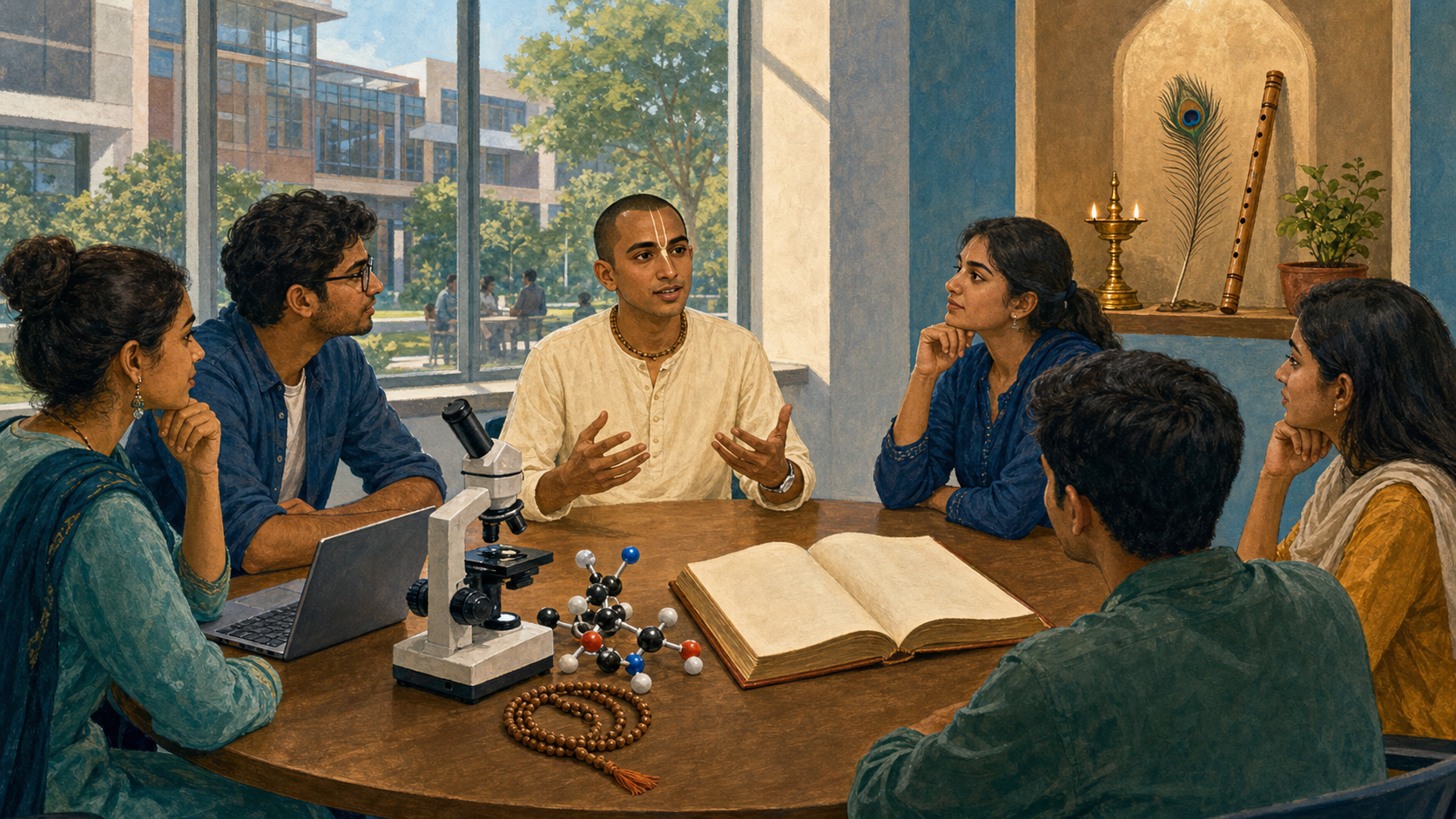
You may be teaching Krishna-bhakti on a campus, managing a temple’s digital outreach, or answering a young person who assumes religion and science cannot share a room. The pressure usually produces a false choice: soften the siddhanta until it sounds secular, or answer every scientific question with a scriptural quotation.
Neither choice serves bhakti. You can communicate with intellectual honesty while remaining unmistakably Vaishnava. The practical key is to separate different kinds of claims, match each claim with the right kind of support, and place modern tools under devotional discipline.
The scientific age changes the burden of speech
Living in a scientific age does not mean that everyone is a scientist. It means that educated audiences have learned to ask certain questions: What exactly do you mean? How do you know? Can the claim be checked? What evidence would count against it? A serious Vaishnava mission should welcome those questions. Precision is not hostility to faith.
Scientific inquiry is powerful because it works within defined limits. It investigates questions that can be approached through observation, measurement, comparison, and repeatable reasoning. That strength is also a boundary. A laboratory can investigate measurable effects of a practice; it cannot use the same procedure to settle every question about consciousness, value, divine personhood, or the ultimate purpose of existence.
This boundary rules out two common shortcuts. The first is to declare that science has proved Krishna whenever a scientific finding appears compatible with a Vaishnava teaching. Compatibility is not identity, and an analogy is not proof. The second is to assume that only measurable things can be real. That assumption is a philosophical position, not a result produced by laboratory measurement.
Your job is not to force science and theology into one vocabulary. It is to tell the audience which question is being considered, what kind of answer is being offered, and why that answer deserves attention. This lets you present settled Vaishnava teaching, or siddhanta, without disguising it as an experimental result.
Separate the claims before defending them

Many weak presentations of dharma fail because a single sentence quietly combines several different claims. Before publishing a lecture, video, essay, or course, classify its important statements by the kind of warrant they require.
- Publicly checkable claims concern matters such as history, manuscripts, observable behaviour, or measurable outcomes. They require evidence appropriate to the field. If you claim that chanting produces a particular cognitive effect, the sacred status of chanting does not by itself establish that measurable result.
- Philosophical claims concern consciousness, causation, knowledge, personhood, and the limits of material explanation. They require explicit premises and sound reasoning. An unanswered scientific question is not automatically evidence for a preferred metaphysical conclusion.
- Theological claims state what the Vaishnava tradition teaches about Krishna, the jiva, bhakti, the holy name, grace, or liberation. Present these through scripture and guru-parampara. Do not apologize for their theological character, but do not advertise them as chemistry or neuroscience.
- Experiential claims describe what a practitioner notices through chanting, study, worship, or seva. Such experience can be deeply significant to the practitioner without functioning as automatic public proof. Offer a disciplined practice and an honest invitation, not a guaranteed result.
Consider the claim that chanting proves consciousness is non-material. As written, it jumps from a devotional practice to a philosophical conclusion and gives the impression of scientific demonstration. A clearer presentation separates the ideas: Vaishnava siddhanta teaches that the conscious self is not reducible to the body; chanting is a prescribed means of devotional realization; and any claim about a measurable effect of chanting must be assessed independently.
This separation does not make the teaching weaker. It prevents the listener from discovering, halfway through the discussion, that the word “evidence” has changed meaning without warning.
A simple editorial method is to mark important sentences as checkable, philosophical, theological, or experiential. If a sentence receives several labels, split it. Then ask whether each resulting statement has the support proper to its category. This small discipline catches exaggerated headlines, arguments from ignorance, vague scriptural appeals, and personal testimony presented as a universal law.
Use yukta-vairagya as a test, not a slogan
A.C. Bhaktivedanta Swami Prabhupada, known earlier as Abhay, combined disciplined Vaishnava formation with education in chemistry and economics, the instruction of Bhaktisiddhanta Sarasvati Thakura, and sannyasa under Bhaktiprajnana Kesava Maharaja. His devotional authority did not come from a scientific credential, and his modern education did not replace guru-parampara. The capacities served different roles within one mission.
His acceptance of sannyasa also shows why renunciation should not be confused with withdrawal. It concentrated responsibility. Conviction that strength descends through Krishna’s grace led to more disciplined human effort: writing, translation, public teaching, kirtana, publication, and community-building. Instrumentality meant becoming more accountable to the work, not waiting passively for a miraculous outcome.
That is the operational meaning of yukta-vairagya. Modern instruments may be engaged in seva without allowing their incentives to redefine the mission. “Use everything for Krishna” is therefore incomplete unless you also ask how the tool is shaping the user.
- Purpose: What act of teaching, worship, care, or service will this tool make possible?
- Formation: Does its use cultivate attention and responsibility, or habitual distraction, vanity, and outrage?
- Truthfulness: Does the medium pressure you toward a stronger claim than the evidence or siddhanta supports?
- Accountability: Who reviews errors in quotations, translations, scientific statements, and theological conclusions?
- Dependence: Can the community preserve its teaching, contacts, and archives if a commercial platform changes its rules or disappears?
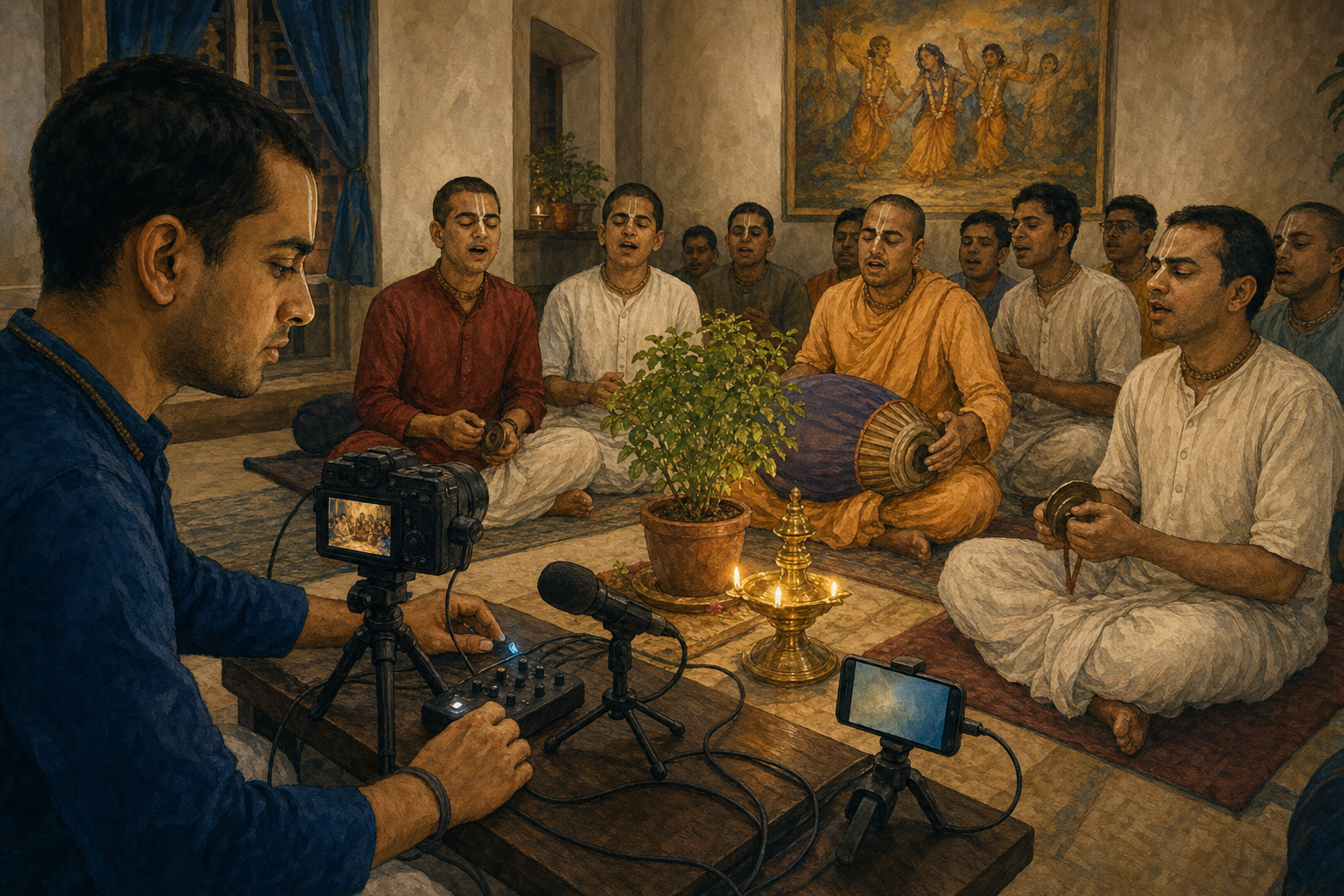
Apply this test before celebrating reach. A video platform can distribute kirtana across borders, but a devotional subject does not sanctify a sensational title. Compare every title with the actual teaching. If the title promises scientific proof while the presentation offers only resemblance or analogy, rewrite the title.
The same rule applies to automated writing, transcription, translation, and indexing. Treat an automated system as an assistant, not as an acharya. A competent human reviewer should verify names, transliteration, verse attribution, context, and conclusions before publication. Speed is useful; it is not spiritual or scholarly authority.
Analytics also need their proper place. Views and impressions describe distribution. They do not measure realization, purity of motive, or faithfulness to parampara. A mission can examine whether people return for study, ask sincere questions, join practice, or undertake service, but it should never turn those signs into a numerical claim about another person’s inner life.
Build a mission that can correct itself

A mission in the scientific age needs more than a persuasive speaker. It needs habits that make fidelity, inquiry, practice, service, and correction repeatable. Charisma may attract attention, but a durable mission cannot depend on the assumption that one teacher is equally qualified in theology, physics, biology, history, psychology, and digital media.
- Textual fidelity: Distinguish the words of a primary text, the explanation received through parampara, and your present application. A listener should be able to tell when you are quoting the Bhagavad Gita or Bhagavata Purana and when you are offering an interpretation.
- Reasoned explanation: State the actual argument. Avoid using technical scientific language merely to make an old analogy sound experimentally established.
- Devotional practice: Let people encounter bhakti as practice through hearing, chanting, study, prasada, and seva. An intellectual defence of bhakti should lead toward devotional life rather than becoming a substitute for it.
- Competent review: Let a knowledgeable Vaishnava examine theology and let someone qualified in the relevant discipline examine specialised factual claims. When those competencies do not reside in the same person, independent review is a strength.
- Visible correction: Keep a clear route for questions and corrections. When a factual error is found, amend it openly instead of protecting the speaker’s prestige. Correction demonstrates that truth is more important than performance.
- Institutional memory: Preserve source notes, translation decisions, recordings, curricula, and contact routes under community stewardship. The mission should survive a change of speaker, platform, or fashion.
This structure also improves relationships across the Dharmic family. Vaishnavas can recognize the Sikh emphasis on seva and humility, Jain commitments to ahimsa and aparigraha, Buddhist cultivation of disciplined sangha and compassion, and the yogic principle of ishvara-pranidhana without pretending that all doctrines are identical. Shared ethical ground makes cooperation possible; honest differences preserve the integrity of each path.
The same balance should govern engagement with universities and professional communities. Enter academic settings prepared to define terms, cite checkable facts, acknowledge the limits of an argument, and hear objections in their strongest form. At the same time, do not hide Krishna-bhakti beneath generic language about wellness merely to gain acceptance. Cultural adaptability concerns intelligible expression. It does not require theological erasure.
Audit your next public teaching before it goes live
Use the following audit on a real lecture, webpage, flyer, or video script. An actual item will expose habits that an abstract discussion cannot.
- Identify the largest outward-facing claims. Pay special attention to sentences containing words such as “proof,” “science,” “always,” “impossible,” or “everyone.”
- Classify each claim as publicly checkable, philosophical, theological, or experiential. Split any sentence that moves between categories.
- Repair the support. Add suitable evidence to checkable claims, show the reasoning behind philosophical claims, connect theological claims to scripture and parampara, and frame experiential claims as testimony or invitation.
- Remove arguments that depend on a temporary gap in scientific knowledge. A Vaishnava conclusion should not collapse merely because a new material mechanism is discovered.
- Check the medium. Make sure the title, thumbnail, short excerpt, and social caption do not promise more than the full teaching delivers.
- Arrange competent review wherever the material crosses into a specialised discipline. Devotional sincerity does not remove the need for technical accuracy.
- Make the practice visible. Tell the interested person what hearing, chanting, study, association, or service actually involves instead of ending with an abstract victory over an opponent.
- Provide a path for questions and corrections, and keep the final material in an archive controlled by the mission rather than solely by a platform.
Key takeaways
- The scientific age raises the standard of clarity; it does not require dilution of Vaishnava siddhanta.
- Empirical, philosophical, theological, and experiential claims need different forms of support.
- Yukta-vairagya asks whether a modern tool is governed toward seva, not merely whether it can distribute devotional content.
- Reliance on Krishna’s grace and disciplined human effort are complementary when the devotee understands service as instrumentality.
- A credible mission preserves parampara, welcomes qualified scrutiny, offers actual practice, and corrects factual mistakes without defensiveness.
Begin with the sentence in your current outreach that makes the biggest claim. Classify it, support it with the right kind of warrant, and rewrite it if it promises more than you can show. Then make the devotional invitation clearer, not weaker. That is how a Vaishnava mission can speak confidently in a scientific age without borrowing authority it does not need.
References
- Dandavats — Harnessing Divine Strength: How a Vaishnava Visionary Married Bhakti with Modern Science