
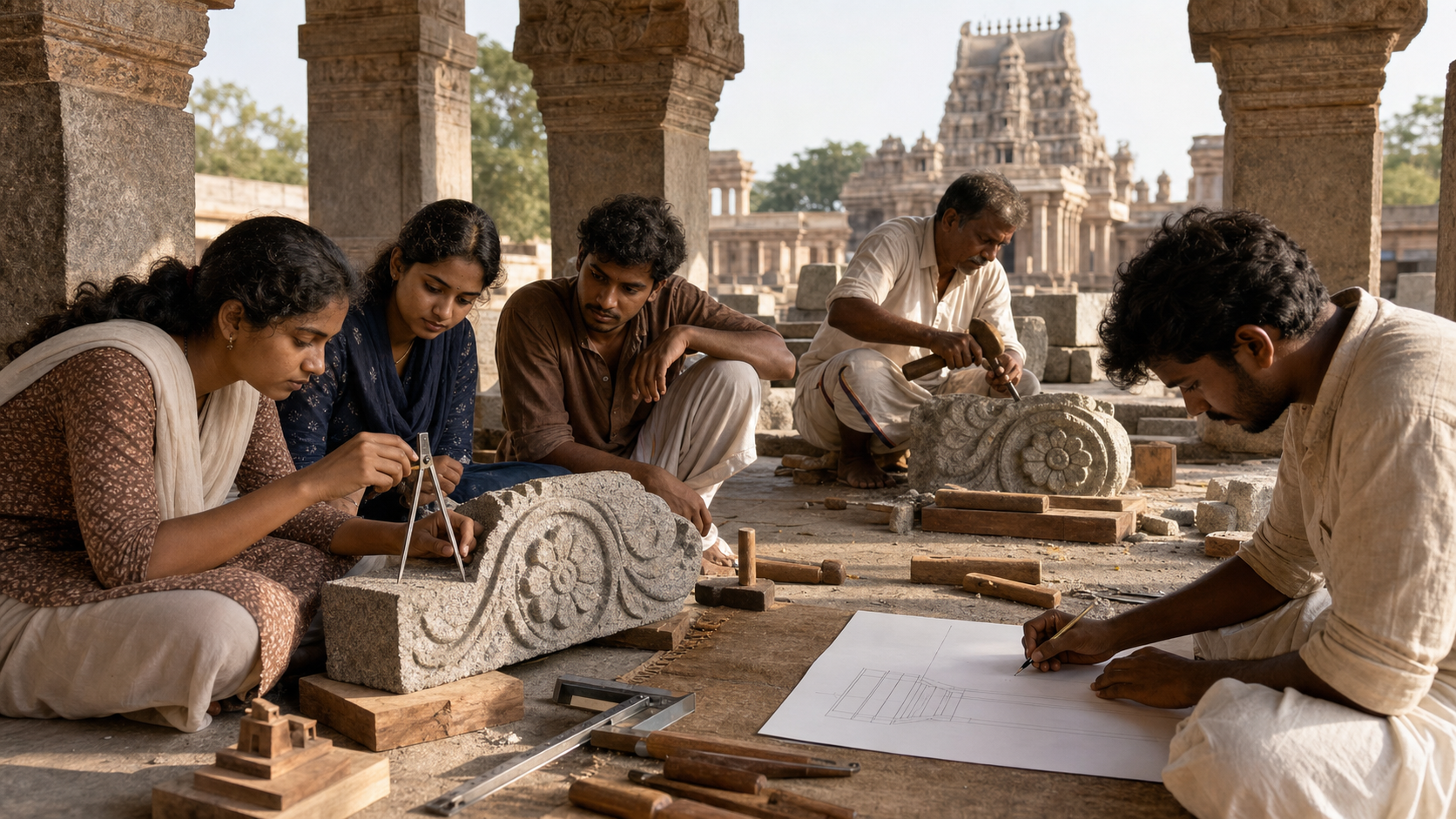
You may love temples, draw well, or feel called to preserve a sacred inheritance. The harder question is whether you want to convert that interest into years of measured drawing, material practice, textual study, correction, and service.
That decision is immediate for prospective students in 2026. The Sri Venkateswara Traditional Temple Architecture & Sculpture College intake offers two routes in Tirupati: a four-year Diploma and a two-year Certificate. Class 10 graduates may apply from 4 May through 20 June 2026, and selected students receive free accommodation. Here is how to choose a route, judge your fit, prepare for the work, and apply without making assumptions the admission notice does not support.
Choose the depth of training before you choose the credential
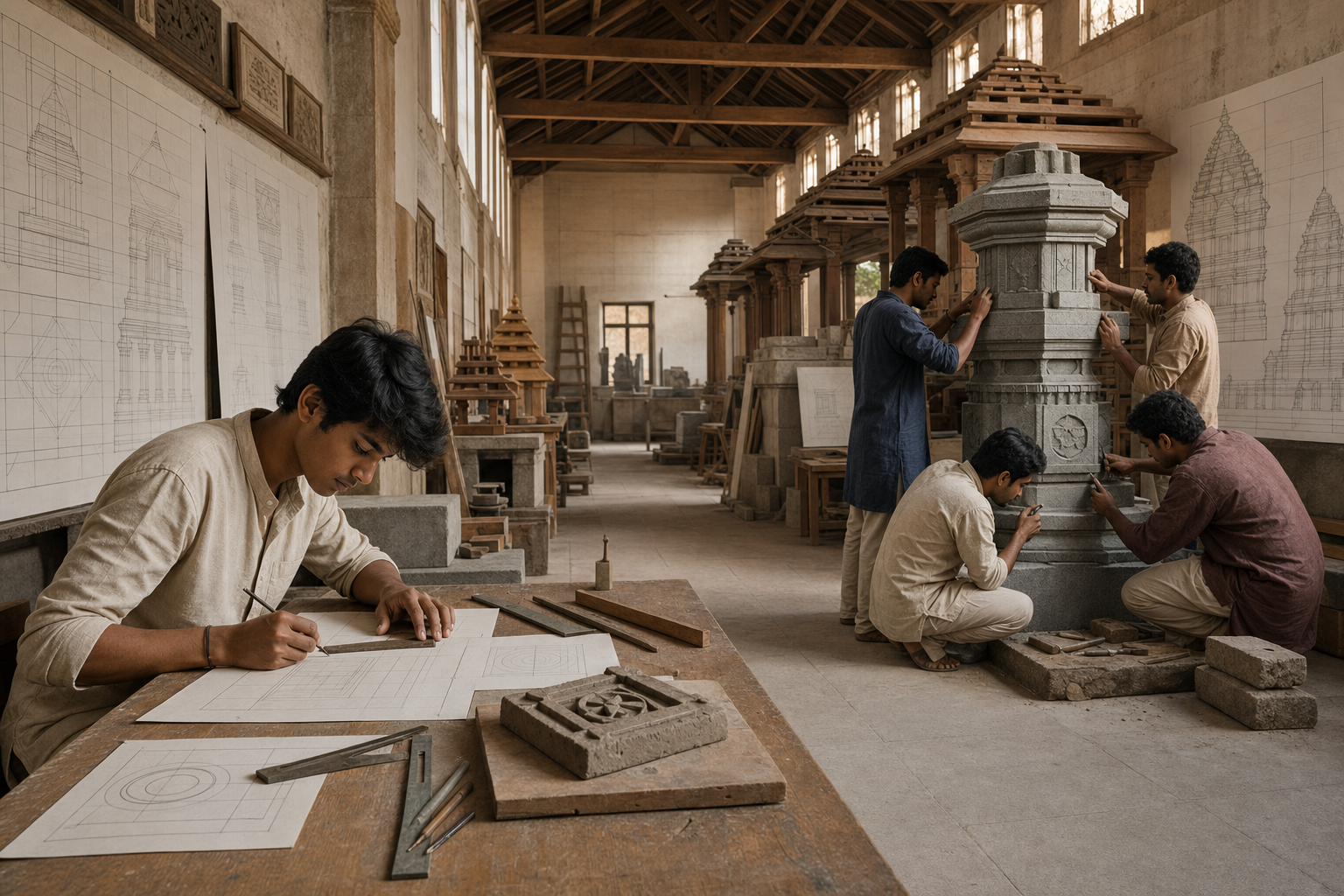
The Diploma and Certificate are not interchangeable versions of the same commitment. Both concern traditional architecture and sculpture, but they lead you into the field at different depths. Make the decision around the craft you want to practise, not the shortest route to a qualification.
| Route | Training emphasis | Choose it when |
|---|---|---|
| Four-year Diploma | Comprehensive study with extended time for hand skills, geometry, canonical principles, design, and sculpture | You want sustained preparation for temple design, sculptural practice, conservation work, or a long-term artisan career |
| Two-year Certificate | A concentrated foundation in drawing, materials, and sculptural basics | You want core competencies before entering artisan practice, seeking an apprenticeship, or considering further study |
Choose the Diploma if you already know that you want the repeated practice required for precise design and carving. Its value lies in the extended period available for developing judgement as well as technique. Choose the Certificate if you need a serious foundation but cannot yet commit to the longer route.
Do not assume that completing the Certificate will automatically shorten, replace, or transfer into the Diploma. That progression is not established by the available admission information. Ask the College to confirm any credit or continuation arrangement before you plan your time or finances around it.
Know what mastery in this field actually requires
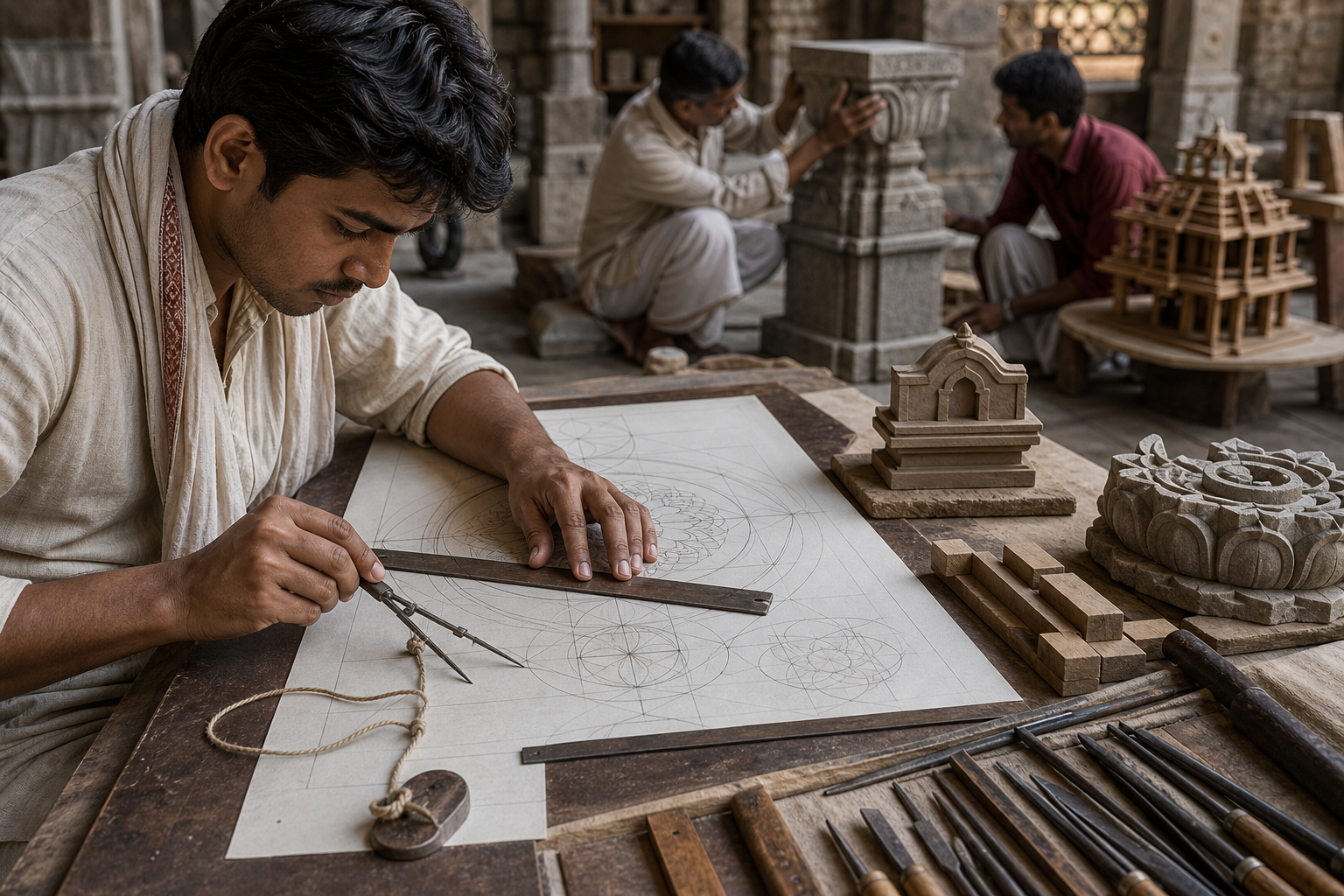
Traditional temple education joins text, geometry, drawing, material knowledge, field observation, and disciplined handwork. A beautiful sketch is useful, but it is not enough. You must learn why a form has a particular measure, how it relates to the building around it, whether the chosen material can carry it, and how the completed work will serve a sacred purpose.
Canonical geometry must become visible on paper
Temple planning draws on Sthapatya Veda, Silpa-sastra, Vastu literature, cardinal orientation, proportional canons, and the Vastu Purusha Mandala. Texts such as Manasara and Mayamata matter because the practitioner must translate verbal and proportional rules into drawings and built form. Memorising technical terms without constructing the geometry will not take you far.
Begin by learning to recognise the main spatial components: the garbhagriha or sanctum, antarala or vestibule, mandapa or pillared hall, and prakara or enclosure. Then observe how entry, movement, enclosure, and the approach to the sanctum are ordered. When you sketch, label these relationships instead of drawing only the most ornate tower.
You should also learn to distinguish Dravida, Nagara, and Vesara articulations without reducing them to superficial silhouettes. Tower form is only one clue. Base mouldings such as the adhisthana and the profile of the superstructure also express a coherent architectural system. Train your eye to read the whole composition from base to summit.
Material behaviour is part of sacred design
A design that ignores drainage, weathering, joints, or load paths is not made sound by correct symbolism. Traditional practice asks you to notice the grain and bedding of stone, the effects of salt exposure, the seasoning and joinery of timber, and the compatibility of lime mortar and its aggregates with existing fabric.
This becomes especially important in conservation. Cracks, efflorescence, and settlement are symptoms to document before anyone intervenes. Minimum intervention, compatible repair, and reversibility help preserve historical fabric while addressing decay. If you hope to work on old temples, cultivate the habit of diagnosing before proposing a replacement.
Sculpture begins with measure, not decoration
Traditional image-making requires iconometry, or talamana, together with iconographic fidelity and close knowledge of the chosen material. The working sequence moves from roughing and blocking to refined planes and controlled finishing. Each stage establishes information needed by the next; premature polishing cannot correct a faulty proportion.
The form may ultimately receive worship, so measurement is not merely an aesthetic preference. The sculptor works within ritual and iconographic responsibilities. You must be comfortable learning prescribed relationships before trying to display an individual style.
Digital recording supports the trained hand
Measured drawings, condition maps, and photographic logs teach you to look carefully and leave an intelligible record. Photogrammetry and 3D scanning can strengthen documentation for archives and restoration planning, but they do not replace freehand observation, geometric construction, or tool control. Learn what the digital model records, what it misses, and how to verify it against the physical structure.
This training can also sharpen your understanding of the wider Dharmic inheritance. Hindu temples, Buddhist viharas and stupas, Jain temples and basadis, and Sikh heritage sites belong to related but distinct traditions. Look for shared Indic concerns such as sacred geometry, spatial dignity, and community stewardship without forcing every tradition into one architectural rulebook.
Test your aptitude with observation and repetition
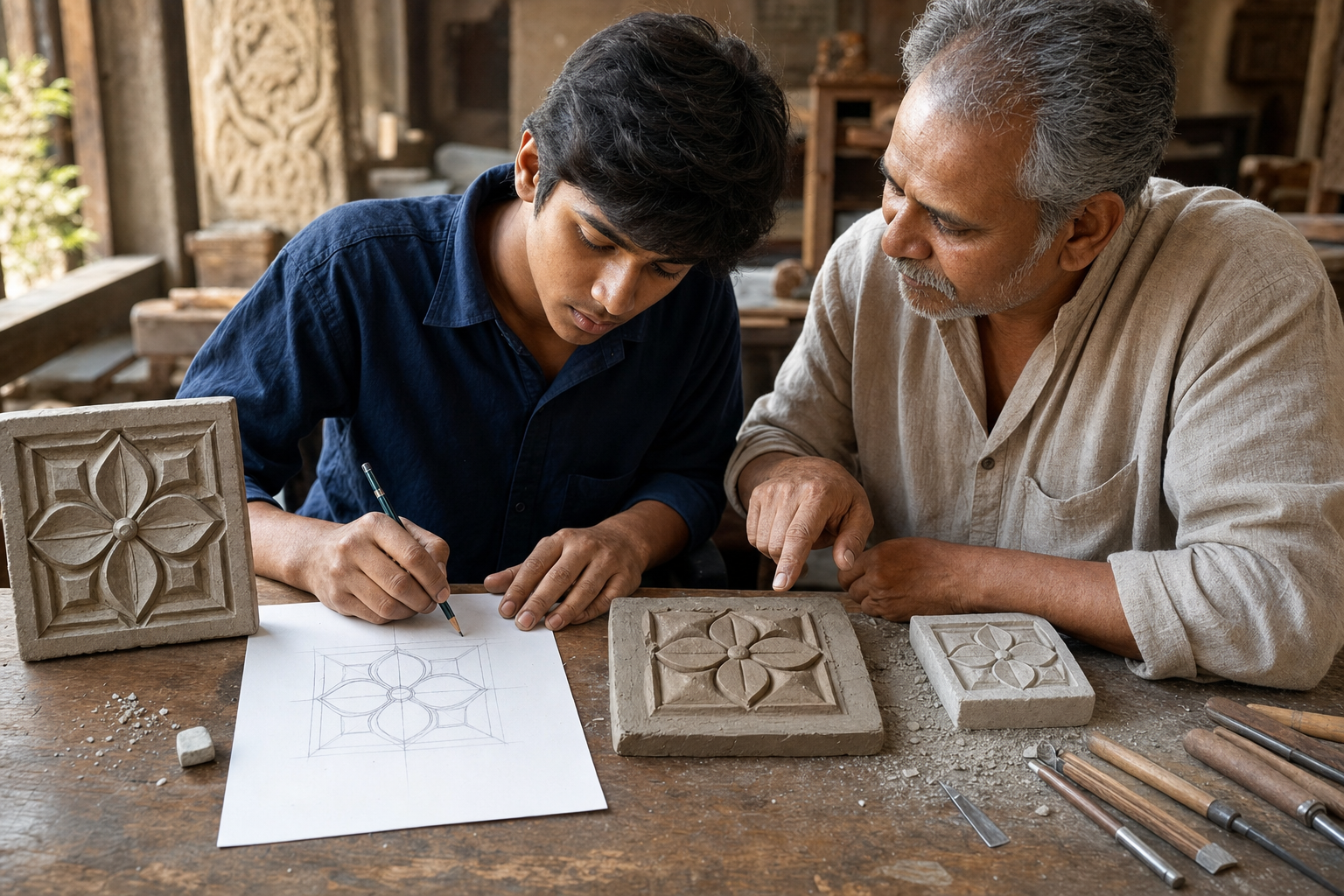
Reverence can bring you to the workshop, but patience keeps you there. Before applying, run a practical self-test. The purpose is not to produce portfolio-quality work. It is to find out whether close observation and repeated correction hold your attention.
- Select one accessible temple element. Choose a column base, threshold, wall moulding, or simple elevation that you can observe from a permitted public area. Respect restrictions on photography and measurement, and ask the temple authority when permission is needed.
- Draw it freehand. Record the large masses before ornament. Mark the base, vertical divisions, transitions, and repeated units. If you begin with decorative details, you will probably lose the governing proportion.
- Construct its geometry. Redraw the same element using a straightedge and compass. Look for axes, symmetry, repeated intervals, grids, and proportional relationships. Note what you can establish from observation and what remains uncertain.
- Make a measured sheet where permission allows. Add dimensions, a scale, the viewing direction, material, visible joints, damage, drainage conditions, and a short photographic log. Never chip, scrape, climb on, or take samples from a sacred or historic structure.
- Revise after comparison. Return to the element and identify where the drawing distorted width, height, alignment, or sequence. The willingness to correct the same sheet is a better test of craft temperament than satisfaction with the first sketch.
Then make an honest physical and ethical assessment. Stone and wood practice require stamina, controlled movement, safety discipline, and respect for tools. Sacred commissions also require reliability toward a community, a ritual context, and materials that cannot be casually wasted. If you resent rules, repeated exercises, or correction, the attraction of temple imagery may not be enough to sustain the course.
Weak first drawings are not a reason to reject the path. They give you a baseline. Pay closer attention to whether you can observe more accurately on the next attempt, accept correction without becoming careless, and keep working when progress is slow.
Build the 2026 application around confirmed facts
The application window runs from 4 May to 20 June 2026 for the 2026-27 session. Eligibility begins with passing Class 10, also described as SSC or an equivalent qualification. No additional eligibility condition should be guessed; the current TTD notification controls the process.
- Choose one route deliberately. Compare the four-year Diploma and two-year Certificate against the depth of practice you want and the time you can commit.
- Obtain the current TTD instructions. Use the prescribed TTD application process and read the 2026-27 notification for the form, submission method, document format, and any institution-specific requirements. Do not substitute an earlier admission cycle’s schedule.
- Prepare the core records. Keep your Class 10 proof, identity documentation, and recent photographs ready in the form requested. The notification, not a generic checklist, determines the exact number, size, format, and attestation rules.
- Submit within the window. Complete the form before 20 June 2026 and retain a copy of the submission and any acknowledgement. If a field or document instruction is unclear, seek clarification through the official TTD channel rather than improvising.
- Track the next instructions. Watch for announcements concerning shortlisting, credential verification, counselling, admission, or joining. Dates and assessment arrangements can be issued for the individual cycle.
- Plan the move conservatively. Selected students receive free accommodation, which can remove a major barrier. Do not infer that accommodation also covers tuition, deposits, meals, tools, materials, uniforms, or travel. Confirm each cost separately before committing.
Admission is only the beginning of the obligation. Selected candidates can expect credential checks and joining instructions covering conduct, studio protocols, workshop safety, and hostel life. Read those requirements as part of the education itself: a practitioner entrusted with sacred work must be dependable before becoming accomplished.
Key takeaways
- The four-year Diploma is the deeper route; the two-year Certificate provides a concentrated foundation.
- Passing Class 10, or SSC equivalent, establishes basic eligibility for the 2026-27 intake.
- Applications are scheduled from 4 May through 20 June 2026, subject to the prescribed TTD process.
- Selected students receive free accommodation, but you should confirm every other cost independently.
- Prepare by practising freehand drawing, geometric construction, measured observation, material awareness, and careful revision.
- Do not treat digital documentation as a substitute for the trained eye, drawing hand, or craft discipline.
Your next move is concrete: find the current TTD notification, decide which depth of training matches your intention, assemble the required records, and begin one measured temple sketch. The application and the apprenticeship of your eye can start together.