
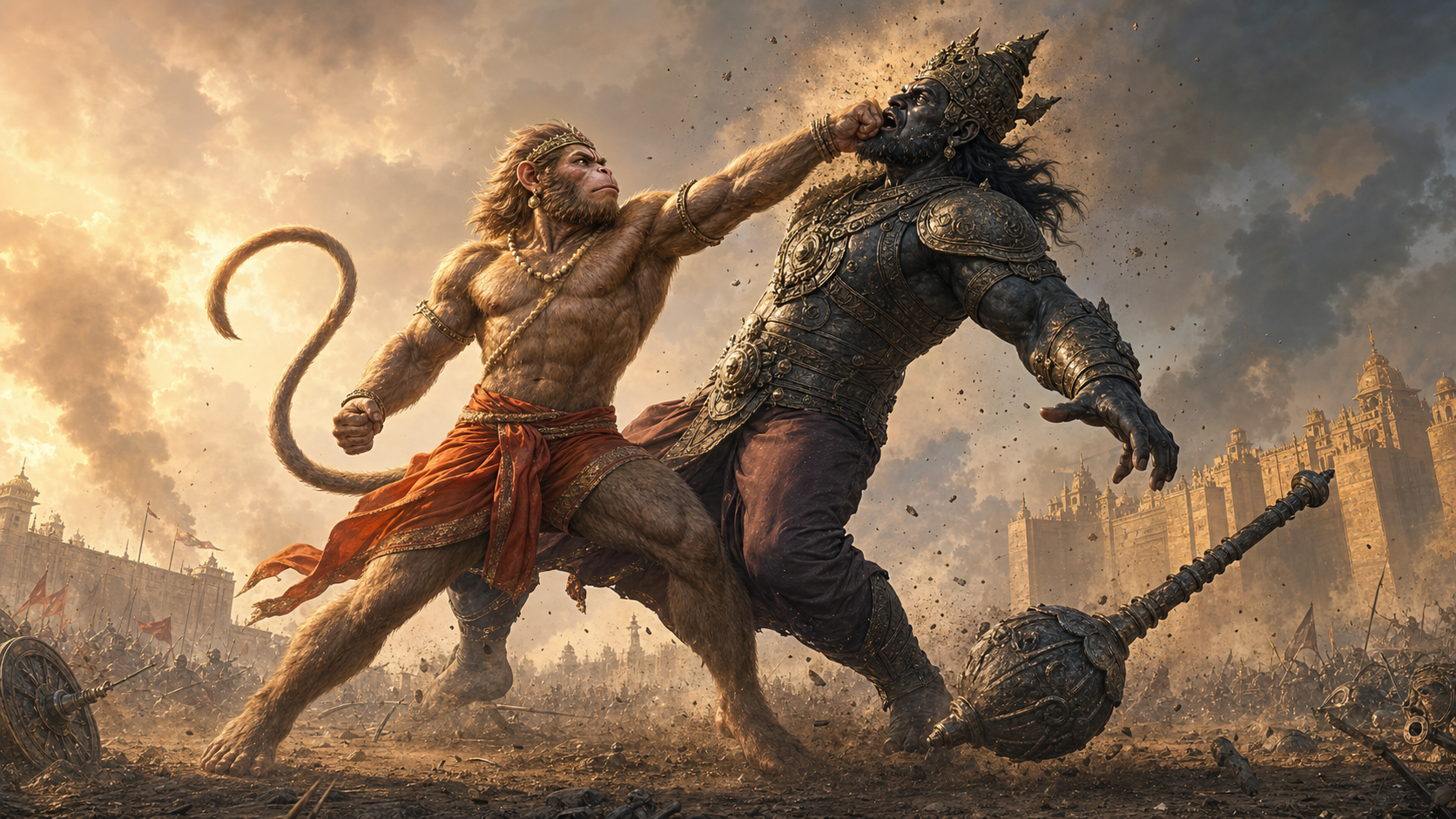
If you came looking for the exact reason Devantaka falls, the answer is brief: after joining Ravana’s coordinated assault on the Vanara army, he drives at Hanuman with crushing force. Hanuman ends the encounter with a single fist-blow to his head. The brevity is the point, not a missing part of the story.
Read closely and the scene becomes a compact lesson in how the Ramayana judges power. Devantaka has strength, speed, weapons, status, and a terrifying reputation. Hanuman has something more decisive: strength governed by attention, restraint, devotion, and a clearly understood duty.
The battlefield sequence, without the confusion
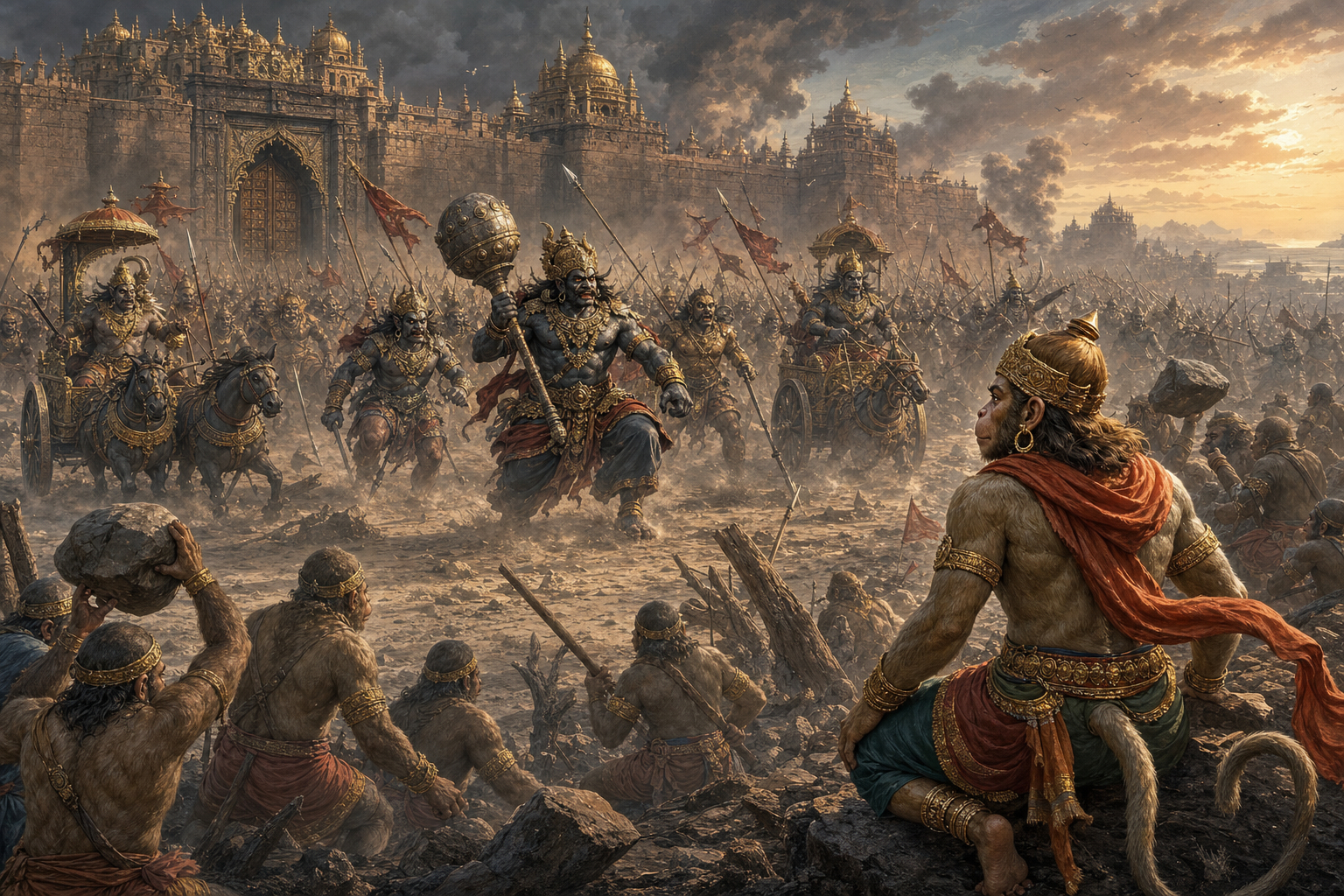
Devantaka’s encounter with Hanuman is sometimes remembered as though two champions simply meet and duel. That loses the military setting. Ravana is trying to recover the initiative during the war in Lanka. He deploys a formidable group that commonly includes Devantaka, Narantaka, Trisira, and Mahodara. Their task is not ceremonial combat. It is to hit the Vanara force hard enough to break its cohesion and morale.
Devantaka is therefore best understood as part of a shock force. Many traditions identify him as a rakshasa prince and son of Ravana. He enters with the confidence of a warrior accustomed to making fear do part of his work. His attack combines speed, bodily power, and the threat of a heavy club or mace. Details such as his mount or vehicle vary among tellings, but the purpose of his advance does not: overwhelm the defender before the defender can settle into an effective response.
The larger offensive divides the Vanara leaders’ attention across several dangerous opponents. Angada and other commanders answer different parts of the attack while Hanuman confronts Devantaka. That context matters. Hanuman is not fighting for personal reputation. He is protecting an army, sustaining Sri Rama’s campaign, and stopping one part of a coordinated attempt to reverse the war.
Devantaka closes violently, expecting his momentum and weapon to control the exchange. Hanuman does not give him time to develop a longer sequence of attacks. He collapses the distance and strikes Devantaka’s head with a fist compared to the vajra in its force. Descriptions of the impact are deliberately physical: teeth shatter, the great body reels, and the attacker falls. One precisely timed blow ends Devantaka’s assault.
When you retell the episode, keep its five movements in order: Ravana launches a multi-pronged attack; Devantaka advances as an elite assault warrior; he tries to impose speed and terror; Hanuman denies him an extended exchange; the rakshasa’s momentum is reversed in a single action. That sequence explains the victory better than simply saying that Hanuman was stronger.
Why Hanuman wins before the fight can lengthen
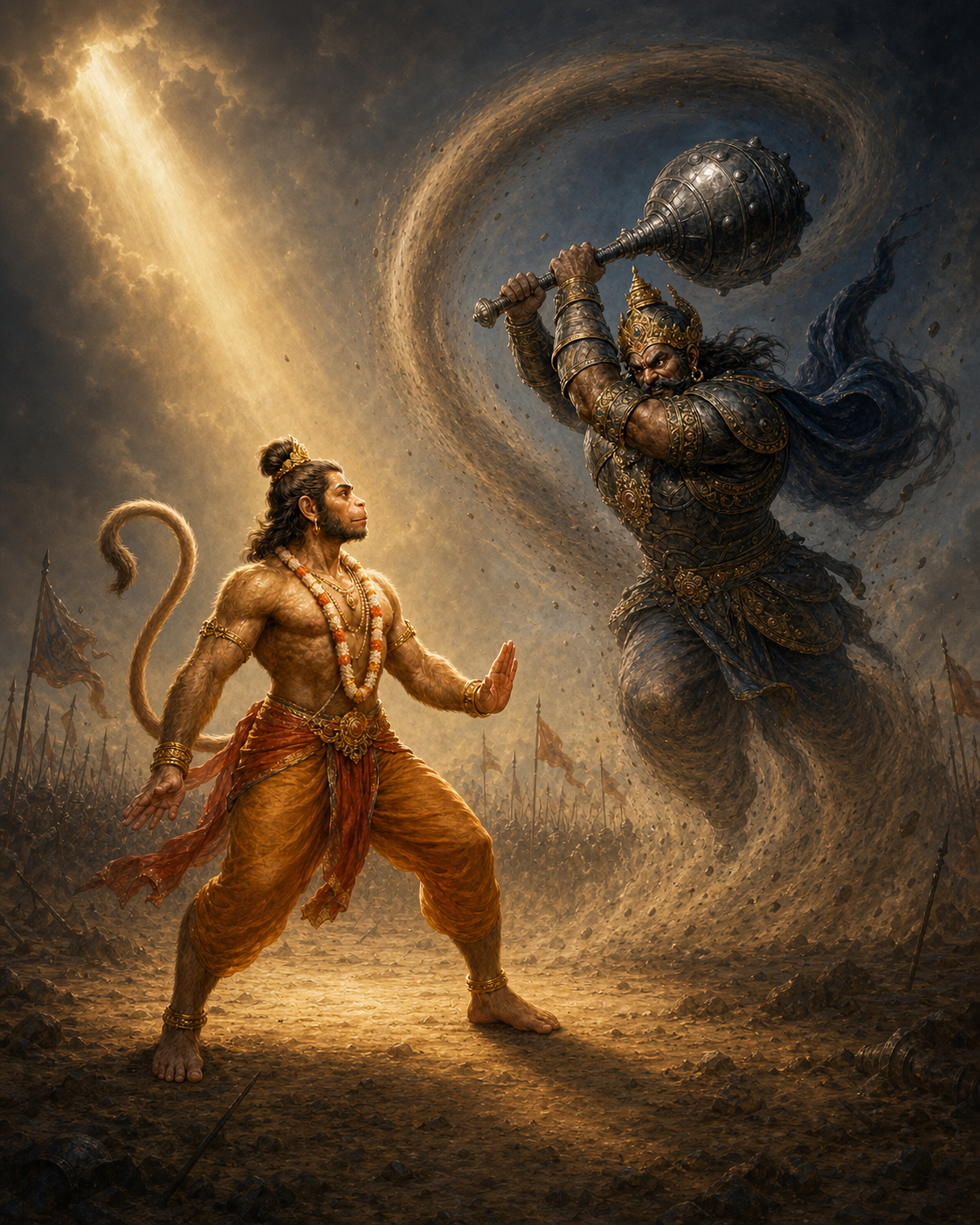
A shock assault succeeds when the defender accepts the attacker’s rhythm. The defender flinches, scatters, answers every threat separately, and eventually mistakes speed for inevitability. Devantaka arrives with exactly that advantage. His violence is meant to narrow everyone else’s attention until they can do nothing except react.
Hanuman is fast, but he is not hurried. That distinction unlocks the scene. He does not mirror Devantaka’s agitation, compete in displays, or allow the heavy weapon to dictate the range of combat. He identifies the decisive point, enters it, and acts with complete commitment.
This is a form of tempo compression: instead of surviving a long chain of attacks, Hanuman prevents that chain from forming. Devantaka is prepared to dominate an extended contest of force. Hanuman gives him no such contest. The encounter moves almost immediately from threat to resolution.
Three qualities make that possible. First is discernment: Hanuman recognizes what must actually be stopped. Second is economy: he does not spend energy on actions that do not serve the mission. Third is commitment: once the necessary action is clear, he does not hesitate halfway through it. Economy here does not mean timidity. It means applying sufficient force at the exact point where it changes the situation.
This also corrects a common misreading. Hanuman does not prevail merely because his body contains more power. Devantaka already possesses extraordinary physical power. What separates them is integration. Devantaka’s strength is driven by aggression and the need to dominate. Hanuman’s strength is coordinated with judgment, purpose, and service. One warrior expends power to create disorder; the other concentrates power to stop it.
When a conflict in your own life becomes loud and fast, notice the same mechanism. Ask what rhythm is being imposed on you. A manufactured deadline may be trying to prevent scrutiny. A stream of accusations may be trying to make you answer every charge instead of correcting the central falsehood. A recurring distraction may survive because you repeatedly negotiate with it. The Hanuman-like response is not literal violence. It is the shortest ethical action that takes control away from confusion: verify the decisive fact, refuse the false deadline, state the boundary, or remove the distraction’s access to you.
Devantaka’s name makes the reversal sharper
The name Devantaka is often understood as “ender of devas” or “destroyer of the devas.” It expresses more than personal menace. It gives the warrior an identity built around attacking the powers associated with protective order. The name announces what Lanka wants him to represent: force so intimidating that resistance appears futile.
His end is therefore shaped as poetic reversal. The supposed destroyer of celestial power is himself brought down by Vayu-putra, the son of Vayu. More importantly, Hanuman’s immense energy is inseparable from his devotion to Sri Rama. The contrast is not between a powerful rakshasa and a still more powerful combatant. It is between power that claims sovereignty for itself and power that accepts responsibility to something higher.
That is why bhakti should not be mistaken for passivity in this episode. Hanuman’s devotion produces clarity, courage, and readiness to protect. Seva does not make him weak; it prevents his strength from becoming self-serving. His martial capacity belongs to a duty rather than an appetite.
The same qualification applies to kshatra, the disciplined protection of order. Kshatra is not rage with a sacred label. Its moral standing depends on whom an action protects, what end it serves, and what limits govern it. Ravana’s warriors can display courage, loyalty, skill, and physical magnificence, yet those qualities alone do not make their cause dharmic. Ability answers the question “Can this be done?” Dharma still asks “What does this action serve?”
You can use those two questions whenever an epic scene appears to celebrate force. Do not stop at who wins. Ask what the victor protects, whether the action is proportionate to the duty, and whether power remains controlled after the threat ends. This reading avoids two opposite errors: treating all strength as suspect, or assuming that victory automatically proves righteousness.
The wider Dharmic family uses different vocabularies for restraint, self-mastery, service, non-harm, courage, and the protection of others. Those traditions should not be flattened into identical doctrines. Yet Devantaka’s fall presents a pattern that readers across them can recognize: energy becomes ethically meaningful when it is governed rather than worshipped.
What remains stable across Ramayana traditions
You may encounter this episode through the Valmiki Ramayana, a regional retelling, temple discourse, family recitation, Ramlila, or another performance tradition. Expect differences in pacing and surrounding detail. A compressed devotional narration may pass quickly over the battlefield mechanics. A dramatic performance may enlarge the confrontation through costume, gesture, percussion, and dialogue. Neither approach necessarily changes the episode’s central movement.
The Yuddha Kanda of the Valmiki Ramayana supplies the principal narrative frame. The Tamil Kamba Ramayanam heightens the poetic intensity of such clashes. The Ramcharitmanas can compress martial sequences while keeping their devotional direction. The Adhyatma Ramayana places the action within a more explicitly theological horizon. Yakshagana, Kathakali, and Ramlila make the antagonists’ menace and Hanuman’s answer visible through performance.
Some surrounding details remain fluid. Devantaka is frequently called Ravana’s son, and many genealogical lists name Dhanyamalini as his mother. Dhanyamalini’s place in Ravana’s household is described differently across retellings, including varying accounts of her relation to Mandodari. The mode of Devantaka’s advance and the precise description of his weapon can also shift. These variations should be preserved as variations, not merged into a falsely uniform version.
The stable narrative spine is enough to identify the episode: Devantaka is an elite rakshasa combatant aligned with Ravana; he enters a larger assault against the Vanara army; Hanuman meets his aggressive advance; and a decisive strike from Hanuman brings him down. If a version changes adjacent pairings, compresses the action, or expands the drama, test it against that spine before declaring that the story has fundamentally changed.
Key takeaways
- Devantaka is commonly presented as a son of Ravana and an elite member of Lanka’s assault force.
- His defeat occurs within a coordinated battlefield offensive, not an isolated contest arranged for personal glory.
- Hanuman stops the attack with one crushing blow to Devantaka’s head, denying him the time needed to exploit speed, terror, and heavy weaponry.
- The moral contrast is not strength versus weakness. It is self-directed force versus strength disciplined by bhakti, seva, and dharma.
- Regional and devotional tellings may alter genealogy, pacing, vehicles, weapons, or nearby encounters while retaining the same central outcome.
Turn the episode into a discipline, not a slogan
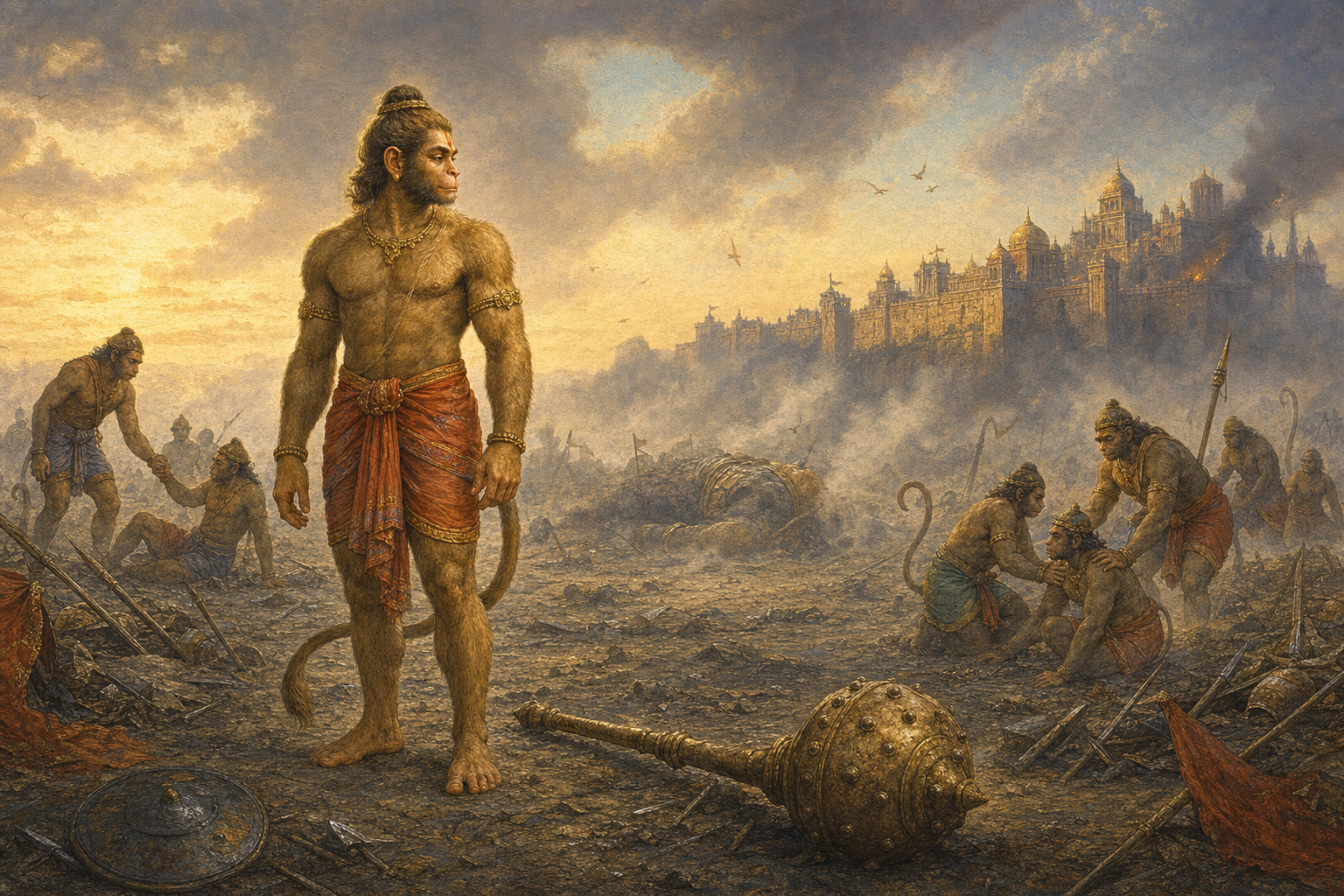
“One decisive blow” is easy to admire and easy to misuse. In an ordinary disagreement, it is not permission to become aggressive, impatient, or punitive. The useful analogy lies in disciplined decisiveness: understand the duty, identify the point on which the situation turns, take the least harmful action that reliably fulfils that duty, and stop when the duty is complete.
When you feel pressured into frantic reaction, use this five-step test:
- State the duty in one sentence. Name what you are protecting: a person, a promise, a truthful record, a community responsibility, or your capacity to serve.
- Separate the threat from the theatre. Identify what can actually cause harm, then distinguish it from noise intended only to frighten or distract you.
- Find the decisive point. Ask which action would remove the problem’s momentum rather than merely helping you endure another round of it.
- Choose proportionate means. Use enough clarity, firmness, evidence, or intervention to fulfil the duty without turning correction into domination.
- Stop when the dharmic aim is met. Do not prolong a necessary response for pride, revenge, applause, or the pleasure of winning.
In practice, your decisive action may be one documented fact that ends a false claim, one unambiguous refusal that breaks a coercive pattern, one timely act of assistance that protects someone being isolated, or one removed temptation that ends a recurring negotiation with yourself. The outward form changes. The discipline remains: do not let an aggressor, a fear, or a distraction decide your tempo.
At your next reading or recitation of the Lanka battle, pause immediately before Hanuman strikes. Notice not only what he does, but what he refuses to become. He does not boast, prolong the encounter, or imitate Devantaka’s love of terror. Carry that question into your next difficult decision: what would firm action look like if it remained completely in service of dharma?