

If you are trying to decide whether Mysore University’s decline was caused by caste politics, administrative neglect, or falling academic standards, do not choose one label too quickly. In a university, these failures reinforce one another. Opaque appointments weaken scholarly authority. Weak authority deprives students of mentorship. Factional mobilisation then finds space that serious academic life has vacated.
The useful question is not whether Mysore can recreate a celebrated past. It cannot. The useful question is whether its next appointment, promotion, course, thesis, and student dispute will be handled in a way that rewards learning and protects institutional duty. That is where decline becomes measurable, and where renewal can begin.
The decisive break was in the transmission of scholarship
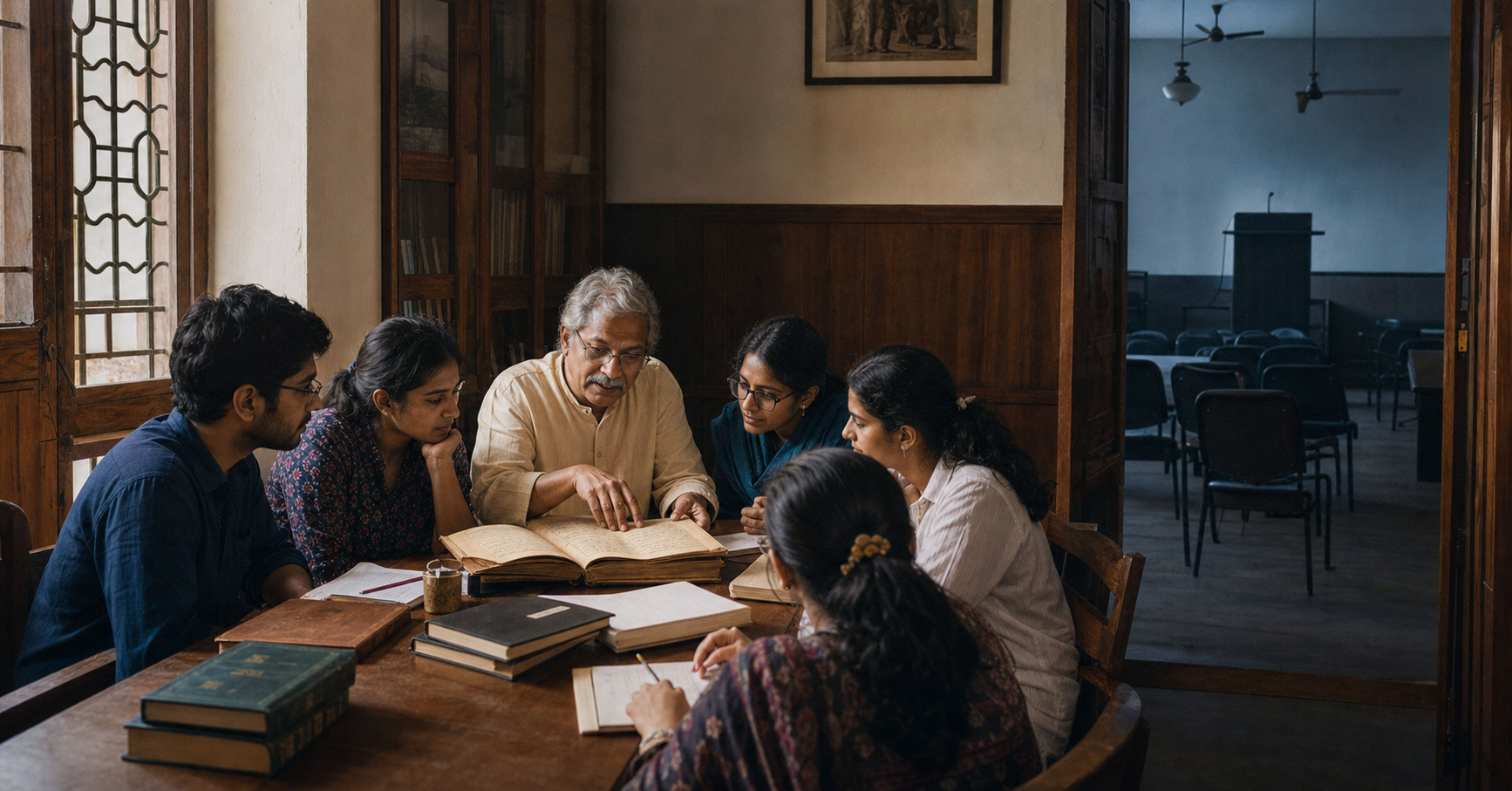
In the remembered Maharaja’s College of the 1930s, teachers drew authority from command of their subjects and personal integrity, while students sought knowledge beyond the minimum needed for a credential. Lectures, discussions, texts, and the example of accomplished teachers formed an intellectual ecology. A student did not merely receive information. The student encountered standards embodied by living scholars.
By the time S.L. Bhyrappa entered the BA programme in 1950-51, much of that constellation had disappeared. M. Hiriyanna and other leading figures of the older Mysore tradition were no longer present, scholars trained in that demanding lineage had become fewer, and some who remained were reportedly pushed to the margins. The important change was therefore not simply generational. A university always loses senior teachers to time. The deeper failure occurs when it cannot recognise, cultivate, and succeed them.
H.K. Raja Rao’s experience is remembered as a case in which prejudice and bureaucratic unfairness in appointments and advancement embittered a highly learned philosophy scholar. The institutional cost went beyond one person’s career. When a capable teacher loses confidence that learning will receive fair recognition, students receive less guidance, junior scholars lose a model to follow, and the department learns that advancement depends on something other than academic duty.
N. Balasubrahmanya’s treatment reveals the same inversion even more sharply. He was remembered as a scholar of unusual breadth, yet colleagues reportedly treated sustained study as a private eccentricity rather than a qualification for university service.
We didn’t ask you to study so much; you studied to satisfy your itch.
Colleagues of N. Balasubrahmanya, as recorded by S.L. Bhyrappa
That taunt matters because it reverses the moral economy of a university. The person who studies deeply becomes naive; the person who masters a faction becomes practical. Once that reversal is normal, ambitious younger academics respond rationally. They invest less in languages, texts, laboratories, archives, and students, and more in whatever networks actually control appointments and recognition.
The physical campus eventually reflected the intellectual neglect. Decades later, rooms intended for teaching were reportedly fouled by cow dung and donkey excreta. You do not need to treat every remembered image as a complete inventory of the campus to understand the warning. A lecture room that nobody is responsible for maintaining expresses the same failure as a promotion file that nobody is responsible for justifying.
Because much of this history reaches us through recollection and literary testimony, you should treat the named cases as diagnostic signals, not as a statistical account of every appointment or teacher. A serious institutional inquiry would test those signals against appointment files, committee minutes, promotion decisions, course records, thesis supervision, grievance outcomes, and the condition of teaching spaces. Nostalgia is not an audit.
When you examine a department, look at three connected layers:
- People: Are the most knowledgeable teachers given the authority, time, and students needed to transmit what they know?
- Processes: Can an outsider reconstruct why one candidate was selected, another rejected, or a faculty member promoted?
- Places: Are classrooms, libraries, laboratories, archives, and common spaces usable for their declared purpose?
If one layer fails, repair it. If all three fail together, the university is not facing a collection of isolated incidents. It is facing institutional decline.
Merit must be a decision system, not a political slogan

Calls to restore merit often fail because the word is left undefined. Merit is not a person’s caste, family, ideology, social polish, foreign credential, or proximity to an office-holder. Nor is it a single examination score. In a university, merit is demonstrated fitness to carry a particular academic responsibility.
That fitness must be visible at four decision points:
- Eligibility: The vacancy names the knowledge and work the institution actually needs. A philosophy appointment may require competence in specified texts, languages, methods, and courses; a generic claim of brilliance is not enough.
- Selection: Every candidate is assessed against criteria published before applications are reviewed. Committee members disclose conflicts, use the same core questions, and record reasons against the rubric.
- Performance: The university examines what the appointee subsequently teaches, supervises, edits, translates, discovers, publishes, preserves, or builds. Appointment is the beginning of accountability, not its end.
- Academic authority: Responsibility for curricula, research supervision, and scholarly evaluation follows demonstrated competence. Seniority and factional strength cannot substitute for knowledge of the work.
The allegation surrounding Mysore is not merely that caste identities existed within university life. It is that identity calculations became decisive where scholarly judgement should have governed. That allegation must not become a warrant to condemn a community, dismiss historical exclusion, or install a counter-prejudice. Caste should neither confer entitlement nor justify exclusion. The remedy is an evidence-bound process that can withstand scrutiny regardless of who wins.
This is why equity and excellence cannot be protected by rival systems. Both require the same safeguards: criteria known in advance, equal opportunity to present relevant work, written reasons, conflict-of-interest rules, and an appeal that examines whether the process was followed. Merit without fair procedure can become patronage expressed in flattering language. Equity without academic standards can place people in posts without giving students the teaching they are owed.
Do not reduce performance to a raw publication count. Fields produce different kinds of work. A critical edition, an annotated translation, a laboratory result, an archival catalogue, and a journal essay require different methods and timescales. Use field-normalised standards and ask whether the work is original, verifiable, competently executed, and useful to the discipline. A long bibliography cannot compensate for weak teaching or unethical supervision.
A simple test exposes much institutional theatre: could the committee show the vacancy description, scoring rubric, relevant evidence, conflict declarations, and written reasons after the decision? If it cannot, no speech about merit or social justice can repair the missing chain of accountability.
Dharmic values become credible when translated into procedures

A Dharmic university is not one that decorates its entrance with Sanskrit while reproducing arbitrary power inside. It is not a religious loyalty test, and it cannot be another route to factional capture. Its distinctiveness must appear in the duties it imposes on everyone who governs, teaches, studies, or uses public resources.
The shared civilisational values of Hindu, Buddhist, Jain, and Sikh traditions offer a demanding framework for those duties. Satya, karuna and ahimsa, tapas, and sewa can each be expressed as an institutional rule:
- Satya, or truthfulness: Publish the real selection criteria. Preserve accurate minutes. Do not conceal inconvenient evidence or alter standards after seeing the applicants. Correct the record when an error is found.
- Karuna and ahimsa, or compassion and non-harm: Give candidates, faculty, and students due process. Prevent humiliation, intimidation, vandalism, and retaliatory use of authority. Hear grievances without presuming guilt or innocence from group identity.
- Tapas, or disciplined effort: Reward the slow work by which knowledge is acquired and preserved: language study, textual criticism, repeated experimentation, careful translation, revision, and patient teaching.
- Sewa, or service: Judge office-holders by what their authority enables others to learn and accomplish. Administration is stewardship, not possession; scholarship carries an obligation to students and the wider community.
These principles also clarify what Dharma is not. Satya does not permit a selection committee to hide favoritism behind institutional prestige. Ahimsa does not require silence when standards are violated. Tapas does not reward needless hardship or academic gatekeeping. Sewa does not demand obedience to an incompetent superior. Each value disciplines power as much as it guides personal conduct.
The older Mysore ideal was sustained not only by professional academics. D.V. Gundappa’s service to the advancement of the university belongs to a civic tradition in which scholar-householders, administrators, and public-minded citizens treated higher education as a trust. Alumni and citizens can recover that role, but they should support institutions rather than individual camps. Fund a manuscript catalogue, language fellowship, laboratory, reading room, or open repository with public deliverables. Do not purchase influence over appointments.
Rebuild the intellectual ecology, not merely the university’s image

A ranking campaign, commemorative volume, new gate, or ceremonial lecture may improve visibility without changing what happens between teacher and student. Renewal has to reach the ordinary academic transactions through which a university either produces knowledge or merely processes credentials.
Make appointments and promotions reconstructable
Before opening a vacancy, the department should state which courses the appointee must teach, which research capacity is missing, which evidence will be scored, and how each criterion will be weighted. The search committee should include external scholars with relevant credentials, and every member should disclose personal, professional, political, and familial conflicts.
After shortlisting, give candidates the same core academic tasks: analyse a defined problem, teach a sample class, discuss submitted work, and explain a feasible research programme. Record the committee’s reasons against the published criteria. An appeal should review procedural fairness and material error; it should not become a second factional contest over the preferred candidate.
Apply comparable discipline to promotions. Specify what counts as responsible teaching, completed supervision, field-appropriate research, and institutional service. Evaluate vice-chancellors, deans, and heads on academic outcomes and campus well-being, not only on budgets, events, or political access. A leader who announces programmes but leaves courses untaught and grievances unresolved has not performed the academic duty of the office.
Restore direct contact with texts, languages, and evidence
In philosophy, literature, and history, students should not encounter Indian thought only through summaries. Build language pathways in Sanskrit, Kannada, Pali, Prakrit, and Persian where the field requires them. This does not mean that every student must master every language. It means that a programme claiming authority over a textual tradition must contain a credible route from translation to original-language study.
Use text seminars in which students prepare a passage, identify the claim, reconstruct the argument, compare interpretations, and answer objections. The guru-shishya ideal is valuable here when it means precision, attention, humility, and dialogue. It becomes harmful if invoked to shield a teacher from questions or accountability.
A BA capstone thesis with an oral defence can make undergraduate formation accountable. Keep the scope manageable, require citations and drafts, check authorship, and have an examiner test whether the student understands the argument. The purpose is not to manufacture impressive titles. It is to ensure that a graduate can gather evidence, make a claim, answer criticism, and take responsibility for submitted work.
Reward the forms of research that preserve civilisation
Universities often praise heritage while making long-horizon scholarship professionally irrational. Critical editions, annotated translations, manuscript catalogues, and commentaries can demand sustained work yet receive less attention than quickly countable outputs. Field-normalised evaluation should recognise these forms on their own terms.
Support editorial training, manuscript preservation, and digital repositories as routine academic infrastructure. A repository should expose usable records: title, author or attributed author, language, script, provenance where known, physical condition, rights status, catalogue data, and the relationship between images, transcription, and edition. Digitisation without metadata merely moves obscurity from a cupboard to a server.
Evaluation still matters. Civilisational importance cannot excuse unreliable transcription, poor argument, or unsupported claims. Require appropriate peer review and make corrections visible. Reverence for a tradition is compatible with exacting criticism; indeed, responsible preservation requires it.
Turn mentorship into recognised academic work
When accomplished scholars are sidelined, the first loss is often invisible: junior faculty and students no longer learn how serious work is actually done. Pair junior academics with senior mentors across specialisations, with a written compact covering research design, teaching observation, ethical supervision, and progress review. Cross-specialisation pairing reduces dependence on a single departmental camp.
Offer regular faculty development in research design, textual method, classroom pedagogy, and relevant traditions of reasoning, including nyaya and mimamsa where appropriate. Reward supervisors for timely and ethical completion of theses, but inspect quality rather than rewarding speed alone. A completed thesis that the student cannot defend is an administrative success and an academic failure.
Protect study from factional coercion
Student politics does not have to be abolished for academic life to be protected. Draw a clear boundary: students may organise, advocate, disagree, and protest; they may not prevent a class from meeting, threaten a participant, destroy university property, or substitute crowd pressure for an academic appeal.
Create interest-based societies that give ambition a scholarly outlet: textual study circles, logic and debate forums, translation groups, archival workshops, and laboratory guilds. Give them modest resources, faculty access, regular meeting space, and a requirement to produce something visible, such as a debate record, reading guide, translation draft, demonstration, or public lecture.
Inter-school and interfaith colloquia should begin with a defined question and texts or evidence circulated in advance. Shared values become intellectually meaningful when participants can identify genuine differences without hostility. A staged celebration of harmony teaches less than a disciplined disagreement conducted without contempt.
Make the next academic cycle auditable
Do not begin renewal with a slogan about returning to glory. Begin with a sequence that produces records the university community can inspect.
- Establish the baseline. Publish current appointment and promotion rules, declared vacancies, course responsibilities, supervision loads, unresolved academic grievances, research facilities, and the condition of teaching rooms. Mark unknown information as unknown rather than filling gaps with ceremonial claims.
- Choose commitments tied to real decisions. Apply the published rubric to the next vacancy and promotion. Apply the capstone standard to the next eligible cohort. Assign responsibility for each unusable classroom, laboratory, archive, or library space before announcing new construction.
- Publish academic artifacts. Release permitted selection criteria and reasons, course outlines, seminar schedules, repository records, anonymised thesis outcomes, and society outputs. Protect personal data, confidential references, and legitimate examination security, but do not confuse confidentiality with freedom from accountability.
- Invite competent external scrutiny. Ask independent scholars to inspect a representative set of appointments, courses, theses, and research outputs. Reviewers should disclose conflicts and assess the work against criteria published in advance.
- Correct the mechanism, not just the embarrassment. If a course failed because no qualified teacher was assigned, fix staffing. If a selection failed because the rubric was vague, rewrite it before the next vacancy. If intimidation went unpunished because jurisdiction was unclear, assign responsibility and due process. Do not treat each failure as an isolated public-relations incident.
Your own leverage depends on your place in the institution:
- If you are a student, ask for the syllabus, assessment rubric, office hours, grievance route, and capstone expectations in writing. Form a study circle around a specific text or problem and publish the work it produces.
- If you are a teacher, document course goals, reading requirements, feedback, supervision milestones, and service. When challenging an appointment or policy, point to the violated criterion and the evidence; do not answer factionalism with another faction.
- If you are an alumnus or donor, attach support to public academic deliverables such as catalogued manuscripts, restored reading rooms, language instruction, or repository access. Refuse requests that make funding contingent on a personal appointment.
- If you are an administrator or council member, require decision files that a future reviewer can reconstruct. Track whether courses happened, theses were responsibly completed, grievances received due process, facilities remained usable, and promised academic outputs appeared.
An anniversary history can list every year correctly and still conceal the life of an institution. The better record is what a student can read, whom a junior scholar can learn from, why an appointment was made, whether a disagreement can proceed without fear, and what knowledge the university leaves available to the next generation.
Key takeaways
- Mysore’s central failure was not simply the departure of famous scholars. It was the weakening of the process that should have recognised and formed their successors.
- Merit is demonstrated fitness for a defined academic duty. It requires published criteria, relevant evidence, written reasons, conflict disclosure, and reviewable procedure.
- Caste or ideological identity should neither guarantee selection nor trigger exclusion. The same transparent process must protect excellence, equity, and due process.
- Dharmic values matter institutionally only when satya governs records, ahimsa governs disputes, tapas governs standards, and sewa governs the use of authority.
- Renewal should be judged through appointments, courses, theses, mentorship, research artifacts, student conduct, and usable facilities – not ceremonies or reputation alone.
The next test of Mysore is not whether it can repeat the names of its great teachers. It is whether the next well-prepared student can find a demanding mentor, whether the next learned applicant receives a fair hearing, and whether both can work without factional coercion. Before the next appointment or jubilee, ask for the criteria, the reasons, and the academic work that followed. That is where recovery will become visible.