
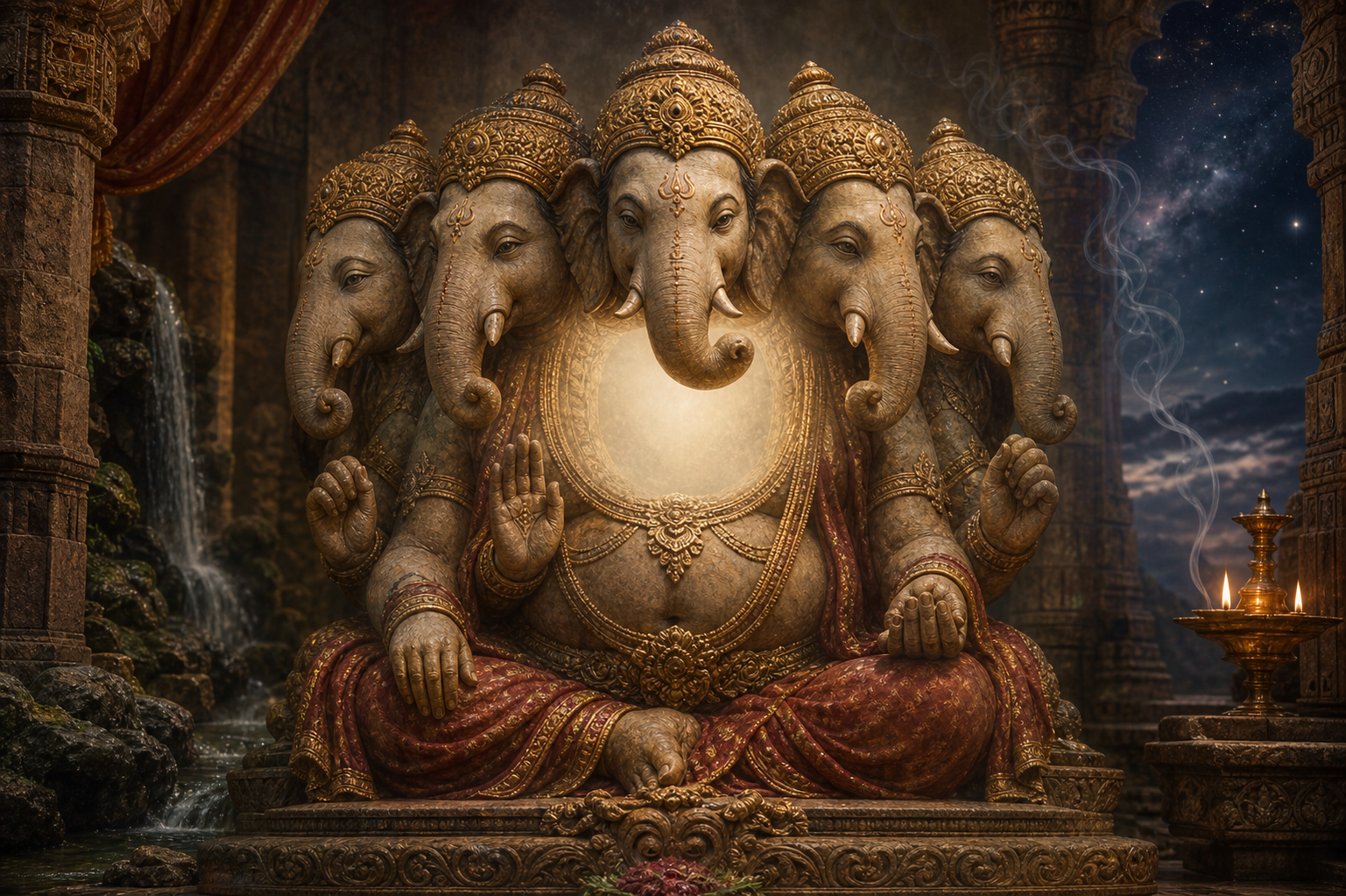
You can learn every correspondence of a five-faced murti and still remain caught in the same fear, pride, resentment, or need for control. The decisive question is not whether you can decode the five. It is whether the symbol helps you discover what cannot be confined by them.
Vedantic self-transcendence does not require you to reject the senses, neglect the body, or manufacture an exalted state. It asks you to bring the fivefold field of experience into order, examine each layer you call me, and recognize the awareness to which every layer appears. Panchamukhi Ganapati gives this inquiry a sacred and practical form.
Why the symbol has five faces – and a silent center
Fivefold symbolism works because ordinary human experience is already dispersed through distinguishable channels. You hear, touch, see, taste, and smell. Each channel presents a world, attracts attention, and supplies material for desire, aversion, memory, and identity. A five-faced form gathers those outward movements around one divine presence.
Classical Indic correspondences relate the senses to the pañca mahābhūta, the five great elements. These are not merely five substances lined up beside five organs. They form a contemplative grammar connecting a sense, its field, and a quality of manifestation:
| Sense | Element | Quality to notice | Question for inquiry |
|---|---|---|---|
| Hearing | Ākāśa, space or ether | Sound arises within openness | Can a sound be known without becoming part of my identity? |
| Touch | Vāyu, air | Pressure, motion, and change | Does a changing sensation define the one who knows it? |
| Sight | Agni, fire | Form, color, and luminosity | What remains present as visible forms come and go? |
| Taste | Āpas, water | Fluidity and flavor | Can pleasure or displeasure be felt without being obeyed? |
| Smell | Pṛthvī, earth | Solidity and fragrance | Is the knower limited by the object being smelled? |
This arrangement turns sensory life into material for viveka, discrimination. The aim is not to stop hearing or seeing. It is to notice the usually hidden leap from a sensation is present to this sensation is happening to a separate, vulnerable me. That leap is where experience hardens into bondage.
Panchamukhi Ganapati is often envisioned with four faces directed horizontally and a fifth face rising upward. The horizontal faces honor manifestation: directions, elements, senses, activities, and relationships. The upward face introduces another axis. It points beyond the spread of objects without treating those objects as profane. Transcendence is therefore placed above the four directions, yet remains joined to their center.
The same five faces may be contemplated through other established matrices: the five vital winds, the five sheaths, or the fivefold articulation of Oṁ as A, U, M, bindu, and nāda. Five offerings in pañcopacāra worship – fragrance, flower, incense, flame, and nourishment – return the elemental world to its divine ground. These meanings complement one another, but you do not need to force all of them into a single sitting.
Use one matrix at a time. If your attention is scattered, work with the senses and elements. If bodily energy feels disordered, receive instruction on the five prāṇas within an appropriate yogic lineage. If the central problem is identity, use the five sheaths. A symbol becomes useful when it organizes practice; it becomes a distraction when accumulating correspondences replaces practice.
Move through the five sheaths without turning against them

Self-transcendence can sound like self-erasure. Advaita means something more precise: the correction of mistaken identity. Adhyāsa is the attribution of what belongs to one thing to another. Upādhi is a limiting adjunct through which the limitless appears confined. The body, mind, memory, occupation, and social role are real as parts of lived experience, but none can establish the boundary of awareness itself.
Consider the recurring thought I am anxious. Anxiety is present, and it may require a responsible response. Yet it is also known. It changes in intensity, has a beginning, and may disappear while knowing remains. Vedantic inquiry replaces neither care nor action; it corrects the additional claim that a passing condition exhausts what you are.
This mistake has two movements. Āvaraṇa, veiling, conceals the ever-present ground. Vikṣepa, projection, fills the apparent absence with a constructed identity: body, temperament, status, grievance, accomplishment, or spiritual persona. Together they make the limited self seem self-evident. The familiar rope-snake analogy captures the mechanism: incomplete recognition allows a projected object to command a real reaction until knowledge corrects the error.
The Taittirīya Upaniṣad supplies a disciplined way to investigate that error through Pañca Kośa Viveka, discrimination concerning the five sheaths. Work from the grossest layer toward the subtlest:
- Annamaya, the physical sheath: Notice posture, weight, temperature, hunger, comfort, discomfort, age, and appearance. The body must be cared for, but it is also perceived. Ask: Can the perceived body be the whole of the perceiver?
- Prāṇamaya, the vital sheath: Notice breathing, vigor, fatigue, and the felt movement of life. These conditions affect the mind, yet they fluctuate. Ask: Does awareness become more or less present when energy rises or falls?
- Manomaya, the mental sheath: Notice images, emotions, preferences, doubts, and reactions. Do not suppress them. See that each becomes an object of knowledge. Ask: If this thought is known, is the knower contained inside the thought?
- Vijñānamaya, the intellective sheath: Notice judgment, interpretation, decision, and the personal claim I understand. The intellect is essential for discrimination, but its conclusions can change. Ask: What knows certainty, uncertainty, and the transition between them?
- Ānandamaya, the sheath of bliss or causal delight: Notice quiet, satisfaction, absorption, or the ease associated with the subsiding of mental agitation. Do not seize a pleasant state as final realization. Ask: Is this peace an experience that appeared, or the awareness by which both peace and disturbance are known?
The witness is not a sixth sheath hidden behind the other five. Anything discovered as an object, sensation, image, or special state belongs to the known field. The witness, sākṣin, is the self-revealing awareness because of which the field is known at all. You cannot stand outside it and look back at it as another object.
This is why neti neti, not this, not this, is a discipline of precision rather than hostility. You are not saying that the body does not exist, emotions do not matter, or intellect is useless. You are withdrawing an excessive claim: this changing layer is my absolute identity. The sheath remains available for dharmic use after the false claim is removed.
Vedanta often teaches through adhyāropa-apavāda: a provisional structure is introduced and later withdrawn. The five sheaths are such a structure. Use them to expose identification, then do not convert them into five permanent walls around the Self. A good map leads you through the terrain and eventually releases your dependence on the map.
A five-pass practice for gathering the senses and examining the knower

Use this practice after pūjā, before a difficult decision, or whenever sensory and mental pressure has scattered your attention. It combines the integrative symbolism of Panchamukhi Ganapati with the discriminative movement of Vedanta. Keep the breathing natural. If mantra worship is not part of your practice, begin with silent reverence instead.
- Establish the sacred center. Sit before a Panchamukhi Ganapati mūrti or hold the form gently in memory. If it belongs to your practice, invoke Oṁ Gaṁ Gaṇapataye Namaḥ. Let the divine form establish the purpose: not escape from experience, but freedom from confusion within it.
- Receive the five sensory fields. Move through hearing, touch, sight, taste, and smell. At each sense, name only what is present. For example: sound, pressure, color, flavor, fragrance. Delay interpretation. This exposes the difference between immediate perception and the personal story added to it.
- Remember the five elements. Relate hearing to ākāśa, touch to vāyu, sight to agni, taste to āpas, and smell to pṛthvī. Notice that the body and its world participate in one elemental order. This loosens the assumption that experience is divided into an isolated self on one side and an alien universe on the other.
- Apply seer-seen discrimination. For each sensory event, recognize: this is known. Then include the reactions it produces: attraction is known, resistance is known, memory is known, and the thought I am experiencing this is also known. Do not hunt for a visual image of the witness. Rest with the fact of knowing.
- Return through dharma. Let the upward face signify freedom from confinement, then bring that freedom back into the horizontal world. Identify the next concrete duty before you rise: speak truthfully, complete the neglected task, offer service, apologize, set a necessary boundary, or perform worship with full attention. Insight that cannot enter conduct has not yet been assimilated.
Do not judge the practice by unusual visions, a dramatic surge of energy, or the temporary absence of thought. A simpler change matters more: perception becomes clearer, reaction is no longer automatic, and you can choose a dharmic response without making the outcome the measure of your worth.
If one sense repeatedly captures you, give it special attention in later practice. Strong attraction to praise may begin in hearing; comparison and envy may be fed by sight; comfort-seeking may organize itself around taste or touch. The sense itself is not the enemy. Trace the movement from contact, to preference, to story, to identification. That sequence shows you where discrimination is needed.
Keep symbolism in its proper domain. Element-sense correspondences are contemplative and philosophical tools, not substitutes for empirical anatomy or medical care. Their value lies in reorganizing attention and meaning. They help you see experience as ordered, sacred, and knowable without turning every correspondence into a literal physical claim.
Test transcendence in conduct, not in spiritual vocabulary

Freedom leaves the person functional
A common error is to use the language of the witness to avoid the work of being human. I am not the body becomes an excuse to neglect health. I am not the mind becomes an excuse to deny grief or refuse accountability. The world is māyā becomes an excuse to ignore another person’s suffering. These are new superimpositions built from Vedantic words.
The classical ideal of jīvanmukti is freedom while living. Life circumstances and the momentum of prārabdha karma may continue. The body acts, the mind responds, and duties remain. What weakens is the compulsive centering of every event around a separate self. The practical signs are clarity, compassion, equanimity, and less egoic residue in action – not theatrical indifference.
Use these tests when you wonder whether your practice is producing insight or avoidance:
- Body: You care for it as an entrusted instrument without treating appearance, comfort, or decline as the measure of the Self.
- Emotion: You acknowledge what is present and respond responsibly, but you do not turn a temporary state into a permanent identity.
- Intellect: You can defend a conclusion without making disagreement an assault on your being.
- Action: You perform the next duty with care while surrendering the demand that its result confirm your value.
- Relationship: Reduced self-preoccupation creates more room for truthfulness, patience, service, and appropriate boundaries.
Karma Yoga and bhakti are therefore not decorative preliminaries. Karma Yoga exposes possessiveness around action and results. Devotion to Īśvara loosens the conceit that the individual mind is the owner and controller of the whole. Both prepare a more transparent, sāttvic mind for inquiry. If discrimination is making you harsher or more self-important, strengthen service, devotion, ethical discipline, and honest reflection rather than repeating more non-dual formulas.
Shared Dharmic patterns do not erase doctrinal differences
Fivefold symbolism belongs to a broad civilizational grammar. Hindu traditions contemplate the five elements and five sheaths; Buddhist practice analyzes experience through five aggregates; Jain thought attends to five senses within a wider ontology; Sikh teaching invokes the elemental constitution of the body. This shared pattern makes dialogue possible, but it does not make the traditions metaphysically interchangeable.
Advaita identifies Ātman with Brahman and treats liberation as the removal of ignorance concerning that identity. Viśiṣṭādvaita and Dvaita preserve decisive distinctions in how the soul, the world, and Īśvara are understood, giving loving relationship, service, and grace their own theological force. Do not tell a devotee that devotion is merely an inferior stage unless that person’s lineage teaches it that way.
Pātañjala Yoga diagnoses avidyā as confusion of the impermanent with the permanent and the non-Self with the Self, then directs discriminative insight toward kaivalya. Buddhist paths challenge clinging through anattā, analysis of the aggregates, and the deconstruction of imagined inherent existence; that does not amount to discovering an Advaitic Ātman under another name. Jainism affirms jīva and understands karmic obscuration, stoppage, and shedding within its own account of liberation. Sikh practice confronts haumai through Nām, Śabad, service, and grace rather than through an Advaitic reduction of its revealed language.
The responsible comparison is functional: ask what kind of clinging is being diagnosed, what discipline loosens it, and what freedom means inside that tradition. This preserves real convergences in contemplative discipline without dissolving meaningful differences. Unity grows stronger when it does not require misrepresentation.
Key takeaways for your next practice
- Read the five faces as a way to gather dispersed experience, not as five competing explanations that must be combined at once.
- Use the sense-element pairs to notice how raw perception becomes preference, personal story, and identification.
- Examine the five sheaths as objects known to awareness; care for each sheath without granting it absolute identity.
- Treat neti neti as the removal of a false claim, not the denial of body, emotion, relationship, or duty.
- Let the upward face point beyond limitation, then return deliberately to one concrete act of dharma.
- Measure progress by reduced compulsion, clearer judgment, and more responsible compassion rather than by extraordinary inner experiences.
The next time you approach Panchamukhi Ganapati, choose one doorway. If the senses are pulling you outward, gather them through the elements. If identity feels contracted, examine the five sheaths. If understanding has become merely verbal, carry the insight into service, worship, or a duty you have postponed.
Begin with what is being heard, felt, seen, tasted, or smelled. Recognize that it is known. Then ask, without trying to invent an answer: What is the awareness that none of these five can contain?
References
- DharmaRenaissance Blog – Break Free from Maya: Transcending Superimpositions for God-Realization in Advaita Vedanta
- DharmaRenaissance Blog – Decoding Panchamukhi Ganapati: Five Faces that Harmonize Elements, Senses, and Self