
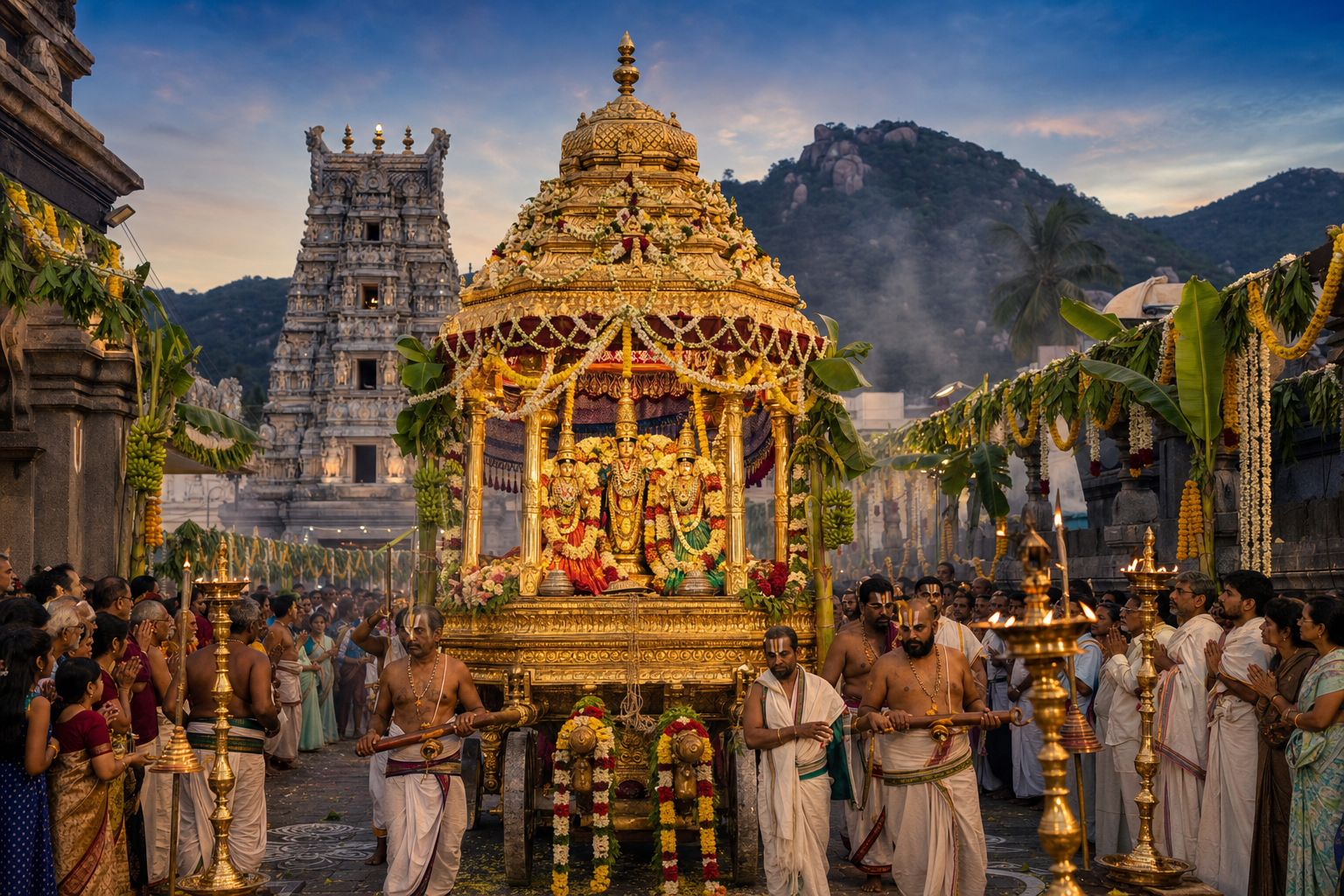
If you can attend Srinivasa Mangapuram Vasanthotsavams on only one day and the Golden Chariot is your priority, choose 8 May 2026. Sri Kalyana Venkateswara Swamy, accompanied by Sridevi and Bhudevi, is scheduled to bless devotees on the Swarna Ratham during the unusually specific 6 pm to 7 pm darshan window.
The three festival days are not interchangeable. Each includes Snapana Tirumanjanam, Unjal Seva, and a ceremonial procession, but the second day adds the Golden Chariot and the final day culminates in prayers for universal welfare. Choose your date by the form of worship you most want to witness, then leave room for TTD to adjust operational timings.
Key takeaways for planning your darshan
- The festival runs from 7 to 9 May 2026 at the Sri Kalyana Venkateswara Swamy temple in Srinivasamangapuram near Tirupati.
- Choose 8 May if Swarna Ratham darshan is essential to your pilgrimage; its announced time is 6 pm to 7 pm.
- All three days include the core cycle of Snapana Tirumanjanam, Unjal Seva, and a procession, so 7 or 9 May still offers the substance of Vasanthotsavam.
- Only the Golden Chariot has a precise time in the announced outline. Confirm the other seva timings through current TTD notices or instructions at the temple.
- Arrive before the procession window, travel with only essentials, and take your place along a permitted route rather than trying to move against the crowd at the last moment.
Choose the festival day that matches your purpose
A useful pilgrimage plan begins with a simple question: are you going primarily for the complete Vasanthotsavam rhythm, the Golden Chariot, or the concluding prayers? The answer matters more than trying to label one day as universally better.
| Date | Festival emphasis | Choose this day if |
|---|---|---|
| 7 May 2026 | Opening day, with Snapana Tirumanjanam, Unjal Seva, and a ceremonial procession | You want to enter the festival from its beginning and experience its recurring ritual sequence. |
| 8 May 2026 | Daily ritual cycle plus the Golden Chariot from 6 pm to 7 pm | Swarna Ratham darshan with Sri Kalyana Venkateswara Swamy, Sridevi, and Bhudevi is your main purpose. |
| 9 May 2026 | Concluding rituals and procession, culminating in prayers for lokakshema | You are drawn to the festival’s completion and its prayer for the welfare of all. |
If you have enough time, attending more than one day changes the experience. You can watch the recurring sevas establish a devotional cadence rather than treating each ritual as an isolated attraction. If you have only a few hours, do not build your plan around an unannounced clock time. The three-day programme identifies the daily observances, but temple authorities may fine-tune the operating schedule.
Follow the ritual sequence, not just the procession
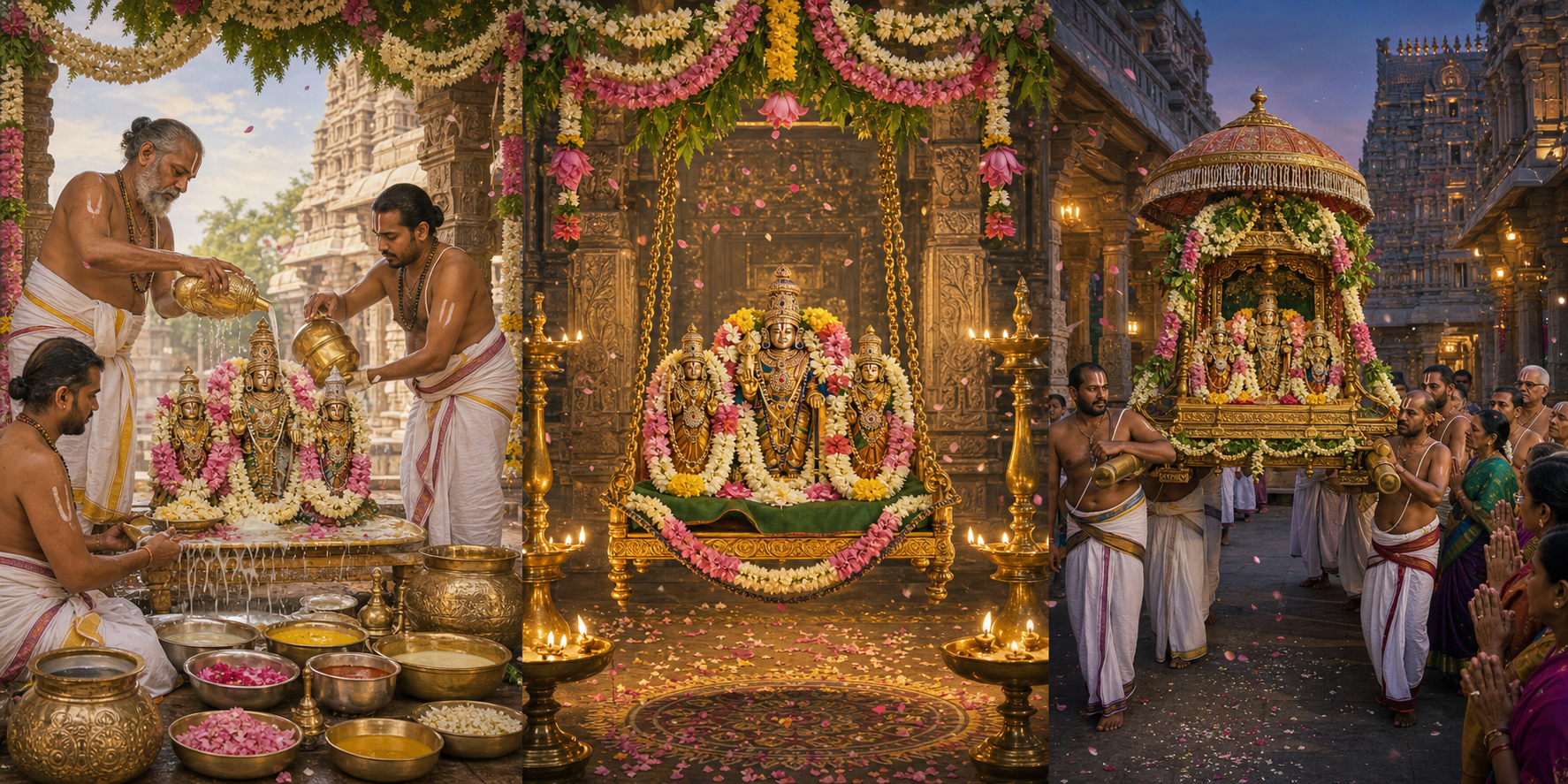
Vasanthotsavam is a festival of renewal and ritual cooling. In the South Indian Vaishnava tradition, its language of ushna-shamana, or soothing heat, appears through fragrant bathing, flowers, sandalwood, and gently paced seva. The outward cooling also gives you an inward discipline: reduce agitation, receive darshan attentively, and let the senses become supports for bhakti rather than distractions.
- Snapana Tirumanjanam: The utsava murtis receive an elaborate ritual bath. The consecrated substances typically include sandal-perfumed water and dravyas such as milk, curds, honey, and tender coconut water, in accordance with the temple’s agamic practice. Do not reduce this to a decorative abhishekam. Its devotional movement is from external purification toward an examination of your own habits, intentions, and attachments.
- Unjal Seva: The deities are placed on an unjal and gently swung, commonly amid Vedic recitation and devotional music. The measured movement evokes balance between the devotee’s inner world and the larger cosmic order. This is the part of the festival in which stillness matters: settle your attention instead of treating every moment as something to record.
- The ceremonial procession: The utsava murtis move into public view, extending darshan beyond the innermost temple precincts. The procession is therefore not an ornamental finale. It expresses a central temple principle: divine presence comes among the gathered community, including people who may not be able to enter every interior space.
The presiding form is Sri Kalyana Venkateswara Swamy, Venkateswara in the auspicious aspect of sacred nuptials. The presence of Sridevi and Bhudevi gives the iconography a balanced devotional meaning: prosperity and protection, material responsibility and spiritual orientation. A family coming for darshan can use that symbolism as a practical sankalpa – not merely to ask for abundance, but to ask for the discernment to use abundance in accordance with dharma.
The festival remains distinctly Vaishnava; its identity need not be blurred to recognize its wider dharmic resonance. Seva, ahimsa, gratitude toward nature, disciplined conduct, and concern for collective welfare are intelligible across Hindu, Buddhist, Jain, and Sikh traditions. Respecting the particular form of worship while noticing these shared values is a stronger basis for dharmic unity than flattening every tradition into sameness.
Plan the Golden Chariot hour deliberately
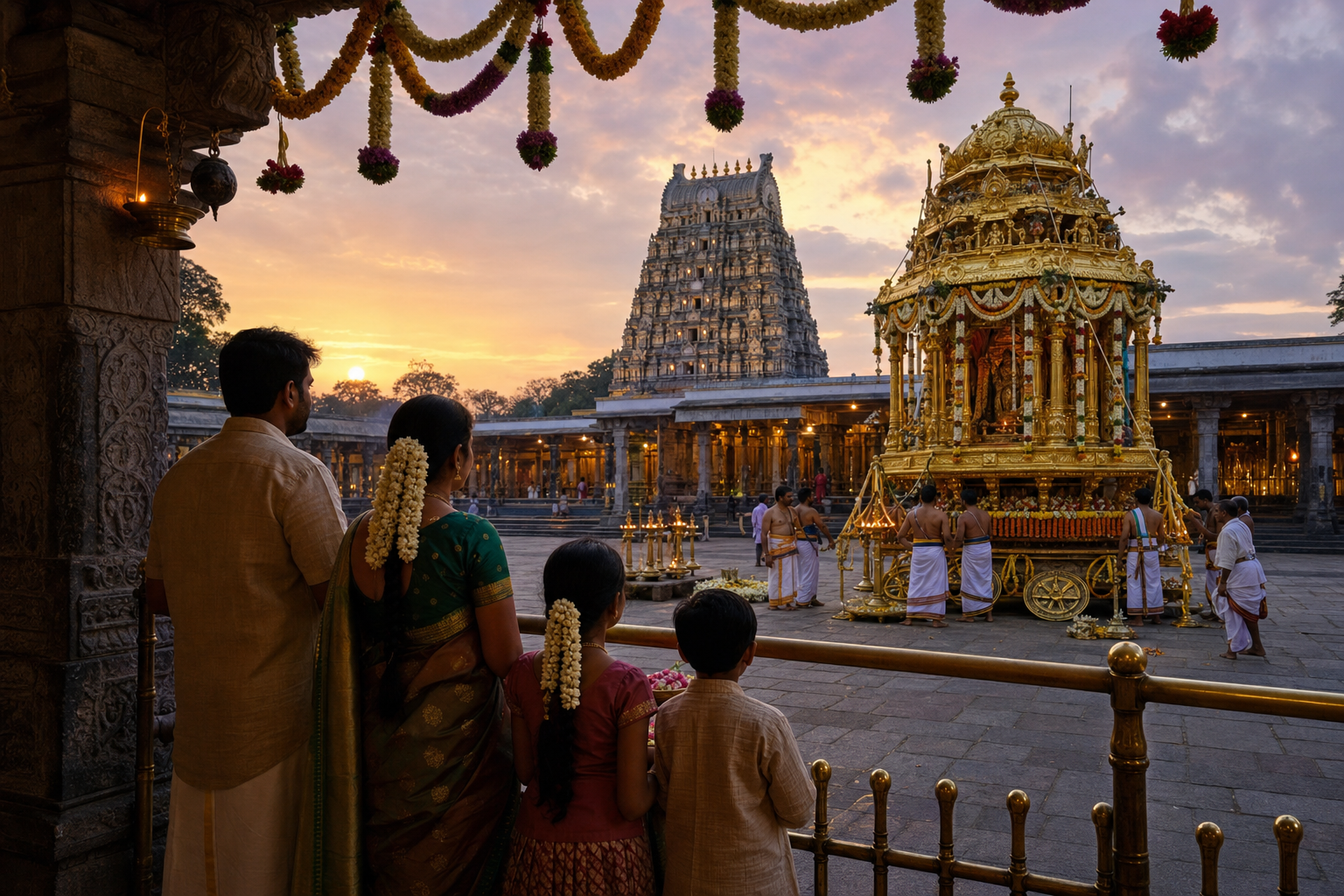
The Swarna Ratham is the visual high point of 8 May, and it will draw the strongest concentration of pilgrims. Gold carries the symbolism of radiance, auspiciousness, and divine grace that does not fade. Yet the splendour of the ratham is meant to deepen humility. Your preparation should therefore protect both your darshan and the ability of others to receive theirs.
- Build the day around 6 pm, not around your arrival in Tirupati. Complete the onward journey to Srinivasamangapuram with enough margin to be inside the managed festival area before the 6 pm start. A transport arrival close to the procession time leaves no room for local movement, queues, or route controls.
- Check the current TTD direction before taking a position. The announced chariot window is 6 pm to 7 pm, but access points, movement corridors, and other operational details can change. On-site instructions take precedence over a plan made earlier.
- Use a permitted viewing route. Trying to cross a controlled corridor for a marginally closer view can obstruct the procession and the devotees around you. Once placed, remain patient and let crowd-management personnel direct movement.
- Carry only what you can keep close. Fewer belongings make queues, security movement, and family coordination easier. Keep any reusable water bottle only where temple rules permit it.
- Agree on a meeting point before entering the dense area. Families should choose an identifiable place outside the main congregation in case members become separated. Do not depend on being able to stop or reverse direction within a moving crowd.
- Verify assistance rather than assuming it. Help for elderly devotees and persons with disabilities may be provided according to current TTD policy and available capacity. Confirm the applicable arrangement before committing someone with limited mobility to the busiest procession hour.
Do not make a tightly timed onward booking immediately after 7 pm. The ratham window may end then, but a large congregation still has to disperse through designated routes. Keeping the rest of the evening flexible protects the devotional purpose of the visit from becoming a race against transport.
Make the Tirupati journey support the pilgrimage
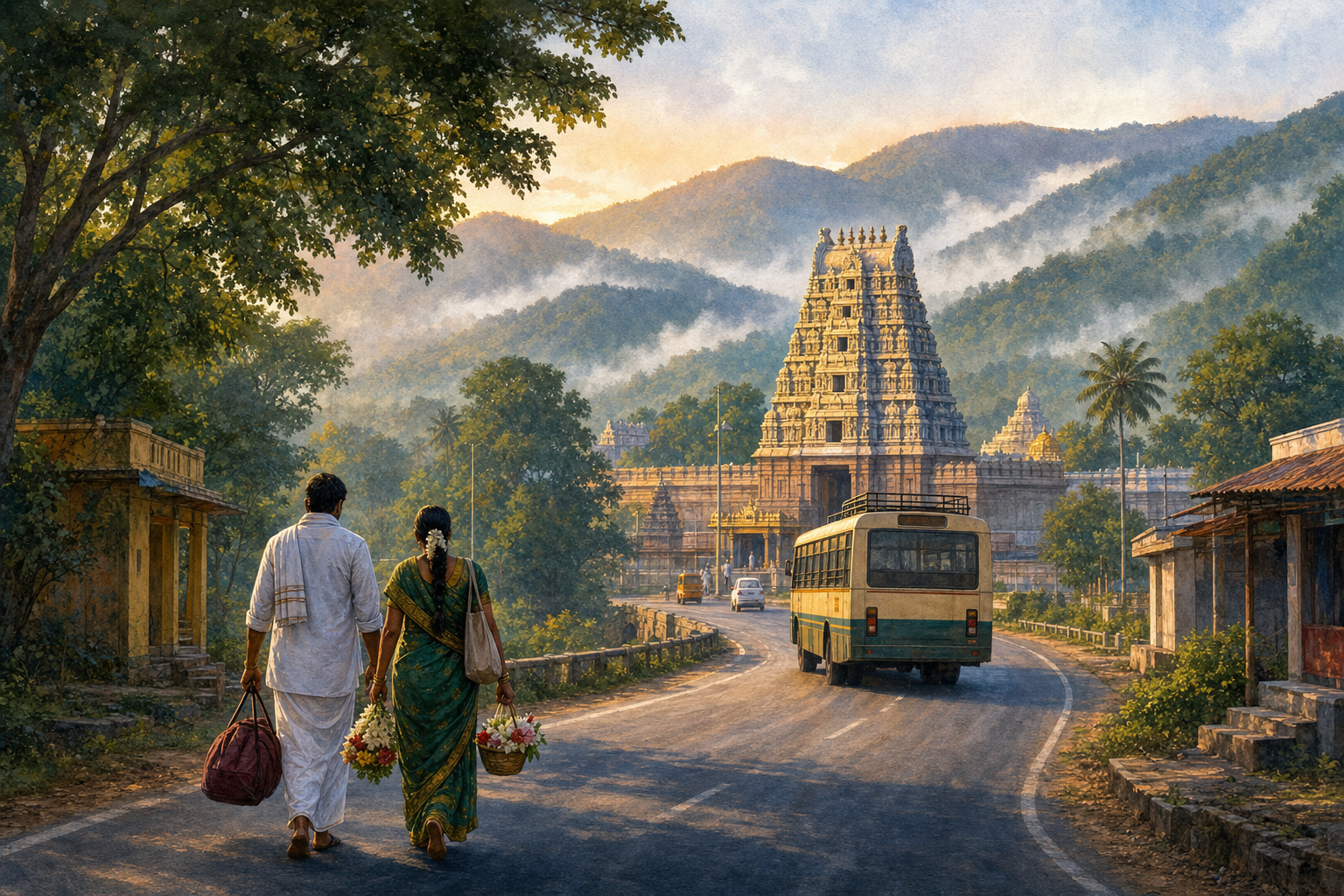
Tirupati is the principal transit hub for Srinivasamangapuram, with rail and air connections and frequent local transport for the onward journey. Festival demand makes advance accommodation and transport planning sensible, but flexibility remains important because local services and temple-side arrangements can change.
Before leaving, separate what must be fixed from what must remain adjustable:
- Fix early: your festival day, travel to Tirupati, accommodation, and the broad plan for reaching Srinivasamangapuram.
- Reconfirm near the visit: seva timings, procession access, local transport operation, permitted items, and assistance arrangements.
- Leave flexible: the period after an evening procession, meal timing, and any optional activity that would force you to abandon a queue or rush through darshan.
TTD customarily arranges measures such as drinking-water points, first aid, signage, and crowd management during major festivals. Treat those as support systems, not as reasons to arrive unprepared. Follow the signs, ask designated personnel when uncertain, and do not presume that a customary facility will be available at every point or at every moment.
Temple etiquette is practical crowd care as much as personal piety. Wear modest clothing, keep your voice low in sanctified areas, maintain the queue, and leave movement corridors clear. Bring no more than you need. Dispose of offerings only as directed, avoid single-use plastic where possible, and carry a reusable bottle only if it is permitted. A clean precinct is not separate from worship; it is seva offered to the deity, fellow pilgrims, and the sacred landscape.
Choose your day now. If it is 8 May, organize the entire itinerary around being settled on a permitted route before the 6 pm Golden Chariot procession. If it is 7 or 9 May, confirm the daily seva timings and give the ritual sequence the time it deserves. Then carry one simple sankalpa into the temple: receive darshan without making another devotee’s darshan harder.