
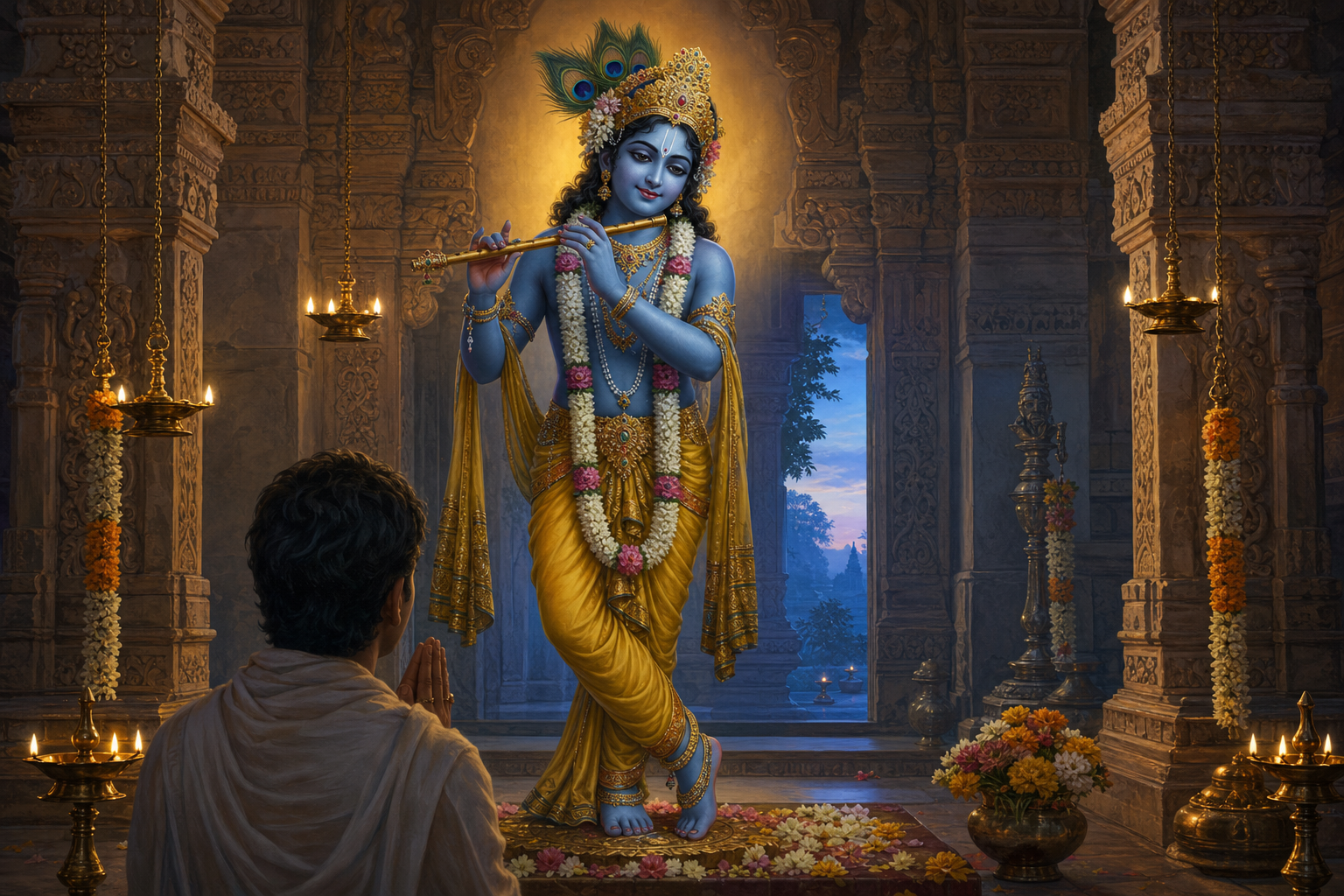
You may be drawn to Krishna’s form, temple adornment, music and līlā, yet still wonder whether you are approaching Bhagavan or simply enjoying a beautiful religious culture. The question becomes sharper around Rādhā-Krishna and the rāsa-līlā: how can the language of longing and intimacy free the heart rather than feed fantasy?
The answer lies in what beauty does to you after the first attraction passes. Krishna-centered aesthetics becomes bhakti when seeing leads to remembrance, remembrance leads to loving attention, and loving attention changes conduct. The decisive test is not how intense the experience feels. It is whether you become less possessive, more truthful, more compassionate and steadier in dharma.
Key takeaways for Krishna-centered bhakti
- Receive darshan as an encounter with divine presence, not as the inspection of an attractive object.
- Treat śṛṅgāra as love refined by devotion. If beauty increases grasping, self-display or indulgence, the movement has not yet become bhakti.
- Use Krishna’s tribhaṅga posture, flute, peacock feather and yellow garment as cues for attention rather than as decorative details to collect.
- Follow the devotional direction of Krishna’s līlā without pretending to reproduce its transcendent relationships in ordinary life.
- Judge practice by its fruit: humility, self-restraint, compassion, truthfulness and sustained remembrance of Bhagavan.
Why beauty can become knowledge rather than decoration
Śṛṅgāra is often translated as the aesthetic mood of love, attraction and beauty. Murti, within Hindu worship, is a consecrated form through which the divine becomes approachable. Sringara Murti therefore does not mean that an ordinary body has been made religiously glamorous. It names a divine form whose beauty can serve as a disciplined way of knowing.
That distinction matters because attraction normally contracts attention around the private self: What do I want from this? How does it make me feel? Can I possess it, repeat it or display it? Bhakti reverses the direction. Krishna’s beauty still awakens feeling, but the feeling is offered back through reverence, remembrance and service. The important movement is from consumption to relationship.
Classical Sanskrit aesthetics calls śṛṅgāra rasa-rāja, the sovereign among rasas. Rasa is not merely a raw emotion. It is emotion made available for contemplative savoring through disciplined form. Abhinavagupta’s idea of sādhāraṇīkaraṇa, or universalization, helps explain the transformation: private feeling loosens its narrow autobiographical ownership and becomes a more spacious experience. You recognize longing, tenderness or wonder without remaining trapped inside the personal story that first awakened it.
Bhakti gives that spacious feeling a divine center. Krishna is not an excuse to worship emotion itself. Emotion becomes a way of attending to Krishna. This is why sacred art, ornamentation, poetry and music can belong to rigorous spiritual life. Form disciplines feeling; devotion gives it direction; dharma tests its truth.
Different Vaishnava lenses preserve different emphases
You do not need to erase the distinctions among Vaishnava traditions to appreciate Krishna’s divine beauty. Each theological lens protects an important part of the encounter:
- Śrī Rāmānuja’s divya-maṅgala-vigraha: the divine form is suffused with perfectly auspicious qualities. Form is not a limitation imposed on the Absolute; it is a gracious manifestation.
- Madhva’s emphasis on sovereignty: Krishna’s accessibility and charm do not cancel his transcendence. Sweetness must not be mistaken for equality between the individual soul and Bhagavan.
- Gauḍīya acintya-bhedābheda: Krishna’s mādhurya, or sweetness, coexists with his aiśvarya, or majesty, through an inconceivable oneness and difference. Intimacy does not dissolve divinity.
Rūpa Gosvāmin’s Bhakti-rasāmṛta-sindhu gives devotional feeling a precise vocabulary. A stable devotional orientation, or sthāyī-bhāva, is deepened by the objects and circumstances that awaken it, the expressions that reveal it, passing emotions and involuntary responses. In his Gauḍīya framework, mādhurya-rasa is the most intimate relation to Krishna. That claim belongs within a developed theology and discipline; it is not permission to call every intense attraction spiritual.
When Krishna’s beauty moves you, make three quiet turns. First, notice the feeling without immediately chasing it. Second, name its devotional possibility: tenderness, wonder, longing or the wish to offer. Third, return attention to Krishna through nāma, prayer or a concrete act of worship. That small redirection is how aesthetic response begins to ripen into bhāva.
Read Krishna’s form as a grammar of devotion
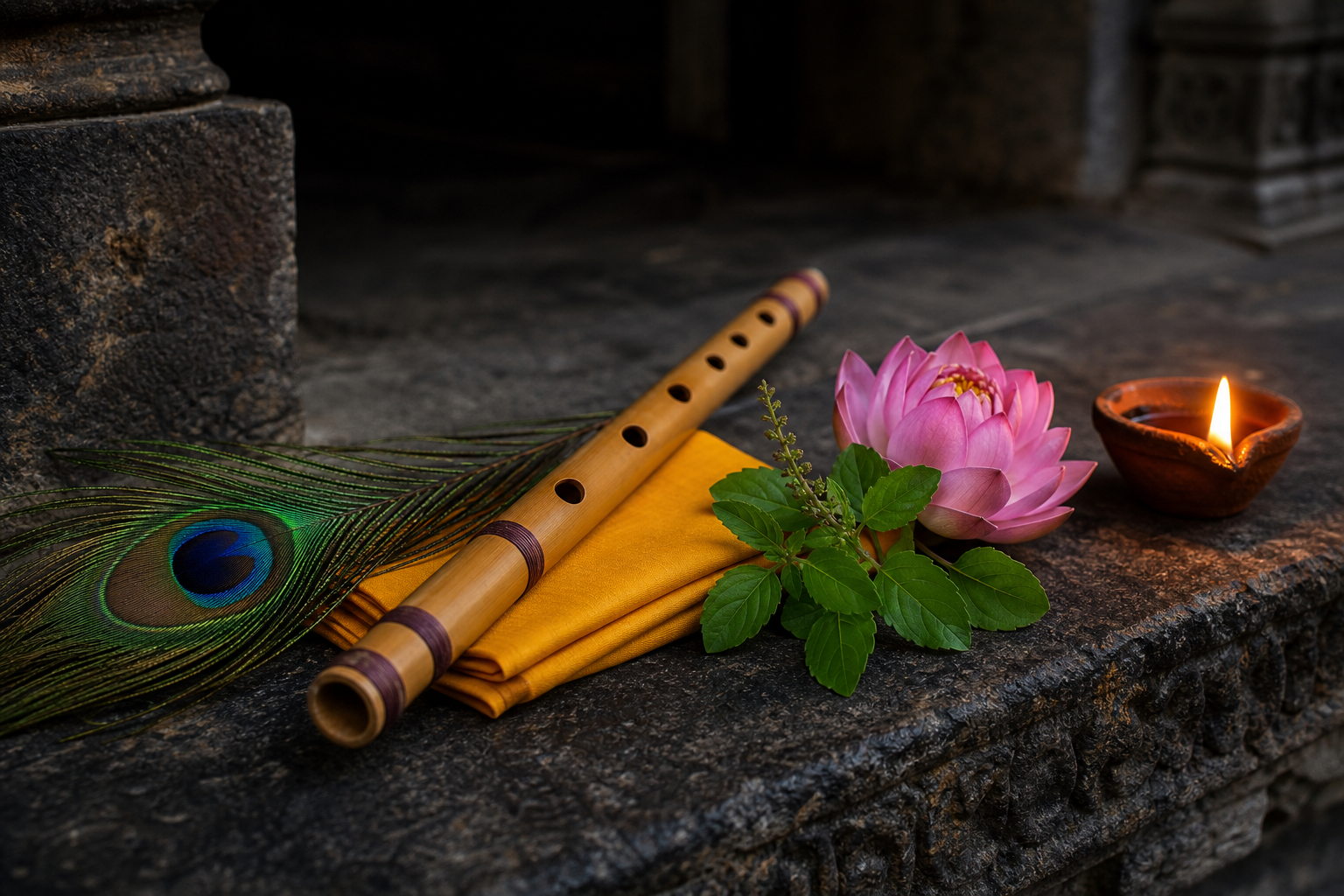
Krishna iconography is not a pile of attractive accessories. Posture, instrument, color and ornament create a visual grammar for divine sweetness. Learn that grammar before adding elaborate private interpretations. It gives your attention something stable to follow.
| Feature | Devotional cue | What you can do during darshan |
|---|---|---|
| Tribhaṅga posture | Three graceful bends create a visual rhythm of suppleness rather than rigidity. | Let your attention become receptive without becoming vague. Hold reverence and tenderness together. |
| Flute, or veṇu | The divine call draws awareness inward even while its beauty enchants the senses. | After looking at the flute, repeat Krishna’s name and notice what competes for your attention. |
| Peacock feather | Cosmic play and layered perception belong within Krishna’s līlā. | Allow wonder, but resist turning every detail into a fixed private omen or prediction. |
| Yellow garment, or pītāmbara | Earthly ripeness is touched and illuminated by divinity. | Bring one ordinary part of your life into remembrance instead of separating worship from daily duty. |
These associations are contemplative cues, not a secret code that mechanically produces revelation. Their purpose is to gather the mind around Krishna. If symbolic analysis leaves you thinking mainly about your own cleverness, return to the whole form and the divine name.
Darshan asks you to receive before you analyze
In ordinary looking, you remain the observer and the visible thing remains an object. Darshan carries a different devotional intention: you come to see and to be seen. Krishna’s murti is therefore not approached like an item in a museum, even when its artistry is extraordinary. The encounter becomes relational.
- Before approaching, choose one feature that will anchor your attention: the eyes, posture, flute, garment or overall form.
- First receive the complete murti. Do not rush into identifying symbols or judging the day’s ornamentation.
- Let your gaze rest on the chosen feature, then connect it to Krishna’s name or one remembered līlā.
- Notice the response without manufacturing emotion. Quiet attention is not an inferior darshan.
- Before leaving, choose one dharmic quality to carry from the encounter into the next duty before you.
Temple proportions and established measures discipline visual beauty so that the form is not governed by an artist’s whim alone. The daily sequence of abhisheka, alankāra, naivedya, ārati and śayana extends the same discipline through time. Bathing, adorning, offering food, presenting light and preparing the deity for rest make devotion relational and rhythmic. They teach that love attends, offers and remains present; it does not merely arrive for a striking image.
If a still image does not readily gather your heart, another traditional doorway may. Odissi and Kathak embody Krishna’s līlā through gesture and rhythm. Hindustani compositions in rāgas such as Yaman and Khamāj voice tenderness and longing. Pahari and Rajasthani paintings use moonlight, night and monsoon landscapes to make the seeker’s inward condition visible. Choose one medium and let it return you to nāma or prayer. Sampling sacred art endlessly without settling into remembrance can become another form of distraction.
Approach Rādhā-Krishna and the rāsa-līlā with discipline
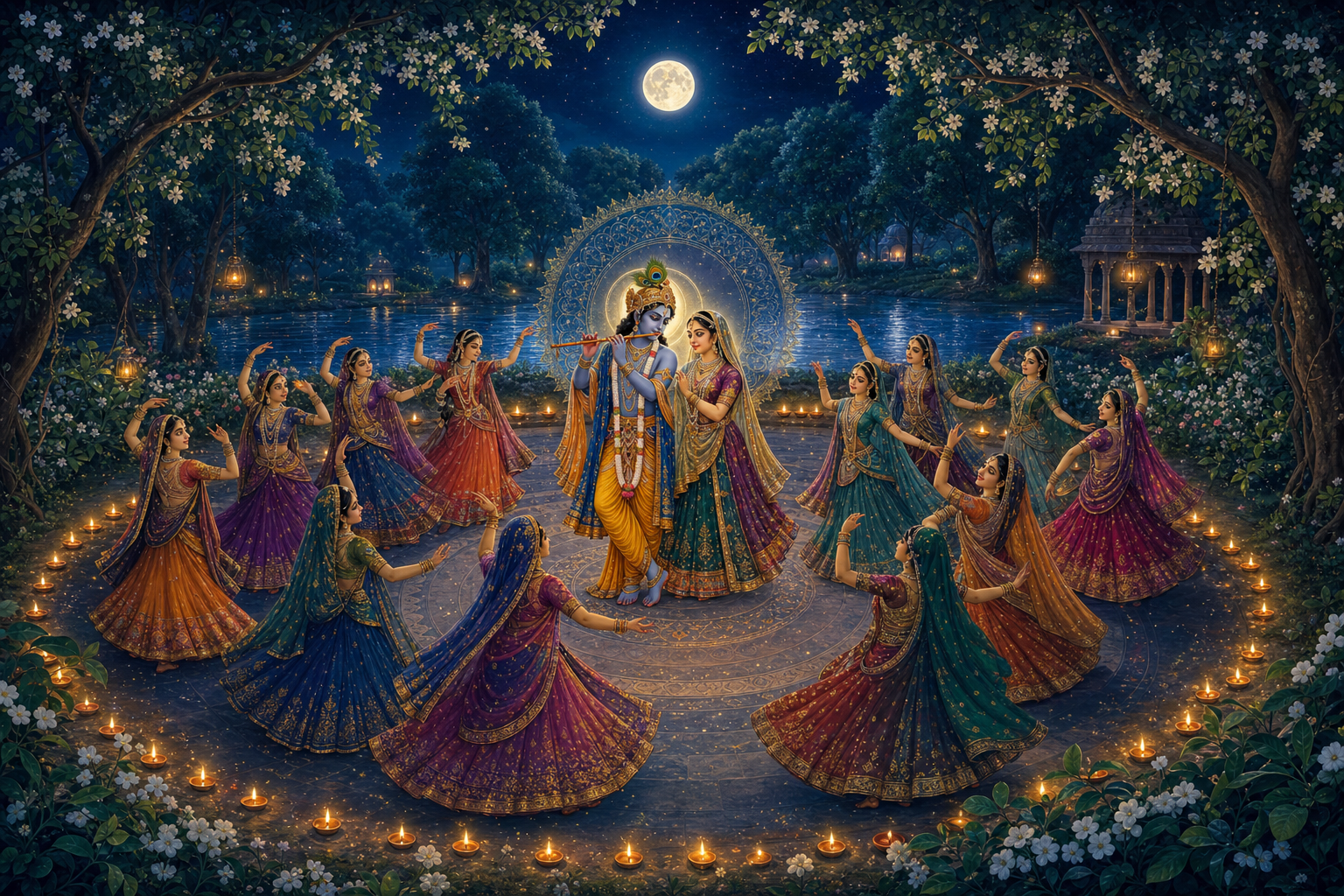
The rāsa-līlā is where many sincere readers become uncertain. One mistake is to reduce it to extraordinary human romance. Another is to strip away every trace of intimacy until nothing remains but an abstract lesson. Both approaches miss the theological claim: divine love can use the language of longing and union while exceeding possessive desire.
Within Gauḍīya theology, Śrī Rādhā is the hlādinī-śakti, Krishna’s bliss potency. Rādhā is therefore not an ornamental companion added to complete a pleasing picture. Rādhā-Krishna reveals divine relationality: lover, beloved and the exchange of love belong to the sacred reality being disclosed. This theological frame keeps śṛṅgāra from collapsing into sentimentality.
Read the sacred drama in its devotional frame
The Rāsa-pañcādhyāyī in Śrīmad-Bhāgavatam 10.29-33 places Krishna’s flute, the gopīs’ response and the circle dance within the Tenth Canto’s revelation of Bhagavan. Jayadeva’s Gītagovinda unfolds separation and reunion through sacred poetry. The Tamil Āḻvārs give yearning, or viraha, a devotional grammar in which apparent absence can purify perception. These are not interchangeable works, but each asks you to let longing become God-centered rather than self-enclosed.
Viraha is especially useful when worship feels dry. It shows that the absence of a consoling emotion is not necessarily the absence of devotion. Longing can reveal what you actually seek. Do you want Krishna, or only a repeatable spiritual feeling? Instead of forcing sweetness, continue nāma-japa, remembrance and ordinary dharmic duty. Yearning becomes purifying when it deepens fidelity rather than grievance.
If you are beginning, read the Bhāgavatam passages within their wider theological context and alongside the interpretive discipline of a trusted sampradāya. Approach the Gītagovinda as devotional poetry rather than as isolated romantic imagery. Let the Āḻvārs teach you that separation can sustain prayer. The purpose is not to flatten the works into one theory, but to prevent fragments from being detached from worship and dharma.
Follow the bhāva; do not imitate the scene
Devotional teaching distinguishes anusaraṇa, following, from anukaraṇa, imitation. Following means receiving the spiritual direction of a līlā: wholehearted attention to Krishna, humility, surrender of possessiveness and constancy in remembrance. Imitation copies an external appearance or claims a transcendent intimacy without the corresponding purification.
Use four tests when a performance, interpretation or private meditation invokes Krishna’s intimate līlā:
- Does Krishna remain Bhagavan? Sweetness should reveal his accessibility without erasing majesty.
- Is the treatment tethered to dharma? Divine līlā cannot be used to excuse deceit, exploitation or lack of self-restraint in ordinary relationships.
- Does it encourage humility? A mature approach does not turn private emotion into a claim of spiritual rank.
- What fruit follows? Increased compassion, truthfulness and steadiness are more trustworthy signs than fascination with erotic detail or emotional intensity.
If one of these tests fails, step back from imaginative participation. Return to Krishna’s name, the whole form of the murti, scriptural context and simple offerings. That is not a rejection of mādhurya. It is how mādhurya is protected from projection.
Build a beauty-centered bhakti practice you can sustain
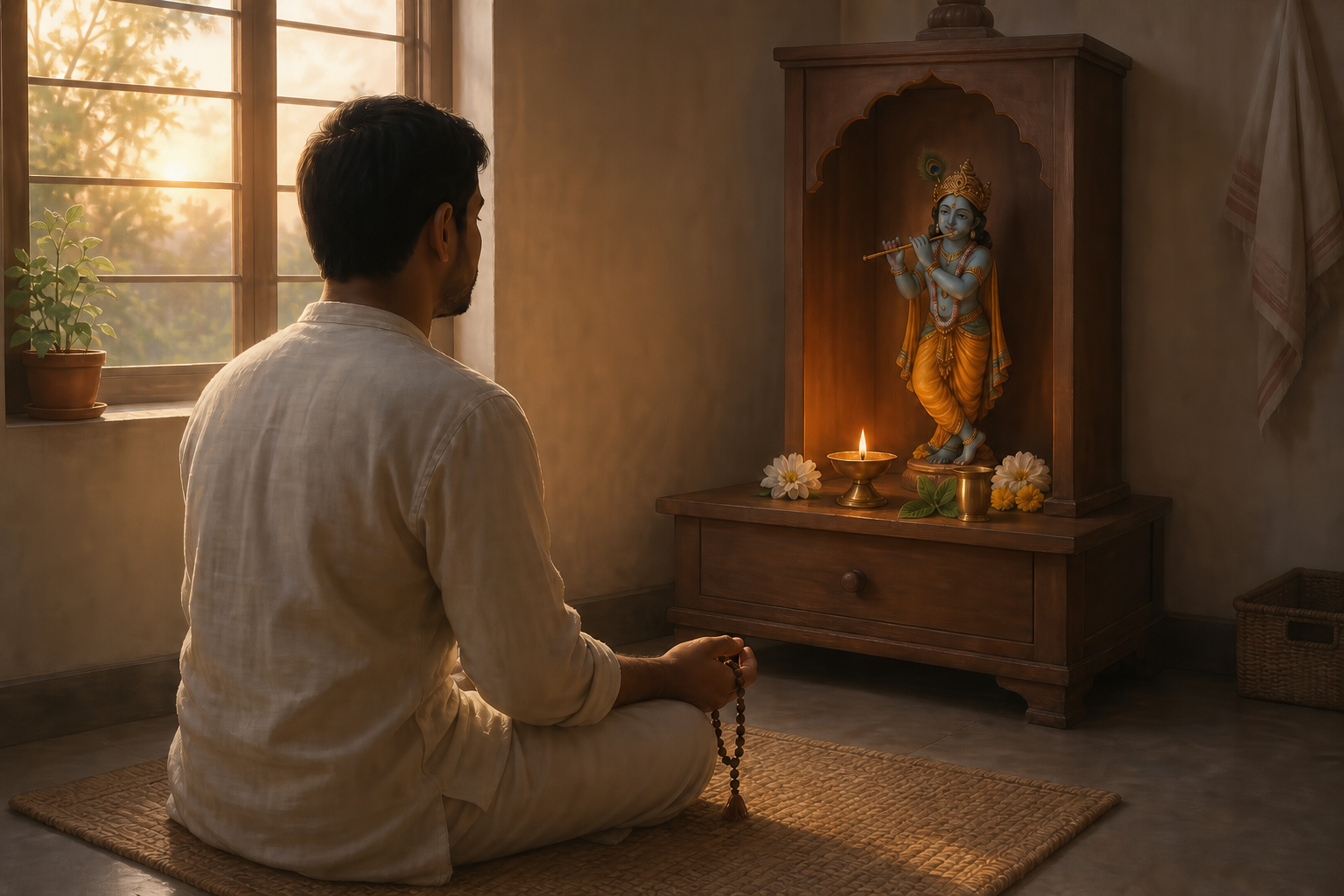
You do not need to reproduce a temple’s complete ritual cycle at home. A small practice can unite form, feeling, remembrance and conduct. The aim is consistency of relationship, not the production of an impressive devotional atmosphere.
A simple sequence for the home shrine
- Prepare the place. Clear unnecessary clutter and approach Krishna’s murti or image with deliberate attention. The preparation marks a transition from casual seeing to worship.
- Offer one beautiful thing. A flower, a safely tended lamp or a sung verse is enough. Let the offering express care rather than display.
- Receive darshan. See the whole form first, then rest attention on one iconographic feature. Do not demand a particular feeling.
- Practice nāma-japa. Repeat Krishna’s name so that aesthetic response acquires a stable devotional center.
- Enter smaraṇa. Recall the meaning of the chosen feature or one līlā connected with it. Keep remembrance anchored in reverence rather than free-floating fantasy.
- Carry one quality outward. Choose truthfulness, compassion, patience, humility or self-restraint and apply it to the next real interaction or duty.
This sequence matters because beauty alone can remain episodic. Nāma steadies it, smaraṇa deepens it, and conduct verifies it. If the practice becomes elaborate but the ethical step repeatedly disappears, simplify the ritual until the connection between worship and life is visible again.
Let the temple calendar educate your emotions
Seasonal worship prevents you from treating Krishna’s beauty as one unchanging aesthetic preference. Jhulan Yatra places the divine couple within the playful movement of the swing. Chandan Yatra brings cooling sandalwood and seasonal care into worship. Rāsa-līlā pageants make sacred drama communal and embodied. Rather than consuming each festival as spectacle, ask what mode of attention the season is teaching: play, care, longing, reunion or gratitude.
At home, families can participate through a flower, a lamp, a song or a remembered verse. A child who helps choose an offering or joins a refrain is learning more than religious information. The household is transmitting a feeling-tone in which beauty is connected with affection, reverence and responsibility.
Examine the fruit without chasing symptoms
Periodically ask three direct questions:
- Does Krishna come to mind outside the shrine, especially before speech or action that requires restraint?
- Has appreciation of divine beauty made you less grasping toward people and experiences, or merely more selective about religious aesthetics?
- Are truthfulness, compassion and steadiness becoming easier to choose when no devotional mood is present?
A quiet practice that changes conduct is not spiritually inferior to an emotionally dramatic one. Tears, stillness, longing or joy may arise, but none should become a trophy. The purpose of rasa is not to build an identity around refined feelings. It is to make the whole emotional life transparent to devotion.
At your next darshan, choose one feature of Krishna’s form, connect it to the divine name, and carry its meaning into one concrete act of dharma. That movement from seeing, to remembering, to living is where divine beauty ceases to be decoration and ripens into bhakti.