
If you are considering Danda Dhauti because it appears in a classical yoga curriculum, the first decision is not which stick to use or how far it should go. It is whether the practice should be attempted at all. For almost everyone practising outside a medically screened traditional setting, the safe answer is no: do not try Danda Dhauti at home.
That answer does not dismiss the kriya or the tradition that preserved it. It places an authentic but invasive practice in its proper context. You can understand what Danda Dhauti was designed to accomplish, recognise why it carries unusual risks, and pursue its underlying yogic goal without turning your oesophagus and airway into a field for experimentation.
What Danda Dhauti is, and what it was meant to serve

Danda means stick or rod, while dhauti means washing or cleansing. The practice belongs to hrid-dhauti, a group of internal cleansing methods concerned with the upper digestive region. Here, hrid should not be misread as an instruction to cleanse the heart muscle. The relevant anatomical territory is the throat, oesophagus and gastric cardia, the area where the oesophagus enters the stomach.
The Gheranda Samhita, usually placed around the 17th century, presents three forms of hrid-dhauti: danda, vamana and vastra. Danda employs a smooth, pliable implement; vamana uses tepid saline water followed by controlled expulsion; and vastra involves swallowing and withdrawing cloth. The Hatha Yoga Pradipika, generally dated to around the 15th century, places dhauti among the six purificatory actions and gives particular attention to vastra dhauti. Later hatha compilations, including the Hatha Ratnavali, expand the classifications and the cautions surrounding advanced cleansing. These differences reflect lineage-specific methods within the wider dhauti family, not one standard procedure suitable for every practitioner.
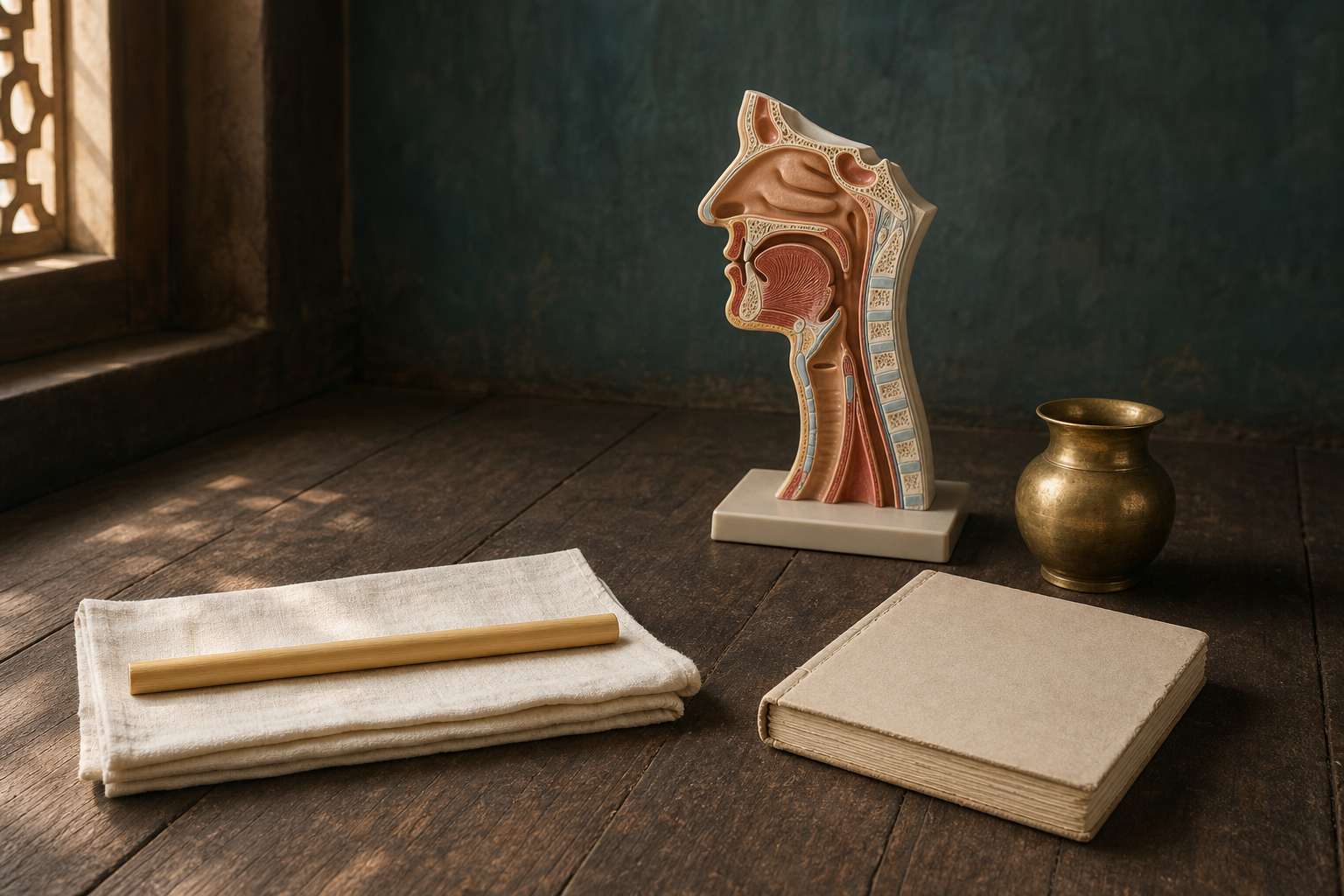
Traditional descriptions refer to a softened, non-abrasive plant stem, such as plantain stalk or turmeric root, introduced under close guidance. That historical detail is not a household recipe. A plant being natural does not make it sterile, smooth enough for internal use, dimensionally appropriate or safe against breakage. Substituting a garden stem, kitchen utensil, plastic tube or improvised catheter adds risks that a reader cannot control through enthusiasm or cleanliness alone.
The intended purpose was to dislodge stubborn mucus and residual matter from the upper gastrointestinal tract, particularly where heaviness in the throat, chest and stomach was thought to interfere with breath discipline. In yogic physiology, this clearing was associated with freer udana vayu, the ascending current linked with speech and uplift, and a more balanced prana vayu in the thoracic field. In the Ayurvedic vocabulary, it was used to address excess kapha and ama around the upper digestive channel and to support agni.
Those terms should be understood within their own system. Kapha is not simply mucus, ama is not a laboratory label for a vaguely defined toxin, and a sensation of congestion does not prove that material must be mechanically scraped away. Traditional practitioners might interpret post-cleansing lightness, vocal resonance or greater sensitivity to breathing as signs of a more responsive pranic field. Modern clinical reasoning asks a different question: did the intervention produce a demonstrable benefit large enough to justify its hazards?
Danda Dhauti is generally treated as the most invasive of the three hrid-dhauti forms. Its rarity is therefore not evidence that modern yoga has lost an indispensable secret. It is evidence that lineages recognised a narrow use case and a high threshold for teaching it. Authenticity does not create a personal indication, and an advanced practice is not necessarily a spiritually superior one.
Why the physiology explains both the effect and the danger
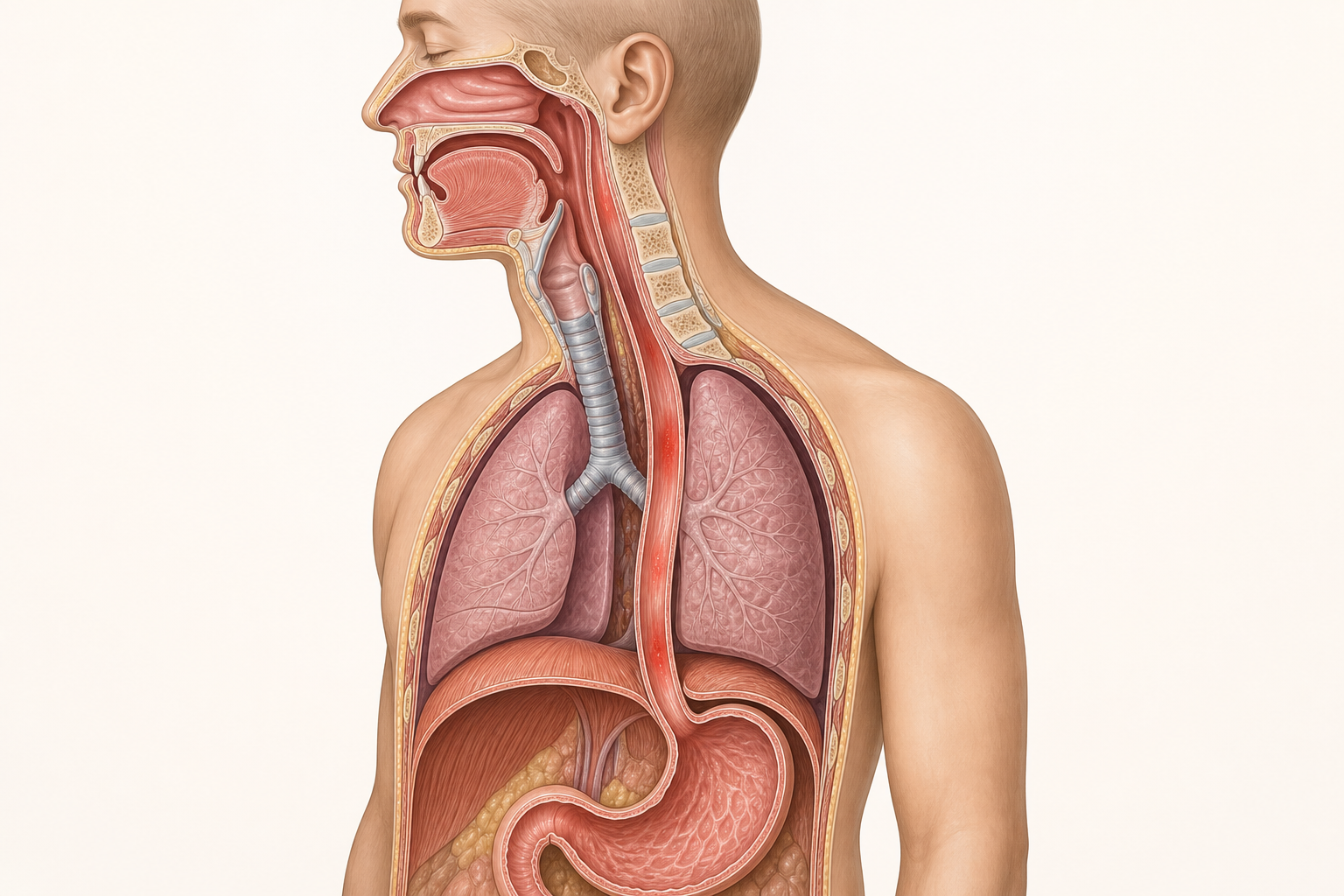
The mouth and pharynx are a shared gateway for the digestive and respiratory tracts. Passing an object towards the oesophagus can provoke gagging, retching, coughing, salivation and protective muscular contraction. These responses are not failures of will. They are part of the body’s attempt to keep a foreign object away from vulnerable tissue and, most importantly, out of the airway.
The oesophageal lining is moist and delicate rather than armoured against friction. An implement that feels smooth in the hand can abrade tissue, catch against a fold or create concentrated pressure during gagging or spasm. The resulting harm can range from irritation to a tear. The larynx and laryngopharynx are also exposed to injury during insertion, withdrawal or an uncontrolled retching movement.
Aspiration is a separate danger. Saliva, mucus, stomach contents or the implement itself can enter or obstruct the respiratory route. Someone who is coughing or struggling to breathe during an attempted internal cleansing does not need encouragement to surrender more deeply to the kriya. The attempt must end, and breathing difficulty warrants urgent medical attention.
Strong stimulation of the gag reflex can also trigger a vasovagal response. Heart rate and blood pressure may fall, producing sweating, nausea, weakness, dizziness or fainting. A practitioner may be tempted to call dizziness an energetic release, but transient bradycardia and light-headedness belong to the documented risk profile. Treat them as physiological warning signs, not proof that purification is working.
Non-sterile material can introduce infection into tissue that may already have been abraded. Reusing an implement, wiping it with a household cloth or rinsing it in ordinary water does not establish medical sterility. The problem is not merely visible dirt. Micro-organisms and tiny surface defects cannot be assessed reliably by eye.
If you or someone with you has already attempted Danda Dhauti, use symptoms rather than spiritual interpretation to decide what happens next:
| What you notice | Why it matters | What to do |
|---|---|---|
| Gagging, coughing or uncontrolled retching | A protective reflex is being strongly activated, with possible airway or tissue risk. | Stop the attempt. Do not force the implement farther or repeat the attempt to overcome the reflex. |
| Dizziness, marked weakness or fainting | This may reflect a vasovagal response affecting heart rate and blood pressure. | Stop. Fainting, persistent symptoms or recurrence requires medical assessment. |
| Sharp throat, neck, chest or upper abdominal pain | Pain can indicate significant irritation or injury. | Do not make another attempt. Seek prompt medical assessment; severe or worsening pain is urgent. |
| Blood in saliva or vomit | Bleeding after instrumentation can indicate mucosal injury or a more serious tear. | Seek urgent medical care rather than watching for a spiritual or cleansing response. |
| Difficulty breathing or swallowing | Airway involvement, swelling, obstruction or deeper injury may be present. | Seek emergency medical help. |
| Fever or increasing pain after the attempt | Delayed inflammation or infection may be developing. | Obtain prompt medical assessment and disclose exactly what was inserted and when. |
There is another reason not to trade these hazards for promised benefits: rigorous peer-reviewed trials specific to Danda Dhauti are lacking. Reports of lightness, clarity and improved breath awareness remain largely subjective and lineage-based. Evidence concerning other shatkarmas cannot be transferred automatically to an instrument placed in the upper gastrointestinal tract. Jala neti improving nasal openness, for example, would not establish that Danda Dhauti safely treats oesophageal or gastric complaints.
An evidence gap is not proof that every traditional claim is false. It does mean that the size, duration and likelihood of benefit are unknown, while plausible routes to injury are readily identifiable. That imbalance should make your threshold for declining the practice lower, not higher.
Medical screening is more than asking whether you feel healthy

Danda Dhauti is generally contraindicated in gastroesophageal reflux disease, peptic ulcer disease, hiatal hernia, oesophagitis, oesophageal varices, bleeding disorders, pregnancy, recent gastrointestinal surgery, and an active infection of the throat or chest. These are not minor modifications to be solved by using a thinner or softer implement. Each can increase the likelihood or consequences of bleeding, aspiration, irritation, infection or structural injury.
Feeling well does not rule out every relevant condition. Oesophageal inflammation, a hiatal hernia or vulnerable veins may not be something you can identify through body awareness. Recurrent heartburn, painful or difficult swallowing, unexplained vomiting, upper abdominal pain, a history of gastrointestinal bleeding, persistent cough after eating, or recent surgery calls for assessment by an appropriately licensed medical clinician. A yoga teacher cannot diagnose these conditions through pulse reading, posture observation or confidence in your constitution.
Medical clearance and yogic competence also perform different jobs. A clinician can assess whether your history or symptoms make upper gastrointestinal instrumentation especially hazardous. A senior practitioner can judge whether a kriya belongs in a particular lineage progression. Neither role cancels the other, and neither can make an invasive procedure risk-free.
The phrase under supervision is often used too loosely. A friend watching in the bathroom, an instructor leading a crowded workshop, or a teacher available by video call does not amount to the tightly controlled and medically screened setting appropriate to this risk profile. Before even considering a programme that includes Danda Dhauti, you should be able to obtain clear answers to these questions:
- What specific training has the instructor received in this kriya, and under which lineage was that training completed?
- What medical history is screened, who performs that screening, and what findings lead to refusal?
- How are the material, cleanliness controls and risk of breakage addressed without relying on improvised household objects?
- What is the plan for bleeding, fainting, aspiration, airway difficulty or an implement that cannot be removed as expected?
- Can emergency medical care be reached immediately, and does the instructor know how to communicate what happened?
- Will the instructor decline to teach the practice when its purpose is unclear, even if the student insists?
An inability to answer any of these questions is enough reason to decline. So are claims that gagging must be conquered, bleeding proves that an obstruction has cleared, faith prevents injury, or discomfort shows karmic purification. Those claims turn predictable warning signs into pressure to continue.
You should also ask what concrete problem the kriya is supposed to solve. Persistent mucus, reflux, chest heaviness, swallowing difficulty or digestive discomfort may require medical evaluation rather than a cleansing procedure. Danda Dhauti must never be positioned as a substitute for diagnosis or treatment.
A safer path to the capacity the kriya was meant to support

The traditional objective was not to collect difficult techniques. It was to make the body, breath and attention steady enough for pranayama and meditation. You can work directly towards that objective without mechanically entering the oesophagus.
In rigorous gurukula-style progressions, practitioners commonly spent months establishing foundational shatkarmas and bodily control before hrid-dhauti was even discussed. Jala neti, kapalabhati and progressive nauli were among the preparatory disciplines. This reference to months describes the culture of gradualism, not a countdown after which Danda Dhauti becomes safe or necessary.
Start by naming your actual aim. If you want easier nasal breathing, a properly taught nasal practice may be more relevant than an upper gastrointestinal procedure. If you want steadier pranayama, consistency, posture, unforced breath awareness and suitable instruction address the skill directly. If the concern is reflux, pain, swallowing or persistent chest and throat symptoms, begin with a clinician rather than a kriya. If the attraction is spiritual advancement, remember that difficulty and invasiveness are not measures of inner maturity.
Contemporary yoga teaching often favours gentler purifications such as jala neti and, in selected settings, sutra neti using medical-grade catheters. Kapalabhati and nauli may also be developed progressively. Vamana dhauti is more commonly encountered than Danda Dhauti, but deliberately inducing emesis is still not a casual home substitute and should remain under qualified oversight. Each practice has its own indications and cautions; safer does not mean universally appropriate.
A prudent progression looks less dramatic: clarify the problem, obtain medical assessment when symptoms are present, build ordinary steadiness, learn lower-risk techniques from a competent teacher, and judge progress by the quality of breath and attention. If those measures already support practice, there is no missing spiritual credential that Danda Dhauti must supply.
This restraint belongs inside Dharma rather than outside it. Hindu, Buddhist, Jain and Sikh disciplines differ in doctrine and method, yet each gives serious weight to purity, simplicity, self-command and responsible conduct. Saucha begins in how you eat, rest, speak, act and care for the mind. Ahimsa sets a boundary around the means used to pursue purification. A technique cannot serve clarity when ambition prevents you from recognising avoidable harm.
Key takeaways
- Danda Dhauti is a rare, invasive form of hrid-dhauti, not a routine cleansing exercise or a prerequisite for spiritual progress.
- Its traditional goal was to reduce upper-tract heaviness and prepare the practitioner for subtler breath and contemplative work.
- Its hazards include mucosal injury, oesophageal spasm, aspiration, vasovagal dizziness or bradycardia, bleeding and infection.
- GERD, ulcers, hiatal hernia, oesophagitis, oesophageal varices, bleeding disorders, pregnancy, recent gastrointestinal surgery, and active throat or chest infection are reasons not to attempt it.
- No household material, online demonstration or distant observer turns it into an appropriate home practice.
- Medical assessment for symptoms, foundational yoga, lower-risk purification and steady pranayama offer a more proportionate route to the intended goal.
If Danda Dhauti appears in a course, retreat or private lesson you are considering, pause before consenting. Ask what problem it addresses, obtain independent medical screening where relevant, and require a credible answer to every safety question above. Walking away from an unnecessary invasive kriya is not a failure of courage. It can be the clearest expression of viveka, disciplined discernment, in your practice.