
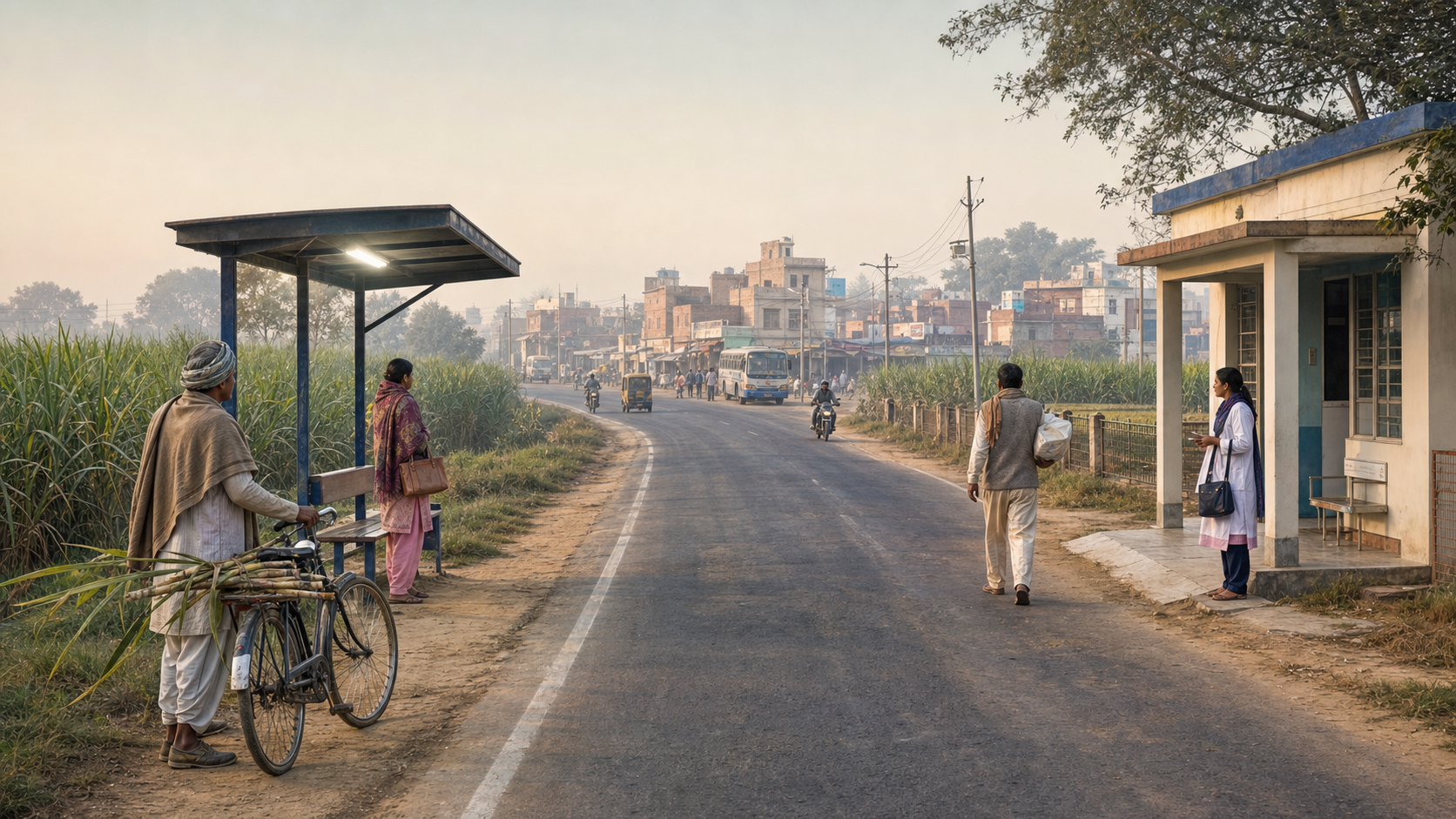
You may hear the line ‘from fatwas to vikas’ and wonder whether it marks a governing change or simply a more disciplined campaign slogan. Do not begin with the size of the crowd. Begin with the frictions that shape an ordinary week: a delayed cane payment, an expensive last-mile journey, a stalled artisan order, an unsafe trip home, or a hospital that cannot provide the next level of care.
Yogi Adityanath’s development-first strategy in Deoband is credible only if cultural assertion becomes a promise of public service, and if that service can be checked district by district. For you, the useful question is not whether identity has disappeared from politics. It has not. The question is whether identity now binds political power to measurable delivery.
Why Deoband can carry a Western UP-wide message
Deoband is not a neutral campaign stage. It is associated with Islamic theological scholarship, while the surrounding sacred geography includes Bala Sundari in Deoband and Shakumbhari Devi near Saharanpur. That overlap allows one address to place religious authority, Hindu cultural memory and the performance of the state in the same political frame.
Invocations of Shakumbhari, Bala Sundari and Shri Ram are therefore more than decorative additions to a development speech. They ask the listener to interpret Hindu confidence as a duty of seva, satya and samriddhi: service, truth and shared prosperity. This is not post-identity politics. It is an attempt to give identity an administrative test.
Seen strategically, Deoband performs three political jobs at once:
- It changes the stated object of conflict. The target is presented as sectarian diktat and political veto, while development becomes the common alternative.
- It broadens the possible coalition. Roads, irrigation, reliable policing, healthcare and market access can serve citizens whose religious and caste identities differ.
- It makes sacred language answerable to civic results. If a leader invokes revered names as calls to protect and uplift, the administration must show whom it protected, what it delivered and where it fell short.
This coalition logic matters because Western Uttar Pradesh includes Jat farmers, Dalit communities, traders, migrant workers and a substantial Muslim population. None of these groups is politically or economically uniform. A cane grower may judge the state through mill payments and irrigation. A trader may care first about security and transport. A graduate may ask whether local training leads to local work. A Muslim family may ask whether universal delivery really includes them.
Development creates common ground only when those different tests receive concrete answers. A flagship project cannot compensate indefinitely for unresolved farm cash flow, weak local transport or selective enforcement. The strategy is broad precisely because its burden of proof is broad.
Vikas has to solve four different Western UP problems
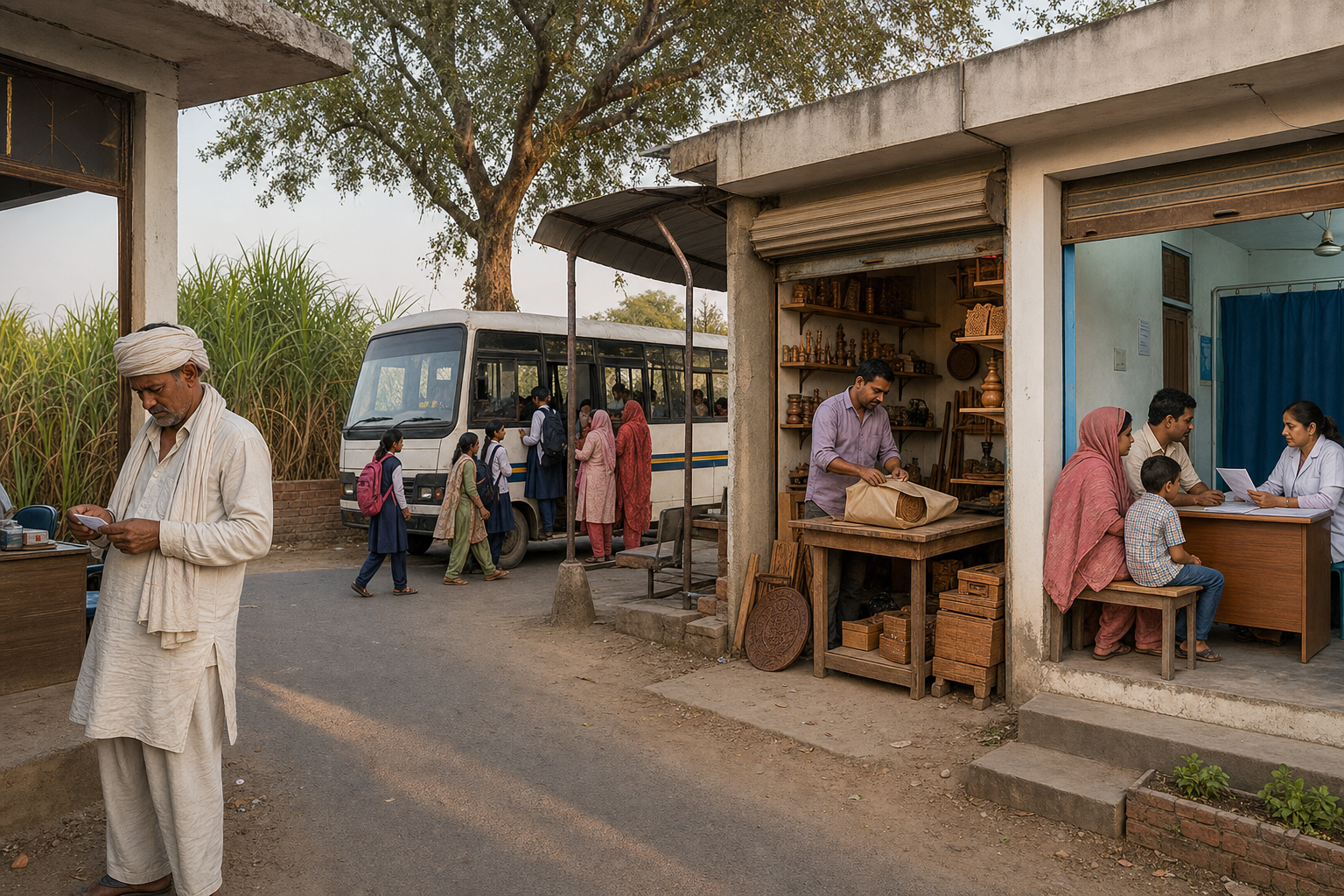
Western UP is simultaneously a sugarcane heartland, a manufacturing belt and a peri-urban corridor connected to the National Capital Region. A development-first message must therefore work at four levels. Treating all infrastructure or welfare spending as one undifferentiated achievement will hide the bottleneck that matters to each household.
1. Farm policy must improve cash-flow predictability
In a cane economy, the first test is not how many agricultural announcements were made. It is whether the grower can predict when the mill will clear payment. A delay can affect household purchases, input decisions and the ability to plan the next crop. Cane-payment turnaround should therefore sit near the top of any Western UP governance dashboard.
Irrigation must be judged with the same precision. A connection, sanctioned project or installed device is an output; water arriving reliably when a crop needs it is the outcome. Track the timing and dependability of irrigation alongside PMKSY interventions, micro-irrigation adoption, crop-diversification support, cold-chain access and the practical effects of ethanol policy. These measures address different risks and should not be merged into a single claim of farmer welfare.
2. A transport corridor must connect the last mile
The Delhi-Meerut Regional Rapid Transit System, the Ganga Expressway, peripheral expressways around Delhi and highway upgrades through the Saharanpur-Muzaffarnagar-Meerut corridor form the mobility backbone of the development pitch. Their political value, however, does not end when the main corridor becomes operational.
For every large transport claim, ask two separate questions. Has it reduced the relevant intercity journey time? Can a village, market, industrial cluster or residential neighbourhood reach it without an expensive or unreliable final leg? A major corridor can improve the regional map while merely moving congestion and cost to the feeder road, bus connection or freight-transfer point.
That is why annual travel-time audits should specify the origin, destination and kind of journey being measured. A commuter trip, a truck movement and a farmer’s journey to market do not receive the same benefit from the same road. Completion status is useful, but access and actual journey time tell you whether the project has entered daily life.
3. Traditional industry needs orders, not only credit
Meerut’s sports-goods industry and Saharanpur’s woodcraft economy show why Western UP cannot rely on a single model of industrialisation. These are established local capabilities that can gain from technology upgrades, quality certification, e-commerce onboarding, better logistics and export access.
Credit facilitation and One District One Product support matter, but a sanctioned loan is not the same as a stronger enterprise. Ask whether firms are receiving more viable orders, reaching new markets and completing payments through lower-friction channels. For women-led enterprises, check both access to finance and access to buyers; credit without a route to market can simply shift risk onto the borrower.
Skills policy needs a similar outcome test. ITIs and polytechnics should publish the local industries their courses serve and the employment pathways attached to those courses. A new seat is useful only when its training corresponds to real work in manufacturing, mechatronics, logistics, agro-processing or another identifiable regional activity.
4. The everyday state must be reliable and lawful
Piped water through Jal Jeevan Mission, electrification, clean cooking, PMAY housing and digitised benefit transfers are presented as the everyday delivery layer. Judge them by reliability and usable access, not coverage claims alone. A household connection that works intermittently is not equivalent to a dependable service, and a registered beneficiary who cannot resolve an error has not received frictionless governance.
Healthcare and public safety belong in this same category because both determine whether a family can live and work with confidence. District-hospital capacity, nursing and paramedical seats, functioning women help desks and crime-resolution times are more informative than isolated inaugurations or dramatic enforcement images.
Law and order can create the predictable environment that commerce, education and community life require. But the word predictable must apply to the state as well as the citizen. Police modernisation, faster handling of heinous crimes and asset forfeiture against organised criminal networks remain developmental only when evidence, oversight and due process govern their use. Selective or opaque coercion may produce fear, but it does not produce durable civic trust.
Cultural assertion must not become collective blame

A fatwa has a specific theological meaning, but campaign language uses the term more loosely as shorthand for a sectarian diktat that is said to obstruct civic priorities. That compression makes the slogan memorable. It also creates the strategy’s greatest risk.
If the target is coercive politics, intimidation or an attempt to place a religious veto above equal law, political leaders should identify that conduct precisely. If the language slides into a general verdict on Muslims, the claim of development without discrimination defeats itself. A neighbour’s faith is not evidence of a political veto, and a theological institution is not interchangeable with an unlawful act.
For a pro-Hindu reader, the standard should be demanding rather than defensive. Hindu civilisational confidence must be capable of fairness. Honouring Bala Sundari, Shakumbhari Devi and Shri Ram does not require the erasure of Deoband’s Muslim citizens or institutions. It requires a state strong enough to resist intimidation, protect temple traditions, enforce equal law and deliver public goods without communal bargaining.
Three guardrails keep development-first politics on that course:
- Name the conduct being opposed. Criticise threats, unlawful pressure, organised crime or preferential vetoes with evidence. Do not convert an allegation against an actor into suspicion of an entire community.
- Publish the distribution of delivery. District dashboards should make it possible to see which villages and neighbourhoods received water, roads, health capacity, enterprise support and policing improvements.
- Bind enforcement to constitutional procedure. Record the grounds, process and outcome of serious enforcement actions, keep them open to oversight, and consult religious, educational and civic institutions before local tensions become wider confrontations.
This is not a concession to political timidity. Social cohesion is an economic input. Rumours can disrupt markets, schools, transport and ordinary cooperation long before they reach a courtroom. District dialogue forums and rapid-response mediation can contain that damage, especially when participants already know one another through practical service.
A wider dharmic framework can strengthen this discipline. Hindu, Buddhist, Jain and Sikh traditions do not erase their doctrinal differences, but they offer overlapping civic languages of self-command, seva, compassion, truthfulness and respect for more than one spiritual path. Joint blood donation, flood relief and school-improvement work can turn those values into visible cooperation. Such projects do not replace public policy; they help preserve the trust that allows policy to work.
Digital political communication is the immediate stress test. Before you forward a clip alleging disorder, appeasement or discrimination, look for its date, location, full context, official response and verifiable outcome. If those elements are absent, do not use the clip to judge a whole community. A development-first campaign should answer rumours with local facts, open delivery data and examples of citizens solving problems across religious lines.
A public scoreboard makes the strategy believable
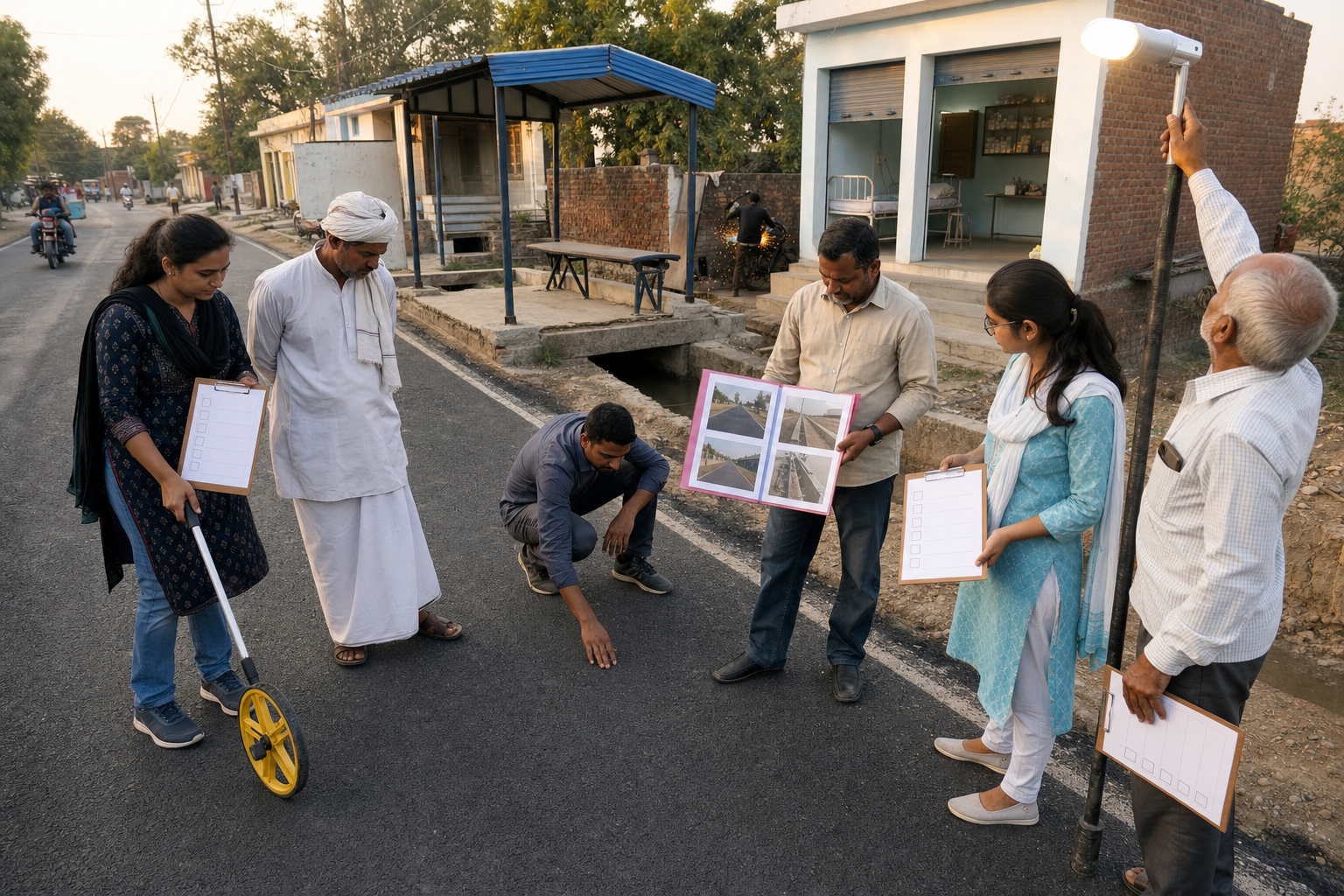
The question ‘Has development happened?’ is too broad to be useful. Replace it with a small set of repeatable questions. The following scoreboard separates a political promise from the evidence needed to assess it.
| Policy test | Question you should ask | Evidence that matters |
|---|---|---|
| Connectivity | Are relevant passenger and freight journeys actually easier? | Annual travel-time audits, operational status, feeder access and last-mile logistics |
| Agriculture | Can growers predict payment and manage water risk? | Cane-payment turnaround, irrigation reliability, micro-irrigation adoption, diversification support and cold-chain access |
| MSMEs | Can a local firm make, certify and sell more effectively? | Export growth, technology upgrades, quality certification, e-commerce onboarding and market access for women-led firms |
| Human capital | Can residents move from learning to earning and obtain adequate care? | ITI and polytechnic links to local work, female labour-force participation, district-health outcomes and nursing or paramedical capacity |
| Public safety | Is enforcement timely, fair and predictable? | Crime-resolution times, functioning women help desks, due-process records and oversight of serious enforcement actions |
| Social cohesion | Can a local dispute be contained without collective punishment? | District dialogue forums, rapid mediation capacity, transparent corrections and cross-community service efforts |
Start with a baseline. For every measure you choose, record the district, the definition and the observation date. Compare the same measure annually. If the definition changes whenever the result becomes inconvenient, the dashboard has become campaign decoration rather than public accountability.
Next, classify every large claim as announced, funded, under construction, operational or producing a measurable outcome. These stages are not interchangeable. A sanctioned road is not an operational road. An operational road is not automatically a shorter village-to-market journey. A training programme is not a job, and a household connection is not a reliable service.
Compare each district with itself over time before relying on a broad state average. A regional headline can conceal a neglected block, a weak feeder network or a hospital that has not gained the staff needed to use its facilities. Local scrutiny is especially important in Western UP because its farm, manufacturing and peri-urban economies encounter different bottlenecks.
Finally, resist the temptation to collapse everything into one triumphal score. A region can travel faster while its artisans struggle to secure orders. Crime resolution can improve while due-process concerns remain. Cane payments can become more disciplined while irrigation reliability lags. Development-first politics should be able to acknowledge partial progress without using one flagship success to silence every unresolved grievance.
Key takeaways for judging the Deoband strategy
- Deoband matters because Islamic theological scholarship and a living Shakti landscape meet in the same region, allowing cultural identity and state performance to be tested together.
- The strategy does not abandon Hindutva. It asks Hindu symbols to carry an administrative obligation expressed through service, truth, security and shared prosperity.
- Western UP needs separate tests for farm cash flow, corridor access, MSME competitiveness, human capital and lawful public safety. One flagship project cannot stand in for all five.
- The word fatwa should identify a claimed form of sectarian diktat, not become a collective label for Muslim citizens. Precision protects both equal law and the credibility of the development message.
- Before the 2027 Uttar Pradesh polls, judge delivery through stable district-level measures such as cane-payment turnaround, journey times, MSME export growth, female labour-force participation, health outcomes and crime-resolution times.
Before the next rally or forwarded campaign clip, write down one local indicator for agriculture, mobility, enterprise, healthcare and public safety. Place every claim in its proper stage: announced, funded, operational or measurably useful. That small discipline turns you from a target of political messaging into a judge of governance.
The Deoband strategy should welcome that scrutiny. If invocations of Shakumbhari, Bala Sundari and Shri Ram lead to fair delivery, safer civic life and wider opportunity, cultural confidence will have become a durable public compact. If the indicators do not move, then the language changed while the politics did not.