
Your temple may announce a Vaigasi festival while your family Panchang gives the day a Vaishakh or Jyeshtha label. Another calendar may place the same observance a day earlier. That is not necessarily a contradiction: Tamil solar months, lunar tithis, nakshatras, and temple customs answer different calendrical questions.
Use this planner to separate dates you can enter now from dates that still require local confirmation. That distinction matters most for Vaikasi Visakam, after-midnight tithi changes, temple travel, and any ceremony for which you need a genuine muhurta rather than a general festival date.
Why one sacred season appears under several calendar names
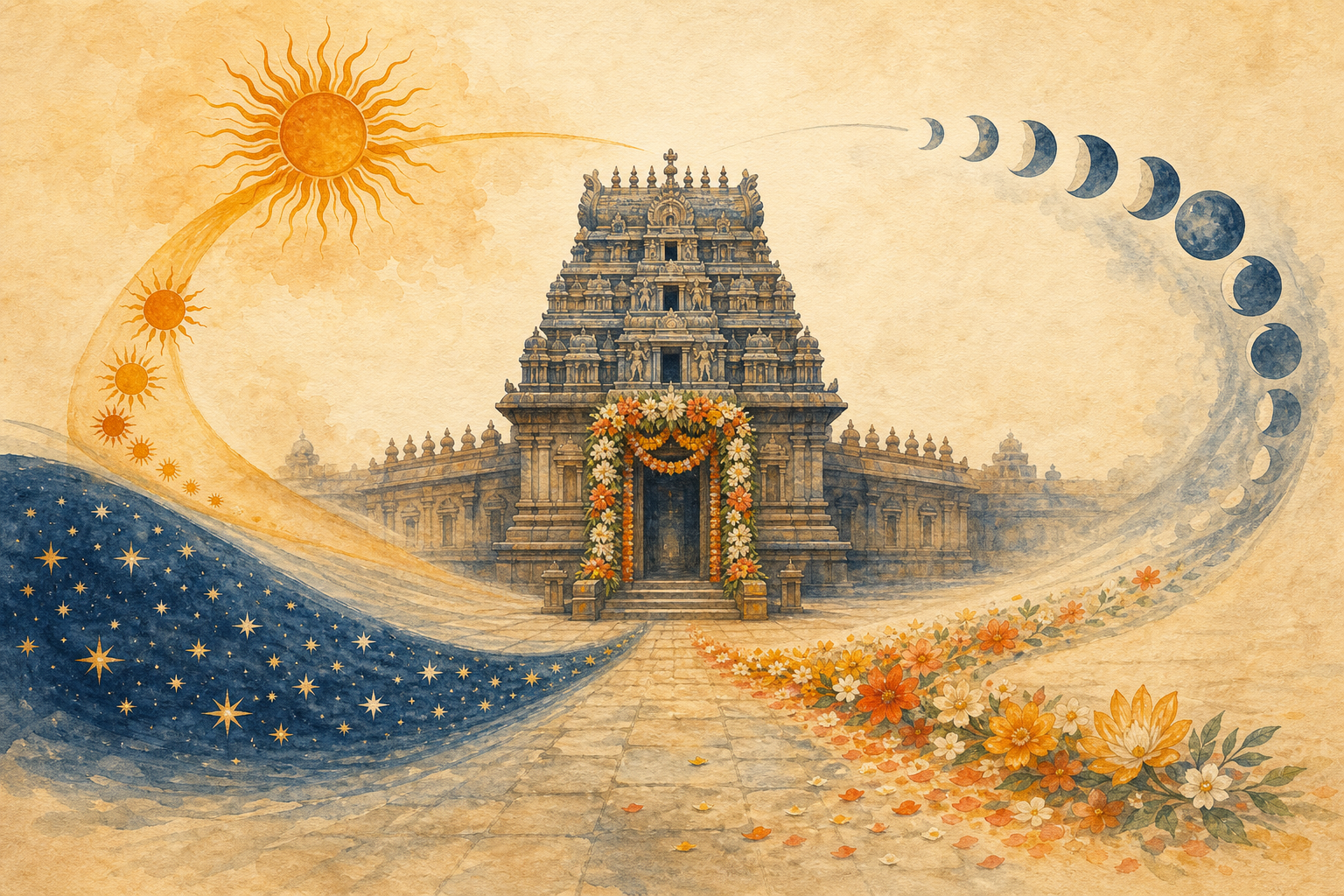
Vaigasi, also written Vaikasi, is the second month of the traditional Tamil solar calendar. In 2026 it runs from 15 May through 14 June in Indian Standard Time. It begins with Surya’s entry into the sidereal sign of Rishabha and ends before the transition into Mithuna and the Tamil month of Aani.
That solar boundary gives you the container, not every observance inside it. Vaigasi overlaps the latter part of lunar Vaishakh and the beginning of Jyeshtha. Its festivals can then be selected by tithi, nakshatra, weekday, or a temple’s inherited utsavam schedule.
- Tamil solar month: Use this to identify the Vaigasi season and its 15 May-14 June boundary.
- Lunar tithi: Use this for Amavasya, Pratipada, Ekadashi, Trayodashi and Pradosham, Pournami, and other vrata days.
- Nakshatra: Use this for Vaikasi Visakam and thirunakshatram observances.
- Temple and lineage custom: Use this for Brahmotsavam processions, Garuda Sevai, abhishekam bookings, kavadi arrangements, and the precise form of household worship.
The lunar month name can also differ without changing the tithi itself. In an amanta calendar, the bright fortnight beginning after Amavasya starts a new lunar month; in a purnimanta calendar, it is the bright fortnight of the month already in progress. If relatives use different systems, compare the tithi and its local start and end times before concluding that one calendar is wrong.
The four dates and windows to mark first
Enter these anchors before filling the month with recurring vratas. The final column tells you whether to treat the entry as firm, location-sensitive, or provisional.
| Date or window | Sacred-calendar signal | What you should enter |
|---|---|---|
| 15 May 2026 | Vrishabha Sankranti and the beginning of Vaigasi in IST | Enter as the firm opening of the Tamil month if you follow the stated IST calendar. |
| 17 May 2026 | Reference timing: Amavasya until 1:37 AM; Shukla Pratipada from 1:37 AM to 11:14 PM; Dwitiya thereafter | Enter the observance with a location-check flag. Do not assume these clock times apply unchanged outside the Panchang’s locality. |
| On or around 31 May 2026 | Expected Vaikasi Visakam window | Hold the date provisionally. Confirm when Visakam nakshatra prevails in your city and which day your temple selects. |
| 14 June 2026 | Final day of Vaigasi before the Aani or Mithuna transition | Enter as the close of this Tamil-month planner, subject to the stated IST convention. |
The important asymmetry is easy to miss. The Vaigasi boundary is a solar-month date stated for IST, while Vaikasi Visakam depends on a nakshatra span and May 17 contains a tithi transition. Copying all four entries as though they were identical all-day events would erase the very information you need for worship.
How to use each observance rather than merely record it
May 17: move deliberately from Amavasya to Pratipada
On Sunday, 17 May, the reference tithi sequence changes twice: Amavasya ends at 1:37 AM, Pratipada continues until 11:14 PM, and Dwitiya begins immediately afterward. Most of the waking day therefore falls under the first tithi of Shukla Paksha.
If your family performs Amavasya japa, deepa-dana, a restrained vrata, or pitru-tarpana, do not automatically force the rite into the short interval after midnight. Family traditions that require a daylight Amavasya may assign the observance to the preceding civil day when that tithi prevails. Check the local Panchang and follow your kula or acharya’s rule for deciding the day.
After Pratipada begins, you can use the daylight period for a fresh sankalpa, cleaning and relighting the shrine, beginning a study discipline, making dana, or starting a modest wholesome project. Worship may be directed to Ganesha, Vishnu, Shiva, Devi, or the Kula Devata according to your sampradaya. This is a practical initiating window, not an automatic approval for every samskara.
If you are selecting the start time of a new undertaking, calculate Sunday’s Rahu Kaal from your own sunrise and sunset and also check Yamaganda and Gulika where your tradition observes them. A favorable tithi does not cancel those diurnal considerations. For a wedding, griha pravesham, or another consequential ceremony, Pratipada alone is not enough to establish the muhurta.
Vaikasi Visakam: prepare for two major devotional currents
Vaikasi Visakam is expected on or around 31 May 2026, but the exact observance depends on the local span of Visakam nakshatra. Marking 31 May as tentative is more accurate than presenting it as a universal date.
- For Murugan devotees: Plan abhishekam, alankaram, Kanda Shashti Kavacham recitation, kavadi where it belongs to your practice, and participation in the temple procession.
- For Sri Vaishnavas: The same Visakam star is the thirunakshatram of Sri Nammalvar. Tiruvaymoli recitation and service connected with the Alvar tradition give the day its distinct Vaishnava expression.
- For a household containing both traditions: Keep one confirmed nakshatra window on the family calendar, then note the Murugan and Nammalvar observances separately. Shared calendrical auspiciousness does not require flattening their different theology or ritual forms.
Palani, Thiruchendur, Tiruttani, and Swamimalai are important Murugan destinations associated with special Vaikasi Visakam worship. Kanchipuram’s Varadaraja Perumal Temple is prominent in the Vaishnava festival season, including Brahmotsavam processions such as Garuda Sevai. Treat those names as a yatra shortlist, not as confirmation of a particular 2026 procession time. Obtain the temple’s own schedule before reserving travel around a single event.
Pradosham and the recurring lunar rhythm
Vaigasi contains two Pradosham observances, each associated with Trayodashi evening worship of Shiva. Ekadashi, Sankashti Chaturthi, Amavasya, and Pournami likewise punctuate the month through lunar calculation. Because their exact civil dates and times were not established here for every locality, add them to your planner only after consulting a regional Panchang configured for your city.
A useful household calendar therefore has recurring observance labels waiting to be dated: Shiva Pradosham, Vaishnava Ekadashi, Ganesha Sankashti, Amavasya practice, and Pournami worship. This prevents the firm solar boundary from being mistaken for a complete lunar calendar.
How to verify a local date without mixing systems
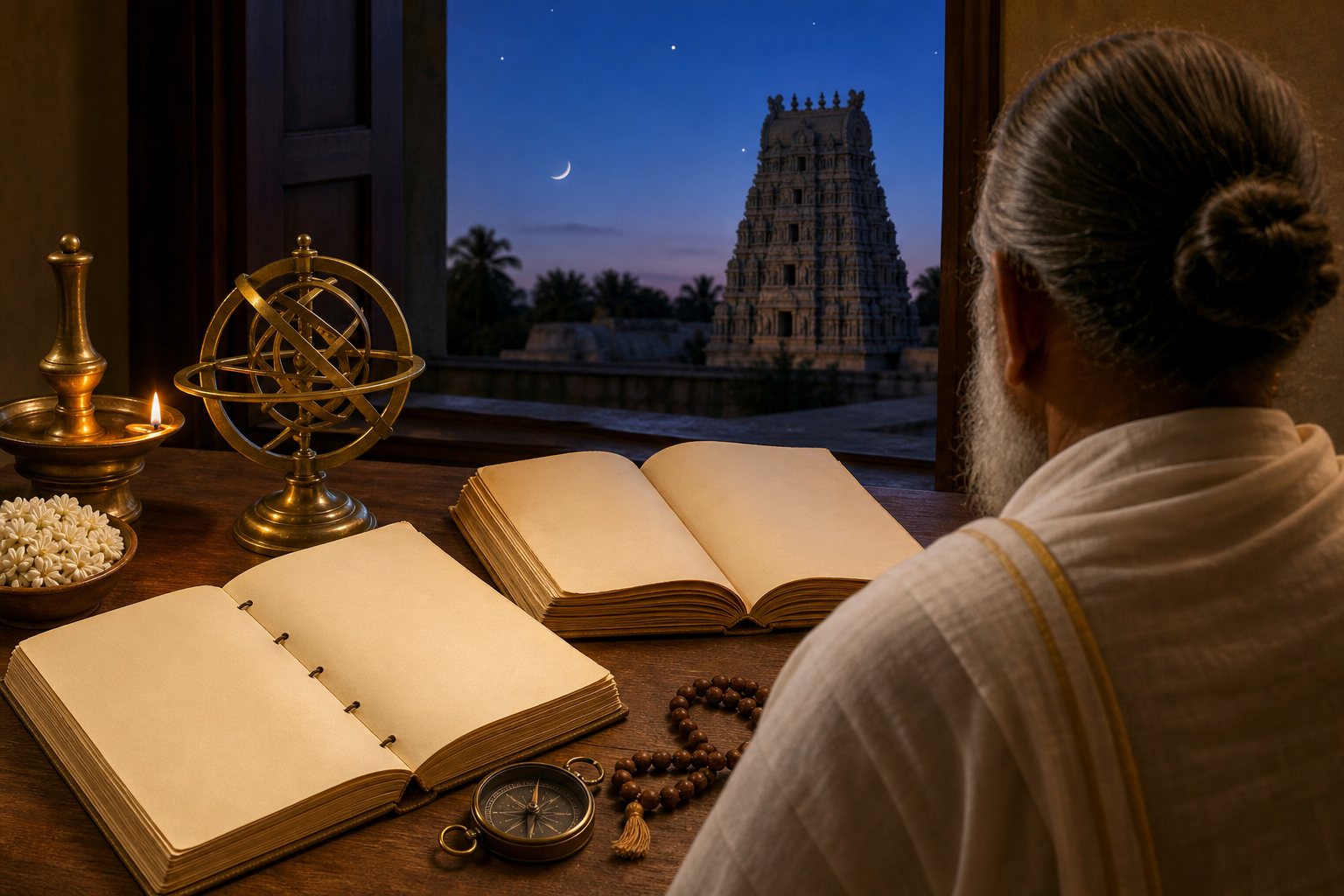
A tithi is determined by each 12-degree increase in the angular separation between the Moon and Sun. Its duration is not a fixed civil day; it commonly varies from roughly 19 to 26 hours. That is why a tithi can begin after breakfast, finish after midnight, or leave portions of two tithis on one Gregorian date.
For diaspora families, this is not a minor technicality. The local sunrise, time zone, and astronomical span can change which civil date carries the required tithi or nakshatra. A calendar calculated for India should not be copied blindly into another country.
- Set the city and time zone first. Confirm that daylight-saving time, where applicable, is reflected correctly.
- Identify the calendar layer. Decide whether the entry is controlled by the Tamil solar month, a lunar tithi, Visakam nakshatra, or a temple schedule.
- Check the observance rule. Ask whether your tradition requires the tithi at sunrise, an evening or Pradosha overlap, or the predominance of a nakshatra. Do not choose the date merely because an app displays the name somewhere within it.
- Record start and end moments. Keep the tithi, nakshatra, sunrise, and sunset times beside the festival name. An all-day label is often too crude.
- Apply the right level of muhurta refinement. For a personal ceremony, examine Nakshatra, Yoga, Karana, Vara, Chandra Rashi, Tara Bala, Chandra Bala, and relevant dasha and transit factors. Seek a competent Jyotisha practitioner where the decision warrants individual calculation.
- Confirm institutional events separately. A temple may place a procession, homam, or public abhishekam according to its Agamic and practical schedule even when your household vrata uses the same sacred window differently.
This process also resolves apparent North-South disagreement. Compare the actual tithi or nakshatra and its local span before comparing month names. Amanta, purnimanta, and Tamil solar conventions may label the season differently while preserving the underlying astronomical event.
Key takeaways for your 2026 calendar
- Vaigasi runs from 15 May through 14 June 2026 in the stated IST Tamil-calendar frame.
- On 17 May, the reference timing places Amavasya until 1:37 AM, Pratipada from 1:37 AM to 11:14 PM, and Dwitiya afterward; verify those times locally.
- Vaikasi Visakam is expected on or around 31 May, but you should keep the date provisional until your city’s Visakam span and your temple’s choice are confirmed.
- Murugan worship and Sri Nammalvar’s thirunakshatram give the Visakam window distinct but complementary devotional expressions.
- Pradosham, Ekadashi, Sankashti, Amavasya, and Pournami require lunar calculation; the Vaigasi solar dates alone cannot place them.
- A festival date can guide ordinary worship, but a personal muhurta requires more than one favorable tithi.
Open your family calendar and give each entry one of three statuses: firm solar boundary, verify locally, or temple confirmation required. Enter 15 May and 14 June as the Vaigasi frame, preserve the full May 17 tithi sequence, and keep 31 May tentative for Visakam. Then replace provisional entries as soon as your regional Panchang and chosen temple publish matching details.
That simple discipline lets you plan leave, travel, vrata, seva, and home worship without pretending that every sacred time is an all-day Gregorian appointment.
References
- DharmaRenaissance Blog – May 17, 2026 Panchang: Precise Tithi Timings, Auspicious Muhurat Guide, and Ritual Insights
- DharmaRenaissance Blog – Vaigasi Masam 2026 (Vaikasi): Definitive Guide to Dates, Vaikasi Visakam & Temple Festivals