

If you encountered the name Krishna Kirtan devi dasi in a condolence message, you may be asking a simple question: what did she actually represent to ISKCON France? She belonged to the first generation that helped make Krishna consciousness visible, accessible, and durable in French public life.
Her legacy is best understood neither as a list of titles nor as nostalgia for an earlier period. She was a direct disciple of A. C. Bhaktivedanta Swami Prabhupada, a sankirtan heroine of the French yatra, and a devotee remembered for remaining faithful to his mission. Those three facts tell you how to remember her, what not to embellish, and what her example asks of devotees now.
Read her name and service in their proper frame
The suffix ACBSP is not an honorary decoration. Within ISKCON, it identifies someone initiated by A. C. Bhaktivedanta Swami Prabhupada. It therefore places Krishna Kirtan devi dasi in the movement’s founding generation: devotees who received a direct spiritual commitment and then had to translate that commitment into communities, books, worship, festivals, and public outreach far from Bharat.
That designation should be used accurately. ACBSP tells you about her initiating spiritual master; it does not, by itself, supply a complete biography or prove that she held a particular institutional office. Similarly, the word yatra can confuse readers who know it only as a pilgrimage. In this setting, the French yatra means the regional devotional community and its interconnected field of service.
If you are writing a memorial notice, introducing her at a gathering, or explaining her importance to a younger devotee, keep three distinctions clear:
- Call her a first-generation disciple of Srila Prabhupada because ACBSP identifies that relationship.
- Call her a sankirtan heroine of the French yatra because that is how fellow devotees remember the character of her service.
- Do not assign her unverified offices, projects, journeys, or achievements. A faithful tribute becomes stronger, not weaker, when it separates established facts from personal recollections.
The spiritual meaning goes deeper than historical proximity. In the guru-shishya tradition, loyalty is expressed through sustained practice: japa on the maha-mantra, study, deity worship, association, and service. The important test is whether inner discipline becomes outward care. Krishna Kirtan devi dasi is remembered because her fidelity endured and took a public, service-oriented form.
What sankirtan heroism meant in the French yatra
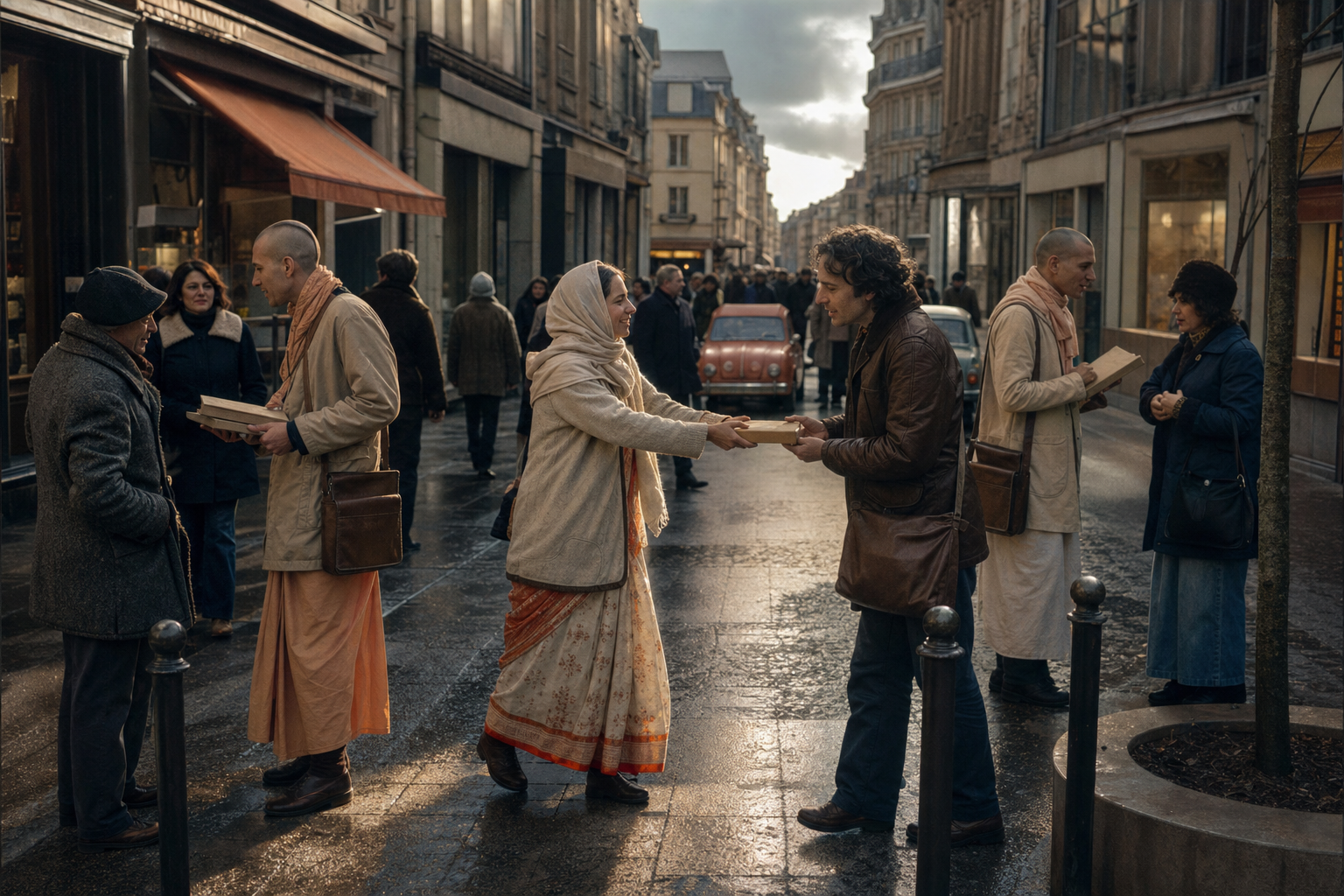
Sankirtan is sometimes reduced to devotional music performed before an audience. In Gaudiya Vaishnavism it is more demanding. Congregational chanting centers the community on remembrance of Krishna, while outreach carries that remembrance beyond the temple. Public kirtan, spiritual conversation, books, prasadam, and festivals are different expressions of the same movement from private conviction to shared spiritual opportunity.
That distinction matters when you hear Krishna Kirtan devi dasi called a heroine. Heroism in sankirtan is not celebrity. It is the willingness to enter public space with a visible religious identity, meet strangers respectfully, continue when responses are uncertain, and return to disciplined sadhana rather than treating outreach as performance.
The French ISKCON community expanded rapidly during the 1970s and 1980s. Its devotional ecosystem joined city temples, notably in Paris, with rural projects such as the New Mayapur farm community in central France. Daily practice supported festivals and outreach, while French translations produced through the Bhaktivedanta Book Trust allowed people to encounter works such as Bhagavad-gita As It Is and Srimad-Bhagavatam in their own language.
The public work took several concrete forms:
- Harinama brought chanting into city centers, where people could hear the holy names without first entering a temple.
- Book distribution through traveling parties, libraries, and cultural events gave an interested person something durable to study after the encounter ended.
- Prasadam outreach connected spiritual hospitality with sattvic vegetarian food and an ahimsa-oriented way of life.
- Seasonal festivals, including Ratha-yatra processions, placed music, dance, philosophy, and service in the civic square.
This was a chain of service rather than a set of isolated activities. Translators and publishers made teachings available in French. Distributors carried them into public life. Temple and farm communities gave seekers somewhere to practice. Cooks, organizers, worshippers, musicians, and mentors turned an initial encounter into sustained association. If one link weakened, the others had to carry more weight.
Krishna Kirtan devi dasi can be placed confidently within this culture of courageous outreach. A fuller allocation of particular campaigns or administrative responsibilities would require reliable archival testimony. What can already be seen is more important than an inflated list: the French yatra depended on devotees willing to connect rigorous practice with repeated public service, and she became one of the women identified with that standard.
Put the women of ISKCON France back at the center
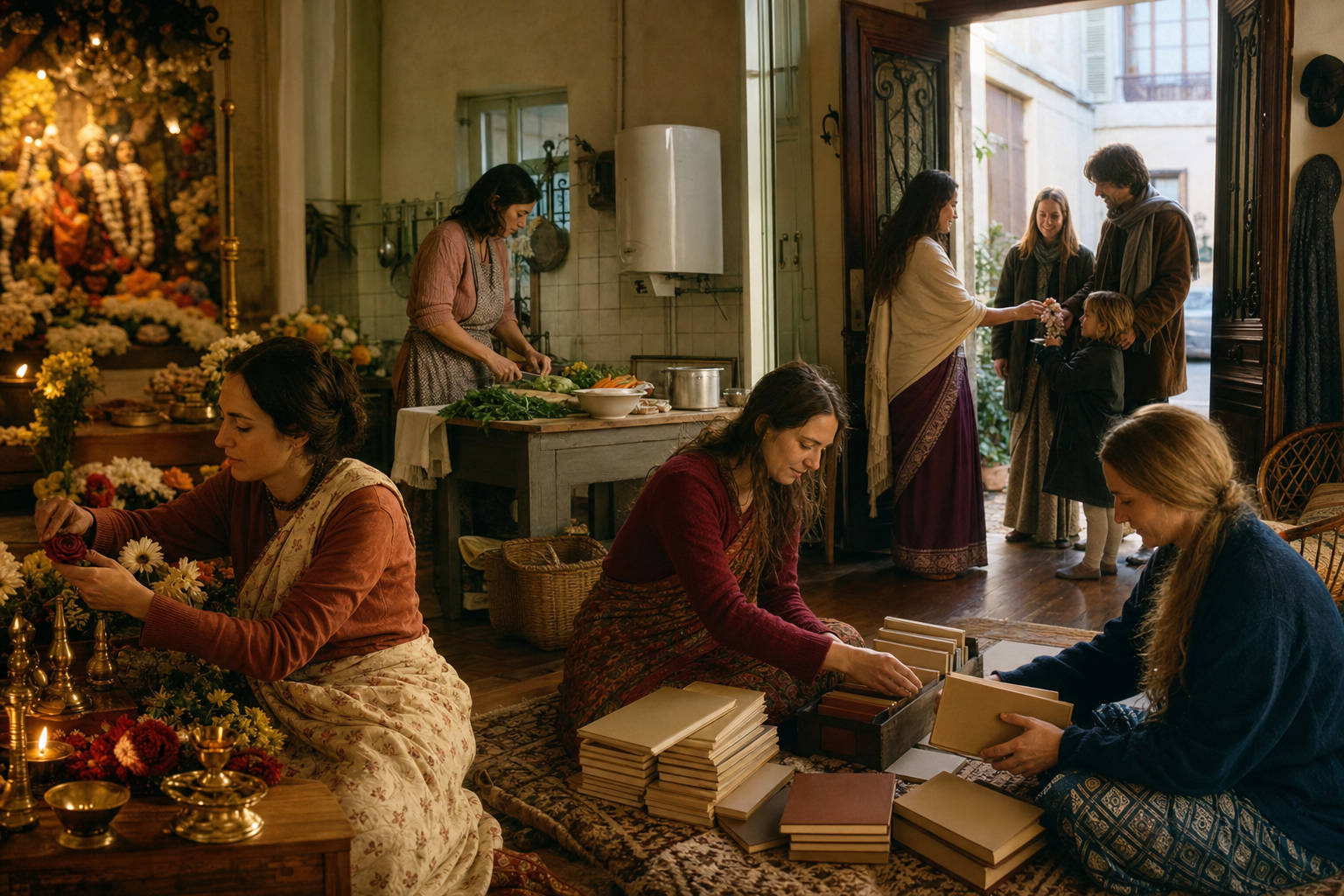
Women were not merely present around the edges of European ISKCON’s expansion. They participated at the front of public kirtan and book distribution and helped organize the communities that sustained those activities. Calling Krishna Kirtan devi dasi a sankirtan heroine acknowledges that history, but the word heroine should begin the work of remembrance rather than finish it.
A community loses part of its memory when it records only formal leaders, property acquisitions, and major festivals. Much of devotional continuity lives in less visible labor: showing a newcomer how to chant, preparing prasadam, maintaining standards during difficult periods, arranging travel, caring for a temple, or encouraging another devotee to continue. These acts may leave fewer institutional documents even when they shape the culture for decades.
If you help preserve the history of ISKCON France, use a disciplined oral-history method. For each recollection, record:
- the service being remembered;
- the temple, city, farm, traveling party, or event connected with it;
- the approximate period, clearly marked as approximate when necessary;
- the names of other participants who may confirm or refine the memory;
- whether the statement comes from direct observation, a letter, a photograph, or something heard from another person;
- the speaker’s consent for the recording, transcription, and public use.
Keep testimony in the speaker’s own voice, but label uncertainty. Two devotees may remember the same event differently without either intending to mislead. Preserve both accounts when they cannot be reconciled, and do not convert a moving anecdote into a definitive biographical fact merely because it fits the tone of a tribute.
This method does more than protect historical accuracy. It reveals how women actually exercised devotional leadership: through public courage, practical competence, spiritual steadiness, and intergenerational care. Krishna Kirtan devi dasi should therefore be remembered as a person, not used as a symbolic substitute for all the women whose individual histories still need to be recorded.
Make remembrance produce present-day seva
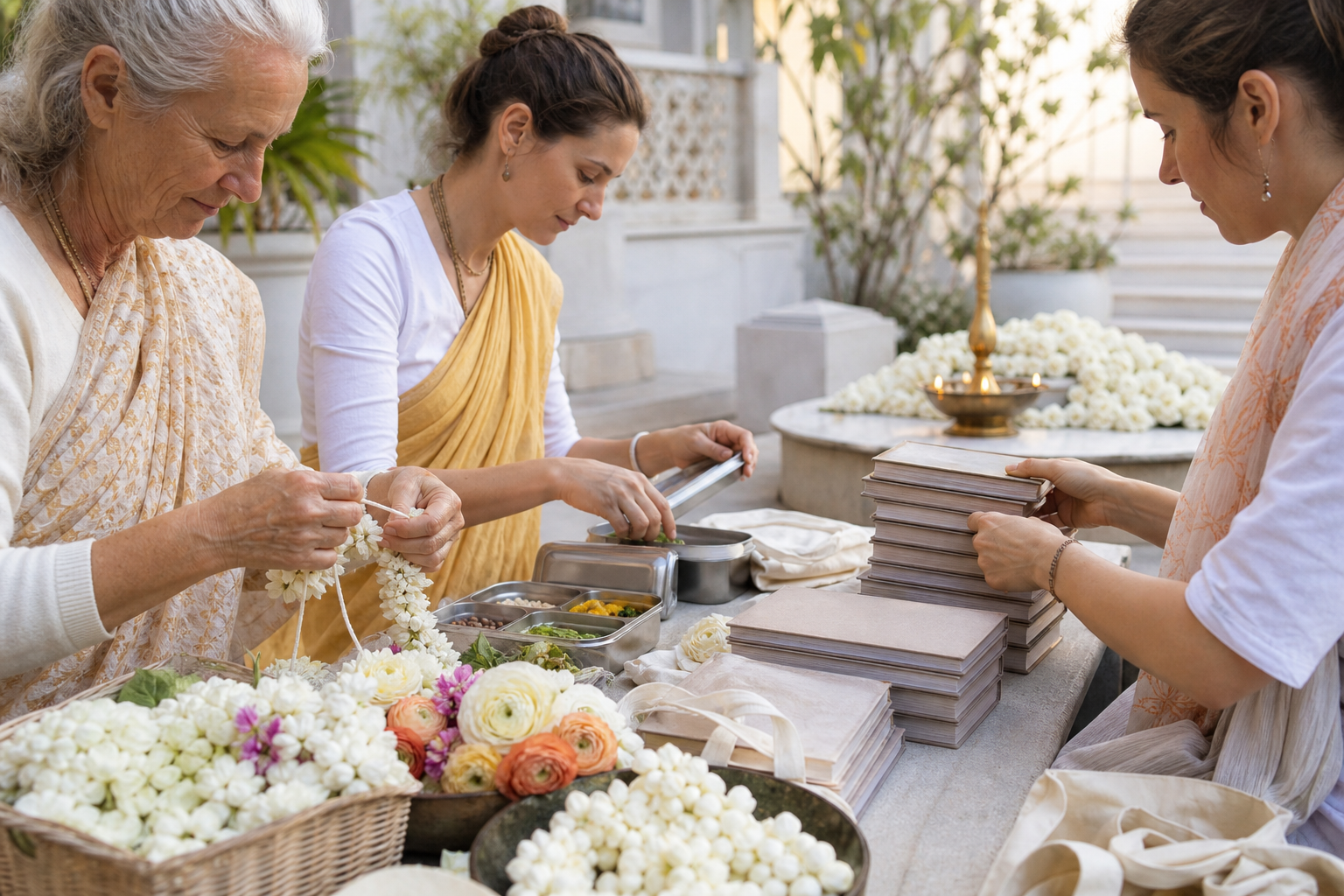
A memorial worthy of a sankirtan devotee should send spiritual benefit outward. Flowers, photographs, and affectionate recollections have their place, but the service culture being honored should remain visible in the form of the gathering itself.
A temple or local nama-hatta can build a focused remembrance around five elements:
- Begin with congregational chanting so the holy name, rather than personality alone, remains at the center.
- Give a short, fact-checked account of Krishna Kirtan devi dasi as a disciple of Srila Prabhupada and a member of the French sankirtan generation.
- Read from Srila Prabhupada’s teachings in French, joining remembrance of the disciple to the instruction she served.
- Undertake one outward-facing act: distribute a French-language book, hold harinama, share prasadam, or welcome newcomers into a clear conversation about bhakti.
- Invite those with direct memories to contribute to an organized archive instead of allowing their knowledge to disappear after the gathering.
The same principle applies if you are acting alone. You do not need to imitate the conditions of the 1970s or 1980s. Choose one repeatable service appropriate to your present responsibilities. Regularly help with kirtan, place a French spiritual book with an interested reader, serve prasadam, mentor a newcomer, or record a senior devotee’s history. Consistency is closer to the legacy being honored than a dramatic gesture that ends after one day.
There is also room for wider dharmic friendship. Gaudiya Vaishnava kirtan has an intelligible kinship with Sikh kirtan and naam-simran. Seva reaches across Hindu, Sikh, Buddhist, and Jain communities, while compassion, restraint, and non-violence provide real ground for cooperation. These affinities can support cultural events, vegetarian outreach, and civic friendship in a plural European society.
Do not create unity by pretending the traditions are interchangeable. Begin by describing the Gaudiya Vaishnava practice accurately: Krishna is the object of devotion, the maha-mantra is central, and sankirtan is understood as the defining spiritual method for the present age. Then identify genuine points of kinship without erasing distinct scriptures, teachers, doctrines, or liturgies. Honest difference makes cooperation more trustworthy.
This balance also explains why the French yatra’s history remains relevant. Its devotees had to preserve a particular lineage while speaking to a modern and religiously diverse public. Conviction supplied the center; hospitality made encounter possible. A community that loses either side becomes less capable of carrying the mission forward.
Key takeaways
- Krishna Kirtan devi dasi was a first-generation initiated disciple of A. C. Bhaktivedanta Swami Prabhupada and is remembered as a sankirtan heroine of the French ISKCON yatra.
- ACBSP identifies her direct disciple relationship; it should not be treated as evidence for unverified offices or achievements.
- Her service belongs within a French devotional ecosystem of city temples, New Mayapur, French-language books, harinama, prasadam outreach, and public festivals.
- Remembering her accurately means documenting the concrete service of women, distinguishing direct testimony from hearsay, and preserving uncertainty where records are incomplete.
- The most fitting tribute is repeatable seva that joins disciplined practice to compassionate outreach.
When you next speak her name, attach it to one concrete act that keeps the channel between sadhana and public service open. Chant with others, share wisdom in the language they understand, welcome someone with prasadam, or preserve a devotee’s memory carefully. That is how a historical legacy becomes a living responsibility.