
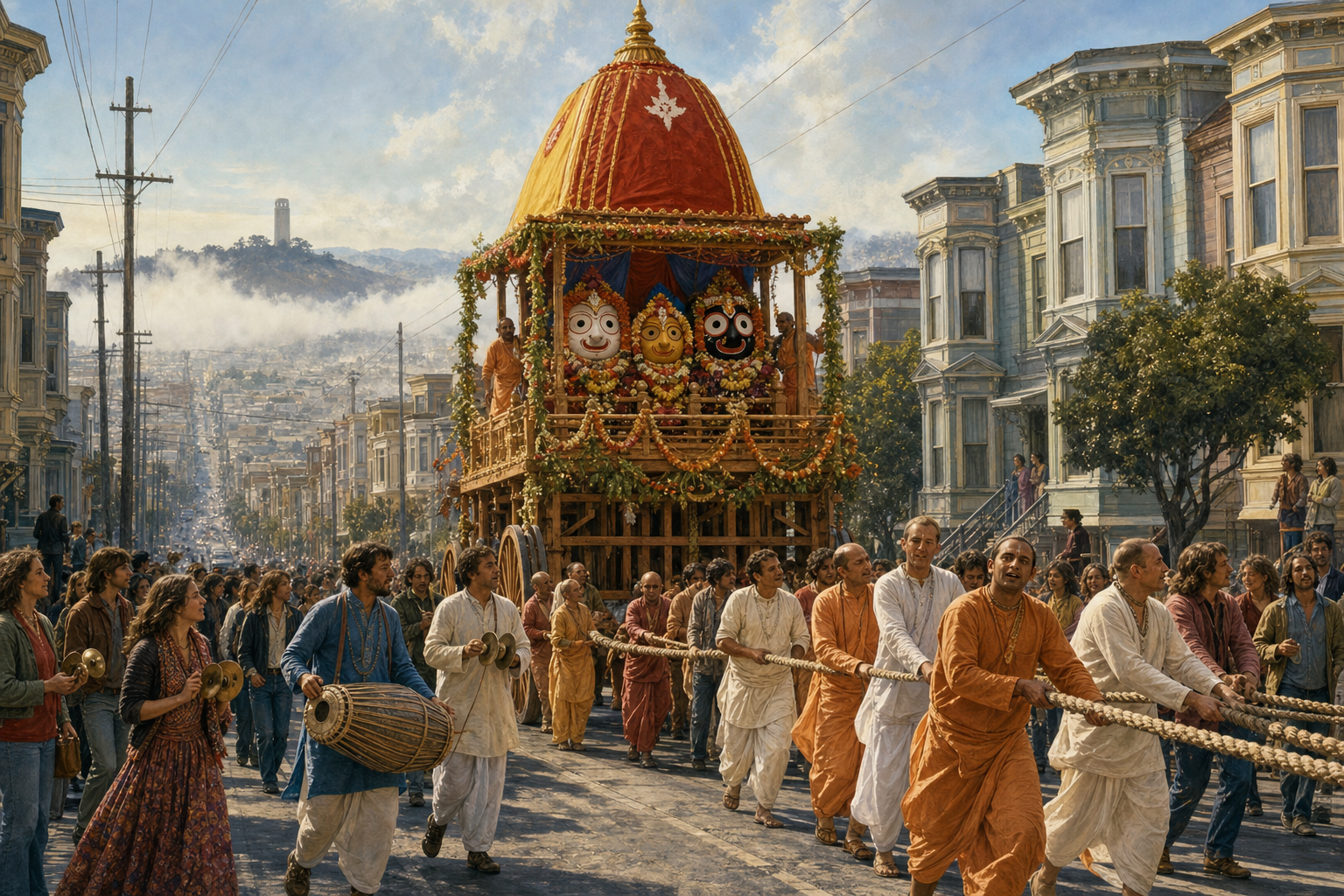
If you have seen a Rathayatra moving through a Western city, it can look as though the festival simply travelled from Bharat and resumed its familiar form abroad. The harder question is what had to happen before Jagannath’s chariot could enter an unfamiliar street without becoming either a private ethnic observance or a public spectacle emptied of worship.
Shyamasundar Das answered that question through action. His work in San Francisco joined theological fidelity, practical craftsmanship, public participation, and civic responsibility. If you want to understand why the first Western Rathayatra mattered, look beyond the novelty of its location. It established a method by which a living dharmic tradition could adapt its outward arrangements while keeping its sacred centre intact.
The decisive sequence was initiation, Deities, then procession
In January 1967, Shyamasundar Das, also known as Sam Speerstra, received initiation from A.C. Bhaktivedanta Swami Prabhupada in San Francisco. Within months, he had carved the first Jagannath Deities for the emerging Western community and coordinated the first Rathayatra outside India.
The order matters. Shyamasundar did not begin with a parade concept and then search for sacred imagery to place upon it. Initiation located his work within a guru-disciple lineage. The carving established Jagannath, Baladeva, and Subhadra as the focus. Only then did the public procession carry Their presence beyond the temple community.
That sequence gives you a reliable way to distinguish devotional adaptation from cultural display. In a devotional procession, the Deities are not decorations, the mantra is not background music, and prasada is not merely event catering. Craft, sound, food, movement, and volunteer service all have a common purpose: making an encounter with the Divine available in public.
The claim that this was the first Rathayatra outside India should not turn the event into a story of the West inventing something new. Rathayatra already possessed its identity, theology, and sacred origin in the Jagannath tradition of Bharat. The San Francisco achievement was different: a small devotional community found a responsible way to receive that tradition, embody it locally, and make room for it within a new civic environment.
Shyamasundar’s role was decisive, but the result was inherently collective. Deity worship, chariot construction, kirtan, food distribution, route management, and public welcome cannot be sustained by one charismatic individual. The enduring lesson is therefore not hero worship. It is that committed leadership can give a community a demanding objective around which many forms of seva become coherent.
Jagannath’s form showed what adaptation could preserve

Anyone encountering the Jagannath triad for the first time may notice the large circular eyes, simplified limbs, and wooden forms before understanding their meaning. These are not deficiencies to be corrected by making the Deities look more naturalistic. Within the tradition, the eyes convey an all-embracing vision, the simplified form communicates accessibility, and the wood points to periodic sacred renewal.
This iconography was especially suited to the first Western setting because it already carried a profound theology of welcome. Jagannath is the Lord of the Universe, not the possession of a social class, nationality, or cultural elite. The form is unmistakably rooted in a particular tradition, yet its gaze does not establish an ethnic boundary around divine grace.
Shyamasundar’s carving therefore did more than solve the immediate problem of obtaining Deities. It demonstrated that diaspora craftsmanship could honour the essential form while adjusting scale, materials, and working conditions. The early approach placed appropriate wood, available ritual protocols, and community participation ahead of ornamental excess.
That distinction is still useful whenever a dharmic community builds something outside its place of origin. Fidelity does not require pretending that San Francisco is Puri. Nor does adaptation grant permission to redesign the sacred until it becomes unrecognisable. A sound decision process begins by identifying the theological and iconographic elements that cannot be traded away. Practical questions of scale, local materials, display, transport, and public interpretation come afterward.
If you are helping to present Jagannath at a festival, temple open day, school, or cultural exhibition, check four things before concentrating on decoration:
- Name the Deities clearly: Jagannath, Baladeva, and Subhadra should be introduced as sacred persons, not as generic examples of Indian folk art.
- Explain the form rather than apologising for it: help newcomers understand the eyes, limbs, wood, and welcoming character on the tradition’s own terms.
- Separate adaptation from reinvention: a smaller scale or locally workable construction method can serve the tradition; altered iconography that obscures identity cannot be justified merely as outreach.
- Keep participation connected to seva: carving, dressing, pulling, chanting, cooking, cleaning, and welcoming are most meaningful when participants understand whom their work serves.
The first chariot also had to become a responsible civic event
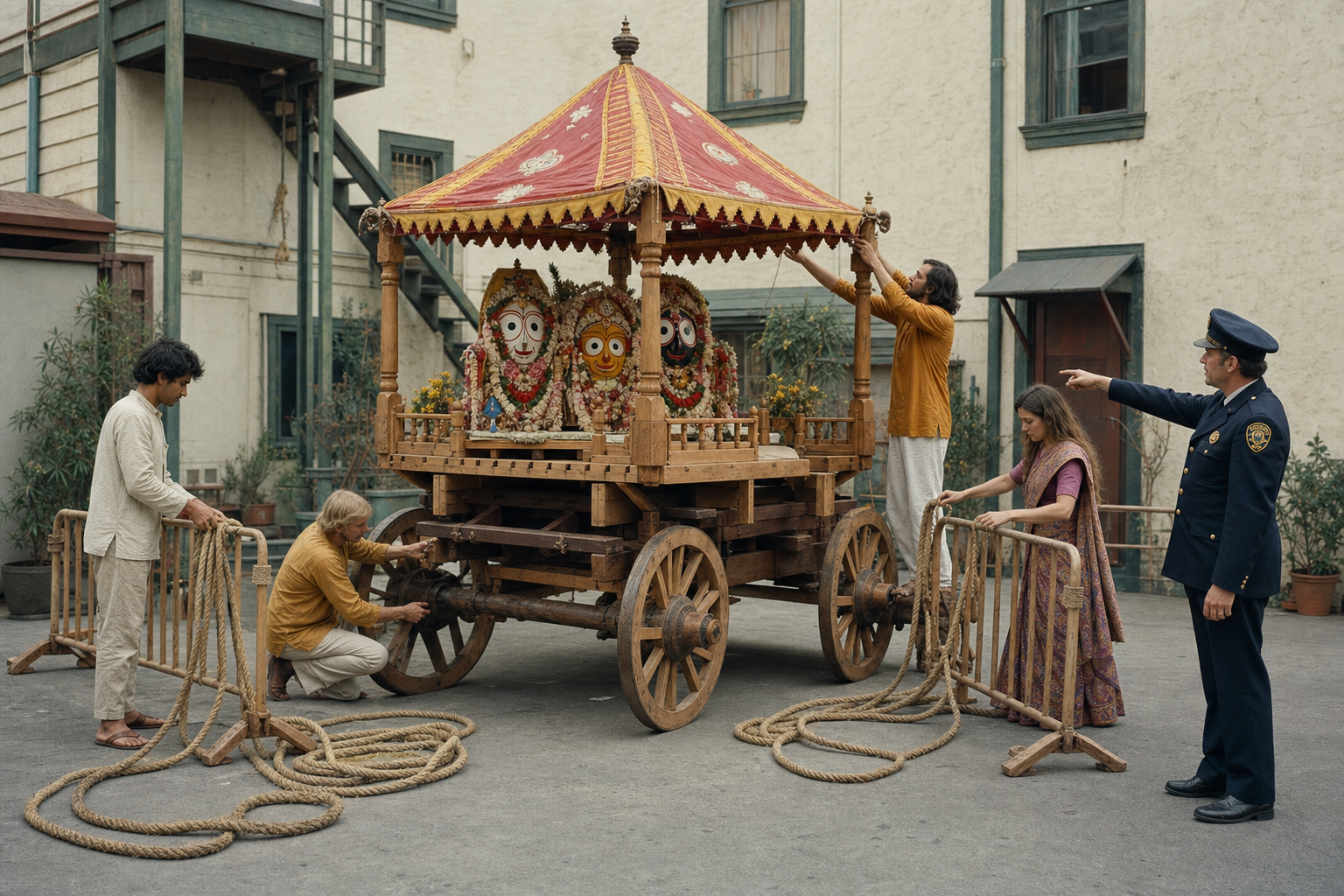
A Deity procession leaves the relatively controlled setting of a shrine and enters space shared with neighbours, officials, pedestrians, traffic, and people who may know nothing about the tradition. In San Francisco, that meant solving practical questions involving permits, a route through park spaces, crowd safety, prasada distribution, and the audibility of kirtan.
Those obligations did not make the festival less sacred. They determined whether devotion would be expressed with care for everyone occupying the same public space. A badly controlled crowd, an unsuitable route, or an unsafe chariot would contradict the spirit of seva no matter how sincere the organisers were.
This is where Shyamasundar’s watchword, Chase the Rhino, becomes more useful than a colourful slogan. The point was to choose a goal difficult enough to force disciplined preparation, attract collaborators, and produce worthwhile results even if every ambition was not achieved. Applied to Rathayatra, that approach turns a large spiritual aspiration into a set of accountable decisions.
If your community is planning a procession, use this order of work:
- Write the sacred brief first. State who is being worshipped, which ritual and iconographic elements must be protected, and what experience the community intends to offer. This keeps later logistical compromises from quietly changing the event’s purpose.
- Match the chariot to the actual route. Local rules, road or park conditions, turning space, gradients, and crowd movement must shape the engineering. A ratha is a moving structure surrounded by people, so construction and operation require qualified technical judgment and compliance with local authorities; enthusiasm is not a substitute for either.
- Map the people affected by the event. City officials, park or route managers, neighbourhood groups, volunteers, interfaith contacts, and nearby institutions need different information. Contacting them early makes cooperation part of the design rather than a last-minute attempt to overcome objections.
- Assign responsibility for predictable risks. Weather, traffic, crowd flow, kirtan sound, prasada service, and communications each need a named owner. If everybody is vaguely responsible, an urgent problem will belong to nobody when it appears.
- Make the public message plain. Explain that Rathayatra is a devotional welcome centred on Jagannath. Invitation should not become pressure, and accessibility should not require hiding the festival’s Vaishnava identity.
- Plan the material aftermath. Reducing single-use plastics, recovering food waste where local systems permit, and encouraging public transport allow the festival’s conduct to express responsibility as clearly as its public message does.
Municipal requirements vary, so no historic model can replace present local guidance. What can be carried forward is the operating principle: sacred purpose and civic duty should be planned together. Compliance is not something to add after the chariot, route, publicity, and food service have already been fixed.
London showed that public bhakti needed more than one channel
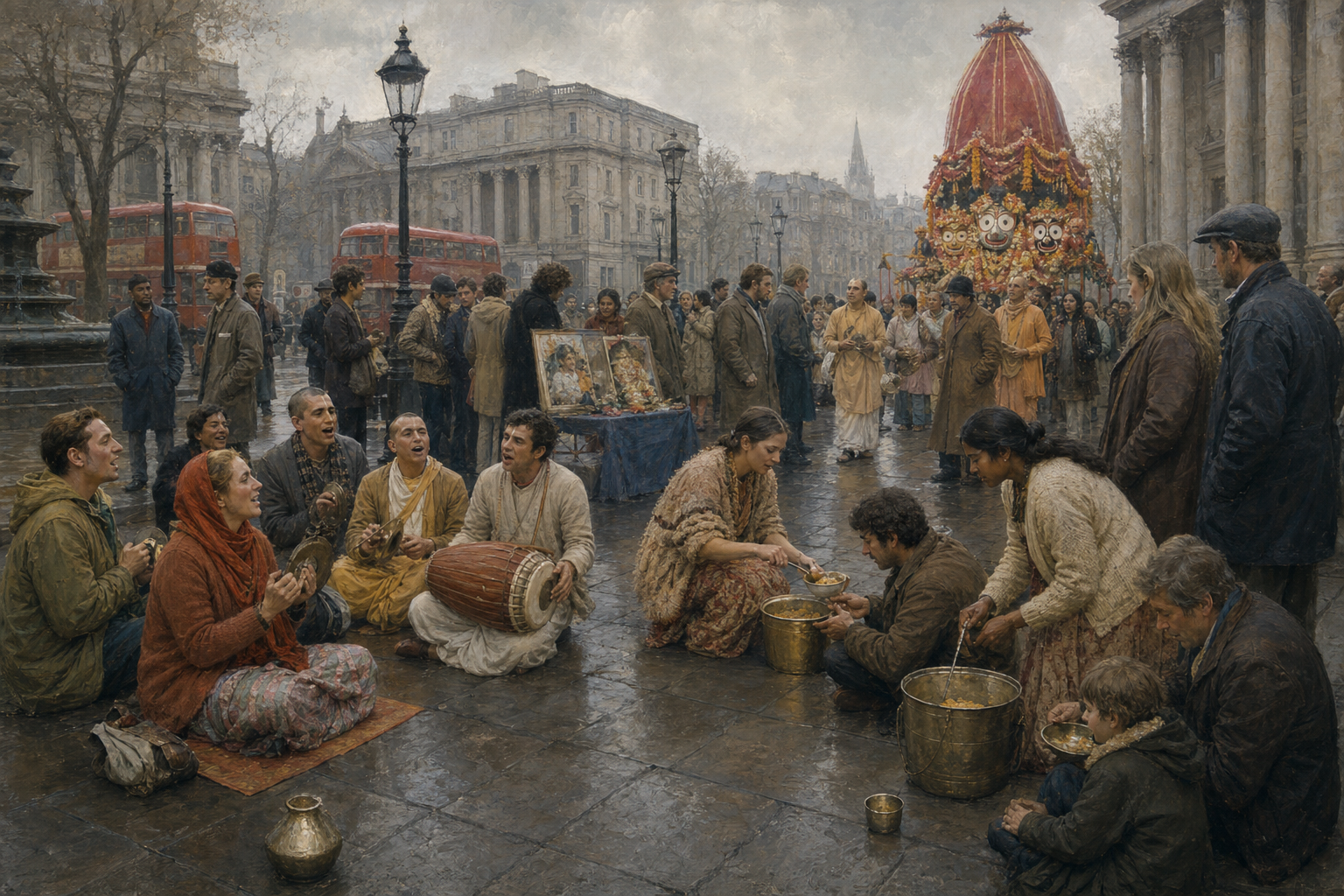
San Francisco demonstrated how a Jagannath procession could enter Western public space. London soon tested a related question: could bhakti become intelligible within the wider cultural life of a major global city?
Working with a small team, Shyamasundar helped establish the International Society for Krishna Consciousness in the United Kingdom, form relationships in the cultural community, and support recordings and events that carried the Hare Krishna mantra onto mainstream airwaves. The work was not a departure from the San Francisco experiment. It extended the same logic through institutions, relationships, music, and media.
The distinction matters if you are assessing the movement’s history. A procession creates a concentrated public encounter. Media allows sound and ideas to travel beyond the route. Institutions give people somewhere to return after their first encounter. Cultural relationships help a practice become understood rather than merely noticed. No one channel can do all four jobs.
This also provides a better measure of success than crowd size alone. A large gathering can disappear without leaving much behind. A durable public tradition remains theologically recognisable, earns enough civic trust to be welcomed again, gives newcomers a truthful explanation of what they encountered, and leaves a community capable of sustaining worship and service between major events.
The subsequent appearance of Rathayatras and kirtan gatherings across five continents shows the strength of that model. Communities did not need to reproduce every physical condition of the first San Francisco procession. They needed to preserve the devotional centre while translating construction, routes, permissions, communications, and public welcome into their own settings.
Dharmic unity works through hospitality, not blurred identities
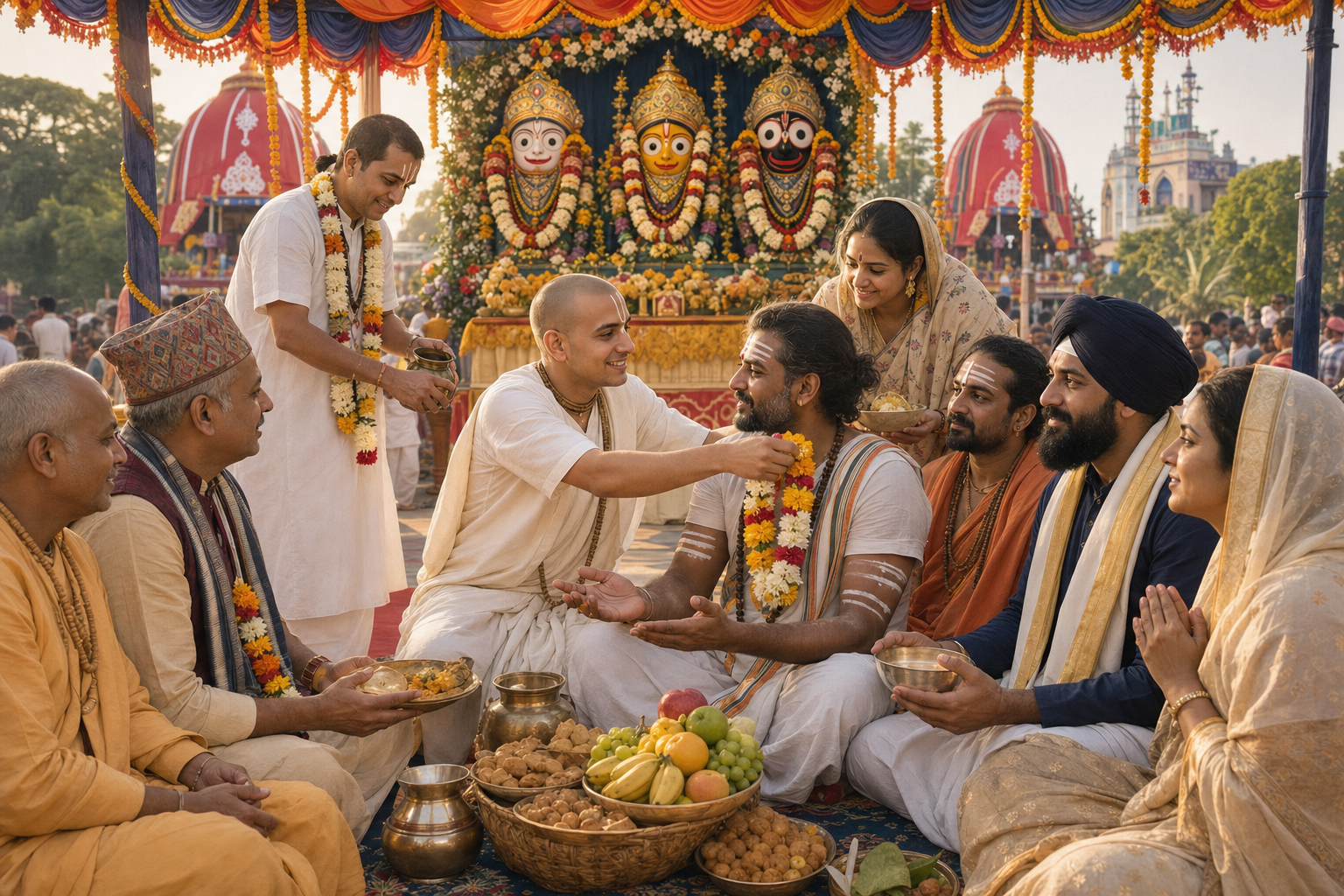
Rathayatra has an unusual capacity to gather people who do not share every doctrine. You can walk beside the ratha, hear kirtan, volunteer, help serve food, or receive prasada without first mastering a theological system. The open form creates several honest points of entry while Jagannath remains visibly at the centre.
This hospitality can support dharmic fellowship when it is described with precision. Congregational singing has a practical resonance with Sikh kirtan. Vegetarian prasada makes non-harm visible in a way that can speak to Jain and Buddhist commitments to ahimsa. Seva gives Hindus of different sampradayas a shared field of action. These affinities are bridges, not proofs that the traditions are identical.
Flattening the differences would weaken the unity it claims to promote. Sikh kirtan, Jain ahimsa, Buddhist ethical disciplines, and Gaudiya Vaishnava bhakti belong to distinct theological worlds. A respectful Rathayatra does not appropriate those identities or reduce them to interchangeable vocabulary. It welcomes neighbours through practices they can recognise while explaining its own commitments without embarrassment.
For diaspora families, this balance is particularly valuable. Public festivals can help children connect household worship with a larger social world rather than treating dharma as something that must remain hidden indoors. You can make that connection concrete by teaching a child the names of the three Deities before the event, choosing one form of seva to perform together, and discussing afterward why the food, music, chariot, and volunteers all belonged to one act of devotion.
Key takeaways for reading or organising a Rathayatra
- Look for a clear centre: an organiser should be able to explain who Jagannath, Baladeva, and Subhadra are and why They are being carried publicly.
- Test adaptations by their purpose: changes in scale, materials, route, or presentation should help the tradition function locally without obscuring its iconography or theology.
- Treat safety and compliance as seva: responsible engineering, permits, crowd planning, traffic coordination, and food service protect both participants and the festival’s public trust.
- Invite without pretending sameness: shared music, service, vegetarian food, and concern for non-harm can build dharmic friendship while each tradition retains its identity.
- Build beyond the festival day: cultural explanation, relationships, media, and durable institutions turn a striking procession into a continuing public presence.
The next time you attend a Rathayatra, do not judge it only by the height of the chariot or the size of the crowd. Notice whether worship governs the aesthetics, whether care governs the logistics, and whether hospitality remains truthful about the tradition. If you are helping to organise one, put those three tests into the first planning document, before committing to a route or public date. That is a practical way to carry Shyamasundar Das’s legacy forward rather than merely commemorate it.