When a parent ages, a child changes before your eyes, or a long plan suddenly feels shorter than it once did, “manage your time” is an insultingly small answer. The deeper problem is not the clock. It is how to act wholeheartedly when nothing you can hold remains unchanged.
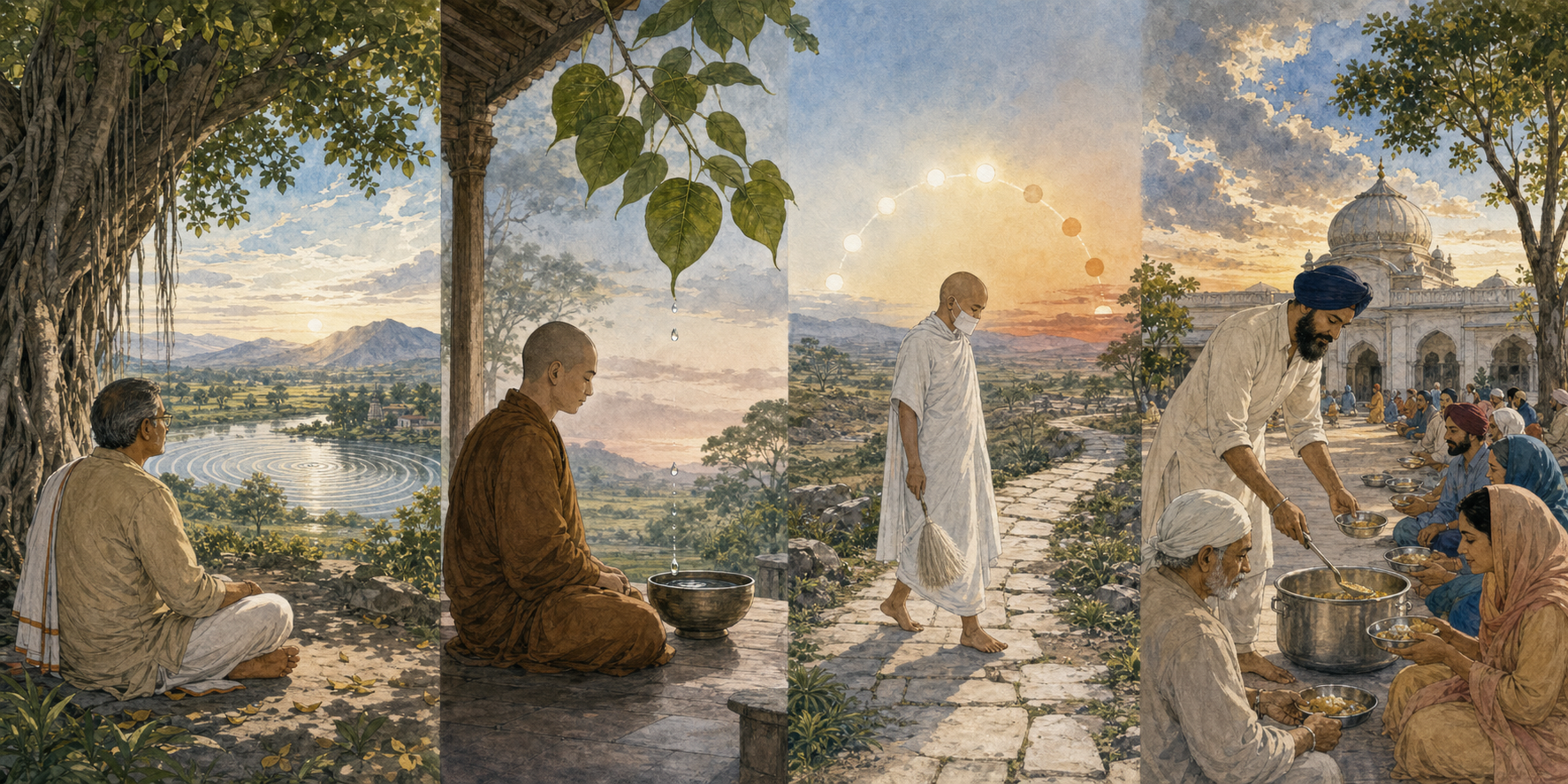
Dharmic traditions meet that problem without pretending it has one simple solution. Hindu, Buddhist, Jain and Sikh thought do not offer an interchangeable theory of time. They ask different questions about what time is, how change occurs, and what can free you from fear or attachment. Those differences give you a practical map: recognize change accurately, choose your duty, and stop demanding permanence from what cannot provide it.
Four traditions do not offer one interchangeable theory
The familiar claim that “Dharmic time is cyclical” is only a starting point. It describes an important cosmological pattern, especially in Hindu and Jain accounts, but it does not tell you whether time is a real substance, a way of understanding events, a divine power, or something the ultimate transcends.
Three questions keep the traditions distinct. What exists? What changes? What relationship to change makes liberation possible? Once you separate those questions, the shared family resemblance becomes clearer without erasing philosophical disagreement.
| Dharmic lens | How time is understood | What you are asked to notice |
|---|---|---|
| Classical Nyāya-Vaiśeṣika and Purāṇic or Vedāntic Hindu currents | Nyāya-Vaiśeṣika treats kāla as a real, eternal and all-pervading substance that makes relations such as before and after intelligible. Purāṇic and Vedāntic currents also portray kāla as the irresistible power through which manifestation, preservation and dissolution proceed. | Your plans exist within an order they do not control. Perform dharma seriously, but do not mistake a temporary result for permanent possession. |
| Buddhist thought | Anicca, or impermanence, marks conditioned existence. In several Abhidharma streams, experience is analyzed as momentary events rather than an enduring temporal substance. | Clinging fails because the object, the one who grasps, and the conditions joining them are changing. Watch arising and passing instead of asking the conditioned to remain fixed. |
| Jain philosophy | Kāla is a real dravya, one of six fundamental substances. It is necessary for change, while cosmic history moves through ascending and descending cycles. | Vast duration does not erase karmic consequence. Your conduct matters within the cycle, so a long cosmic horizon is no excuse for carelessness. |
| Sikh thought | The ultimate is Akal Purakh, the Timeless One. Temporal order remains real at the worldly level, but it is not ultimate. | Aging, loss and death do not define the whole horizon of existence. Simran, devotion and ethical action orient you toward the One who is not bounded by time. |
This is why borrowing one slogan from each tradition can mislead you. Buddhist attention to momentariness is not a claim that time must be an eternal substance. Jain realism about kāla is not identical to a Purāṇic account of divine cosmic agency. Sikh remembrance of Akal is not another unit in a Hindu cosmological calculation. You can recognize a shared concern with bondage, change and liberation while allowing each path to keep its own grammar.
Cyclical time does not cancel your present duty
Dharmic time reckoning moves across nested scales: the blink-like nimeṣa, the muhūrta, days, months and years, then yugas, manvantaras and kalpas. The point is not merely that the numbers become immense. The scale of the picture changes. A human lifetime is significant as a field of action even when it is not the measure of the cosmos.
A cycle also does not mean that every event returns in precisely the same form or that you can wait indefinitely for another chance. Jain cycles still provide the setting for karmic causality. Hindu cosmic rhythms still contain occasions for dharma. Recurrence at one level does not remove consequence at another.
Use three horizons when a decision feels either overwhelmingly urgent or easy to postpone:
- The immediate horizon: What duty belongs to your present role and circumstances? Name the action that is yours, not the result you wish you could control.
- The recurring horizon: Which rhythm keeps that duty from depending on mood? A daily discipline, a regular observance, or a communal calendar turns remembrance into structure.
- The vast horizon: Which concern loses its false importance when placed beside yugas and kalpas? Status, resentment and accumulation often look different when you stop treating the current moment as the whole of reality.
This approach avoids two opposite mistakes. Urgency says everything must be secured now. Fatalism says nothing you do can matter. Dharmic time makes room for a more demanding position: outcomes pass, yet actions still express dharma and carry consequences.
Your calendar can embody that distinction. Use ordinary dates for appointments and obligations, but also mark the observances, periods of discipline and communal occasions that give time moral or sacred texture. The movement from fine measures to ritual and cosmic cycles shows that timekeeping is not only scheduling; it can organize remembrance, restraint and belonging. If your lineage maintains a calendar, follow its reckoning rather than reconstructing contested cosmic arithmetic from isolated claims.
Let kāla reorder your day instead of darkening it
The Bhagavad Gītā’s vision of the Absolute as Time, the destroyer of worlds, is severe because it removes a comforting illusion: no project, institution, body or reputation can make itself exempt from dissolution. Kāla need not be hostile to end what is composite. Change is enough.
That recognition should produce discernment, not apathy. If contemplation of time makes you neglect a duty, dismiss another person’s suffering, or call every effort pointless, you have turned impermanence into an alibi. The useful question is not, “Will this last forever?” Almost nothing in ordinary life passes that test. Ask instead, “What is worthy of care precisely because my opportunity to care is limited?”
Use a weekly kāla audit
At the beginning of your week, sit with four questions before filling every available space:
- What is already changing that I keep treating as fixed?
- Which duty has a real window that will not remain open indefinitely?
- What am I accumulating as though it could make me secure against change?
- Who or what deserves fuller attention because this form of relationship will not last forever?
Then make one correction visible on the calendar. Complete the neglected obligation, begin the necessary conversation, keep the observance, or release a commitment that exists only to protect status. The audit is successful when it changes an action, not when it produces a dramatic mood.
Choose a discipline that matches the actual problem
Different teachings become practical in different forms. Do not flatten them into a generic mindfulness routine:
- When you are clinging to a changing experience: apply the Buddhist lens of anicca. Notice its emergence, alteration and passing. The aim is not to dislike the experience; it is to stop silently requiring it to remain.
- When you are scattered by too many possible futures: use the Hindu distinction between dharma and outcome. Identify the duty proper to the present situation, take its next faithful step, and leave permanence out of the bargain.
- When cosmic cycles tempt you toward passivity: recover the Jain connection between time, transformation and karmic causality. Judge the choice by the conduct it embodies and the consequences it sets in motion, not by how small it appears beside cosmic duration.
- When mortality makes the temporal horizon feel absolute: turn to the Sikh remembrance of Akal Purakh. Simran does not deny the clock; it refuses to let the clock define the ultimate. Let remembrance return you to ethical action rather than withdrawal.
If you stand within a living tradition, let its inherited discipline supply the vocabulary and form. Cross-tradition understanding can deepen respect, but practices are not decorative fragments. Their meaning comes from the account of reality, bondage and liberation in which they belong.
Science can sharpen the question, but it cannot settle it
Modern physics has made ordinary intuitions about time less secure. Relativity ties judgments of simultaneity to frames of reference. Thermodynamics describes an arrow associated with increasing entropy. Quantum theory complicates familiar temporal pictures at very small scales. These developments support intellectual humility, but they do not prove a Dharmic metaphysics.
Relativity does not establish Akal Purakh. Entropy does not demonstrate the yuga cycle. Quantum theory does not turn momentariness into an experimentally confirmed Buddhist doctrine. Scientific theories model observable relations; Dharmic accounts also ask ontological, ethical and soteriological questions. The conversations can illuminate each other without becoming identical.
When you encounter a claim that ancient wisdom “already knew” a modern theory, apply this filter:
- Identify the level of the claim. Is it about measurement, metaphysics, spiritual practice, or a poetic resemblance?
- Check whether the terms do the same work. A cosmic cycle, an observer-dependent temporal relation and the thermodynamic arrow are not synonyms merely because each concerns time.
- Separate analogy from confirmation. A parallel can help you think. It becomes misleading when resemblance is presented as proof.
- Keep the strongest shared lesson. Both Dharmic reflection and modern scientific accounts challenge the assumption that everyday human intuition exhausts the nature of time.
This standard protects both sides of the conversation. Science need not be recruited as prestige for scripture, and scripture need not be reduced to an early physics manual. Each can unsettle human arrogance in its own domain.
A short FAQ on Dharmic time
Do all Dharmic traditions teach that time is cyclical?
No single statement covers them all. Hindu and Jain cosmologies give explicit importance to large cycles. Buddhist analysis in this discussion concentrates on impermanence and momentary processes rather than requiring an independent substance called time. Sikh thought places its strongest emphasis on Akal, the Timeless One. “Cyclical time” is therefore useful as a family resemblance, not as a complete creed shared without qualification.
Is kāla a substance, a divine power, or simply change?
The answer depends on the philosophical framework. Nyāya-Vaiśeṣika and Jain philosophy give time the status of a real dravya. Purāṇic and Vedāntic currents can speak of kāla through divine cosmic agency. Buddhist approaches commonly explain temporal experience through conditioned processes instead of positing an independent temporal substance. Treating one answer as the uncontested Dharmic position hides the most interesting part of the discussion.
Does impermanence make ambition or long-term work pointless?
No. Impermanence removes the promise that an achievement will provide permanent identity or security; it does not remove the value of disciplined action. Build, teach, protect, serve and create when those acts answer dharma or ethical responsibility. Just do not ask the finished work to become immortal on your behalf.
At your next calendar review, do more than rearrange tasks. Mark one change you need to accept, one duty whose opportunity is narrowing, and one practice that returns you to a horizon larger than urgency. That is how you begin to honor time without becoming its servant.