
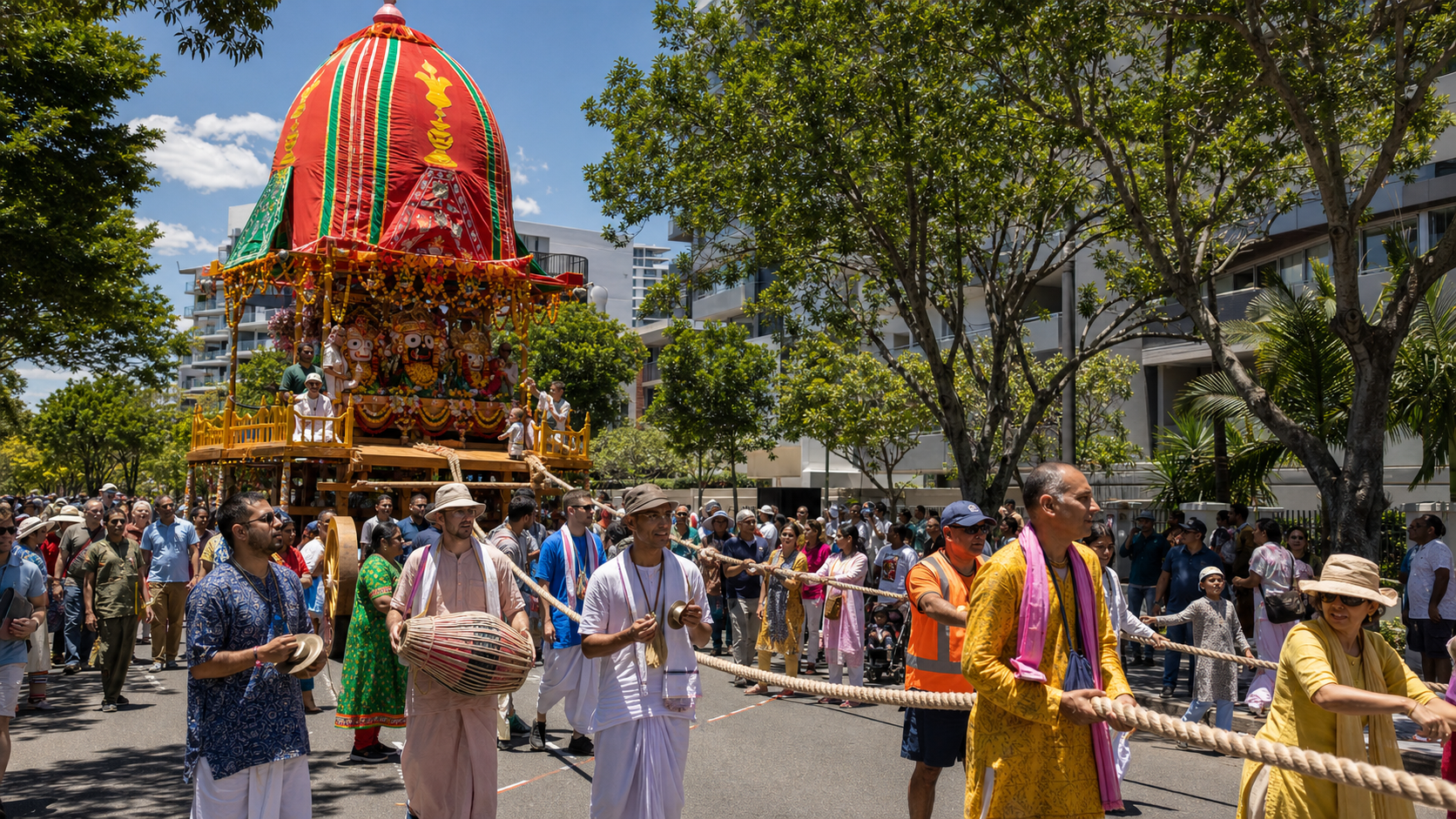
If you are deciding whether to attend Brisbane’s Ratha Yatra for the first time, you do not need to understand every ritual before you arrive. You can walk with the procession, join the chanting, help pull the chariot when directed, receive prasadam, or simply watch respectfully. Public participation is part of the festival’s purpose.
The practical details require more caution. Brisbane’s eleventh annual Festival of Chariots in 2026 is expected to include a street procession followed by a family-oriented program with kirtan, dance and prasadam. An exact date, start time, route and final venue cannot be responsibly stated here. Verify each one in a current organizer notice before arranging travel.
Key takeaways before you make plans
- The 2026 celebration is Brisbane’s eleventh annual Festival of Chariots.
- A street procession and a family-friendly cultural program are expected, but the detailed schedule and route still need current confirmation.
- You may participate according to your comfort: observe, walk, chant, pull the rope when invited, attend arati, or receive prasadam.
- Follow volunteer marshals around the chariot, pulling ropes and procession crossings. A moving chariot is a sacred focus as well as a substantial vehicle.
- Plan for an outdoor city event with comfortable footwear, sun protection and a reusable water bottle. Check transport and accessibility arrangements before leaving home.
What is expected, and what you still need to confirm
The stable core of Ratha Yatra is easier to describe than its local timetable. You can expect a chariot procession led by congregational chanting, opportunities for devotional service, and a gathering where food and cultural performances make the celebration accessible to families and newcomers. The order and duration of those elements may change with the final civic arrangements.
Ratha Yatra customarily falls in the Indian calendar month of Ashadha, but communities outside India may adapt the date to local weather, public-space availability and civic calendars. Do not calculate Brisbane’s date from an observance in Odisha or another city. Do not assume that a route used in an earlier Brisbane festival will be reused in 2026.
Before setting out, confirm these five items in a current announcement from the organizer:
- The calendar date and the stated assembly time.
- The exact meeting point, procession route and destination.
- Road closures, public-transport changes and the best place for passenger drop-off.
- Accessible viewing, toilets, seating, shade and the distance participants are expected to walk.
- Any weather-related change, cancellation instruction or item that attendees have been asked not to bring.
This distinction between expected and confirmed matters if you are bringing children, coordinating a group, travelling from outside Brisbane or depending on step-free access. A general festival description can tell you what Ratha Yatra is; only a current local notice can tell you where to stand on the day.
How the procession unfolds and where you can participate
Ratha Yatra comes from the Jagannath tradition of Odisha, where Jagannath, Balabhadra and Subhadra travel on great wooden chariots for public darshan. The name joins ratha, meaning chariot, with yatra, meaning journey. Its devotional logic is unusually direct: sacred presence comes into public space rather than remaining available only within a temple.
ISKCON helped carry this form of public devotion into cities around the world, especially from the late 1960s onward, while retaining the Gaudiya Vaishnava practices of kirtan, seva and prasadam. Brisbane’s celebration belongs to that global development, expressed within the practical requirements of a contemporary Australian city.
A typical Festival of Chariots has several recognizable stages, although the Brisbane sequence should not be treated as fixed until its program is released:
- Devotees and visitors gather near the chariot for darshan and kirtan.
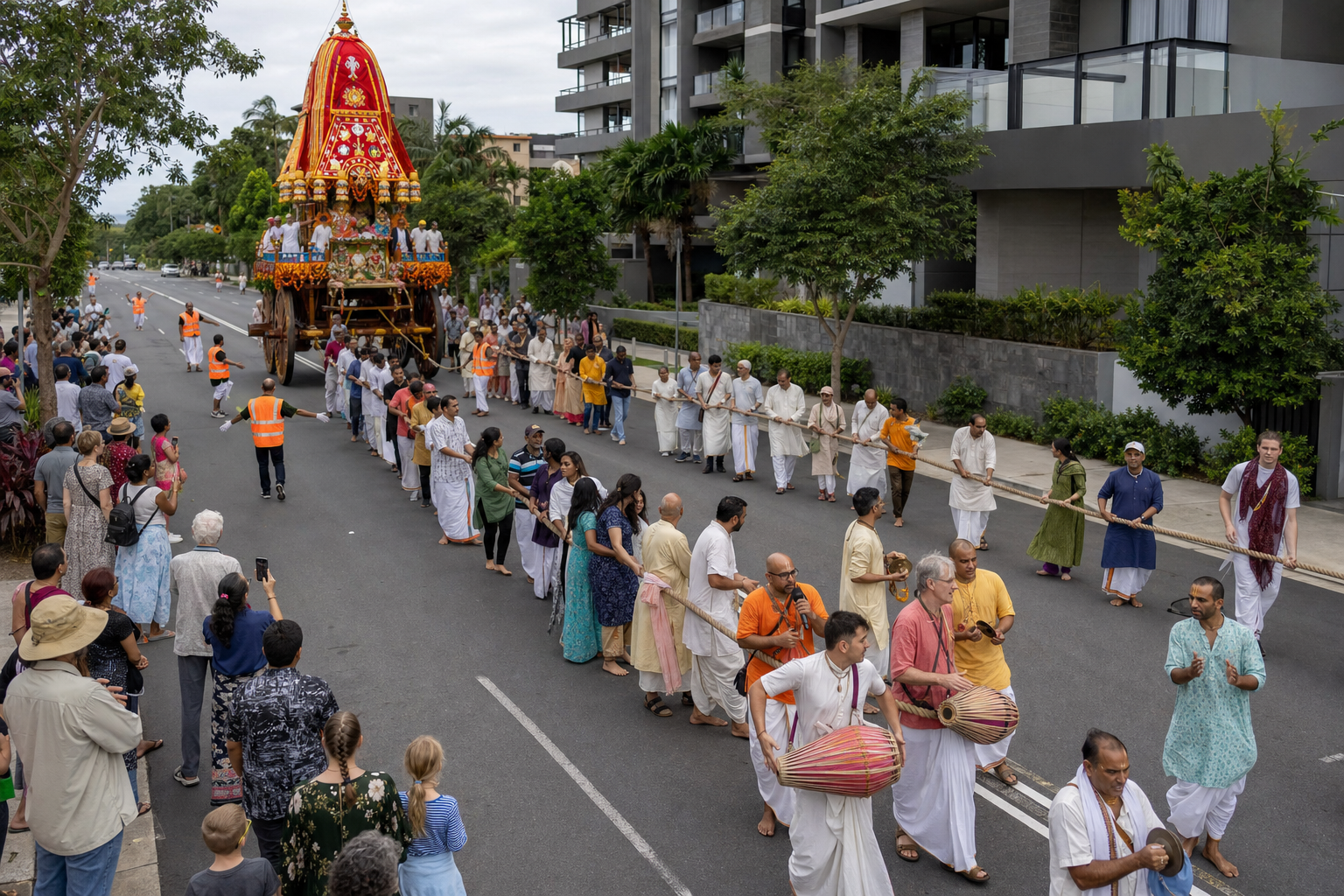
- The procession begins as participants take the long ropes and pull under the direction of marshals.
- Call-and-response chanting continues with mridanga drums and kartal cymbals as the chariot moves.
- Arati or other devotional offerings may take place at designated points.
- A cultural program, commonly including kirtan and dance, follows at the festival venue.
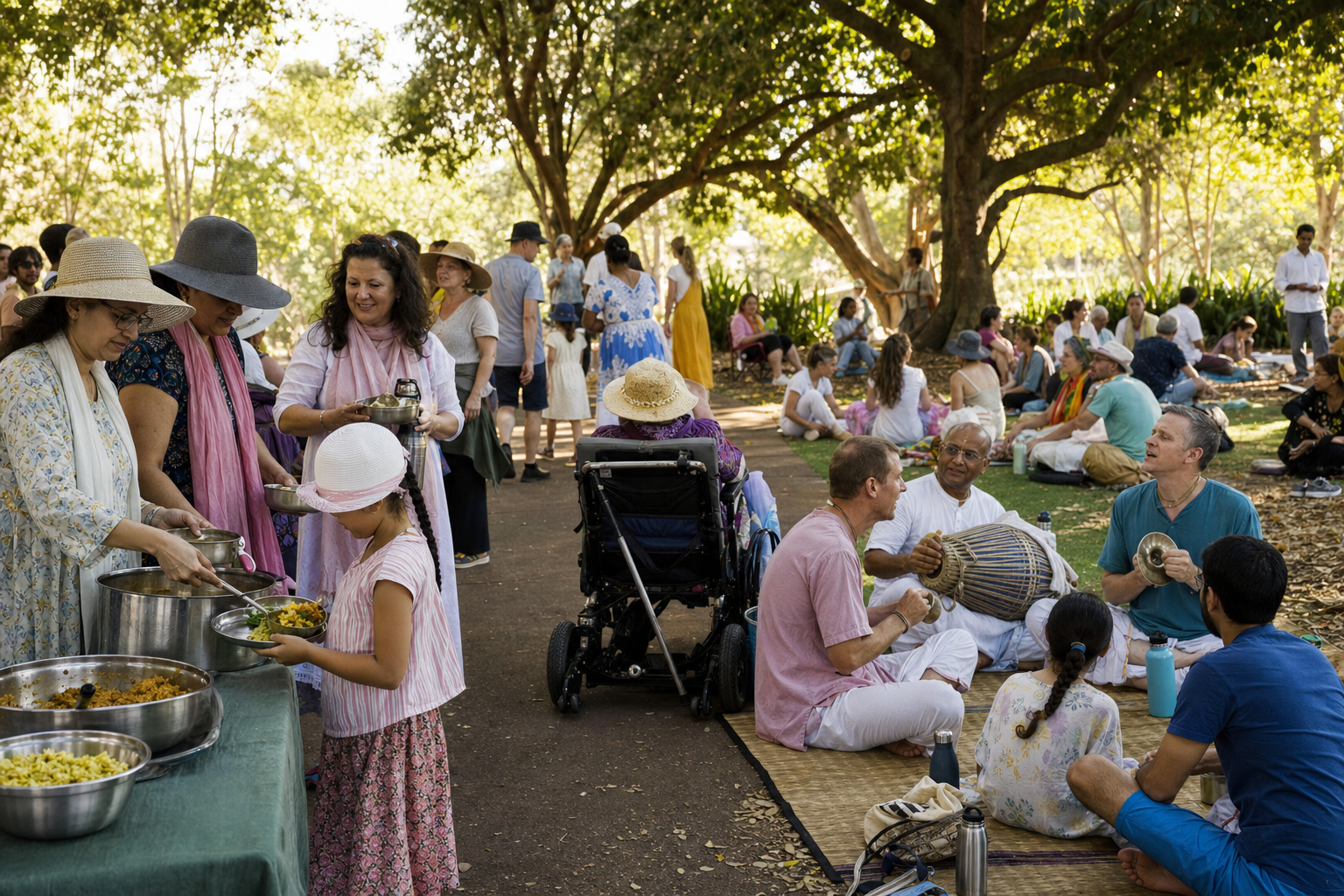
- Prasadam is distributed as sanctified vegetarian food offered in a spirit of devotion and hospitality.
You are not required to pull the rope. If you do, wait until a marshal indicates where to join. Keep the rope out from under your feet, never wind it around your hand or body, and do not move between the rope line and the chariot. Stay clear of the wheels and steering area even when the procession appears to have stopped. If you are managing a stroller or holding a small child, observing from the side is usually the more sensible form of participation.
Kirtan is easier to enter. Listen for the leader’s phrase and answer with the group’s response; musical experience is unnecessary. You may also walk silently and listen. During arati, stand without blocking worshippers or the procession path. You do not need to copy gestures you do not understand.
Receive prasadam as more than complimentary festival food. It has been prepared and offered as an act of bhakti before being shared. Take only what you expect to eat, and ask about ingredients if you have an allergy or dietary restriction. Vegetarian does not automatically mean free of dairy, gluten, nuts or other allergens. A respectful refusal is better than accepting food you cannot safely eat or will discard.
What the chariot means beyond the spectacle
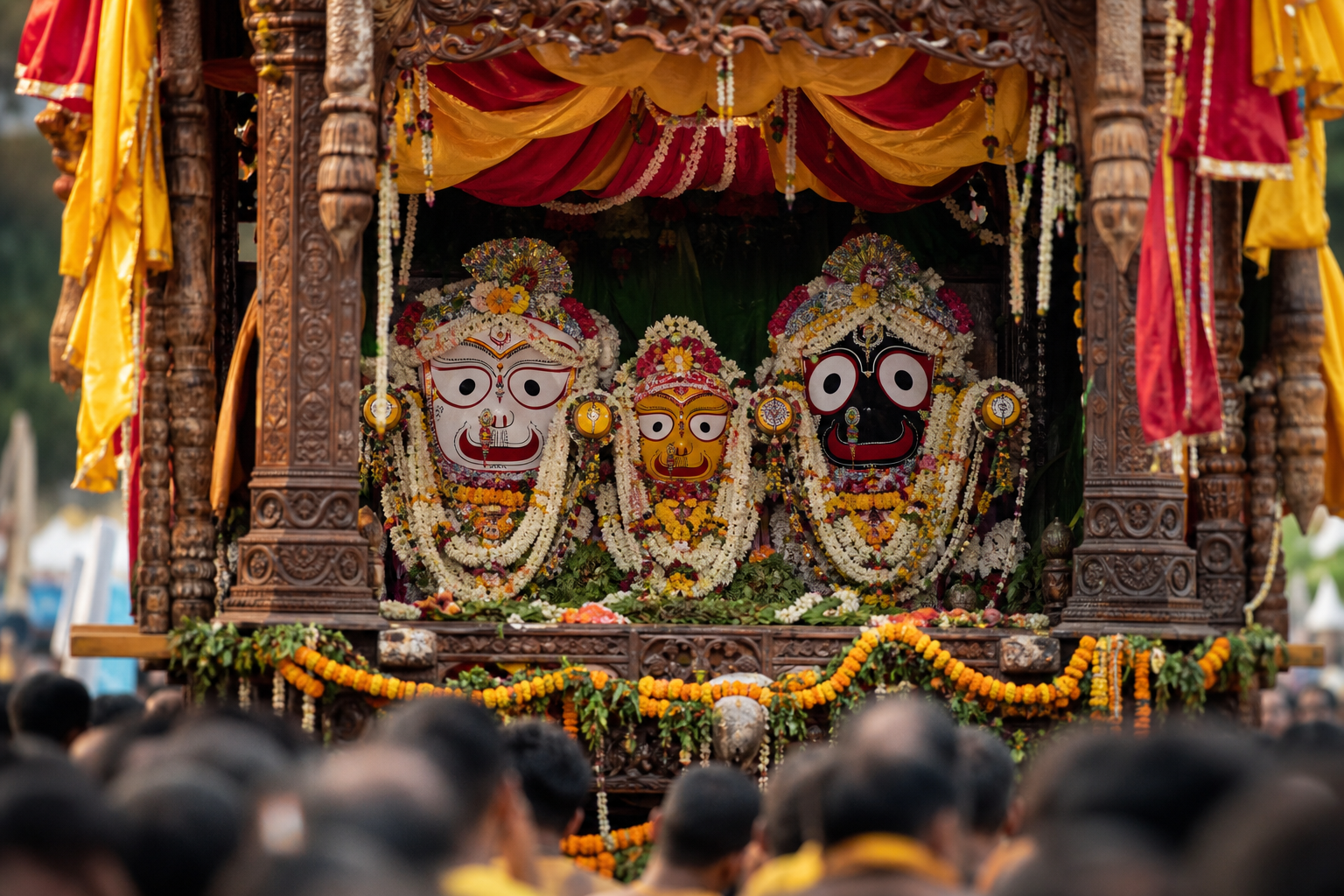
The theological movement of Ratha Yatra is outward. Jagannath, Balabhadra and Subhadra become available for public darshan, including to people who might never enter a temple. Pulling the rope is therefore not merely helping a parade advance. It is seva: the participant lends effort to carrying sacred presence through the shared life of the city.
The Katha Upanishad offers a related chariot image: the body is the chariot, the intellect is the charioteer, the senses are the horses, and the self is the passenger. This metaphor is not the historical origin or ritual explanation of Jagannath Ratha Yatra. It is a complementary way to reflect on what you see. Movement has value when it is guided; strength needs discernment; and a journey becomes meaningful through its direction rather than its speed.
Three actions make that meaning concrete during the festival:
- In kirtan, many voices follow and answer one another rather than competing to dominate the sound.
- At the rope, the chariot advances through coordinated service rather than individual display.
- In prasadam distribution, worship becomes hospitality offered to people beyond the immediate congregation.
That is why the most revealing moment may not be a performance on the stage. Notice what happens when the ropes become taut and many people adjust their pace to one another. Bhakti becomes visible as disciplined cooperation.
A practical visit that respects people, place and tradition
For families, elders and first-time visitors
A city procession is a moving environment, so decide in advance how your group will handle separation, noise and changes to street access. Choose a meeting point away from the chariot path and make sure children know which volunteers to approach. Do not use the moving chariot, a temporary stall or a crowd barrier as your meeting landmark; each may shift during the day.
- Use public transport where practical, but check for event-day diversions before departure.
- Wear footwear suitable for standing and walking on city surfaces, and carry sun protection.
- Bring a filled reusable bottle unless a confirmed notice tells you exactly where refill points will be available.
- If loud percussion is difficult for someone in your group, remain near the outer edge rather than beside the kirtan musicians.
- Ask ahead about step-free access, viewing areas, seating and toilets instead of assuming that recommended facilities have been confirmed.
- Follow marshal instructions promptly. They are coordinating worshippers, spectators, traffic boundaries and the mechanical needs of the chariot at the same time.
Photography at a public celebration can still require restraint. Keep clear of worship, rope crews and emergency access. Ask before taking close photographs of individuals, especially children, and avoid treating arati or prasadam distribution as a staged backdrop.
For a genuinely shared Dharmic gathering
Ratha Yatra can feel familiar across several Dharmic communities without making their traditions interchangeable. The hospitality of prasadam may resonate with the Sikh practice of langar. Its vegetarian offering reflects an ethic of non-harm that speaks to Jain understandings of ahimsa. Chanting, mindful movement and compassionate welcome can also be legible to Buddhist visitors. Sikh Nagar Kirtans and chariot or image processions in Jain and Buddhist settings provide further points of recognition.
These are family resemblances, not claims that every ritual has the same theology. You can honor unity more honestly by asking what Jagannath, kirtan or prasadam means within this Vaishnava setting, while allowing another tradition to explain its own practices in its own terms.
The ideal of Vasudhaiva Kutumbakam, the world as one family, becomes practical here. At the rope, participation is not reserved for a social rank. At the meal, hospitality crosses community boundaries. In the procession, people may chant, walk or witness according to conscience. The unity lies in shared dignity and service, not compulsory sameness.
You can also reduce the festival’s burden on the city: use public transport where possible, carry a reusable bottle, avoid unnecessary single-use items, place waste in the correct bins and follow any volunteer-led cleanup instructions. Civic care is not separate from dharma when a sacred journey passes through common space.
When the final 2026 notice is available, save the date, assembly point, route, accessibility information and transport advice together. Then choose one form of participation you can offer attentively – chanting, walking, pulling under direction, helping your family navigate the day, or receiving prasadam with gratitude. That is enough to enter Ratha Yatra as a participant rather than merely a spectator.