
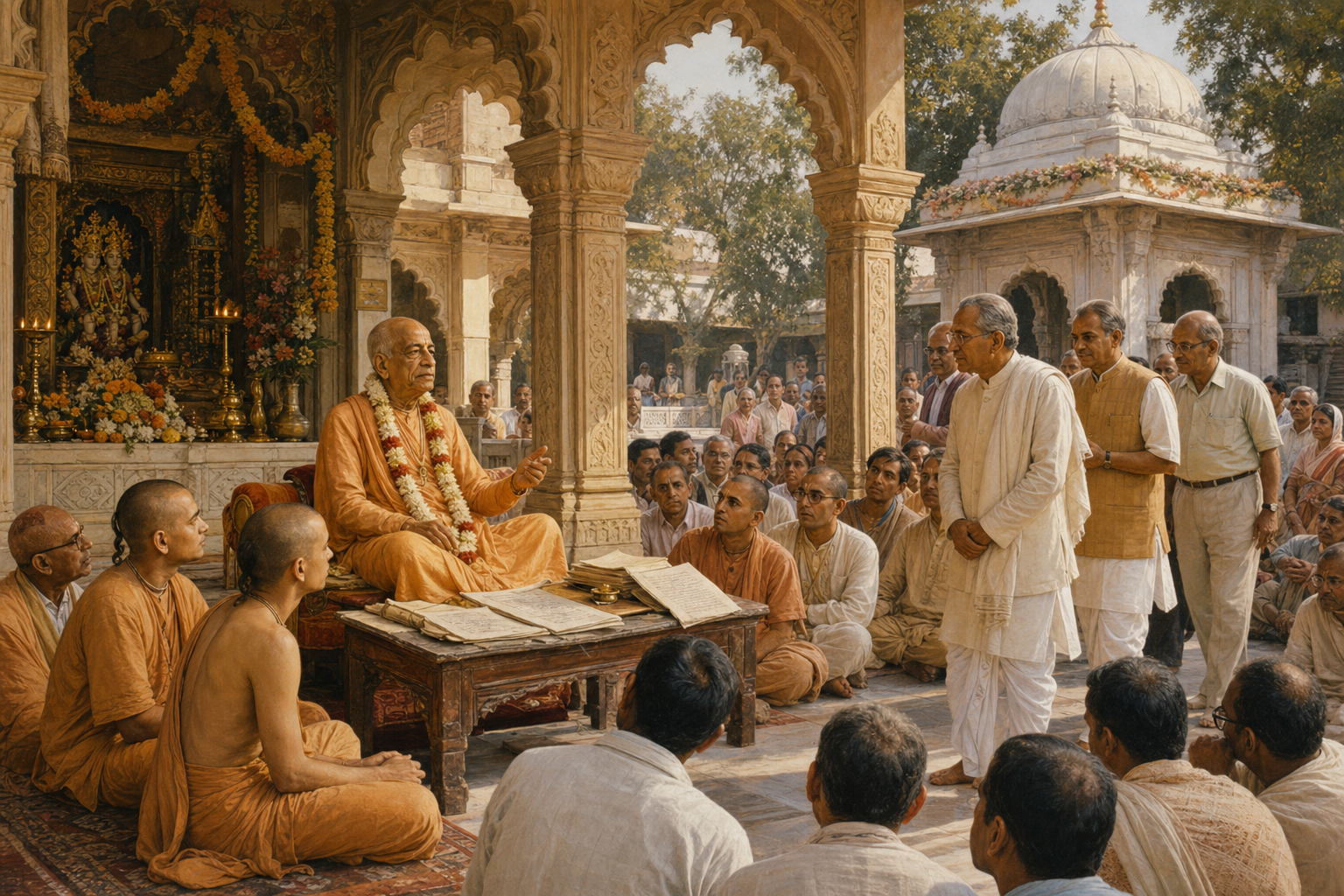
If you are trying to understand Srila Prabhupada’s ministry in Vrindavan, a list of positions or achievements will not take you very far. Watch what happened when worship, disciples, civic leaders, a vast public gathering, and unfinished literary work all claimed the same day.
One festival day in 1976 reveals the governing principle: he did not divide inward devotion from outward responsibility. Sadhana, cultural discipline, public preaching, institutional leadership, and scholarship became different expressions of the same seva. A single remembered day cannot supply a complete administrative history of Vrindavan in 1976, but it can show you how an acharya ordered competing demands when nearly everything required attention at once.
Read the day in sequence, not as scattered anecdotes
The day’s rhythm began at mangal arati. Srila Prabhupada then took an extended morning walk through Vrindavan and preached vigorously for well over an hour. This was not a leisurely interval before the important work. Hearing, chanting, remembrance, instruction, and direct contact with disciples were already the work.
During the walk, Udayananda gradually moved from the back of the group to Prabhupada’s side. When Prabhupada briefly stepped away, the disciple was entrusted with his cane. Udayananda tried to return it with his left hand. Prabhupada paused, questioned the gesture, and gave a rule that the disciple would remember for life: use the right hand.
The pace did not ease after the walk. Prabhupada immediately received dignitaries who had come from New Delhi, including a governor and state representatives. He engaged them on spiritual principles, social ethics, and dharmic responsibility. The same teacher who noticed which hand a disciple used could address people in public office without becoming either timid or theatrical.
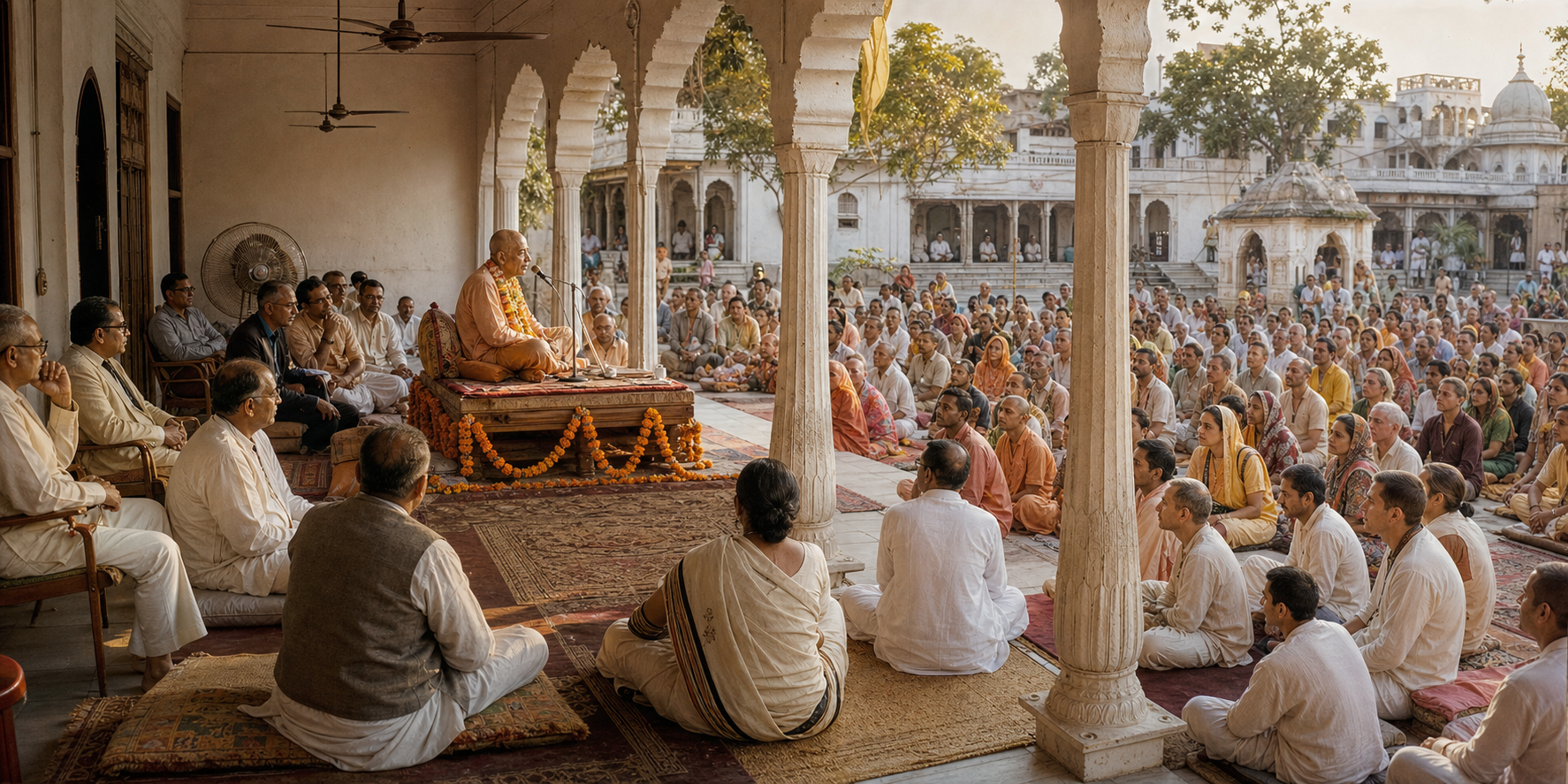
By evening, the centre of activity had shifted to Mathura. A large pandal programme marked the appearance of Lord Ram and drew well over twenty thousand people. Prabhupada chose to speak in Hindi because many people in the gathering might not understand English. He also apologized to his English-speaking disciples for making that choice. The apology did not weaken the decision; it acknowledged the people inconvenienced by a decision made for the larger audience.
Disciples from Africa, England, Australia, America, and South America were present within that Hindi-speaking gathering. Their participation made Bhaktivinode Thakur’s hope of Western people raising their hands and chanting Gaura Hari visible in the land of Krishna. The scene was global without ceasing to be rooted in Bharat: an international Vaishnava community gathered in Mathura while its acharya addressed local listeners in a language they could follow.
The party returned to Fogel Ashram near midnight. In the early hours, the Krishna-Balaram temple’s twenty-four-hour kirtan had softened almost to a whisper, with a lone mridanga accompanying the holy name. At about 2:00 a.m., Udayananda noticed light coming from Prabhupada’s room. After a day that had already run for more than fourteen hours, Prabhupada was dictating with a small recorder.
The sequence matters. Mangal arati was not displaced by a public event. Attention to etiquette was not abandoned because officials were waiting. Civic engagement did not prevent mass preaching. A crowd of more than twenty thousand did not make quiet textual labour seem unimportant. Each responsibility had its proper object, but all of them pointed toward the transmission of Krishna consciousness.
The cane lesson shows how dharma enters ordinary conduct
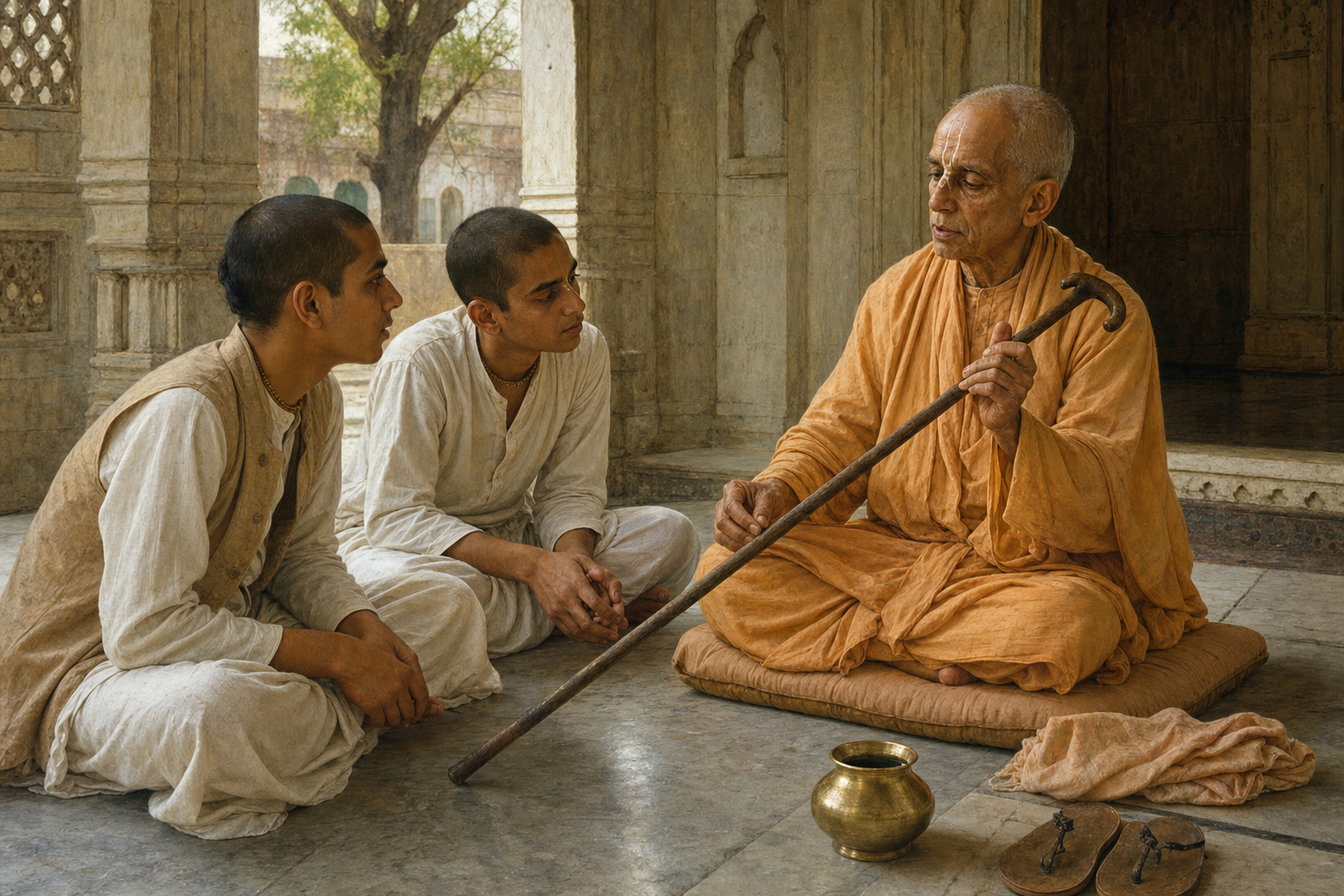
"Always right hand."
Srila Prabhupada, as recalled by Udayananda
It is easy to dismiss the cane exchange as a minor point of Indian etiquette. That would miss its educational force. In classical Indian conduct, offering and receiving with the right hand communicates cleanliness, care, and respect. The physical gesture trains the person making it to remember that an exchange can carry moral and spiritual meaning.
Read as service training, the instruction is not about assigning a magical property to one hand. It is about refusing carelessness when receiving or offering something in a relationship of respect. The body is part of religious formation. Reverence that never reaches posture, speech, timing, cleanliness, or the way an object is handled remains incomplete.
There is also a practical lesson for anyone who teaches in a temple, ashram, family, or youth group. A useful correction has four parts: interrupt the mistake without a long performance, allow the person to correct it, give a stable rule they can remember, and explain the value behind the rule when explanation is needed. The goal is not to prove that the senior person knows more. The goal is to make the next act of service more attentive.
Use a simple test before enforcing a customary gesture: does it protect cleanliness, reverence, or consideration for another person? Can a newcomer understand what to do? Are you correcting them to improve their seva, or merely displaying rank? Where disability or circumstance makes a conventional gesture impractical, the underlying principle of respectful offering remains the proper measure.
This distinction protects dharmic refinement from two opposite failures. If you discard embodied customs as trivial, the tradition can become abstract and culturally weightless. If you enforce customs without purpose or compassion, refinement turns into social policing. Prabhupada’s brief correction joined precision to proportion: a small mistake was corrected clearly, but it did not consume the day.
One centre, two audiences: officials and the public
Speak principles clearly in the presence of power
The meeting with dignitaries shows a form of dharmic public engagement that avoids both withdrawal and courtly flattery. Prabhupada could discuss spiritual principles and social ethics with people connected to the state while remaining rooted in bhakti. Access to an official did not become the message; dharmic responsibility remained the message.
If you represent a temple or dharmic organisation in a civic meeting, prepare at the level of principle before preparing publicity. You should be able to state the value at stake, explain its consequence for public conduct, and identify what cannot be traded merely to preserve access. A photograph with an office-holder proves that a meeting happened. It does not prove that dharma was spoken with clarity.
Firmness and courtesy are not rival approaches here. Courtesy keeps the listener available to hear; firmness keeps the teaching from being absorbed into vague ceremonial language. Remove either one and the encounter changes character. Courtesy without substance becomes deference. Firmness without self-command becomes aggression.
Let the listener’s need determine the language
At the Mathura pandal, humility became an operational decision. Prabhupada did not merely praise accessibility. He spoke in Hindi for the people who might not understand English and acknowledged the English-speaking disciples who would lose access. He served the principal audience while remaining considerate toward the smaller group.
That gives temple organisers a concrete standard. Before announcing a discourse, decide whom it is meant to reach and which language that person can actually follow. If the gathering is multilingual, arrange translation, a concise summary, or a separate follow-up before the programme is advertised. Test specialised words with someone outside the organising circle. Familiarity inside a community can hide how inaccessible its language has become.
In Bharat, English should not become the automatic language of prestige when Hindi or a regional language better serves the people present. Nor should a local language be used to exclude sincere visitors. The governing question is not which language makes the speaker appear most accomplished. It is which arrangement allows Krishna-katha to be heard with understanding.
Accessibility does not require doctrinal dilution. A teacher can preserve the substance of a tradition while changing vocabulary, language, pacing, and explanation. Prabhupada’s choice in Mathura shows that fidelity belongs in the teaching itself, not in attachment to a single medium of delivery.
The light at 2:00 a.m. reveals the movement’s infrastructure
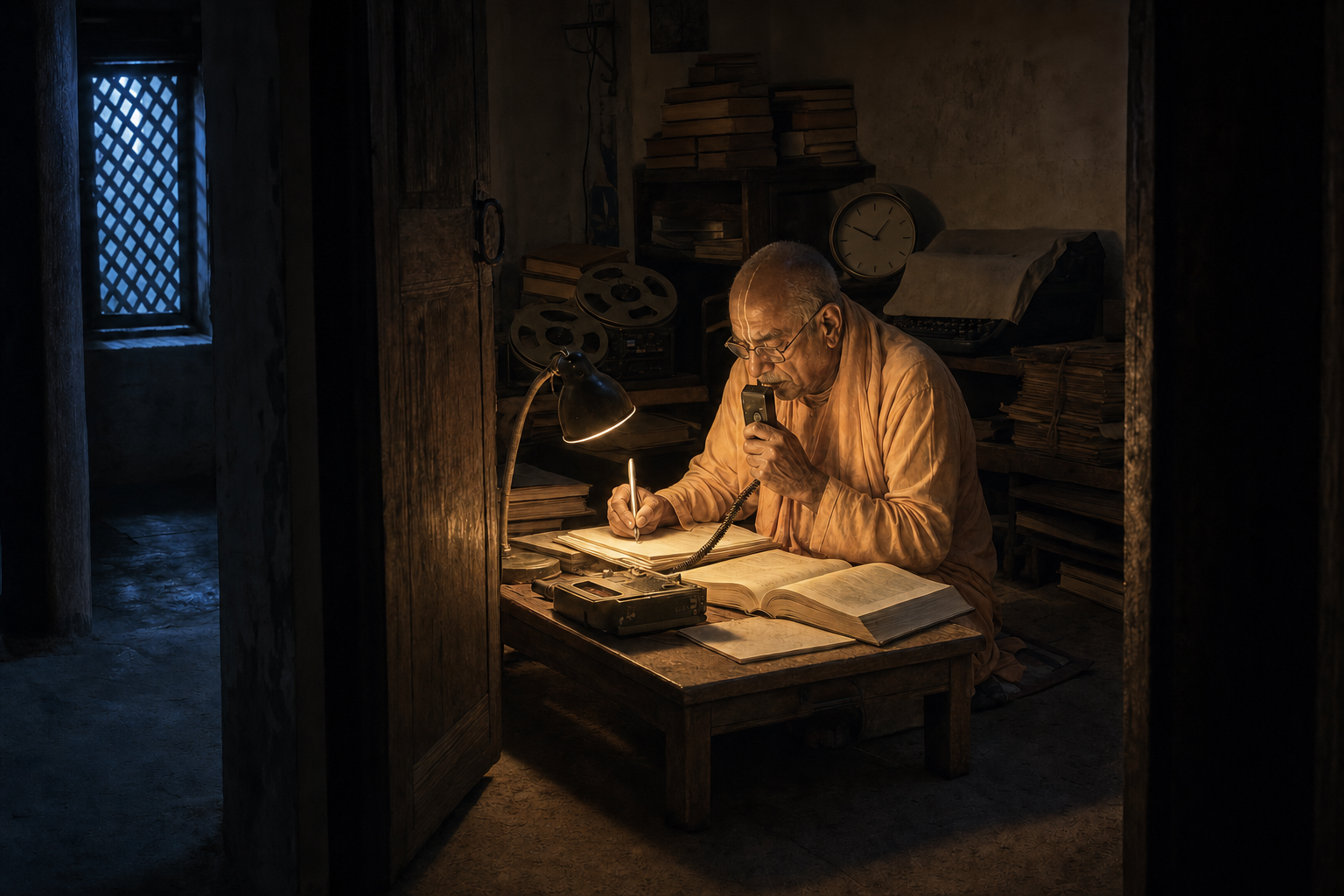
The late-night dictation is the quiet centre of the day. Public preaching could gather thousands, but careful translation and commentary could instruct people who were absent, separated by geography, or born in a later generation. Scholarship was not an ornamental pursuit behind the visible movement. It was part of the movement’s infrastructure.
Udayananda heard Prabhupada refer to Srila Visvanatha Chakravarti Thakur’s explanation of the Bhagavad Gita while working on Srimad-Bhagavatam. That detail matters. Prabhupada’s writing joined active preaching to the inherited Gaudiya Vaishnava commentarial tradition. Global communication did not mean severing teaching from parampara; the older textual inheritance supplied depth to the new international mission.
Do not turn the hour into generic productivity advice. One unusually demanding day is not a universal prescription for sleep deprivation, and exhaustion is not proof of devotion. The useful lesson is about protected priority. Even after visible success, Prabhupada returned to the work that would make disciplined study possible beyond the immediate gathering.
If you teach regularly, give every outreach cycle a durable counterpart. Protect time for study. Check the textual basis of your claims. Preserve a transcript, translation, commentary, or carefully edited set of notes. If you manage a temple, pair the event calendar with a publication and archive calendar. Assign responsibility for recording the date, speaker, language, scriptural references, and context of important teachings.
This is not administrative fussiness. Without preservation, a movement must repeatedly reconstruct its teaching from memory and personality. With responsible textual work, disciples can study, translate, question, and transmit what they received. The pandal creates reach; the book creates continuity. A healthy ministry needs both.
Key takeaways: a practical test for dharmic leadership
- Begin from sadhana. Public activity should grow from actual spiritual practice, not continually displace it. Put worship, japa, study, or the discipline proper to your sampradaya into the schedule before filling the day with meetings.
- Make standards teachable. When correcting conduct, name the action and the principle behind it. The person should leave knowing how to serve better, not merely knowing that a senior person disapproved.
- Carry dharma into civic rooms. Prepare the spiritual and ethical principle you need to express before meeting a public official. Do not confuse proximity to power with influence upon it.
- Choose language for comprehension. Decide the primary language from the needs of the people you intend to reach. Plan honestly for those who will require translation or follow-up.
- Preserve what the gathering cannot. A discourse ends; a carefully prepared text can continue teaching. Protect scholarship, translation, editing, and archives as forms of seva rather than treating them as work left over after public events.
- Watch where recognition goes. Prabhupada remained uninterested in personal fanfare and kept attention on Krishna, instruction, and service. Evaluate leadership by what it directs people toward after the leader leaves the room.
Readers from other Dharmic traditions can recognise parts of this pattern without claiming that the traditions are interchangeable. Buddhist mantra discipline, Jain commitments to ahimsa and service, and Sikh devotion through Naam Simran offer genuine parallels at the level of disciplined practice and ethical responsibility. The comparison becomes useful when it increases mutual recognition; it becomes careless when it erases distinct doctrines, lineages, or goals.
Choose the weakest connection in your own service this week. If the programme is crowded but local people cannot follow its language, fix the communication. If conduct is correct but newcomers are corrected harshly, change the method. If events are plentiful but nothing durable is being written, protect time for textual work. Do not imitate the exceptional timetable. Imitate the refusal to separate inward devotion, responsible conduct, accessible teaching, and service to the future.