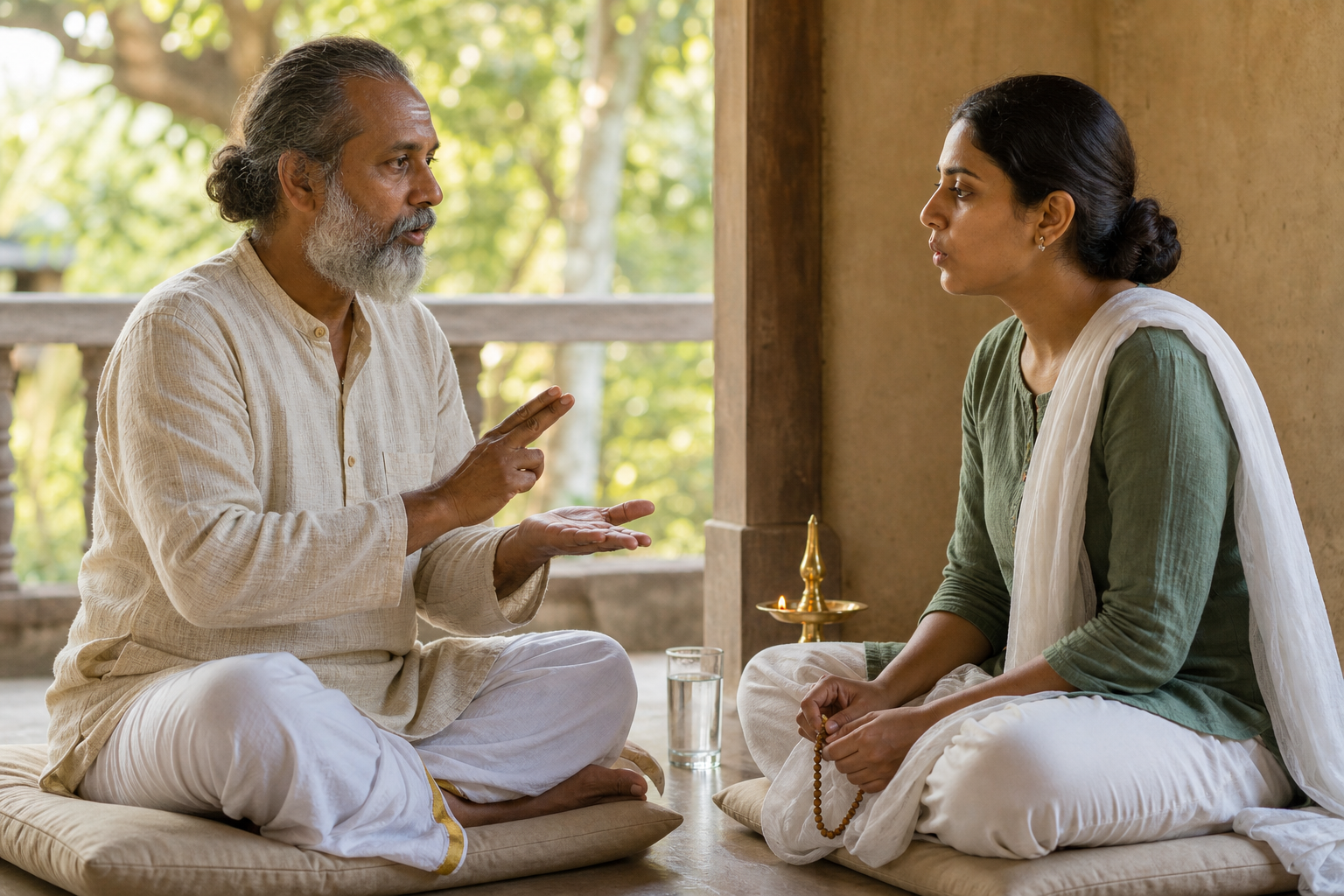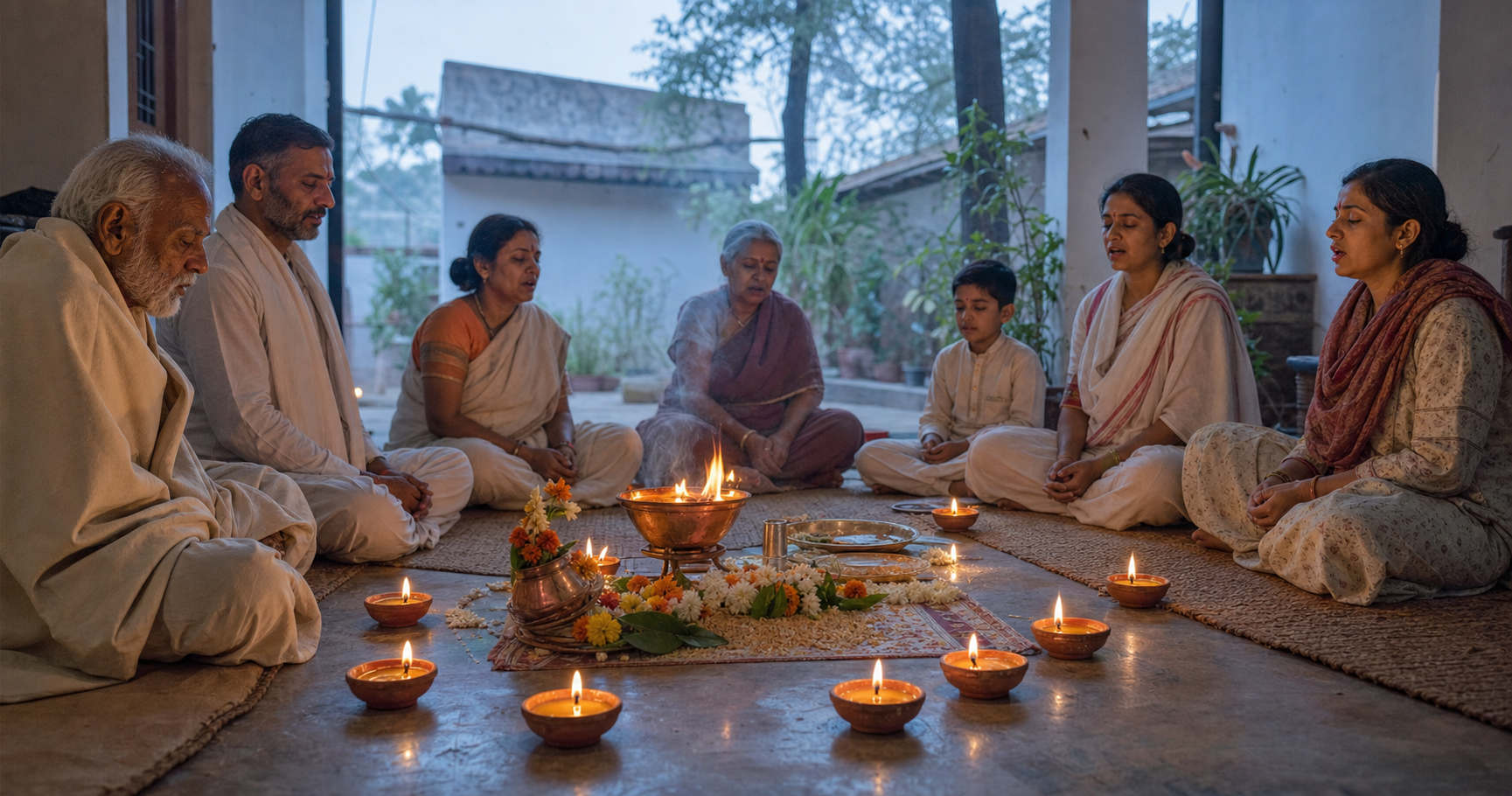
You may know one or two Vedic peace invocations and still be unsure what to do with Dashashanti. Should you recite all ten? Is there a fixed order? Can you use them at home, or do they belong only in formal ritual?
The safest and most fruitful approach is to treat Dashashanti as a living cycle of sacred intentions. Learn the text you actually received, understand what each mantra asks of you, and let the recitation shape the conduct that follows.
Key takeaways
- Dashashanti is a cycle of ten Vedic Śānti Mantras, but the order and even some selections vary across paramparās and regions.
- The mantras address peace at three interconnected levels: divine or natural, social or environmental, and inward or psychological.
- For personal practice, begin with one mantra whose intention matches a real need: learning, truthful speech, discernment, nourishment, protection, gratitude, or ecological harmony.
- For a homa, saṁskāra, temple observance, vrata, or another formal rite, follow the sequence and pronunciation used by the officiant or lineage rather than constructing your own supposedly universal order.
- Correct recitation matters, but Dashashanti is not only a vocal exercise. Truthfulness, mutual goodwill, disciplined attention, and care for the living world are part of the practice.
Why Dashashanti has ten voices rather than one formula
Dashashanti gathers ten peace invocations drawn mainly from the Rigveda, the Yajurveda and its Taittirīya tradition, and invocations associated with major Upanishads. They are used to prepare for study, consecrate ritual space, seek protection, and direct individual and collective life toward auspiciousness.
The ten do not merely repeat the request to feel calm. Each illuminates a different condition required for peace: trustworthy relationships, disciplined speech, healthy faculties, shared effort, wise guidance, freedom from ill will, discernment between the real and unreal, and harmony throughout the natural order. Dashashanti therefore gives you a map of peace rather than a single mood.
This map is traditionally understood through three fields of disturbance. Adhidaivika concerns forces in the divine or natural sphere. Adhibhautika concerns the surrounding world, including social and environmental conditions. Adhyātmika concerns the inward sphere of mind and self. The familiar threefold Oṁ śāntiḥ śāntiḥ śāntiḥ addresses impediments across all three fields.
That distinction changes how you recite. If the mind is settled but relationships remain poisoned, peace is incomplete. If a ceremony invokes peace while its surroundings are treated carelessly, peace is incomplete. If public order is maintained through untruth, peace is incomplete. The cycle repeatedly turns you from private composure toward right relationship with teacher, community, nature, devas, and Brahman.
There is also no single sequence that can be imposed on every Hindu community. Regional and lineage-based arrangements may place the mantras differently or substitute closely related Śānti Pāṭhas. This is not an invitation to casual alteration. It means that faithful transmission of sound can coexist with sanctioned liturgical variation. When your family, teacher, temple, or Vedic school has a received order, that order is the one relevant to your practice.
The ten mantras and the work each one does
The Sanskrit below identifies the ten invocations by an opening line or commonly recited form. Some entries are complete short invocations; others are listed by their identifying opening words. Use this as a map of the cycle, not as a replacement for the complete and accent-marked text followed by your paramparā. The English descriptions give the spiritual orientation rather than a word-for-word translation.
| Mantra | Textual home | Central intention | Useful focus for personal practice |
|---|---|---|---|
| Bhadraṁ karṇebhiḥ śṛṇuyāma devāḥ | Rigveda 1.89.8 | May we hear what is auspicious, see what is ennobling, and live with vigor in sacred service. | Use its intention before study, listening, or any situation in which the quality of your attention will shape your judgment. |
| Namo brahmaṇe; namaste vāyo; tvam eva pratyakṣaṁ brahmāsi | Taittirīya Upaniṣad tradition | Reverence for Brahman through Vāyu as an immediate manifestation, joined to truth, ṛta, and protection for learner and teacher. | Choose it when you need to align speech, breath, and study with truthfulness rather than display. |
| Śaṁ no mitraḥ śaṁ varuṇaḥ | Taittirīya Āraṇyaka 4.1.1 | Harmony through Mitra, Varuṇa, Aryaman, Indra, Bṛhaspati, and Viṣṇu, whose powers evoke covenant, order, strength, wisdom, and expansive intelligence. | Let it orient a shared act of worship or learning toward trust, moral order, and dependable relationships. |
| Saha nāvavatu; saha nau bhunaktu; saha vīryaṁ karavāvahai; tejasvināv adhītam astu; mā vidviṣāvahai; oṁ śāntiḥ śāntiḥ śāntiḥ | Common invocation of the Taittirīya and Kena Upanishads | Shared protection, nourishment, effort, and brilliance in study, with an explicit rejection of mutual hostility. | Recite it with a teacher, student, or study group. Then make cooperation, not intellectual rivalry, the standard for the session. |
| Pūrṇam adaḥ pūrṇam idam; pūrṇāt pūrṇam udacyate; pūrṇasya pūrṇam ādāya; pūrṇam evāvaśiṣyate | Invocation of the Īśā Upaniṣad | The transcendent and manifest are whole; what proceeds from wholeness does not diminish that wholeness. | Use it before study or offering when fear of insufficiency is narrowing your attention. Let gratitude govern what follows. |
| Asato mā sad gamaya; tamaso mā jyotir gamaya; mṛtyor mā’mṛtaṁ gamaya; oṁ śāntiḥ śāntiḥ śāntiḥ | Bṛhadāraṇyaka Upaniṣad 1.3.28 | A movement from the unreal to the real, darkness to light, and death to immortality. | Choose it when the immediate work is discernment: identifying confusion, seeking clarity, and acting without being ruled by fear. |
| Āpyāyantu mamāṅgāni vāk prāṇaś cakṣuḥ śrotram atho balam indriyāṇi ca sarvāṇi | Taittirīya Upaniṣad, Śikṣāvallī | May speech, breath, sight, hearing, strength, and all the faculties flourish as instruments of knowledge. | Use it before serious study as a reminder that learning involves the whole embodied person, not the intellect alone. |
| Āpyāyasva sametu te viśvataḥ soma vṛṣṇayam; bhavā vājasya saṁgathe | Taittirīya tradition | Vitality and nourishment gathered from every direction, supporting strength and shared prosperity. | Let it frame nourishment, sustained effort, or communal work as participation in sacred order rather than private acquisition. |
| Svasti na indro vṛddhaśravāḥ; svasti na pūṣā viśvavedāḥ; svasti nas tārkṣyo ariṣṭanemiḥ; svasti no bṛhaspatir dadhātu | Rigveda 1.89.6 | Welfare through strength, all-knowing guidance, safe passage, and wise counsel. | Choose it when beginning a journey, undertaking, gathering, or period in which protection and sound judgment are foremost. |
| Oṁ dyauḥ śāntiḥ; antarikṣaṁ śāntiḥ; pṛthivī śāntiḥ; āpaḥ śāntiḥ; oṣadhayaḥ śāntiḥ; vanaspatayaḥ śāntiḥ; viśvedevāḥ śāntiḥ; brahma śāntiḥ; sarvaṁ śāntiḥ; śāntir eva śāntiḥ; sā mā śāntiḥ; edhi; oṁ śāntiḥ śāntiḥ śāntiḥ | Yajurveda tradition | Peace in the heavens, mid-space, earth, waters, herbs, trees, all deities, Brahman, and the whole of existence. | Use it to close worship or collective activity with the recognition that human well-being cannot be separated from cosmic and ecological harmony. |
The table also prevents a common mistake: selecting a mantra only because its sound is familiar. If you are preparing to study with another person, Saha nāvavatu directly addresses the relationship. If you are facing confusion, Asato mā gives the sharper contemplative direction. If your concern is the well-being of an entire gathering or journey, Svasti na indro brings protection, guidance, and wise counsel to the foreground. Match your personal practice to the mantra’s intention; do not claim that your choice replaces the liturgical selection for a formal rite.
How to learn them without flattening a living tradition
A Roman transliteration can help you recognize a mantra, but it cannot by itself transmit a Vedic chant. Vowel length, aspiration, articulation, and accent affect the recitation. In formal Vedic transmission, the accents known as udātta, anudātta, and svarita are preserved with care. A page that omits those markings should not be treated as sufficient authority for reproducing the full chant.
Build a dependable personal practice
- Choose the context first. Decide whether you are preparing for study, seeking discernment, beginning worship, invoking general welfare, or closing with universal peace. This keeps the mantra connected to a real intention.
- Obtain the complete text used by one trustworthy lineage. If you have a teacher, family tradition, temple, or Vedic school, use its version. Do not splice words, recordings, and accents from several arrangements into a new composite.
- Learn the sound before increasing speed. Listen to a qualified reciter, work through manageable units, and repeat accurately. A slow, stable rendering is more useful than a fast performance whose syllables have blurred.
- Study the meaning alongside the sound. Before recitation, state the intention in plain language. Afterward, identify the duty implied by it. This prevents sacred sound from becoming detached from dharma.
- Add mantras gradually. One mantra learned carefully is a sounder beginning than ten openings memorized approximately. When the first recitation is stable, add another according to the received sequence or the needs of personal practice.
No universal daily count is established by the shared idea of Dashashanti alone. If your teacher has prescribed a count, follow that instruction. If not, do not invent a number and present it as Vedic law. Regularity, accuracy, meaning, and conduct give a personal practice its integrity.
Know when personal selection must yield to ritual order
In private reflection, you can choose one of the ten according to its meaning. A formal upanayana, vivāha, vrata, homa, temple consecration, or other inherited observance is different. These settings have liturgical roles, ritual authorities, and local patterns. Follow the officiant and the applicable paramparā, including its order, complete wording, accents, and points of recitation.
This boundary protects both freedom and fidelity. You can bring a peace invocation into daily life without pretending to have established a new Dashashanti recension. You can also respect regional variation without assuming that pronunciation is optional. The cycle has long served household rites, teaching, homa, vrata, and temple settings, but the form appropriate to each setting comes through practice and transmission.
Make peace visible after the chanting ends
The first result to look for is not an unusual sensation. Look at the next choice you make. Each invocation establishes a test that can be applied to ordinary conduct:
- After Bhadraṁ karṇebhiḥ, examine what you admit through attention. Auspicious hearing does not mean refusing difficult truths. It means learning to receive what supports clear, dharmic judgment rather than feeding distraction or malice.
- After Namo brahmaṇe, make one act of speech answerable to satya and ṛta. Correct a misleading statement, keep a promise, or refrain from using technically true words to create a false impression.
- After Saha nāvavatu, remove one source of hostility from learning. Ask a sincere question, acknowledge what another person contributed, or disagree without turning the learner into an enemy.
- After Pūrṇam adaḥ, make gratitude concrete. Offer time, knowledge, food, or attention without assuming that every act of giving leaves you diminished.
- After Asato mā, name the confusion before seeking the answer. Write down what you know, what you merely assume, and what remains uncertain. The movement toward light begins with refusing to disguise uncertainty as knowledge.
- After Āpyāyantu mamāṅgāni, prepare the faculties you are asking to flourish. Sit attentively, reduce needless interruption, listen fully, and use speech for the work of learning.
- After Svasti na indro, pair the request for protection with prudent action. Seek wise counsel, prepare carefully, and do not call avoidable carelessness an act of faith.
- After Oṁ dyauḥ śāntiḥ, include the more-than-human world in your decision. A prayer naming earth, waters, herbs, and trees should make ecological disregard harder to justify.
This is where Dashashanti speaks naturally to the wider Dharmic family without erasing real differences among traditions. Its commitments to non-harm, truthful speech, disciplined awareness, and common welfare have clear ethical resonances with Buddhist mettā, Jain ahiṁsā, and Sikh emphasis on truthful living and collective well-being. These resonances create room for fraternity; they do not make distinct scriptures, disciplines, or theological claims interchangeable.
If you are bringing a peace invocation into a mixed Dharmic gathering, keep both truths visible. Name the mantra’s Vedic identity accurately, and invite others to meet it through the shared ethical responsibility it expresses. Unity becomes credible when it respects origin as well as common purpose.
Your next step can be small and exact. Choose one mantra whose intention matches a duty already before you. Obtain its complete recitation from the tradition you trust, learn its sound and meaning together, and attach one observable act to it. When that practice becomes steady, learn the next mantra in the sequence you have received.