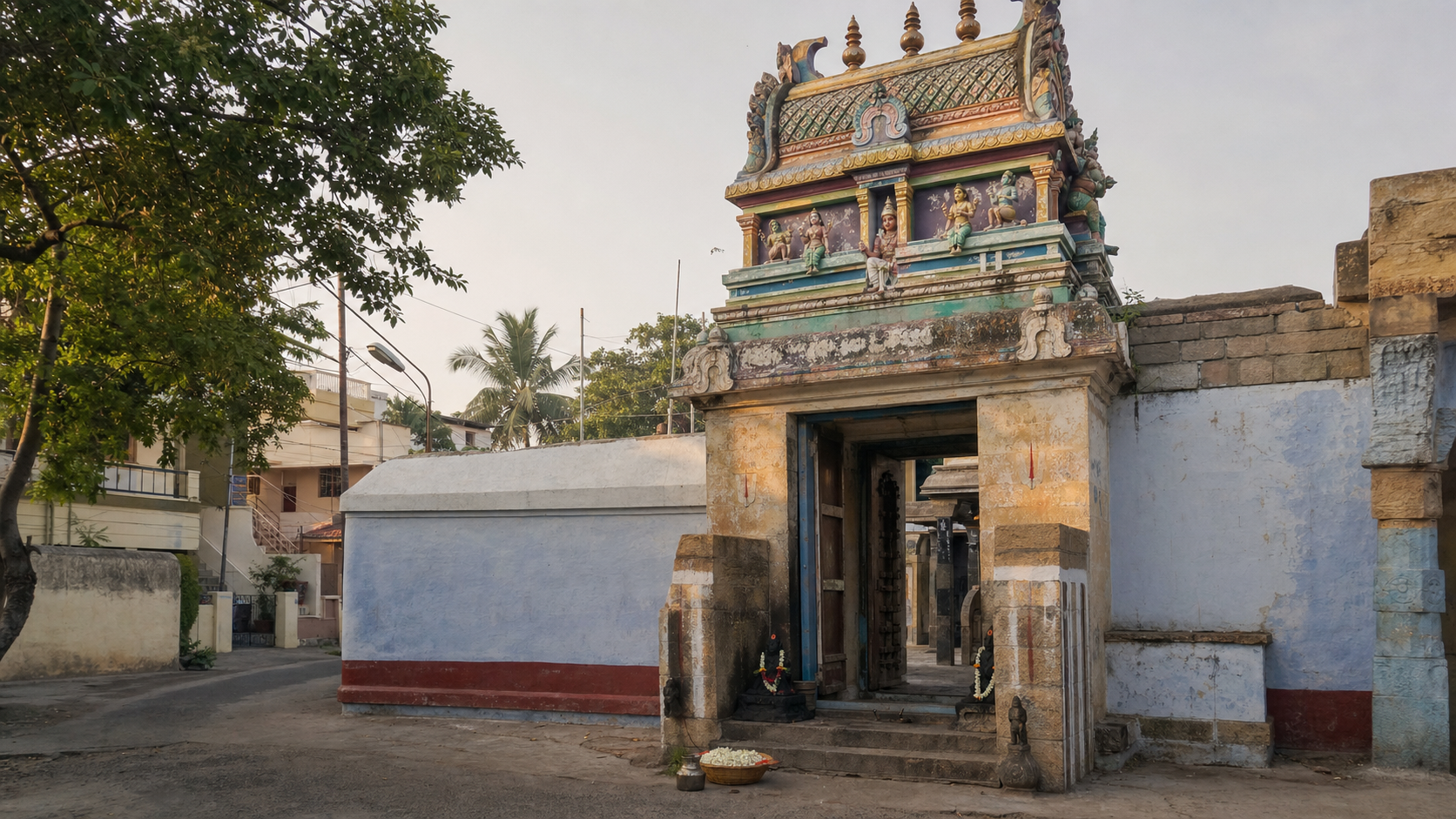
If you are adding Nachiyar Koil to a Tiruchirappalli pilgrimage, settle one practical question before arranging transport: which Nachiyar Koil do you mean? The shrine connected with Kamalavalli’s divine wedding is the Thirukozhi Divya Desam at Uraiyur, not the better-known temple of the same popular name near Kumbakonam. Confusing the two does more than alter a map pin; it takes you to a different sacred story.
Once you reach the right temple, do not treat it merely as a stop where people pray for marriage. Its deeper significance lies in the way the wedding of Kamalavalli Nachiyar and Azhagiya Manavala Perumal shapes the shrine’s identity, ritual hierarchy, iconography and festival year. If you know what to notice, the temple becomes a carefully preserved theology of compassion, sovereignty and auspicious union.
First identify the Uraiyur Nachiyar Koil correctly
The formal name is Azhagiya Manavala Perumal Temple. Thirukozhi is its sacred place-name, Uraiyur is its historic locality, and Nachiyar Koil is the popular name arising from the prominence accorded to the goddess. Those names belong together. When searching, speaking to a driver or preparing an itinerary, use at least three identifiers: Thirukozhi, Uraiyur and Kamalavalli Nachiyar.
- Destination: Thirukozhi or Uraiyur Nachiyar Koil.
- City: Tiruchirappalli, commonly called Trichy.
- Presiding divine couple: Azhagiya Manavala Perumal and Kamalavalli Nachiyar.
- Defining tradition: the sacred wedding associated with Kamalavalli’s earthly appearance as a princess of Uraiyur.
This identification also places the temple within the right religious landscape. Thirukozhi is one of the 108 Divya Desams praised by the Alvars in the Nalayira Divya Prabandham. It belongs to Tiruchirappalli’s wider Sri Vaishnava sacred geography alongside Srirangam and Thiruvellarai. You can visit these shrines as a circuit, but Thirukozhi should not be reduced to an incidental detour from Srirangam. Its theological emphasis is distinct.
Ancient does not mean architecturally untouched
Uraiyur was an early Chola centre, and the older name Thirukozhi carries the local memory of a kozhi, or cock, motif. That antiquity supplies the setting, but it does not mean every visible surface belongs to one Chola-period construction campaign. Later Vijayanagara and Nayaka patronage, together with endowments accumulated over time, contributed to the complex now encountered by pilgrims.
This matters when you look at the building. Do not force every pillar, mandapa or stucco feature into a single date merely because Uraiyur is ancient. Read the temple as a living structure with historical layers. Fragmentary inscriptions and stylistic differences can preserve evidence of continuity without yielding a neat date for every component.
The wedding is the temple’s organising memory
The sthala-purana begins with Lakshmi appearing on earth as Kamalavalli, a princess of Uraiyur. Her devotion was directed toward Vishnu, who came to Uraiyur as Azhagiya Manavala Perumal and married her. The shrine preserves this encounter not as a story left in the distant past, but as a sacred event continually made present through worship, bridal iconography and festival.
That distinction changes how you should approach the temple. A historical monument asks you to reconstruct what happened long ago. A living kalyana-sthalam asks you to recognise what the community continues to celebrate. At Thirukozhi, the wedding is visible in at least four ways: the bridegroom identity of Perumal, the regal presentation of Kamalavalli, the precedence given to Nachiyar and the annual kalyana observance centred on Panguni Uthiram.
The marriage also carries more than romantic symbolism. Kamalavalli is Lakshmi, the divine presence of compassion, fortune and gracious mediation. Perumal is Vishnu, the protector of dharma. Their union expresses the Sri Vaishnava conviction that divine compassion and divine sovereignty are inseparable. Refuge is not offered by power stripped of tenderness, nor by tenderness lacking the power to protect.
This is why the first honour given to Nachiyar is not a decorative courtesy. It turns doctrine into ritual order. Sri Vaishnava acharyas, including Ramanuja and later commentators, articulate the inseparability of Lakshmi and Narayana in relation to sharanagati, or surrender to the Divine. Thirukozhi allows you to encounter that principle spatially: the goddess’s precedence embodies the primacy of compassionate grace.
If you visit with a personal prayer concerning marriage, family or reconciliation, this context protects the prayer from becoming transactional. The temple is rightly known as a sacred wedding site, but its tradition should not be reduced to a mechanical promise that one ritual guarantees one worldly result. A more faithful prayer asks for the qualities displayed by the divine couple: steadfastness, mutual regard, moral order, compassion and the grace to place relationship within dharma.
The same discipline helps when relating Thirukozhi to the wider Dharmic family. Its reverence for the feminine can resonate with Shakta traditions; its language of compassion can be recognised alongside Buddhist and Jain commitments to karuna and non-harm; its sung remembrance of the Divine can speak to a Sikh reader. These resonances need not erase difference. Thirukozhi remains specifically Sri Vaishnava, and its universal depth becomes clearer when that identity is respected rather than blurred.
What to notice from the gateway to the sanctum
The temple follows a Dravida architectural sequence: gateway, pillared spaces, circumambulatory paths and the inward movement toward the garbhagriha. Instead of rushing directly to the deity, notice how the setting changes as you proceed. The mandapa accommodates communal visibility, recitation and festival presentation; the darker sanctum gathers attention into a concentrated encounter. Architecture controls pace before ritual words explain anything.
Look upward where the vimana rises above the sanctum, then return your attention to the human scale of pillars, thresholds and lamps. The contrast is meaningful. The temple simultaneously announces a cosmic order and creates an intimate bridal setting. The pushkarini, or temple tank, extends that ordered sacred environment beyond the inner building through its association with purification, seasonal rites and kalyana symbolism.
Read the two divine forms together
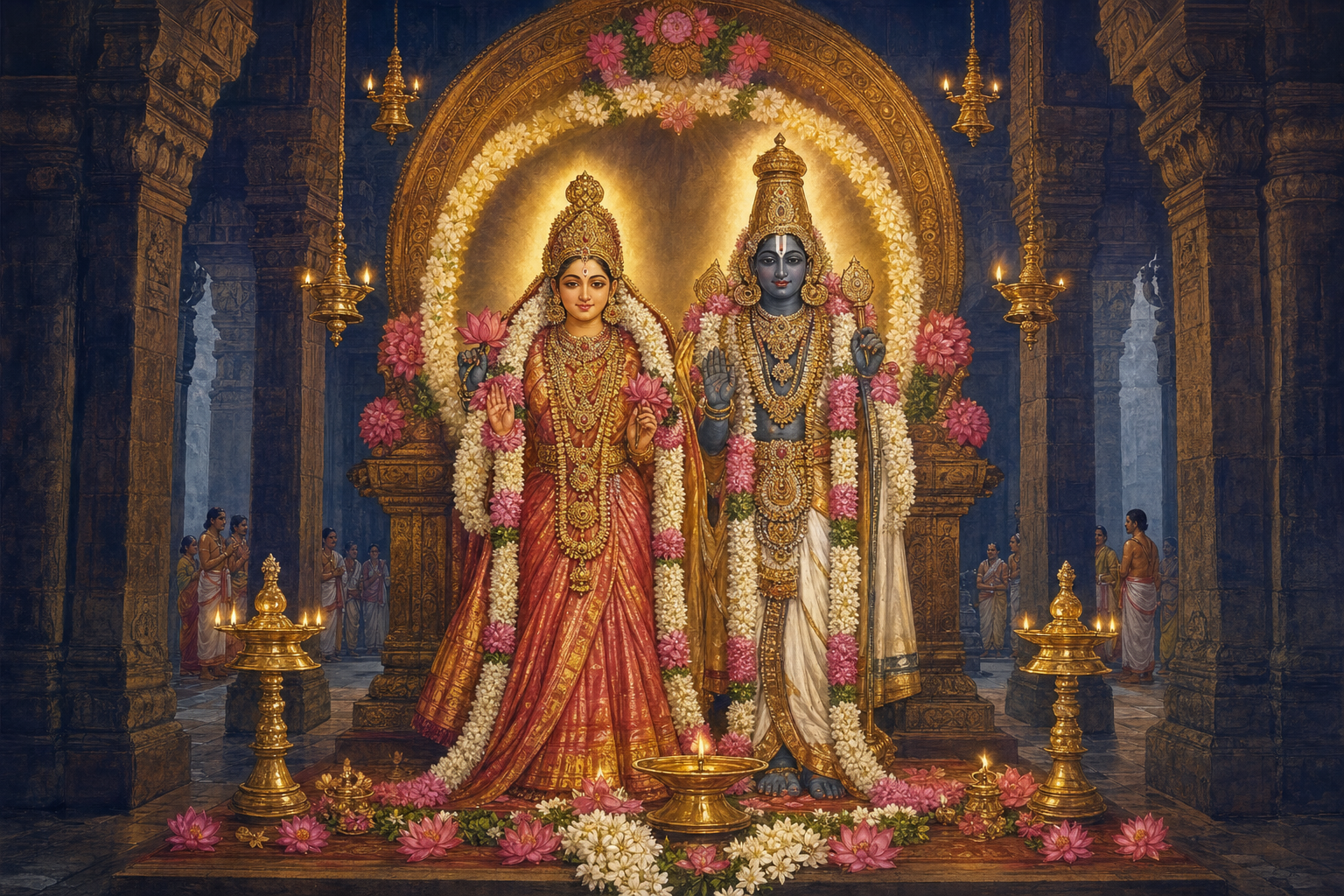
Azhagiya Manavala Perumal is presented standing, with shankha and chakra identifying Vishnu’s protective and ordering presence. Kamalavalli Nachiyar appears with the dignity of a royal bride. Do not view one image as the principal deity and the other as supplementary scenery. The temple’s meaning emerges from their complementarity, while its popular name deliberately directs your attention toward Nachiyar.
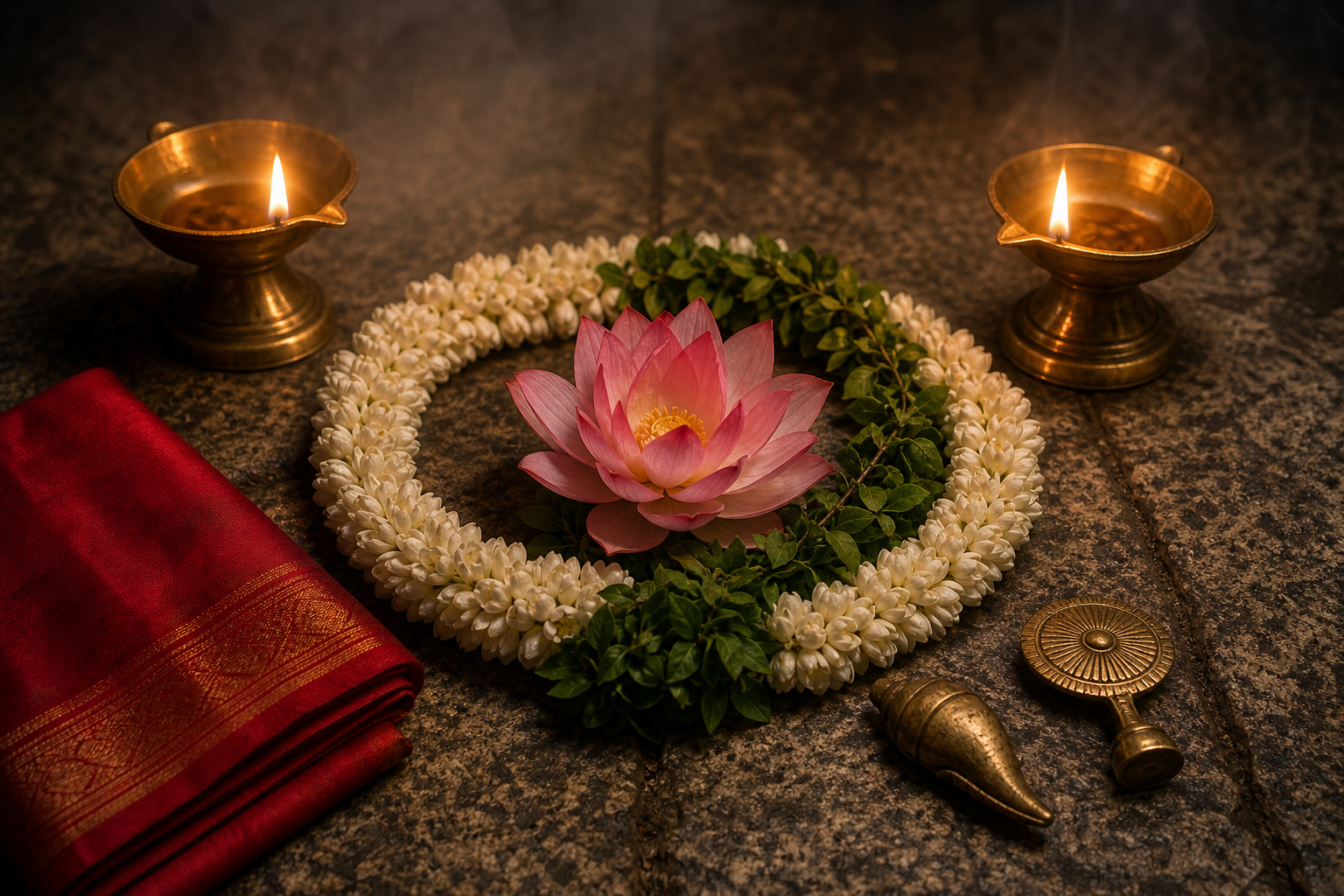
The materials of daily worship reinforce this distinction without creating separation. Tulasi garlands are characteristically offered to Perumal; sandal paste and kumkum contribute to Nachiyar’s adornment. Bells, conches, lamps and food offerings bring the senses into the act of attention. When bridal alangaram is visible, look beyond ornament as spectacle. Adornment identifies Kamalavalli as the goddess whose wedding is not merely narrated but ritually renewed.
Let a complete ritual sequence unfold
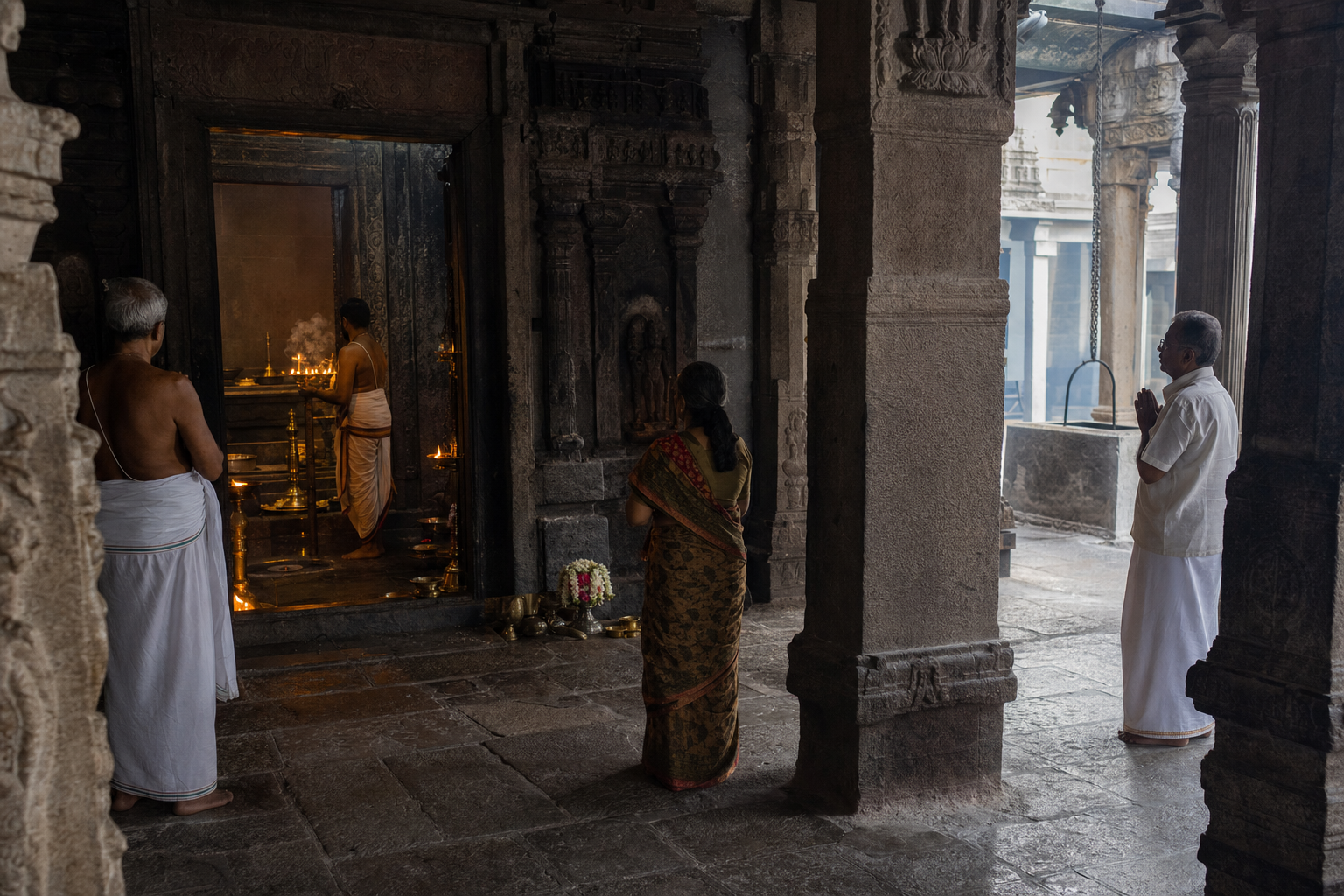
Daily worship is organised through the Sri Vaishnava agamic rhythm of Ushathkalam at dawn, Kaalasanthi in the morning, Uchikalam at midday, Sayaraksha in the evening and Ardha-jama at night. Within the worship sequence, adornment, neivedyam and deepa aradhana engage sight, sound, fragrance and offering rather than treating darshan as a momentary glance.
These ritual names describe the day’s structure; they are not exact clock times for your travel plan. Confirm current opening and puja times locally instead of building a tight connection around an assumed schedule. Once inside, allow enough time to remain through deepa aradhana or a passage of Divya Prabandham recitation. Arriving, seeing the murti for a few seconds and immediately leaving will show you the icon but conceal the temple’s living rhythm.
If you hear Tamil hymns being recited, place them within the Divya Desam tradition rather than treating them as background music. The Nalayira Divya Prabandham gives sacred Tamil a liturgical presence beside the agamic ritual order. You do not need to understand every word to behave attentively: stand without obstructing worshippers, keep conversation low and follow the congregation’s cues.
Choose the visit that matches your purpose
The best time to visit depends on what you want to understand. A festival day offers collective energy and a fuller public enactment of the wedding tradition. A quieter morning or evening gives you more space to observe iconography, architectural transitions and the ordinary discipline that sustains the shrine between celebrations.
| Your purpose | When to consider visiting | What to attend to |
|---|---|---|
| Witness the divine wedding tradition at its annual high point | Panguni Uthiram, in March-April | Kalyana utsavam, bridal presentation and processions through the temple streets |
| Understand the temple without the intensity of a major festival | A regular morning or evening darshan | Nachiyar’s precedence, the daily worship sequence and the movement from mandapa to sanctum |
| Focus on the goddess’s festival adornment | Navaratri | The dedicated alankarams offered to Nachiyar |
| Experience a major Sri Vaishnava observance | Vaikuntha Ekadashi in Margazhi | Collective devotion within the broader Vaishnava festival calendar |
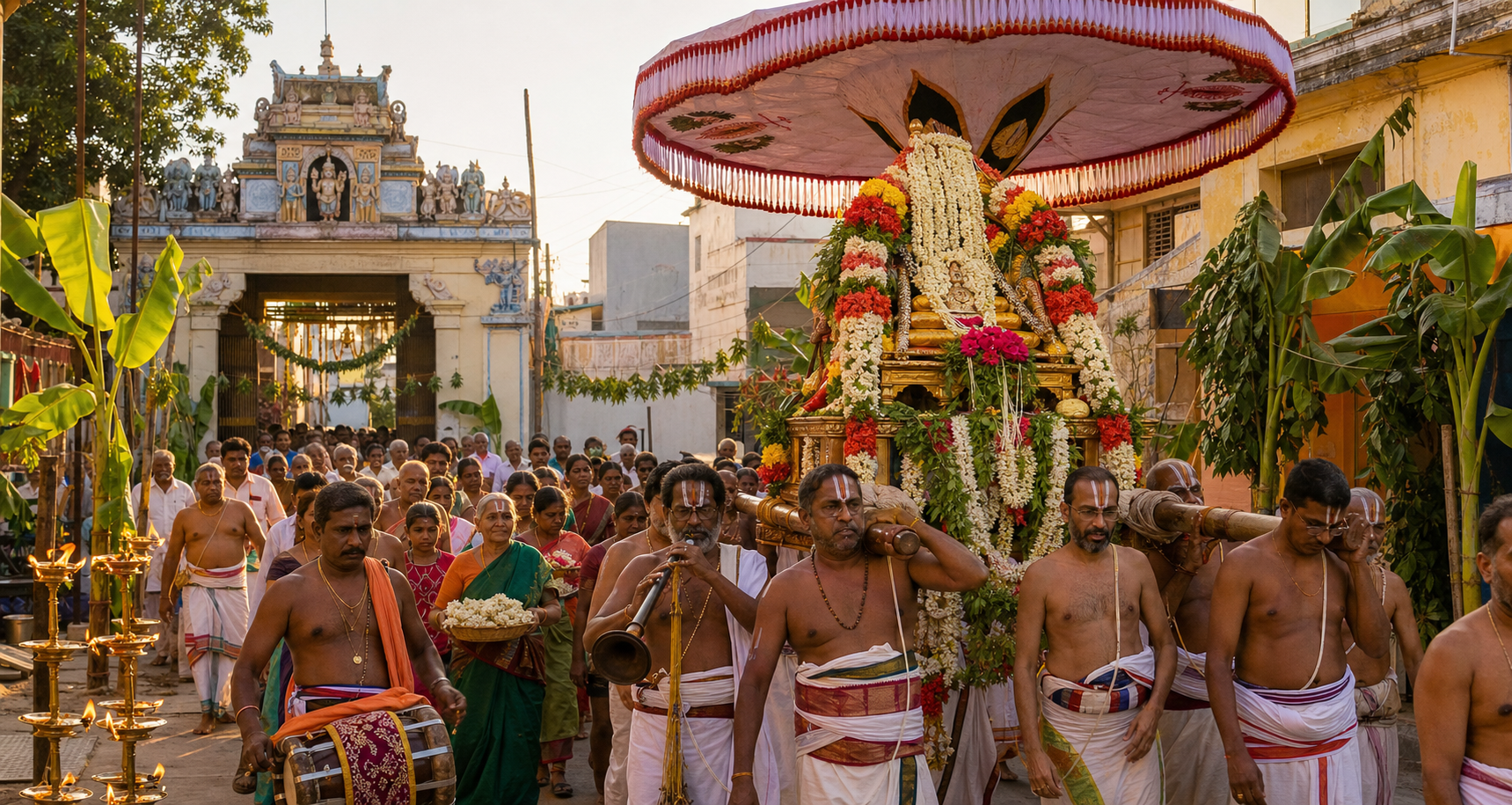
Panguni Uthiram is the central wedding celebration. The kalyana utsavam and street processions make the marriage publicly visible through decorated festival images, flowers, chant, drums and communal participation. If this is your priority, plan around the festival rather than assuming any day described as auspicious will present the same rites. Exact festival dates and daily timings should be checked before travel.
If your aim is contemplation, an ordinary morning or evening may serve you better. Those periods are traditionally valued for a more serene darshan, and they allow attention to rest on Kamalavalli rather than on the logistics of a large observance. Neither choice is spiritually superior. One reveals the wedding as a community festival; the other reveals how its meaning remains embedded in daily worship.
Build a workable Tiruchirappalli itinerary
Uraiyur is accessible by road from central Tiruchirappalli. Tiruchirappalli Junction is the nearest major railhead, and Tiruchirappalli International Airport serves travellers arriving by air. If you combine Thirukozhi with Srirangam or Thiruvellarai, leave enough margin for worship rather than treating temple visits as timed photo stops.
- Save the destination under its full identity: Thirukozhi Nachiyar Koil, Uraiyur.
- Check current opening, puja and festival timings before setting out; the traditional ritual periods are not a substitute for a current timetable.
- Choose Panguni Uthiram if witnessing the wedding celebration matters more than quiet observation.
- Choose a regular morning or evening if you want time to notice Nachiyar’s precedence, the architecture and the recitation tradition.
- Wear modest traditional clothing where practical, silence your phone and follow posted or spoken instructions concerning movement and photography.
- After darshan, remain briefly in a mandapa or circumambulatory space. Give the experience time to settle before moving to the next destination.
Respectful conduct is not an ornamental addition to pilgrimage. Thirukozhi remains a functioning place of worship, not a static heritage display. Its masonry, stucco and woodwork require conservation, but so do its recitation lineages, ritual music, festival routes and inherited forms of service. A visitor supports that living continuity by refusing to obstruct worship, treating performers as ritual participants rather than entertainers, and following the temple community’s directions.
Key takeaways for a meaningful darshan
- Use Thirukozhi, Uraiyur and Kamalavalli Nachiyar when identifying the temple; Nachiyar Koil alone can lead you toward Kumbakonam.
- Read the divine wedding as the organising principle of the shrine, not merely as an annual pageant or a promise of marriage-related favours.
- Notice that Nachiyar receives ritual precedence. This expresses the Sri Vaishnava understanding that compassionate grace is inseparable from Vishnu’s protection.
- Visit during Panguni Uthiram for the kalyana utsavam and public processions; choose a regular morning or evening for a quieter reading of the temple.
- Allow one worship sequence to unfold. The lamps, recitation, offerings and bridal adornment disclose more than a hurried glimpse of the sanctum.
Before you leave Thirukozhi, pause with one question: what changes when compassion receives the first honour? That question carries the temple’s divine wedding beyond festival memory and into conduct. Plan the right destination, give the worship enough time, and let Kamalavalli’s precedence shape how you understand strength, relationship and refuge.