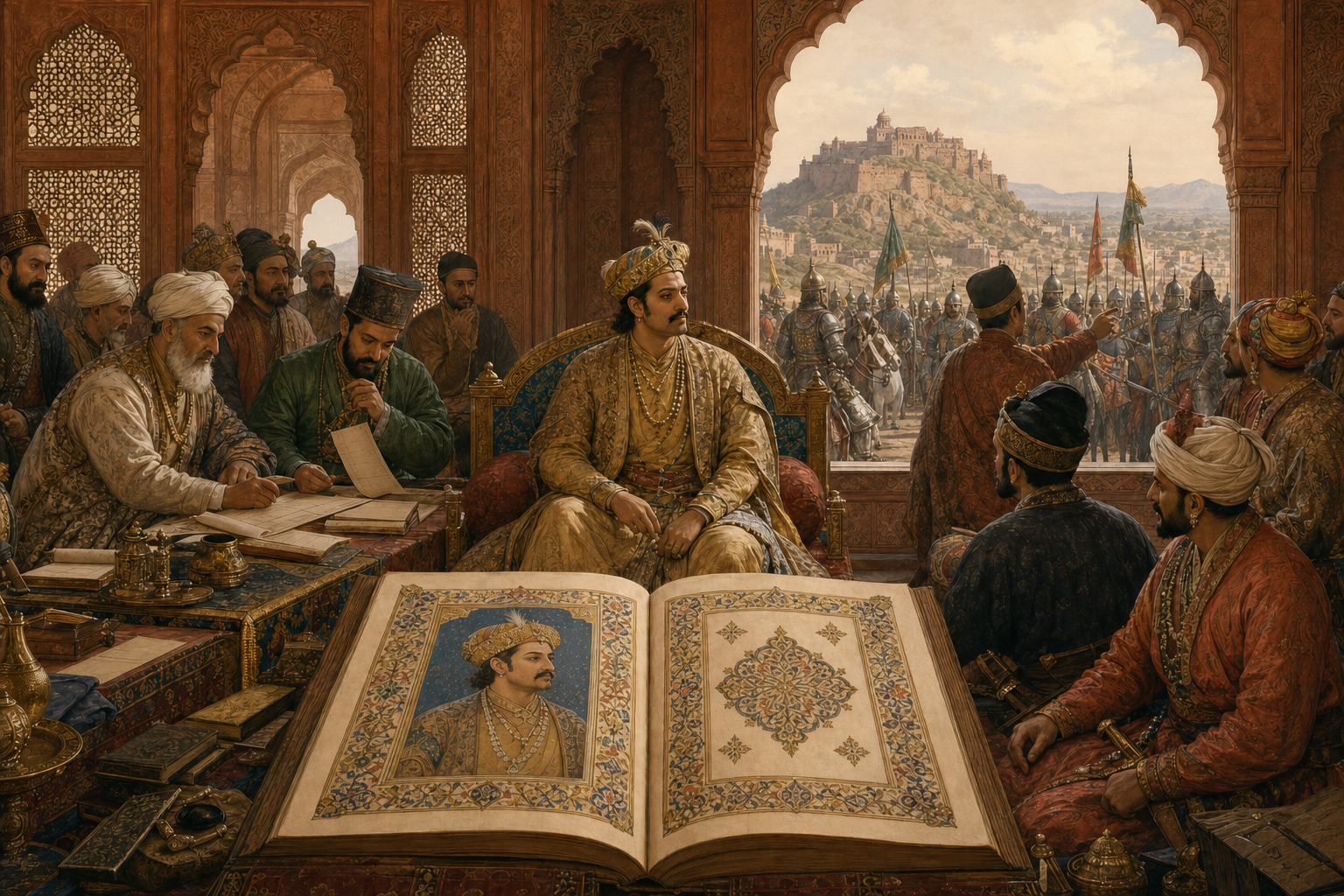
If you are trying to decide whether Akbar deserves the familiar label of “tolerant ruler,” a simple yes or no will mislead you. Ask a more exact question: tolerant toward whom, in which part of his reign, and for what imperial purpose?
The clearest answer is that Akbar used accommodation as an important instrument of rule, but that accommodation existed alongside conquest, religious inequality and mass violence. You can acknowledge a beneficial policy without turning it into absolution. You can also condemn an atrocity without pretending that every act of a long reign had the same character.
Judge tolerance as a policy, not a personality
Calling a ruler “tolerant” turns several separate questions into a flattering personality trait. It asks you to infer what was in the ruler’s heart when the historical record more often shows what the state did. A sound assessment begins with identifiable policies, beneficiaries and limits.
Akbar’s abolition of the jizya, a tax imposed on non-Muslims, belongs on the positive side of that ledger. Removing a discriminatory burden mattered to the people who had borne it. The possibility that the decision also served imperial consolidation does not make its material effect imaginary.
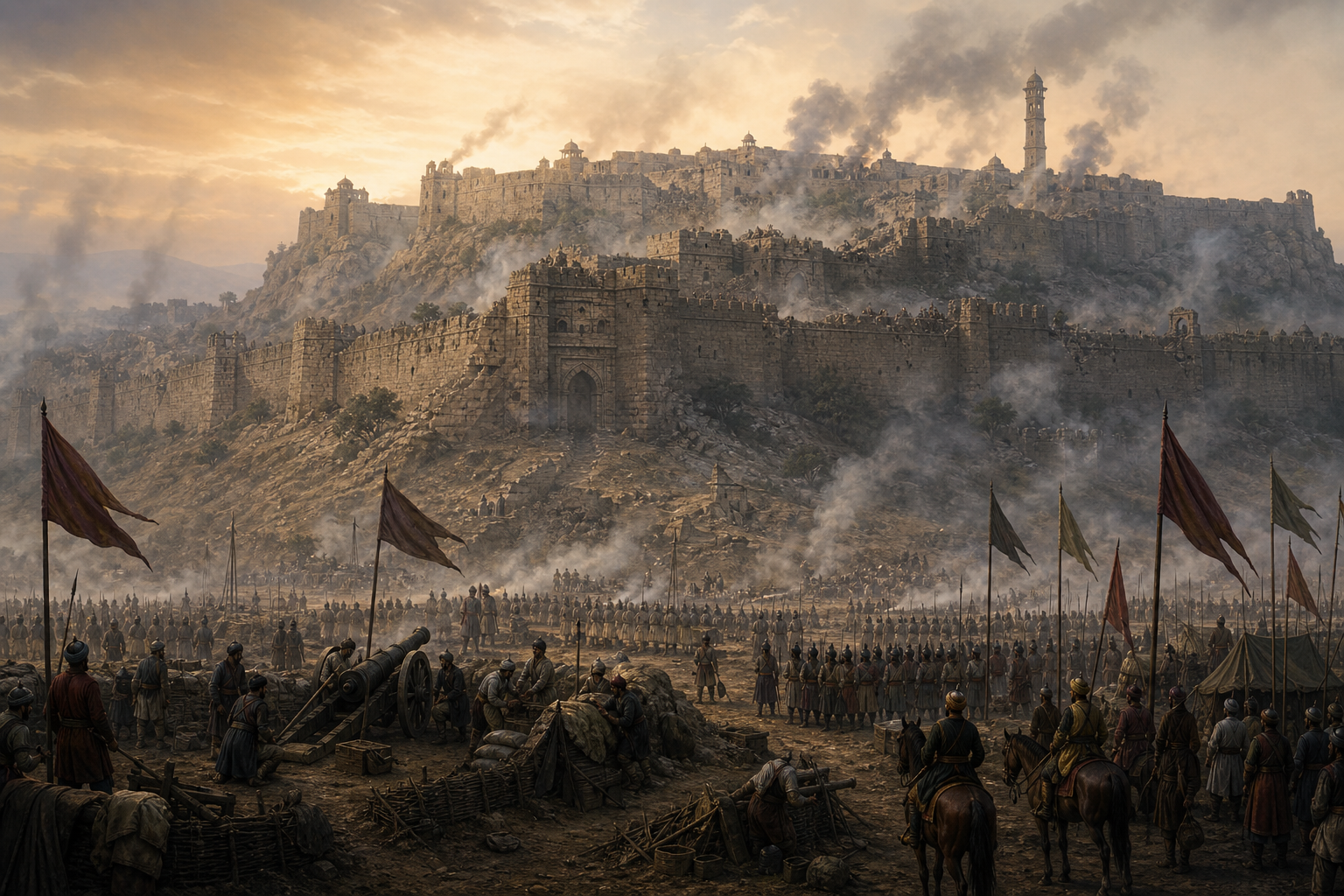
But one reform cannot serve as a moral certificate for an entire reign. Akbar’s campaigns could involve the destruction of Hindu temples and the killing of civilians. At Chittorgarh in 1568, the victory culminated in the reported deaths of tens of thousands of defenders and civilians, including women and children. That event is not a minor exception to be hidden behind courtly dialogue. It reveals what imperial tolerance could become when political submission was refused.
Chittorgarh should therefore be your stress test. When someone praises Akbar’s openness, ask whether the claim describes his conduct among selected courtiers, his fiscal treatment of non-Muslim subjects, or his treatment of a resisting population. An empire can admit religious diversity into its court and still exercise devastating violence beyond it.
| Part of the record | What it establishes | What it cannot establish by itself |
|---|---|---|
| Abolition of the jizya | A specific discriminatory tax was removed. | That religious equality governed every policy or campaign. |
| Chittorgarh in 1568 | Imperial expansion could culminate in mass killing. | That every administrative decision had an identical motive. |
| Hindu officials at court | The regime incorporated important Hindu talent. | That participation transferred ultimate authority to Hindu communities. |
This distinction also prevents an error in the opposite direction. Temple destruction during a campaign establishes an act and its consequences; it does not, without further evidence, prove that every decision in that campaign had only one motive. Keep the violence visible, but do not turn an inference about motive into an unqualified fact.
Put Todar Mal, Birbal and the craftsmen back into the story
Great-ruler history has a built-in distortion: administration, architecture and cultural achievement acquire the sovereign’s name even when many other people supplied the expertise. Akbar’s court was not a one-man engine of innovation.
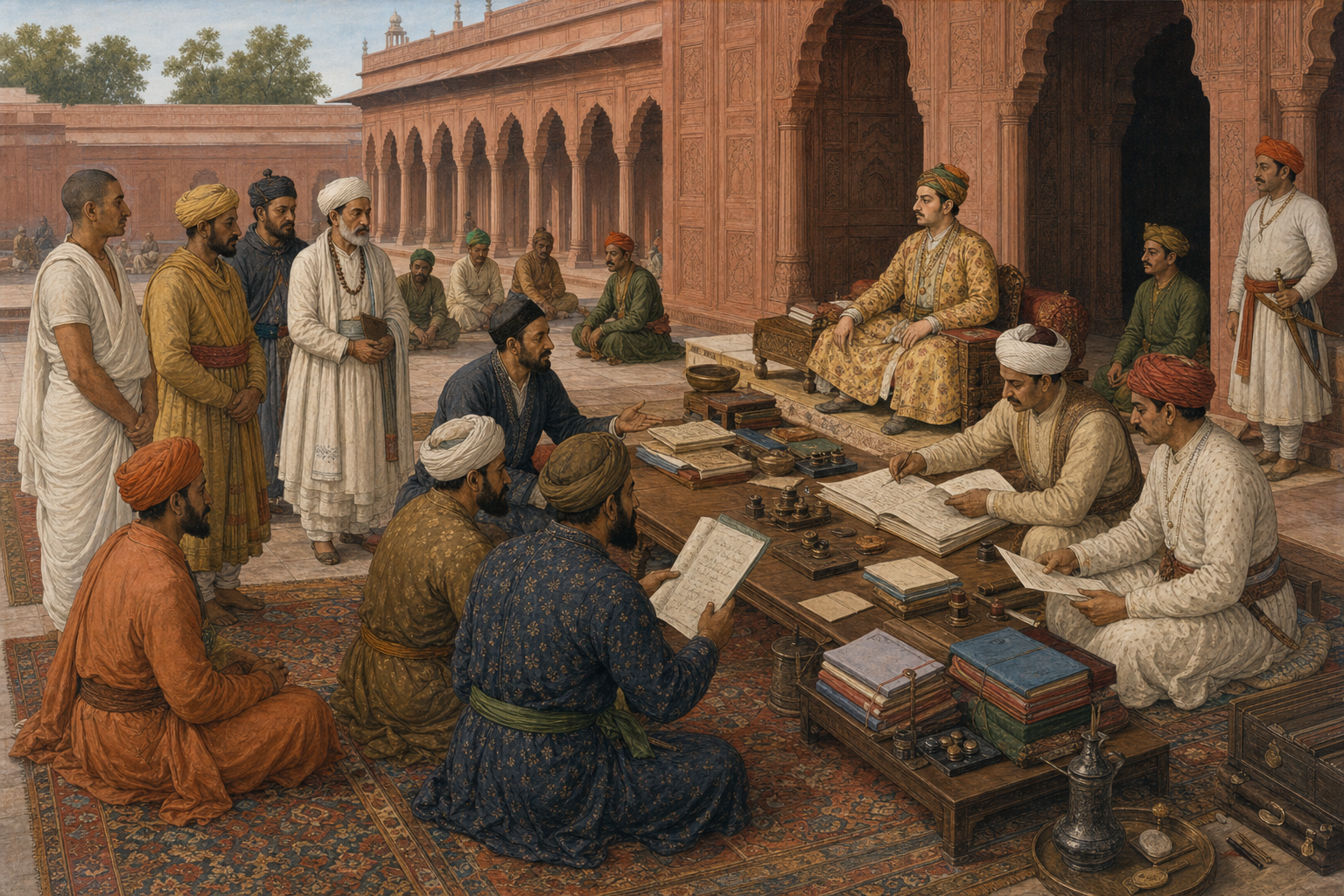
Raja Todar Mal developed the revenue system that sustained Mughal finance. Birbal served as a close Hindu adviser who helped moderate disputes and shape decisions. These were not decorative appearances in an otherwise complete imperial project. They were contributions to the regime’s capacity to govern.
The same correction applies to monuments. Fatehpur Sikri and Agra Fort carried Akbar’s imperial identity, but Hindu craftsmen supplied labour and inherited artistic skill. Royal patronage is part of the explanation; it is not the whole explanation.
When you encounter a sentence such as “Akbar created” or “Akbar introduced,” perform an attribution audit:
- Identify who designed or formulated the system.
- Identify who administered it from day to day.
- Identify whose labour and technical knowledge produced the physical result.
- Separate the person who commissioned an achievement from the people who made it possible.
- Ask whether later memory retained the contributors’ names or only the emperor’s.
This does not require erasing Akbar from his own government. It requires using more accurate verbs. The emperor commissioned, approved, incorporated or claimed an achievement; an administrator devised a system; artisans built and ornamented a structure. Once the verbs are accurate, the distribution of credit becomes much harder to manipulate.
Inclusion at court must also be distinguished from equality of power. A Hindu adviser could be influential while remaining subject to the emperor’s final authority. Hindu expertise could strengthen the state while Hindu temples remained vulnerable during its campaigns. Participation in an empire is not the same thing as sovereignty over it.
Why a small court experiment became proof of modernity
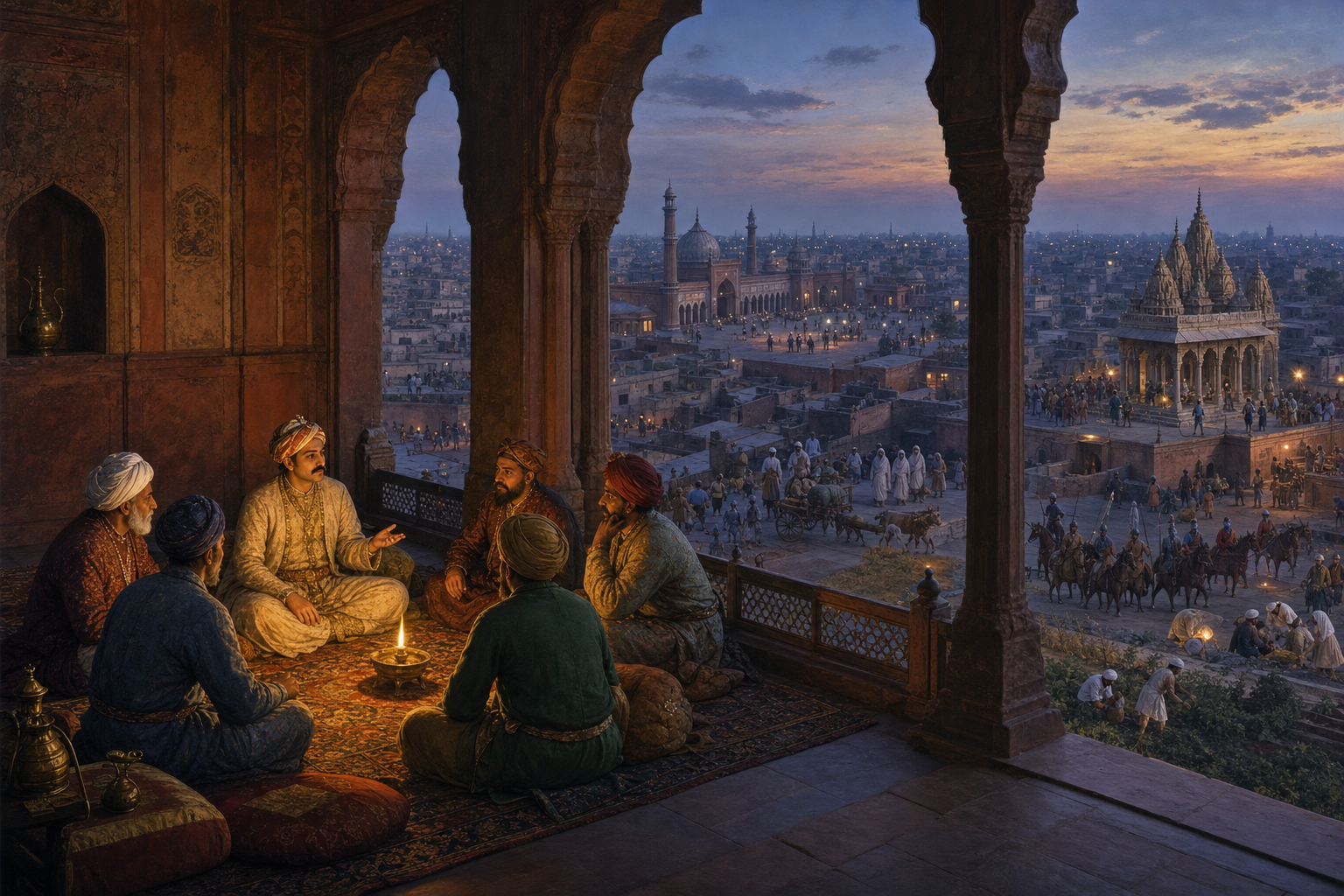
Din-i Ilahi is often made to carry far more historical weight than its reach can support. It is presented as evidence that Akbar rejected inherited religion, transcended Islam or anticipated a modern secular order. Yet the experiment was confined to a small circle of courtiers and failed to acquire broad popular support.
Scale matters. An initiative discussed among a handful of people near the throne is not automatically a popular faith, a social movement or a transformation of everyday religious life. Before calling Din-i Ilahi revolutionary, ask three concrete questions: How many people participated? How far beyond the court did it travel? What durable community or institution did it leave?
Its limited reach does not make it meaningless. It does change what can responsibly be claimed for it. The strongest conclusion is that Akbar experimented with religious language inside an imperial setting. The claim that this amounted to a successful new spiritual order goes much further than the evidence described here.
There is also a civilisational problem in treating imperial interest in plurality as though plurality itself arrived in Bharat with Akbar. Hindu and other Dharmic traditions had long debated cosmic unity, difference and the coexistence of paths. Encountering those ideas at a Mughal court did not create them. Nor does their political use prove that the emperor originated the intellectual traditions from which they could be drawn.
British colonial historians, including Vincent Smith, later helped establish the image of Akbar as the unusually rational and tolerant Muslim monarch, contrasted with rulers depicted as fanatical. That framing made Din-i Ilahi especially useful: a limited court initiative could be recast as proof that the admired emperor had become recognisably “modern.” It also supported a wider colonial story in which India’s moments of progress required an enlightened impulse from outside its indigenous traditions.
The intention behind a school of historiography is an interpretation, not an event you can observe in the same way as the repeal of a tax. Test it through patterns of selection. Which policies are repeatedly foregrounded? Which massacres or indigenous contributions are reduced to footnotes? Who receives the credit for ideas and institutions? Mythmaking often works less through outright fabrication than through this unequal distribution of attention.
Correct the myth without manufacturing a counter-myth
A Dharmic reassessment loses credibility if it merely turns the old hero into a one-dimensional villain. The harder and more defensible conclusion is that Akbar’s accommodation was real in particular policies, politically useful, conditional and far from universal. That conclusion keeps the abolition of the jizya, Chittorgarh, Hindu participation and imperial hierarchy in the same frame.
Use three layers when you evaluate any claim about his legacy:
- Record: What identifiable action, appointment, campaign or institution is being described?
- Inference: What motive or political mechanism is being proposed to explain it?
- Verdict: What moral label is then placed on the ruler or reign?
For Din-i Ilahi, the small court circle and lack of popular traction belong to the record. Political consolidation is an interpretation of its purpose. Calling it an expression of imperial ego is a verdict. The interpretation and verdict may be persuasive, but neither should be smuggled into the first layer as if motive had been directly observed.
Apply the same discipline to praise. The abolition of the jizya belongs to the record. Pragmatic coalition-building may explain it. “Universally tolerant” is a verdict, and one contradicted by evidence from violent campaigns. This method does not make moral judgement impossible; it makes the judgement answerable to the full record.
Watch the verbs. “Abolished,” “appointed,” “besieged” and “commissioned” describe actions. “Believed,” “transcended” and “intended” make claims about an inner purpose. The second group requires stronger evidence than the first. Likewise, labels such as “secular,” “pluralist” and “modern” need definitions before they are projected backward onto an early imperial court.
You should also ask who benefits from each version of the memory. The colonial saviour narrative diminishes indigenous traditions by making enlightened government appear externally bestowed. A triumphalist imperial narrative turns Hindu administrators and artisans into supporting characters in their own land. An indiscriminate counter-narrative, however, makes it easier for critics to dismiss legitimate scrutiny as polemic. Accuracy is not a concession; it is what gives a civilisational correction lasting force.
Key takeaways
- Replace “Was Akbar tolerant?” with “Which policy affected whom, under what conditions, and for how long?”
- Keep the abolition of the jizya and the violence at Chittorgarh in the same moral ledger.
- Distinguish Hindu participation in the Mughal court from equality, security or final authority.
- Credit Todar Mal, Birbal and Hindu craftsmen for the work attributed too casually to the emperor alone.
- Treat Din-i Ilahi as a limited court experiment unless evidence establishes wider social reach.
- Separate recorded events from inferred motives and later moral verdicts.
- Reject both the colonial image of the enlightened outsider and any counter-myth that flattens a complex reign into a slogan.
The next time a textbook, video or public debate gives you a polished sentence about Akbar, mark its contents in four columns: accommodation, coercion, contributors and later memory. If one or more columns are missing, you are probably being given a usable legend rather than a usable history. Restore what was omitted before accepting the verdict.